
STEADI: Intervene
Air Quality Alert? Protect Elderly With Breathing Problems
Air quality alerts are not a single warning for older adults with COPD, asthma, or another chronic breathing condition — each AQI color calls for different actions, and effects can begin at Orange (101+). The color-by-color breakdown maps Green through Maroon to when to stay inside, close windows, run an air cleaner, and stop exertion.
When an air quality alert appears on a phone, the first useful question is not whether the air looks smoky. It is which AQI color is showing. For an older adult with COPD, asthma, heart disease, or limited stamina, that color should become a household instruction: whether the window stays shut, whether the walk waits, whether the air cleaner runs, and whether an appointment needs a different plan.
The Air Quality Index is a six-color scale. An AQI of 100 corresponds to the national ambient air quality standard for the pollutant being measured; values above 100 become unhealthy first for sensitive groups and then, at higher levels, for everyone.[1] Older adults and people with lung or heart disease are among those sensitive groups, and AirNow states that effects for these groups can begin at Orange, which starts at 101.[2]
This article is educational, not medical advice. If a clinician has given your parent or spouse a COPD, asthma, oxygen, heart failure, or rescue-medication plan, use that plan. The AQI color helps decide the day’s exposure; it does not replace individualized medical instructions.
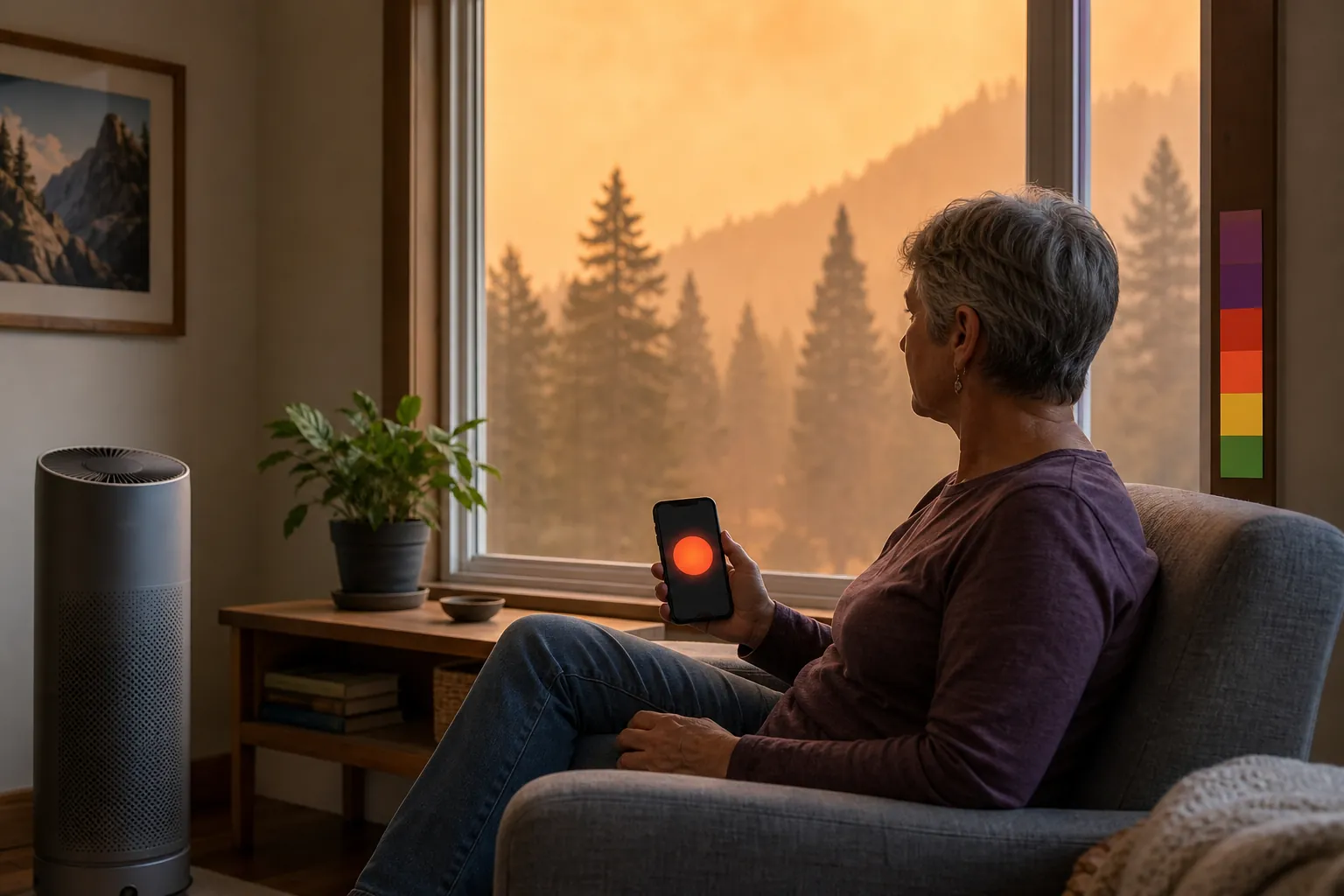
Use the AQI color as the day’s action level
The mistake that gets people into trouble is treating every alert as the same vague warning. Green and Yellow usually call for checking and planning. Orange is already meaningful for many older adults with breathing or heart conditions. Red is the point where the warning expands beyond sensitive groups. Purple and Maroon should be treated as serious exposure days, especially during smoke events.
At higher alert levels, CDC guidance for people with chronic conditions includes staying inside as much as possible, keeping windows and doors closed, and using HVAC filtration or a portable air cleaner when available.[3] CDC wildfire safety guidance also supports using a high-efficiency HVAC filter if the system can handle it, keeping indoor air cleaner, and using properly fitted N95 or P100 respirators when someone must be outside in smoke.[4]
| AQI color and range [1] | What it means for an older adult with breathing problems | What to change today |
|---|---|---|
| Green, 0–50 | Good air quality. This is the easiest day for ordinary outdoor movement. | Keep normal plans. Check the forecast if smoke, heat, or ozone has been a recent issue. Use better-air days for errands that require walking, waiting outside, or carrying bags. |
| Yellow, 51–100 | Moderate air quality. Most people are fine, but a very sensitive older adult may notice symptoms. | Watch the person, not just the number. Keep rescue medication, water, mobility aids, and transportation plans ready. Consider shorter outdoor activity if the person has been symptomatic recently. |
| Orange, 101–150 | Unhealthy for sensitive groups. This is the first level where older adults with lung or heart disease may need changed plans.[2] | Reduce outdoor exertion. Move walks, yardwork, and nonessential errands indoors or to a better-air time. Keep windows closed if outdoor air is the source of the alert. Run HVAC filtration or a portable air cleaner if available. Do not dismiss a short errand as harmless if it requires walking across a large parking lot, waiting outside, or climbing stairs. |
| Red, 151–200 | Unhealthy. Risk is no longer limited to sensitive groups; everyone may be affected, and older adults with breathing problems deserve stricter protection.[1] | Avoid outdoor exertion. Move appointments if they are optional. Keep windows and doors closed. Run filtration. If leaving home cannot be avoided, reduce time outside, avoid carrying loads, use door-to-door transportation when possible, and consider a well-fitting N95 or P100 respirator for smoke exposure if the person can wear one safely.[4] |
| Purple, 201–300 | Very unhealthy. This is a high-exposure day for the whole community, with special concern for people whose breathing can worsen quickly. | Stay indoors as much as possible. Cancel outdoor chores and exercise. Create one cleaner-air room if possible: closed windows and doors, portable air cleaner running, HVAC set to recirculate if appropriate, and fewer indoor particle sources such as frying, candles, fireplaces, or vacuuming.[4] Check medication, oxygen, power, transportation, and backup caregiver plans. |
| Maroon, 301+ | Hazardous. Treat this as a serious exposure event, not a normal bad-air day. | Remain indoors unless leaving is necessary for safety or medical care. Keep filtration running if power and equipment allow. Follow official emergency instructions. If evacuation or relocation becomes necessary, plan around the older adult’s breathing equipment, medications, mobility limits, and need to avoid exertion while getting to the vehicle. |
Green and Yellow: do not waste the easy days
Green and Yellow are the days to do what becomes harder later: pick up prescriptions, schedule a haircut, walk to the mailbox with less worry, or take the longer grocery trip. For someone with limited stamina, planning errands on better-air days is not overprotective; it prevents the caregiver from having to choose between exposure and a necessary task when the AQI turns Orange or Red.
If falls are also a concern, combine air-quality planning with route planning. A cleaner-air day is a better time to choose the entrance with fewer steps, check whether a pharmacy has curbside pickup, or plan a safer walking route. The same practical thinking used in neighborhood fall safety for older adults applies here: reduce the number of things that can go wrong before the day is already stressful.
Orange: the alert is no longer background noise
Orange is where many families make the wrong call because the air may still look ordinary. The AQI may say “unhealthy for sensitive groups,” and the person at risk may say they feel fine. For an older adult with COPD, asthma, chronic bronchitis, heart disease, or reduced stamina, Orange should at least trigger a change in exertion.
- Move walks, yardwork, and outdoor exercise indoors or to a lower-AQI time.
- Keep the windows closed if outdoor pollution is the issue, even if the day feels cool.
- Use a portable air cleaner in the room where the person spends the most time, if one is available.
- Shorten unavoidable trips: park closer, use pickup, ask for wheelchair assistance, or have the caregiver go in alone.
- Watch for symptoms after exposure, because the consequence may show up after the errand, not while standing in the parking lot.
The hard part is that Orange often interrupts normal life rather than an obvious emergency. A routine appointment, church event, or grocery run may still happen, but the plan should change. If the outing requires walking across hot pavement, waiting at a bus stop, or carrying groceries while breathing polluted air, it is not a small exposure for a person whose lungs already have less reserve. For the go/no-go part of that decision, the same framework used for outdoor safety in bad weather for seniors can help: decide what must happen today, what can move, and what needs a safer version.

Red: stop treating exposure as a sensitive-person problem only
Red matters because it marks the shift to “unhealthy” air for everyone, not only for sensitive groups.[1] For an older adult with breathing problems, Red should usually mean no outdoor exertion. The person may still need medical care, food, or help from a caregiver, but the day should be arranged to remove unnecessary breathing work.
- Cancel or reschedule optional outdoor activity.
- Move indoor appointments only if the trip itself can be made with minimal outdoor time and minimal exertion.
- Keep doors and windows closed, including the “just for a breeze” window that quietly defeats the whole plan.
- Run central air or HVAC filtration if available and appropriate for the system; use a portable air cleaner in the main room if available.
- If smoke is the driver and the person must go outside, consider a properly fitting N95 or P100 respirator, but do not force one on someone who cannot tolerate it or breathe comfortably through it.
Red is also when indoor habits matter more. Frying food, burning candles, using a fireplace, and vacuuming can add particles indoors; during smoke events, CDC recommends keeping indoor air as clean as possible and reducing indoor pollution sources.[4] This does not require turning the home into a lab. It means choosing the room where the older adult actually sits, closing it off as well as practical, and making that room the cleaner-air default.

Purple and Maroon: prepare for duration, not just intensity
Purple and Maroon are not days for proving that a quick trip is manageable. They are days to protect breathing capacity and preserve options. The household questions become more basic: Is there enough medication? Is the oxygen equipment ready? Can the person stay in the cleaner room most of the day? Who can bring groceries or check in if the caregiver cannot get there?
Smoke deserves special caution because the visible fire is not the same thing as the end of exposure. CDC notes that wildfire smoke can affect air quality and health even after a wildfire ends.[3] That means a family may need to keep windows closed, keep filtration running, and postpone errands after the sky starts to look less dramatic.
Emergency planning has to include mobility. If the older adult uses a walker, oxygen tubing, a wheelchair, or multiple medications, leaving quickly during a hazardous air event is harder than a weather alert makes it sound. Keep the same practical items ready that matter in other fast-moving hazards: medication list, chargers, backup power needs, mobility aids, and a plan for getting from the chair to the car without rushing. The flash flood fall prevention checklist is written for water, but the preparation logic overlaps whenever a frail person may need to move under pressure.
What the alert does not tell you
The AQI color gives the action level, but it does not tell the whole story. AirNow explains that when more than one pollutant is measured, the reported AQI is based on the pollutant with the highest AQI value.[1] In plain terms, the color tells you how protective to be today; it may take another tap in the app or forecast to see whether the main driver is ozone, particle pollution, or smoke.
That distinction matters for timing. Ozone often changes with heat and sunlight, while fine particles from smoke can make indoor protection more urgent. Cleveland Clinic describes air quality alerts as warnings tied to pollutants such as ground-level ozone and particle pollution, and cautions that people with respiratory or heart conditions should take them seriously.[5]
For the caregiver making a same-day decision, the pollutant details should sharpen the plan, not delay it. If the color is Orange for a parent with COPD, reduce exposure. If it is Red, stop outdoor exertion. If it is Purple or Maroon, shift into a cleaner-air and backup-plan mindset while checking official updates.
Where to check before the day starts
Make AQI checking part of the morning routine, the same way a caregiver might check the weather before deciding on shoes, transportation, or a walker. The National Weather Service points people to AirNow for current AQI, the Fire and Smoke Map for smoke conditions, NOAA Weather Radio, and the Emergency Alert System during air quality alerts.[6]
- Check the AQI color before opening windows.
- Check again before outdoor errands, because conditions can change during the day.
- Look for whether the concern is smoke, ozone, or particle pollution if the app provides that detail.
- Use the color to decide the actual movement of the day: walking, driving, waiting outside, carrying groceries, or staying in the cleaner room.
The simple rule is enough for most household decisions: check the color, treat Orange as meaningful for an older adult with breathing or heart disease, escalate protections at Red and above, and let the day’s AQI decide the day’s actual movements.
References
- AQI Basics — AirNow
- Older Adults and Air Quality — AirNow
- Wildfire Smoke and People with Chronic Conditions — Centers for Disease Control and Prevention
- How to Safely Stay Safe During a Wildfire — Centers for Disease Control and Prevention
- Smog and Pollution: What Do Air Quality Alerts Actually Mean? — Cleveland Clinic
- During an Air Quality Alert — National Weather Service
Related reading
Noticed something outdated or inaccurate on this page? Flag a correction. We review every report against CDC, NIA, and AARP HomeFit guidance before updating a page.
Part of the Fall Prevention section.