
STEADI: Intervene
What to Do When an Elderly Parent Has E. coli Symptoms
Suspected E. coli in a parent 65+ calls for triage, not diagnosis. This guide gives caregivers the warning signs to watch, immediate fluid-replacement steps, the two do-nots that lower HUS risk, and exact thresholds for calling the doctor versus going to the ER.
If your parent is 65 or older and now has diarrhea, stomach cramps, vomiting, or possible bloody stool, treat the next hour as a triage problem, not a home diagnosis project. This guide is mainly about the intestinal, foodborne form of E. coli, which can cause watery or bloody diarrhea, stomach cramps, vomiting, and sometimes a low fever; adults 65 and older are an increased-risk group for E. coli infection complications.[1][2]
Start fluids now, watch for named warning signs, avoid the two risky shortcuts—anti-diarrheal medicines and leftover or requested antibiotics when Shiga toxin-producing E. coli is possible—and use doctor-versus-ER thresholds instead of trying to decide which strain it is.
This is general education, not a diagnosis. If your parent looks seriously ill, is hard to wake, has chest pain, trouble breathing, severe abdominal pain, signs of stroke, or you feel unsafe moving them, call 911 or local emergency services.
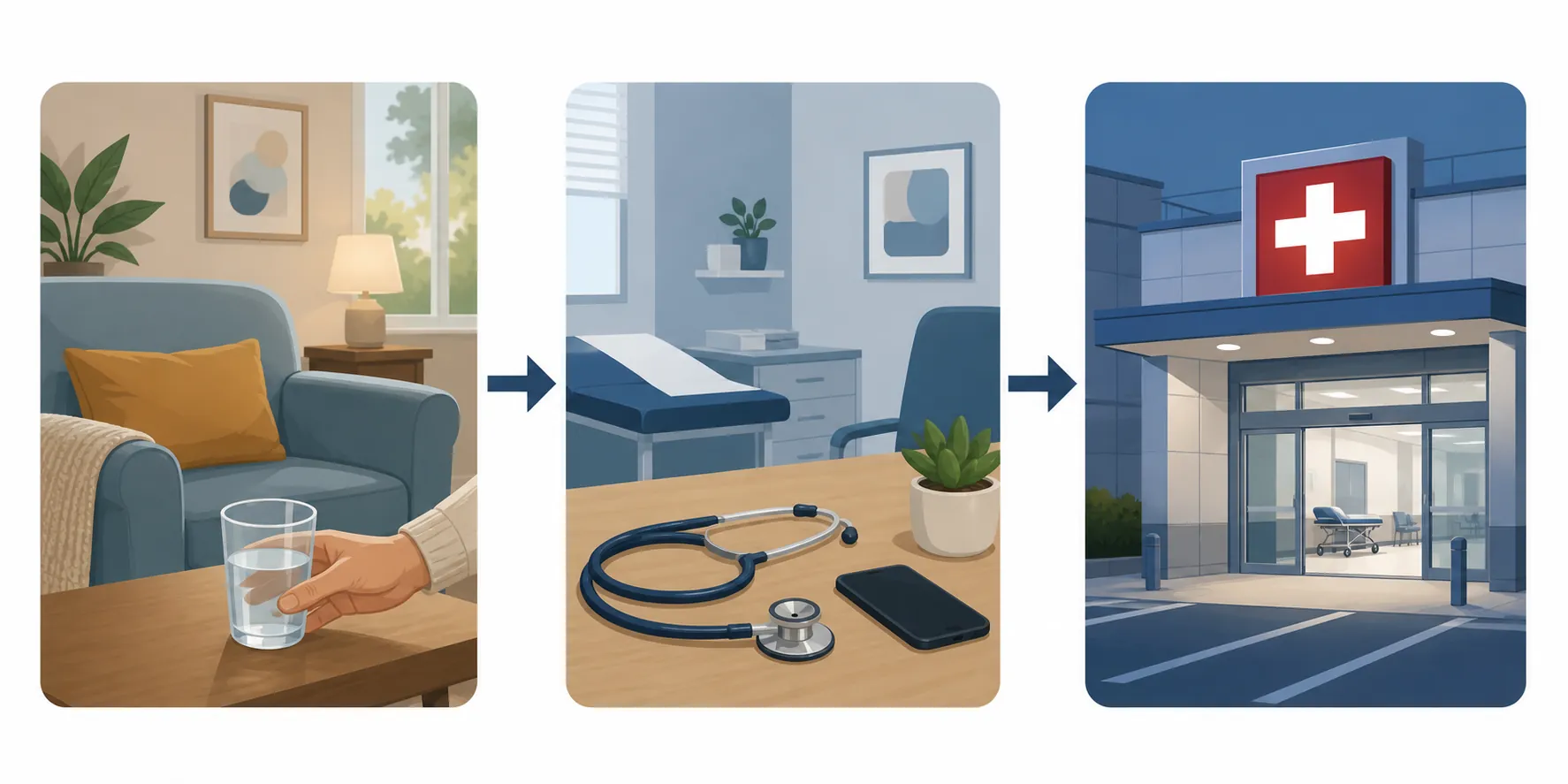
First, make sure this is the right path
The phrase “E. coli symptoms” can point in two different directions. This article covers the gut illness pattern: diarrhea, cramps, vomiting, and possible fever after contaminated food, water, animal contact, or household spread.
If the main problem is urinary burning, urgency, lower belly discomfort, cloudy urine, or blood in the urine—especially without diarrhea—your parent may need a UTI evaluation instead. Also, confusion or a fall by itself does not prove a UTI, and bacteria found in urine without urinary symptoms does not automatically mean antibiotics are needed; older adults are often overtreated for asymptomatic bacteriuria.[3]
That distinction matters because the action paths can diverge. Symptomatic UTIs often require clinician-directed antibiotics. Suspected intestinal STEC is different: antibiotics and anti-diarrheal drugs can increase the risk of a dangerous complication, so do not apply UTI logic to diarrhea.
Use this triage path in the first hour
| What you see right now | What to do |
|---|---|
| Mild diarrhea or cramps; parent is alert; fluids are staying down; no blood; no high fever; urination is normal | Begin fluid replacement, keep them near a bathroom, reduce fall hazards, and monitor closely over the next several hours. |
| Diarrhea or vomiting lasts more than 2 days; any bloody poop or pee; fever over 102°F; or signs of dehydration | Call the doctor or an urgent clinical advice line. These are CDC thresholds for contacting a healthcare provider.[1] |
| Can’t keep fluids down; bloody diarrhea; frequent vomiting; fever over 103°F; very little urination; confusion; extreme weakness | Go to the ER or seek emergency care. Cleveland Clinic lists these as emergency warning signs for E. coli infection.[4] |
A parent may insist they are “fine” while looking pale, newly weak, or unsteady. In an older adult, the hallway signs matter: needing help to stand, dizziness when walking to the bathroom, new confusion, or a new fall during a diarrheal illness should lower your threshold for getting medical advice. The fall may not be “caused by E. coli” in any simple way, but dehydration, weakness, infection, and urgent bathroom trips can turn a manageable illness into an immediate home-safety problem.
What E. coli symptoms can look like in an older parent
For intestinal E. coli, the common symptom pattern is straightforward: watery diarrhea, diarrhea that may become bloody, stomach cramps, vomiting, and sometimes a low fever.[1] A dramatic fever is not required for the situation to be serious.
- Diarrhea: watery or bloody. Bloody diarrhea should not be watched at home without medical input.
- Cramps: often abdominal and may be severe enough that your parent bends forward, refuses food, or has trouble getting comfortable.
- Vomiting: important because it can stop fluid replacement from working.
- Fever: low fever can occur; fever over 102°F meets the CDC call-doctor threshold, and fever over 103°F belongs in the emergency-warning category used by Cleveland Clinic.[1][4]
- Older-adult warning signs: confusion, extreme weakness, very little urination, dizziness, or unsteadiness deserve attention even if the stool symptoms sound “mild.”[4]
Start fluid replacement before you finish reading

Fluid and electrolyte replacement is the most important treatment for food poisoning, and NIDDK specifically recommends oral rehydration solutions such as Pedialyte, Naturalyte, Infalyte, or CeraLyte for older adults with severe diarrhea or dehydration.[5]
Do not make hydration into a test of willpower. If your parent feels nauseated, offer small sips every few minutes instead of a full glass. If they vomit, pause briefly, then restart with tiny amounts. Keep track of whether urine is becoming very infrequent, because very little urination is one of the emergency red flags.[4]
- Use an oral rehydration solution if you have one, especially if diarrhea is heavy or your parent looks dehydrated.
- If you do not have one yet, use available fluids while someone gets an electrolyte solution.
- Keep the path to the bathroom lit and clear. Weakness plus urgency is a fall setup.
- Write down the time symptoms started, number of diarrhea or vomiting episodes if you can, temperature readings, urination, and whether there is blood.
The two do-nots: no anti-diarrheals, no casual antibiotics
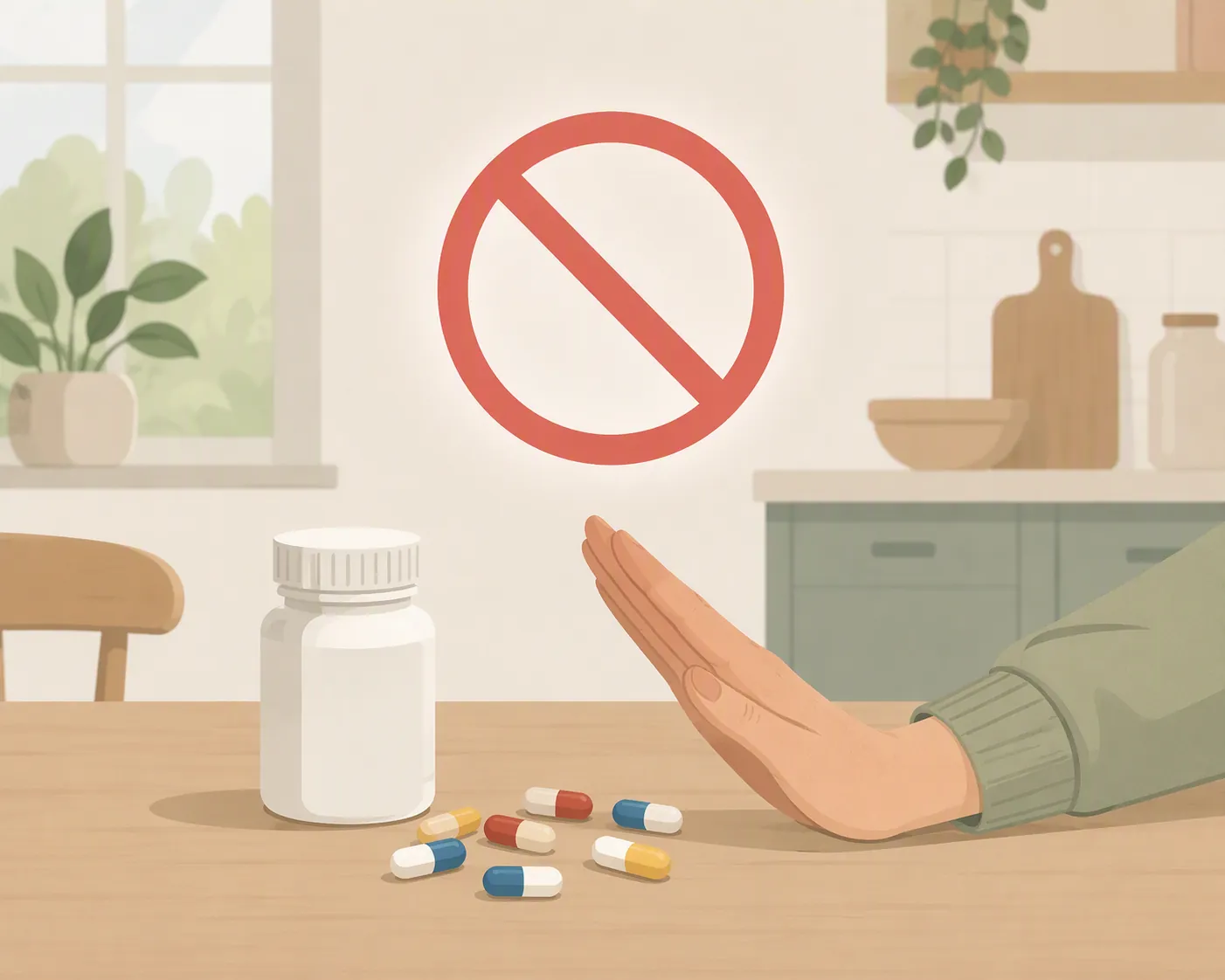
Do not give anti-diarrheal medication for suspected STEC. The CDC warns that anti-diarrheal medicines should not be used with STEC infection because they may increase the chance of hemolytic uremic syndrome, or HUS.[6]
Do not give leftover antibiotics, and do not pressure a clinician for antibiotics if STEC is possible. The CDC also warns that antibiotics should not be used with STEC infection because they may increase HUS risk.[6]
HUS is the reason these rules are not just cautious wording. Cleveland Clinic reports that about 5% to 10% of people with STEC infection develop HUS, and the CDC notes that adults 60 and older are more likely to develop HUS.[4][2]
This does not mean antibiotics are always wrong for every illness involving E. coli. It means that with diarrhea and possible foodborne STEC, the safe move is to let a clinician decide after evaluating the pattern, severity, and test needs.
When to call the doctor
Call the doctor, an after-hours nurse line, or urgent care if any CDC call threshold is met: diarrhea or vomiting lasts more than 2 days, there is bloody poop or pee, fever is over 102°F, or there are signs of dehydration.[1]
For an older parent, it is reasonable to call earlier if you are seeing decline rather than improvement: less walking, more help needed to stand, missed medications because of vomiting, poor fluid intake, or a caregiver at home who cannot safely monitor bathroom trips. The formal thresholds matter, but so does whether the home situation is becoming unsafe.
When you call, be ready with the details a clinician can use quickly: age, major conditions such as kidney disease or diabetes, immune-suppressing medicines if any, when symptoms began, temperature, whether stool or urine has blood, how often vomiting is happening, and when your parent last urinated.
When to go to the ER
Go to the ER, or call emergency services if transport is not safe, when your parent cannot keep fluids down, has bloody diarrhea, has frequent vomiting, has fever over 103°F, is urinating very little, becomes confused, or is extremely weak.[4]
Do not bargain with bloody diarrhea in a parent over 65. Do not wait for “one more bottle of water” if fluids keep coming back up. Do not treat new confusion as an argument you need to win. These are escalation signs, and the caregiver’s job is to get help moving.
If your parent has already fallen, is too weak to get to the car, or cannot sit upright safely, emergency medical transport may be safer than trying to carry or steady them yourself.
Food, cleanup, and the next day
Food can wait longer than fluids. NIDDK advises returning to a normal diet when appetite comes back, while avoiding caffeine, high-fat foods, simple sugars, and lactose during recovery; lactose tolerance may take up to a month to return after food poisoning.[7]
In practice, that means do not push a heavy meal because your parent “needs strength.” Start with small, bland foods if they want them, keep fluids central, and back off foods that worsen diarrhea.
For the household, use the basic food-safety controls: clean, separate, cook, and chill. FoodSafety.gov advises refrigerating perishable food within 2 hours, or within 1 hour when the temperature is above 90°F, and notes that adults 65 and older are more likely to be hospitalized or die from foodborne illness.[8]
- Wash hands after bathroom help, laundry, and cleanup.
- Disinfect bathroom surfaces that may be contaminated.
- Keep raw meat and ready-to-eat foods separate.
- Refrigerate leftovers promptly instead of leaving food out “just in case someone wants more later.”
If symptoms stay mild, keep monitoring; if red flags appear, escalate
If your parent is alert, fluids are staying down, urination is normal, there is no blood, and fever is not high, home monitoring with steady fluid replacement may be reasonable while you watch closely. Keep the bathroom route safe, keep notes, and call if the CDC thresholds are met.
If bloody diarrhea, high fever, dehydration, confusion, extreme weakness, very little urination, inability to keep fluids down, or a new unsafe level of unsteadiness appears, move from monitoring to medical care. For a parent 65 or older, the safest posture is not panic and not wait-and-see denial; it is early hydration, medication restraint, and low hesitation to involve a clinician.
References
- Symptoms of E. coli Infection. CDC. May 2024.
- Risk and E. coli Infection. CDC. January 2025.
- The Truth about UTIs in Older Adults. Cleveland Clinic Consult QD. 2018.
- E. coli: Infection, Causes, Symptoms & Treatment. Cleveland Clinic.
- Treatment for Food Poisoning. NIDDK. June 2019.
- Treatment of E. coli Infection. CDC. May 2024.
- Eating, Diet, & Nutrition for Food Poisoning. NIDDK. June 2019.
- People at Risk: Older Adults. FoodSafety.gov.
Related reading
Noticed something outdated or inaccurate on this page? Flag a correction. We review every report against CDC, NIA, and AARP HomeFit guidance before updating a page.
Part of the Fall Prevention section.