
STEADI: assess
Recognize Heat Stroke Symptoms in Elderly Before a Fall
Learn the seven heat stroke symptoms that directly increase fall risk in older adults, and how to distinguish heat exhaustion from heat stroke so you can intervene before a crisis escalates.
The dangerous moment may look ordinary: your parent gets up to answer the door, walks toward the bathroom, or insists on making lunch even though the house feels too warm. In an older adult, heat stroke symptoms are not only signs of overheating. Dizziness, confusion, fainting, weakness, and poor balance are also fall triggers. The first job is to stop the walking before you finish deciding exactly what is happening.
That matters because heat risk is heavily concentrated in older adults. More than 80% of roughly 12,000 annual heat-related deaths in the United States are among people over 60, according to Harvard Medicine reporting with Climate Central data.[1] The story is not always an outdoor exertion story, either. Classic, non-exertional heat stroke primarily affects adults over 65 and can happen indoors, especially in homes without air conditioning.[2]
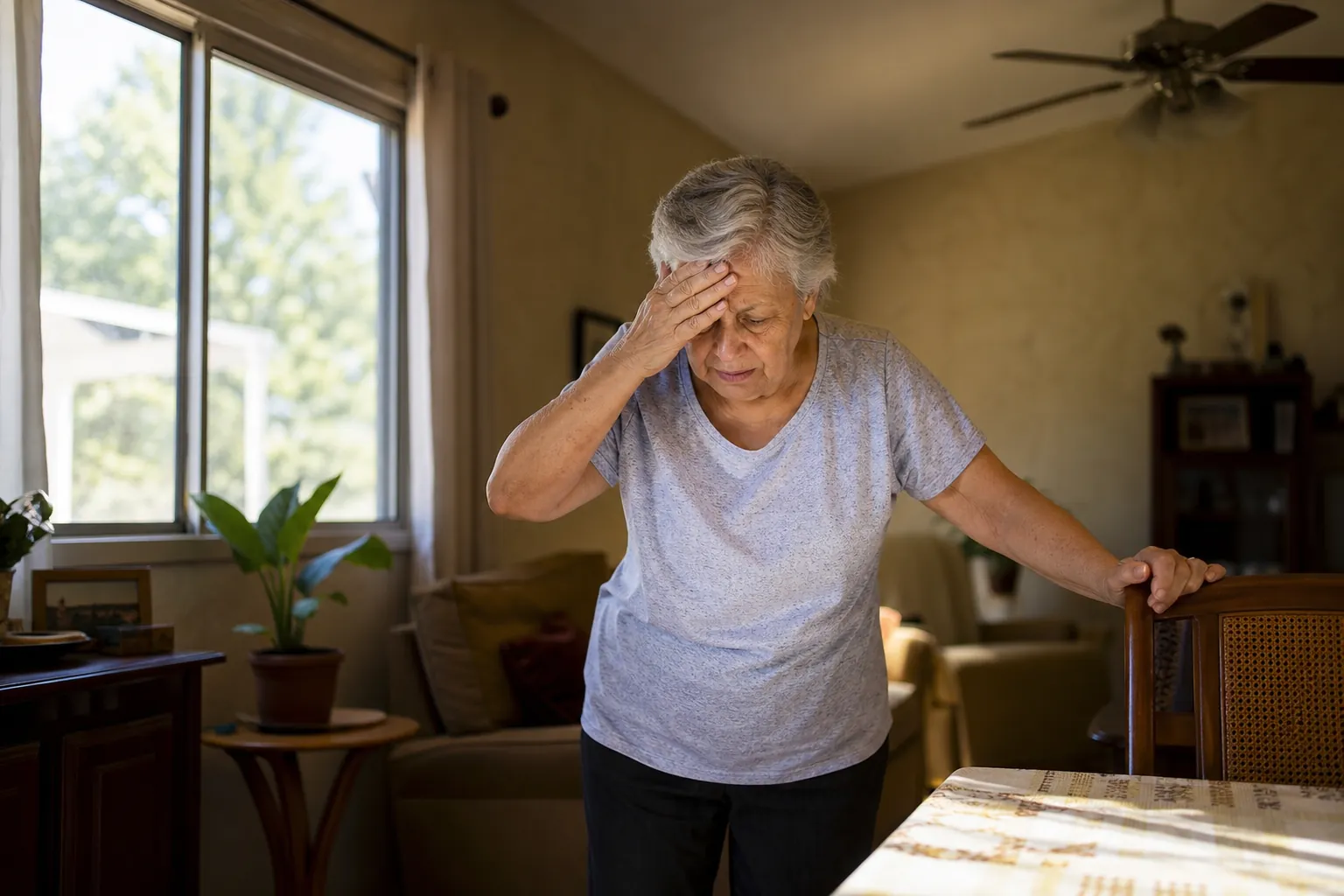
The Seven Symptoms That Should Make You Stop the Walking
A symptom list is useful only if it changes what you do in the room. If an older person is hot, weak, dizzy, confused, faint, unsteady, flushed, or no longer sweating as expected, do not ask them to “just get to the couch.” Bring the chair to them if you can. Sit them down or help them lie down, start cooling, and decide whether emergency help is needed while they are no longer on their feet.
Dizziness
Dizziness is one of the clearest bridges between heat illness and falling. Dehydration can reduce blood volume, and when an older adult stands, blood pressure may drop enough to cause lightheadedness or orthostatic hypotension.[3] That is the pathway behind the familiar line, “I just stood up too fast,” except heat can make the drop more likely and the recovery slower.
Treat dizziness in hot conditions as a movement warning. Have the person sit or lie down. Keep them from walking to another room alone. If dizziness comes with confusion, fainting, very hot skin, or a temperature that suggests heat stroke, move from watchful cooling to emergency response.
Confusion or “Not Quite Right” Behavior
Confusion is not a soft symptom in heat illness. Cleveland Clinic describes heat stroke as involving encephalopathy, meaning brain dysfunction.[2] That can show up as disorientation, agitation, odd answers, trouble following instructions, or a person insisting they are fine while doing something unsafe.
This is where caregivers have to be gently firm. If your parent is confused in a hot room, their self-assessment is not reliable. Do not negotiate a walk to the bathroom, the kitchen, or the porch. Seat them, cool them, and call emergency help if heat stroke signs are present.
Fainting or Near-Fainting
Heat syncope is sudden dizziness or fainting related to heat. Older adults are more vulnerable during hot weather, and heat-related fainting can happen when the body is trying to manage heat through fluid shifts and blood vessel changes.[4] For fall prevention, the name matters less than the consequence: a person who faints does not choose where they land.
A near-faint counts, too. If the person says the room is going dark, grabs the counter, slumps in a chair, or suddenly becomes pale or unresponsive, keep them down and get help. Do not walk them to a cooler place if that requires them to stand. Move air, remove excess clothing, and cool their body where they are while emergency guidance is on the way.
Weakness
Heat-related weakness can look like ordinary fatigue until the person tries to move. They push off from the armrest twice. Their knees soften. They lean on furniture they usually ignore. In an older adult, that is not a harmless hot-day slump if the home is warm and other symptoms are present.
Weakness also changes the amount of help required. A person who could safely walk to the bathroom an hour ago may now need a bedside commode, a wheelchair, or emergency medical care instead of a slow assisted walk. The safest assumption during suspected heat illness is that strength and reaction time are worse than they appear.
Impaired Balance or Poor Coordination
Poor balance may be the symptom the family notices before anyone says “heat stroke.” The older adult reaches for walls, takes shorter steps, turns too slowly, misses the chair, or cannot coordinate sitting down smoothly. Because heat stroke affects the brain, balance and judgment can fail at the same time.[2]
Do not test balance by asking them to walk a few steps. If you are worried enough to test it, you are worried enough to supervise it. Clear the floor around them, keep them seated or lying down, and avoid stairs until the episode has been medically assessed or clearly resolved.
Hot, Flushed, or Dry Skin
Hot, flushed skin raises the danger level, especially when paired with confusion, fainting, or a very high body temperature. Mayo Clinic and Cleveland Clinic both describe hot, dry skin as a classic heat stroke sign, particularly in non-exertional heat stroke.[2][5] In older adults sitting in a hot home, that classic pattern is the one caregivers are most likely to be watching for.
Absence of Sweating
No sweating in a very hot, ill-looking older adult is concerning, but it needs careful wording. Classic heat stroke often presents with hot, dry skin and little or no sweating; exertional heat stroke can look different, with sweating still present.[2][5] For an older adult at home during hot weather, absent sweating should sharpen your concern, not become the only sign you wait for.
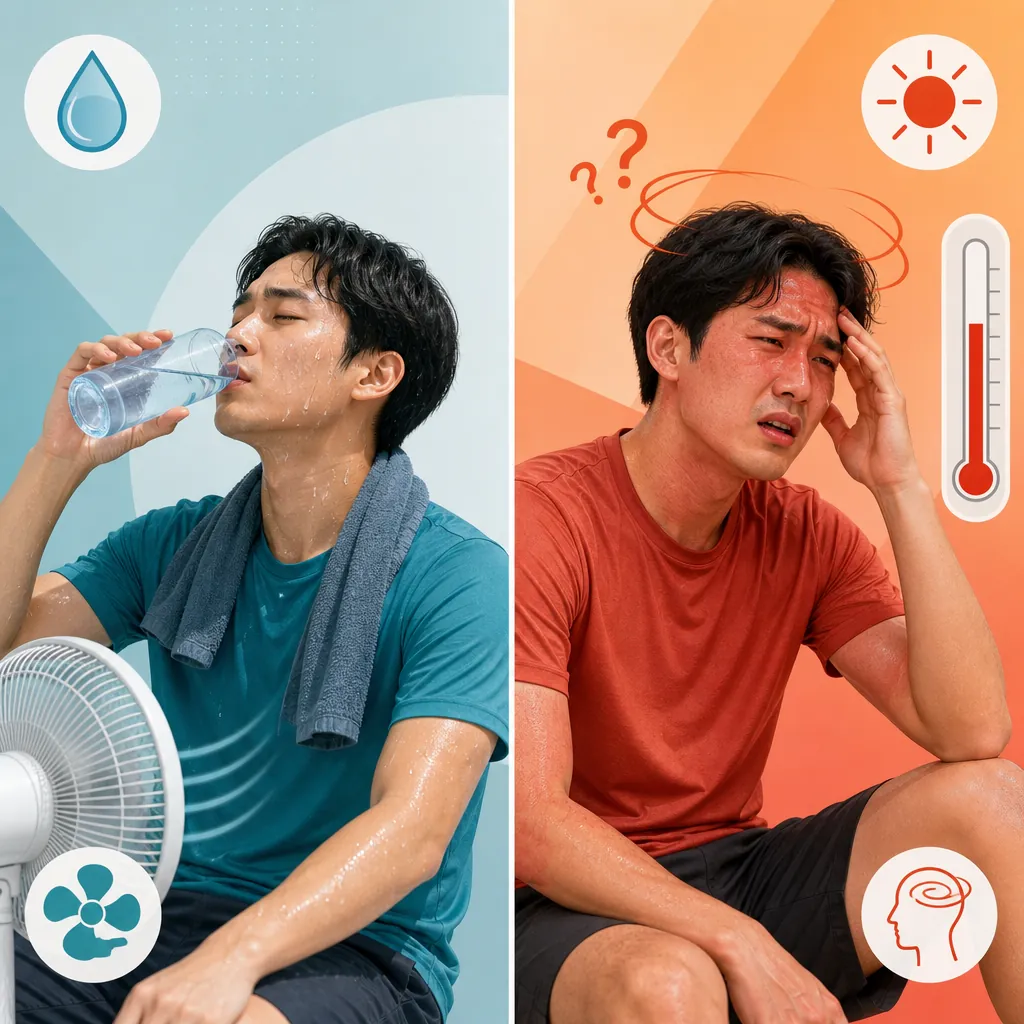
Heat Exhaustion or Heat Stroke: What Changes Your Next Move
You do not have to diagnose perfectly at home. You do need to decide whether this is a serious warning state that needs cooling and close watching, or an emergency where delay can cost the person their footing, consciousness, and life.
| What you see | More consistent with heat exhaustion | More consistent with heat stroke |
|---|---|---|
| Mental status | May feel weak, dizzy, nauseated, or tired | Confusion, altered behavior, fainting, seizure, or loss of consciousness |
| Skin | Cool, moist, clammy skin with heavy sweating | Hot, flushed, often dry skin in classic heat stroke |
| Temperature | May be elevated but typically below 104°F | Body temperature of 104°F or higher is a major warning sign |
| Pulse | May be weak or rapid | Often strong and rapid |
| Fall concern | Dizziness and weakness can still cause a fall | Brain dysfunction, fainting, and severe weakness make walking unsafe |
| Action | Stop activity, move to a cooler place if safe, cool the body, monitor closely | Call 911, start physical cooling, and prevent walking |
Heat exhaustion is not “nothing.” It is a warning that the person is already struggling to regulate heat. Dizziness, heavy sweating, cool moist skin, nausea, and weakness should end the errand, the yard work, the housework, and the unsupervised walk to another room.[5][6]
Heat stroke is the emergency. Confusion, fainting, loss of consciousness, hot flushed skin, absent sweating in classic heat stroke, a rapid strong pulse, or a body temperature around 104°F or higher should move you to 911 and active cooling while help is coming.[2][5][6]
What to Do in the First Few Minutes
The first few minutes are not for proving a point. They are for reducing heat and preventing a fall.
- Get them seated or lying down. If they are already unstable, do not walk them across the room to a “better” chair.
- Call 911 for heat stroke signs: confusion, fainting, loss of consciousness, seizure, very high temperature, hot flushed dry skin, or a rapid strong pulse.
- Start physical cooling: move them out of direct sun if you can do so safely, loosen excess clothing, use cool wet cloths, fan air across the skin, or apply ice packs to the neck, armpits, and groin if available.
- Do not rely on fever reducers. Heat stroke is not a regular fever, and fever-reducing medicine does not correct the overheating problem.[2][3]
- Do not give fluids by mouth if they are confused, faint, vomiting, very drowsy, or not fully alert. Choking and aspiration become part of the danger.
- Keep someone next to them. A confused person may suddenly try to stand, use the bathroom, answer the phone, or “go check something.”
Cooling should begin right away when heat stroke is suspected. Cleveland Clinic notes that rapid treatment is important, and Johns Hopkins describes cooling and rest as central to care after dehydration and heat stroke.[2][3] At home, that means you do what is safe and immediate while emergency services are being called, rather than waiting for certainty.
Why Older Adults Can Look “Fine” Until They Stand
Older adults may not sense or respond to heat the way younger people do. The CDC identifies adults 65 and older as a group at higher risk during heat, especially when chronic medical conditions, certain medications, limited mobility, or lack of air conditioning are part of the picture.[7] A parent sitting quietly in a warm room may not complain until standing exposes the problem.
Standing is a stress test. The heart has to keep blood pressure steady, the brain has to coordinate movement, the legs have to support weight, and judgment has to remain sharp enough to pause when something feels wrong. Heat illness can interfere with every part of that chain.
That is why the small clues deserve respect: the damp towel on the floor after a shower, the hand on the counter, the oddly high thermostat setting, the answer that does not quite match the question. None of those proves heat stroke alone. Together with a hot environment and new dizziness, weakness, confusion, or unsteadiness, they are enough to change the plan from “let’s see how you do” to “sit down now.”
After the Acute Moment, Keep Treating It as a Fall Risk
Once heat illness is suspected, do not assume balance returns the moment the person says they feel better. Weakness, dizziness, slowed thinking, and poor coordination can linger after the most frightening signs ease. Johns Hopkins describes bed rest as part of recovery guidance after dehydration and heat stroke, and Cleveland Clinic notes that some heat stroke effects, including cerebellar ataxia, can persist for weeks.[2][3]
A cautious approach is to treat the next 72 hours as a higher-fall-risk period, especially after a serious episode or emergency evaluation. That is not a universal rule for every warm-day dizzy spell. It is a practical safety window when walking, bathing, stairs, nighttime bathroom trips, and medication timing deserve closer supervision.
- Supervise walking until dizziness, weakness, and coordination are clearly back to baseline.
- Avoid stairs and showers without help if the person is still tired, foggy, or unsteady.
- Ask a clinician about lingering weakness, dizziness, confusion, or balance changes.
- Review heat-sensitive risks such as dehydration, medications, chronic illness, and indoor temperature before the next hot day.
Heat stroke recognition belongs in fall prevention because the earliest usable clue is often not a dramatic collapse. It is the parent who is suddenly dizzy, confused, weak, or unsafe on their feet. If you catch that half-minute before they walk, you have already changed the outcome.
References
- The Effects of Heat on Older Adults, Harvard Medicine
- Heatstroke, Cleveland Clinic, October 2024
- Dehydration and Heat Stroke, Johns Hopkins Medicine
- Heat-related health dangers for older adults soar during the summer, National Institutes of Health
- Heatstroke, Mayo Clinic, September 2024
- Is it heat exhaustion or heat stroke? Here are the symptoms to watch for, UC Davis Health, July 2024
- Heat and Older Adults Aged 65+, Centers for Disease Control and Prevention, June 2024
Related reading
Noticed something outdated or inaccurate on this page? Flag a correction. We review every report against CDC, NIA, and AARP HomeFit guidance before updating a page.
Part of the Fall Prevention section.