
STEADI: intervene
The Earthquake Checklist Seniors Living Alone Actually Need
Standard emergency kit lists overlook what seniors living alone truly need — a 30-day medication supply, mobility backup items, and a communication plan that works without a smartphone. This checklist fills those gaps so you can prepare with confidence.
A generic 72-hour earthquake kit assumes a few things that may not be true at 2 a.m.: that you can see well enough to find it, walk safely across a room, open every package, use a smartphone, refill prescriptions quickly, and wait only a short while for help. That is why an earthquake preparedness checklist for elderly living alone has to start somewhere different.
In a national poll study of adults ages 50 to 80, Bell et al. found that adults living alone had 36% lower odds of having a stocked emergency kit than those living with others. The same study found that 9% used medical equipment requiring electricity, and those adults had significantly lower confidence in handling a power outage. The study did not include adults over 80, so it does not directly represent the oldest people aging at home, but the gap it shows is exactly the one a real checklist has to close.[1]
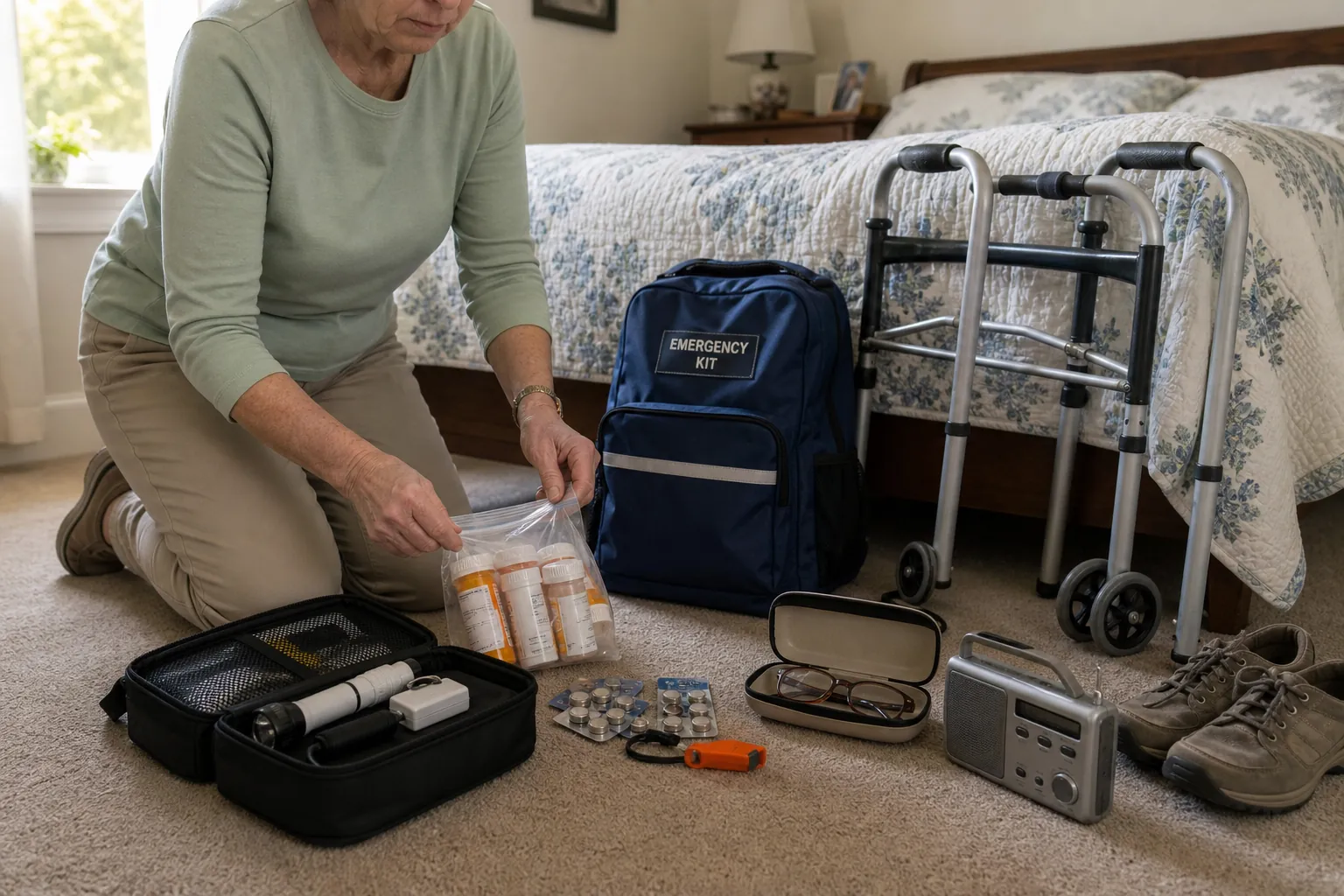
Water, food, and first aid still matter. But for an older adult living alone, the first question is not only, “Do I have supplies?” It is, “Can I keep taking my medication, keep my medical devices running, move without falling, hear and see what is happening, and contact someone if the phone is dead?”
The Senior Earthquake Kit at a Glance
Think of the kit in three places, not one tote shoved in a closet. The main kit keeps you supplied for days. The bedside kit gets you through the first dark minutes after shaking. The paper plan works when the phone does not.
| Keep it here | What belongs there | Why it matters |
|---|---|---|
| Main emergency kit | Water, ready-to-eat food, first aid, 30-day medications, medical documents, hygiene supplies, special diet foods, incontinence supplies, batteries, radio | Supports health needs after the first few hours |
| Bedside or under-bed kit | Sturdy shoes, flashlight, glasses, whistle, gloves, cane or mobility aid within reach | Reduces fall and injury risk when glass, darkness, or furniture blocks the room |
| Medication and device station | Medication list, pharmacy information, backup batteries, charging plan, CPAP or oxygen instructions if used | Prevents a health problem from becoming the emergency |
| Communication folder | Out-of-state contact card, neighbor check-in plan, paper phone numbers, landline information if available | Works when a smartphone is missing, dead, or too confusing under stress |
Start With Medications, Not Flashlights
The American Red Cross recommends that older adults keep at least a 30-day supply of medications and extra assistive items for emergencies.[2] That recommendation is the backbone of this checklist. A three-day food supply is useful; a three-day medication supply may not be enough if roads are closed, pharmacies lose power, a caregiver cannot get across town, or mail-order prescriptions are delayed.
Pack the medication part of the kit so another person could understand it without guessing. That person may be a neighbor, a firefighter, an emergency shelter nurse, or an adult child trying to help by phone.
- A 30-day supply of prescription medications, rotated before expiration when possible.
- A written medication list with drug names, doses, timing, prescribing doctors, pharmacy name, and allergies.
- Copies of insurance cards, Medicare or Medicaid information, advance directives if you use them, and key medical history.
- A small pill organizer for several days, kept separate from the sealed backup supply if that helps prevent mix-ups.
- A note explaining which medications cannot be skipped, which require food, and which should not be taken together.
If a full 30-day reserve is hard to obtain because of insurance rules or controlled-substance limits, do not pretend the problem is solved. Ask the prescriber or pharmacist what emergency refill options are realistic in your state, and write that answer down. The useful kit is the one that names the weak spot before the earthquake does.
Medical Devices Need a Power Plan
If you use a CPAP machine, oxygen equipment, a powered recliner needed for safe transfers, a stair lift, an electric wheelchair, a nebulizer, or any device that turns electricity into independence, list it separately. Do not let it disappear under the word “equipment.”
- Write the device name, model, power requirement, supplier, and after-hours service number on paper.
- Keep charged backup batteries if the device supports them.
- Label chargers and store them where they can be reached without climbing or moving heavy furniture.
- Ask the utility company, doctor, or equipment supplier whether any medical baseline, priority restoration, or emergency power program applies in your area.
- Write down what to do if the device cannot run, including when to call emergency services.
That last item is not pessimism. It is how you keep a power outage from becoming a guessing contest.
Pack the Items Generic Lists Forget
Senior-specific supplies are often ordinary, private, and easy to leave off a public checklist. They are also the things that decide whether someone can stay clean, fed, steady, and calm while waiting.
- Special diet foods if you need low-sodium, diabetic-friendly, texture-modified, allergy-safe, renal, or other medically appropriate food.
- Incontinence briefs, pads, wipes, disposal bags, barrier cream, and extra underwear.
- Hearing aid batteries, cleaning tools, and a labeled case.
- Two pairs of glasses if possible: one in the main kit and one by the bed in a hard case.
- Dentures, denture adhesive, spare containers, or other oral-care items you need to eat safely.
- Extra skin-care, wound-care, ostomy, catheter, or continence supplies if they are part of daily life.
Caregiving preparedness guides specifically include items such as incontinence supplies and special diet foods because emergencies do not pause personal care needs.[5][6] If those supplies are embarrassing to pack, pack them anyway. A sealed bag with a clear label is better than needing help later for something that could have been handled privately.
The Under-Bed Kit Is Not Optional
The first useful kit after an earthquake may not be the main kit. It may be the small one under the bed, because the shaking can leave broken glass, spilled medicine, tipped lamps, and furniture in the path between you and the hallway.
Earthquake Country Alliance recommends keeping sturdy shoes, a flashlight, glasses, and a whistle near the bed, and the California Earthquake Authority also points to the under-bed kit because broken glass is a common earthquake injury hazard.[3][4]
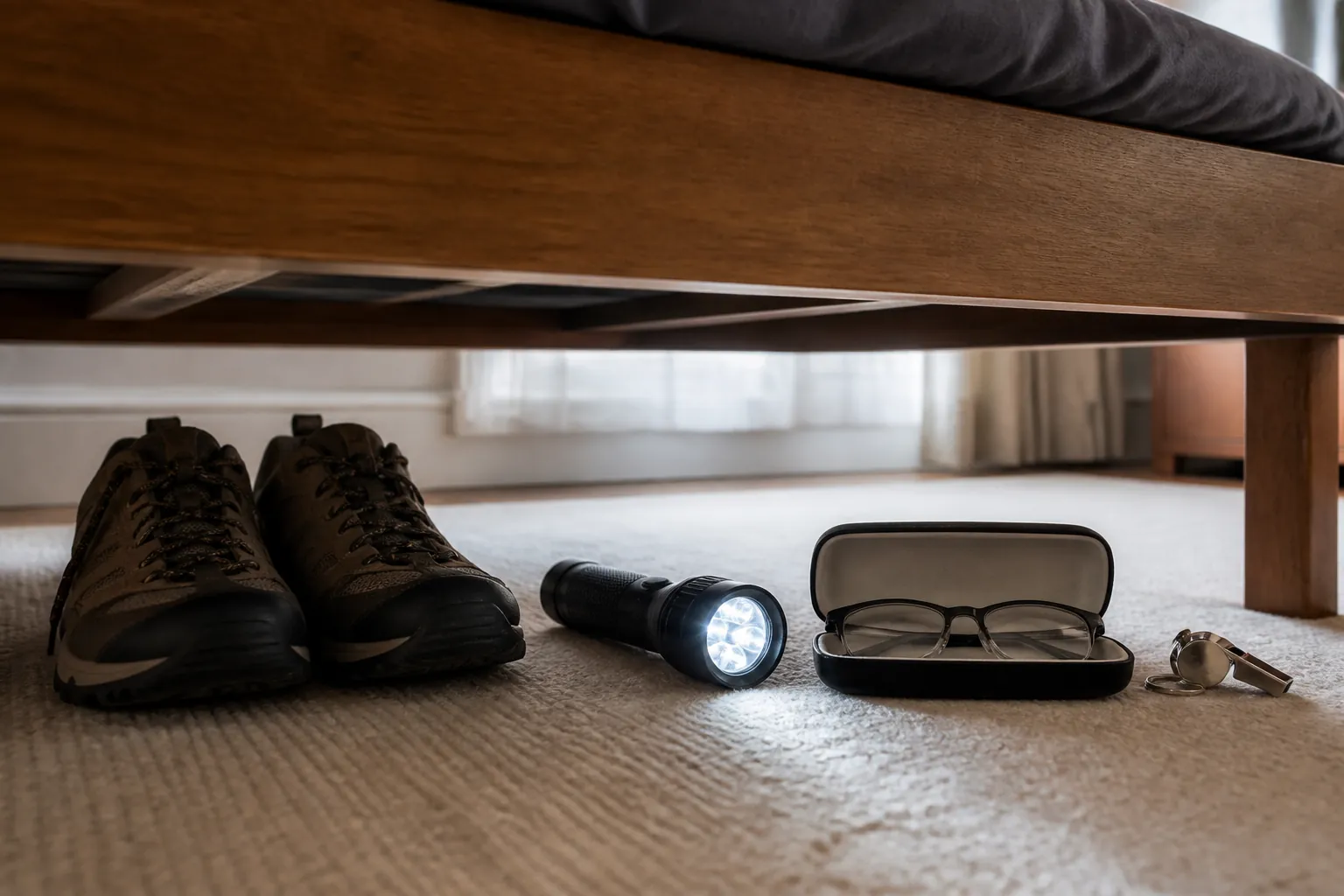
Put these items where your hand can reach them from the bed, not across the room:
- Closed-toe sturdy shoes, preferably the pair you can put on without balancing on one foot.
- A flashlight with fresh batteries, stored in the same position every time.
- Glasses in a hard case, especially if you cannot safely walk without them.
- A whistle to signal for help if calling out is not enough.
- Work gloves or heavy gloves to protect hands from glass and debris.
- A cane, walker, or transfer aid positioned so it will not roll or slide away.
Do a small test on an ordinary afternoon: lie down, close your eyes, and reach for the flashlight, glasses, whistle, and shoes. If you cannot find them without turning on a light, the kit is not ready. If the shoes are under a chair or the flashlight is in a drawer, fix the storage, not your memory.
Mobility Backups Belong in the Kit, Too
A walker, cane, wheelchair, or grabber can be the difference between moving safely and crawling. Pack for the small failures: the loose screw, the worn rubber tip, the missing Allen wrench, the brake that needs tightening.
- Extra cane tips or walker tips.
- A small tool that fits your walker, wheelchair, or rollator adjustments.
- Spare walker glide caps, tennis-ball replacements, or other parts you actually use.
- Reflective tape or bright tape on mobility equipment so it is easier to see in low light.
- A spare cane if you can afford and store one safely.
This is also where fall prevention and earthquake preparation meet. The CDC reports that one in four older adults falls each year; an earthquake kit cannot remove that risk, but it can keep darkness, glass, and missing mobility equipment from making the first walk after shaking more dangerous.[8]
Communication Has to Work Without a Smartphone
A smartphone is useful if it is charged, nearby, unlocked, connected, and easy to use under stress. That is too many “ifs” for someone living alone. The communication plan should assume the phone may be dead, lost under the bed, or impossible to read without glasses.
Build a paper-and-sound backup.
- A laminated or plastic-sleeved contact card with your name, address, date of birth, medical conditions, allergies, medications, doctors, pharmacy, and emergency contacts.
- One out-of-state contact who can receive updates and relay messages if local lines are overloaded.
- A battery-powered or hand-crank radio, with batteries stored beside it if needed.
- A whistle in the bedside kit and another in the main kit.
- A written neighbor check-in plan: who checks on whom, when it is safe, and what to do if there is no answer.
- A landline plan if you still have one, including a corded phone if the service works during a power outage in your area.
The Family Caregiver Alliance includes designating a neighbor to check on an older adult in its caregiver emergency checklist.[6] That arrangement should be specific enough to survive confusion: “Mrs. Lopez next door will knock after shaking stops if her own home is safe” is better than “someone will check.”
Write phone numbers on paper even if they are saved in your phone. A number stored only in a dead cellphone is not a contact; it is a memory test at the worst possible time.
The Main Kit Still Needs the Basics
Do not skip the ordinary supplies. Just do not let them crowd out the health and mobility items. A basic earthquake kit usually includes water, ready-to-eat food, flashlight, batteries, first aid, sanitation supplies, cash, copies of documents, and a radio. The California Earthquake Authority estimated in 2019 that a basic emergency kit could cost about $104, but that figure is only a floor. It does not reflect 2026 prices or the added cost of medications, continence supplies, mobility parts, device batteries, or special foods.[4]
- Water you can lift, open, and pour without straining.
- Food that fits your medical diet and does not require cooking.
- A manual can opener if any food requires one.
- First-aid supplies, including wound dressings you know how to use.
- Hand sanitizer, wipes, toilet paper, disposal bags, and personal hygiene supplies.
- Small bills in cash, copies of key documents, spare keys, and local maps if you use them.
Store heavy items at waist height or lower, not on a high shelf. If you use a rolling cart, choose one that will not block an exit or become a tripping hazard.
Light the Path Before the Power Goes Out
The Illinois Emergency Management Agency’s planning guide for seniors recommends outlet-activated security lights that run 4 to 6 hours during power outages.[7] That is a modest item, but it solves a real problem: getting from bed to bathroom, phone, medication, or exit without stepping into the dark.
Place lights where a fall would be most costly: bedroom, bathroom path, hallway, kitchen, and the route to the main kit. If outlets are scarce in an older house, use plug-in lights where they help most and keep flashlights in fixed places elsewhere.
Adjust for Where You Live
Earthquake risk is not the same across the United States. California, the Pacific Northwest, Alaska, Hawaii, and the New Madrid Seismic Zone do not share the same hazards, and even one city can have different risks from one neighborhood to another. Local alert systems, evacuation routes, tsunami zones, liquefaction zones, winter weather, and rural road access may add items to this checklist.
Use local emergency management instructions for the regional pieces. Keep the senior-specific core the same: medication, device power, mobility, vision and hearing, paper contacts, and neighbor check-in.
If You Are Assembling This for a Parent
A caregiver can buy supplies quickly and still build a kit the older adult cannot use. Before you call it finished, ask the person who lives there to open the containers, lift the water, read the labels, find the flashlight from bed, and explain the contact card. If she cannot use it alone, the kit is not assembled yet.
- Label bins in large print.
- Avoid childproof caps on emergency-only supplies unless safety requires them.
- Put written instructions where they will be used, not in a binder no one will reach.
- Check that hearing aid batteries, glasses, dentures, and mobility tools match the person’s current equipment.
- Set a calendar reminder to review medications, batteries, food, water, and contact information.
Ready.gov advises older adults to create a support network and plan around daily living needs.[9] For a parent living alone, that support network should not exist only in your phone. Put names, numbers, and roles on paper in the house.
A Practical Review Schedule
A senior earthquake kit needs review because bodies, prescriptions, devices, and neighbors change. Use a simple schedule rather than trusting memory.
| When | What to check |
|---|---|
| Monthly | Flashlights, radio, device batteries, phone numbers, and whether the bedside kit is still reachable |
| Every prescription refill | Medication list, doses, pharmacy information, expiration dates, and whether the emergency supply still matches current orders |
| Every 6 months | Food, water, incontinence supplies, special diet foods, hearing aid batteries, glasses, and mobility repair items |
| After any fall, hospitalization, new diagnosis, or new device | Bedside setup, mobility plan, medical documents, caregiver instructions, and neighbor check-in plan |
The finished kit should leave you with four things clearly handled: what goes in the main kit, what stays by the bed, what belongs on paper, and who checks in. For an older adult living alone, an earthquake kit is not a smaller family kit. It is a health, mobility, and communication backup system.
References
- Bell et al., NPHA (PMC7704536). PMC. https://pmc.ncbi.nlm.nih.gov/articles/PMC7704536/
- Older Adults. American Red Cross. https://www.redcross.org/get-help/how-to-prepare-for-emergencies/older-adults.html
- Earthquake Country Alliance Step 3. Earthquake Country Alliance. https://www.earthquakecountry.org/step3/
- How to Make an Earthquake Emergency Kit. California Earthquake Authority. 2019. https://www.earthquakeauthority.com/blog/2019/how-to-make-an-earthquake-emergency-kit
- Prepare Elders for Emergencies. AgingCare. https://www.agingcare.com/articles/prepare-elders-for-emergencies-147770.htm
- Emergency Preparedness Checklist for Caregivers. Family Caregiver Alliance. https://www.caregiver.org/resource/emergency-preparedness-checklist-caregivers/
- IEMA Illinois Planning Guide for Seniors. Illinois Emergency Management Agency. https://iemaohs.illinois.gov/preparedness/earthquake-seniors.html
- Facts About Falls. Centers for Disease Control and Prevention. https://www.cdc.gov/falls/data-research/facts-stats/index.html
- Older Adults. Ready.gov / FEMA. https://www.ready.gov/older-adults
Related reading
Noticed something outdated or inaccurate on this page? Flag a correction. We review every report against CDC, NIA, and AARP HomeFit guidance before updating a page.
Part of the Fall Prevention section.