
STEADI: intervene
Severe Weather Safety Checklist for Seniors Living Alone
A step-by-step severe weather preparedness checklist for older adults who live alone, covering emergency kit essentials, communication plans, fall-proofing during storms, and managing medical needs when the power goes out.
A severe weather safety checklist for seniors living alone has to do more than name the supplies in a closet. The dangerous moment is often smaller and more ordinary: the power fails, the hall goes dark, the phone is at 18%, the bathroom is across a slick floor, and no one else is in the house to hear the alert, steady an arm, check the medication cooler, or say, “Wait—use the other door.”
That is why the checklist below is built as one linked system. It covers the emergency kit, the check-in network, fall-proofing before, during, and after the storm, and medical continuity when normal routines break. Leave one part loose, and the other parts have to carry too much.
The gap is real. In a 2021 NORC survey, 79% of older adults said they were concerned about extreme weather, while 25% had an evacuation plan and 30% had taken no emergency preparedness measures. That survey should not be treated as a fresh 2026 measurement of every household, but it still points to the practical problem: worry is common; a usable plan is less common. [1]
Falls are the home-safety center of this plan. The CDC identifies falls as the leading cause of injury for older adults and reports about 3 million emergency department visits for older adult falls each year. Severe weather adds the conditions that make a familiar home less familiar: darkness, wet shoes, loose rugs, rushed movement, icy steps, and fatigue. [2]
The checklist at a glance
| Part of the system | What to set up | Why it matters when someone lives alone |
|---|---|---|
| Emergency kit | Supplies, documents, light, charging, water, food, radio, personal items | The house has to function for at least the first stretch without a second person making runs to the store |
| Communication and check-ins | Named contacts, alert methods, call-failure rules, neighbor knock, evacuation trigger | No one is automatically there to notice a missed warning, a fall, a dead phone, or a medical problem |
| Fall-proofing | Clear paths, reachable lights, dry entry points, footwear, cane and walker traction, cleanup limits | Storms turn normal walking routes into fall-risk zones |
| Medical continuity | Medication list, refill plan, cold-storage plan, powered device backup, heat and cold plan | A power outage can interrupt prescriptions, devices, refrigeration, and safe indoor temperature |
During Winter Storm Fern in January 2026, PowerOutage.us reported more than 1 million customers without power. That kind of outage number is useful here not because every storm will look the same, but because it shows how quickly “I have a flashlight somewhere” can become a whole-house safety problem. [3]
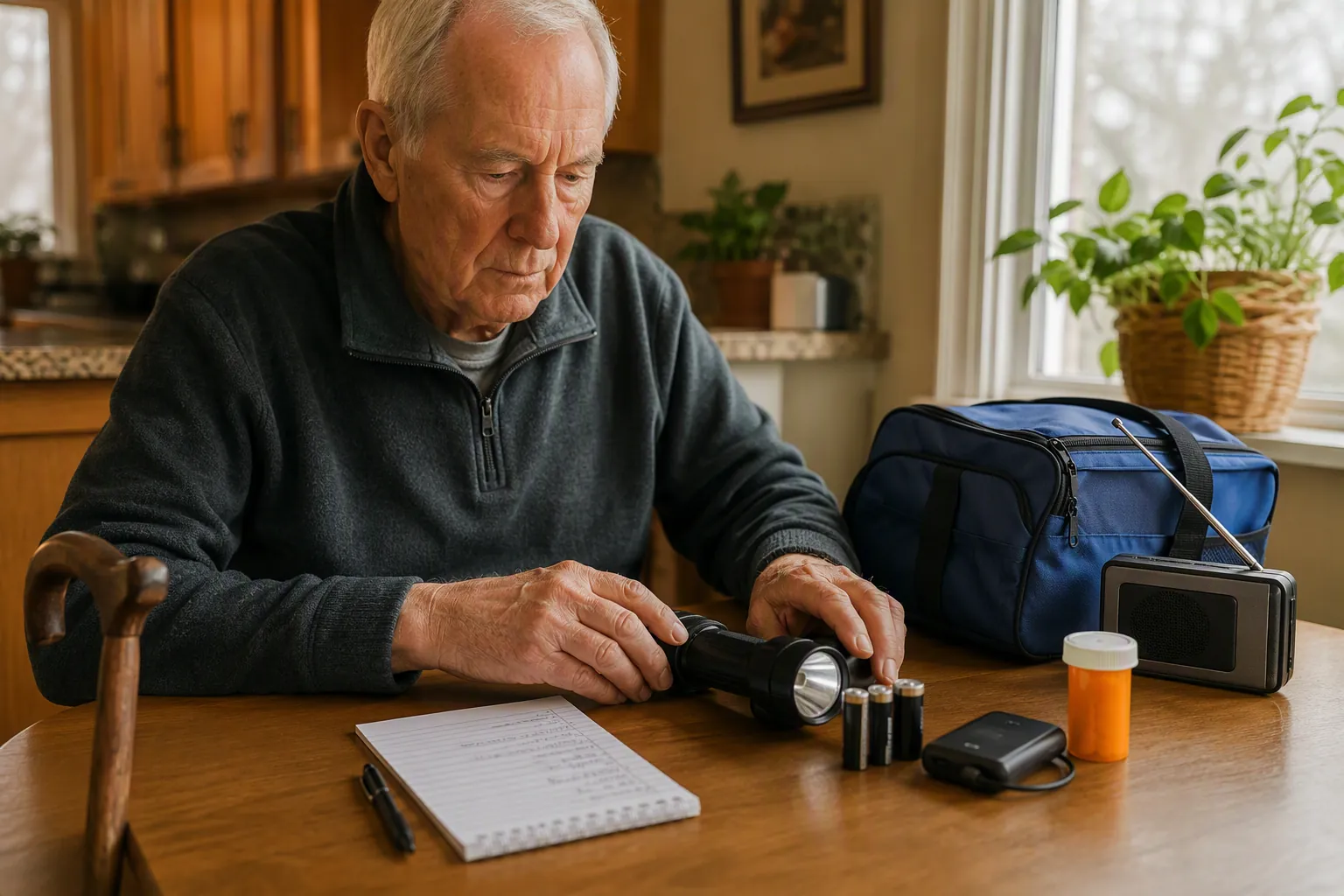
Start with an emergency kit that fits the person, not the average household
The Red Cross uses a 72-hour emergency kit as a basic preparedness benchmark for older adults, and FEMA’s Ready.gov also tells older adults to plan around their daily living and medical needs rather than a generic supply list. The useful kit is not the one that looks complete in a plastic bin. It is the one the person can open, lift, read, and use at 2 a.m. [4][5]
- Water and ready-to-eat food that do not require standing at the stove, sharp knives, or a working microwave.
- A flashlight or lantern within reach of the bed, favorite chair, and main bathroom path—not just one flashlight in a drawer.
- Extra batteries, a fully charged power bank, and a simple charging routine before forecasted severe weather.
- A battery-powered or hand-crank radio, especially if cell service is unreliable or hearing alerts on a phone is not dependable.
- A written medication list, allergy list, medical device list, pharmacy number, clinician number, and emergency contacts in large, readable print.
- Copies of key documents in a waterproof pouch: identification, insurance cards, advance directives if used, and a current contact sheet.
- Personal items that determine whether the kit can actually be used: eyeglasses, hearing aid batteries or charger, denture supplies, incontinence products, mobility-device accessories, and pet supplies if applicable.
- A small first-aid kit, disposable gloves, hand sanitizer, masks if needed, and basic hygiene supplies.
Keep the kit where the person already moves safely. A heavy tote in a basement or garage is not preparedness for someone who avoids stairs, uses a walker, or cannot carry weight during a warning. Split supplies if needed: one bedside light-and-contact pouch, one kitchen supply shelf, one go-bag near the safest exit.
Build a check-in network with rules, not good intentions
“Call me if anything happens” is kind, but it is not a severe-weather plan. A senior living alone needs a named chain: who checks in first, who backs that person up, who is close enough to knock, and when a missed contact becomes an escalation.
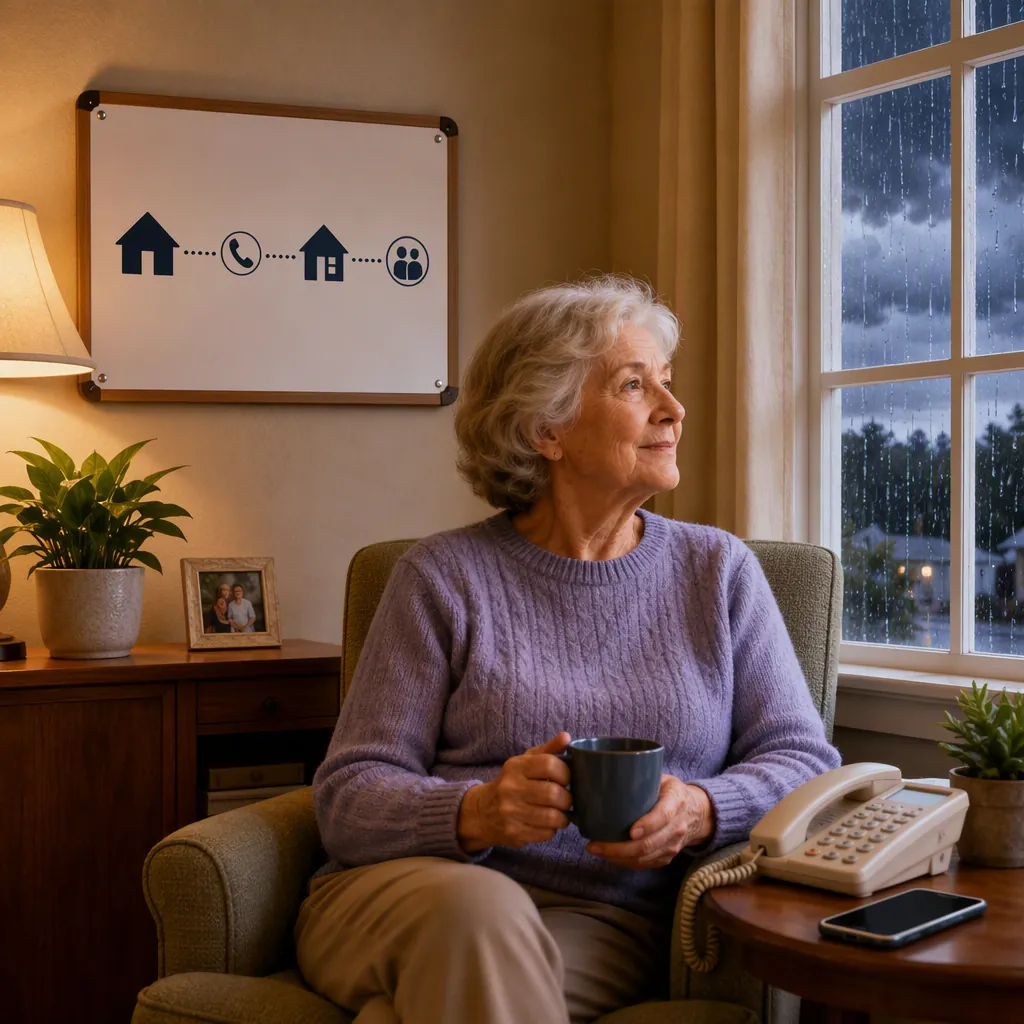
Use three contact roles. The primary contact watches the forecast and starts check-ins. The local contact can physically reach the home, knock, help with a stuck door, or confirm whether the lights are on. The backup contact takes over if the primary person is traveling, asleep, ill, or unreachable.
| Decision | Write down the answer |
|---|---|
| Who sends the first weather check-in? | Name, phone number, usual method |
| Who is close enough to knock on the door? | Neighbor, building staff, nearby relative, faith-community contact, or local friend |
| What counts as a missed check-in? | No answer after a set number of attempts, a confused answer, or no reply by the agreed time |
| What happens if calls fail? | Try text, landline, video call, neighbor knock, building office, or local emergency number depending on urgency |
| Who decides on evacuation help? | Person living alone if able, plus named support contact when transportation or mobility help is needed |
| Where is the safe meeting place? | A nearby indoor location, a family home, a shelter option, or a prearranged pickup point |
The check-in schedule should change with the hazard. A thunderstorm watch may call for a simple “phone charged, lights ready” check. A tornado warning, hurricane evacuation order, wildfire smoke event, major heat alert, ice storm, or prolonged outage needs tighter timing and clearer thresholds. For tornado-specific shelter decisions, use a deeper guide such as The Complete Tornado Safety Guide for Seniors Living Alone or a Tornado Watch Safety Checklist for Seniors rather than trying to improvise shelter choice after the siren.
Make alerts redundant
Weather warnings should not depend on one sound from one device. If hearing is limited, if hearing aids are removed at night, or if the phone is often left in another room, the plan needs layers: Wireless Emergency Alerts on the phone, a weather radio, visual or vibrating alert options where available, a landline call if the person uses one reliably, and a human check-in when the warning level rises.
Adult children often want an app to solve this. Apps help, but they do not notice that a parent put the phone on silent, forgot to charge it, could not hear it from the bedroom, or hesitated to call because “it’s probably nothing.” The local knock is not old-fashioned. For some households, it is the missing safety feature.
Set the escalation rule before pride enters the room
The escalation rule protects independence because it removes negotiation during the worst moment. A written rule might say: if there is no answer after two calls and one text during a warning, the local contact knocks. If the local contact sees water entering the home, smells gas, hears a call for help, finds the person confused, or cannot safely reach the door, they call emergency services. The exact rule should fit the person, the building, and the local hazard, but it should not be invented while the storm is already overhead.
For evacuation, the same principle applies. Decide in advance who provides transportation, whether the person can manage steps, oxygen equipment, a walker, pets, or medications, and which exit is safest. In hurricane-prone areas, pair this checklist with Hurricane Evacuation Tips for Seniors to Prevent Falls. In typhoon-prone regions, use Make Your Typhoon Plan Fall-Safe for Seniors Living Alone for storm-specific route and timing decisions.
Fall-proof the home before, during, and after the storm
Storm preparation often looks out the window: branches, gutters, porch furniture, driveway drainage. For an older adult alone, it also has to look at the path from bed to bathroom, the chair to the kitchen, the door to the mailbox, and the place where wet shoes come off.
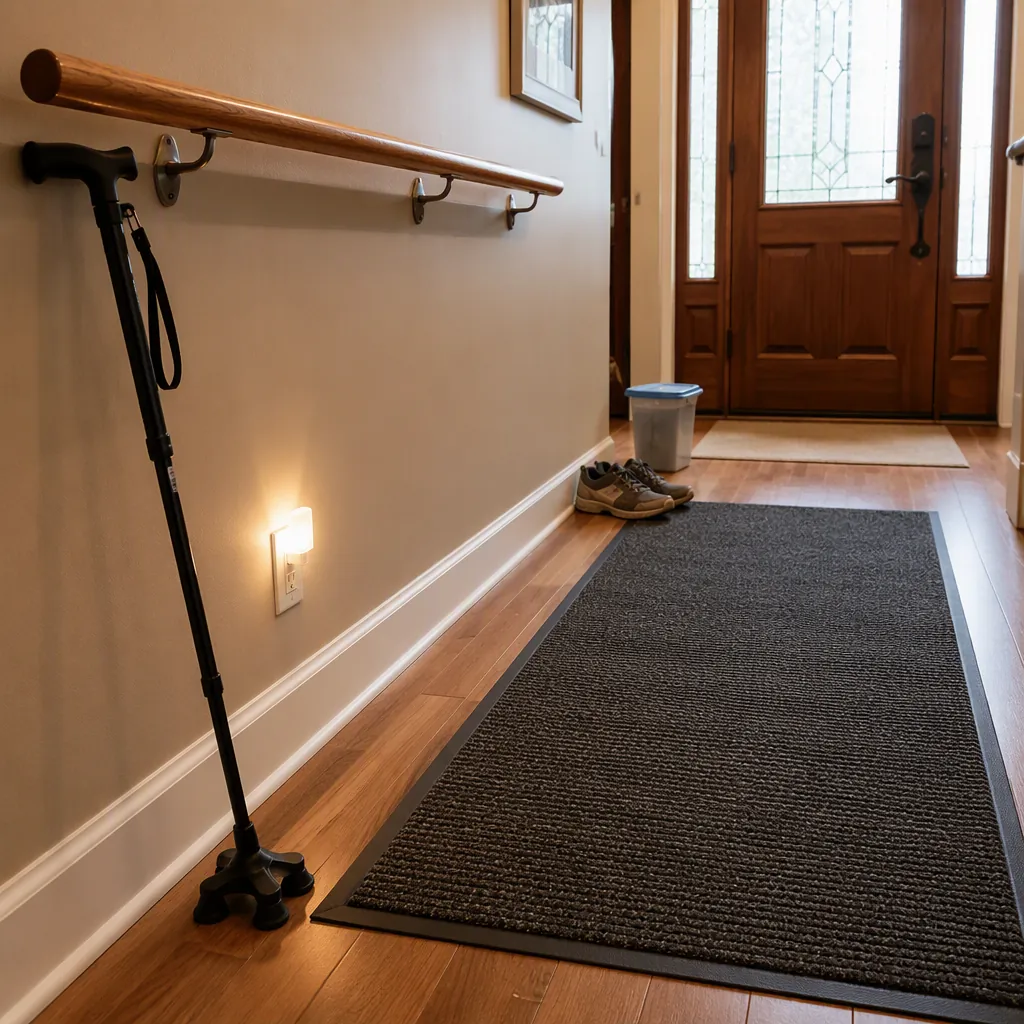
Before the storm: clear the routes that will be used half-awake
- Clear the bed-to-bathroom path, including cords, shoes, laundry baskets, pet bowls, and small rugs that shift underfoot.
- Put a flashlight, lantern, or plug-in rechargeable light where it can be reached before standing up.
- Place a stable chair near the entry only if it does not narrow the walking path; it can help with removing wet footwear.
- Use rubber-backed mats at entrances and remove decorative mats that curl, slide, or bunch.
- Move frequently used food, water, medications, glasses, hearing supplies, and phone chargers to waist-to-shoulder height so the person is not reaching high or bending low during an outage.
- Check that canes, walkers, rollators, and grab bars are where they are actually used, not stored neatly in another room.
A room-by-room check is especially useful before tropical systems, when people tend to focus on windows and outdoor objects. For that narrower preparation, see Fall Prevention Tips for Caregivers Before a Tropical Storm.
During the storm: slow down the first ten steps
The first ten steps after the lights go out are often the problem. The person stands too quickly, reaches for a wall that is farther away than expected, or starts toward the kitchen to “just get the flashlight.” The flashlight should already be at the bed or chair. The phone should be charged before the warning arrives. The walking aid should be beside the person, not across the room.
- Sit up first; pause before standing, especially if dizziness is common.
- Turn on the bedside or chair-side light before moving.
- Use the cane, walker, rollator, handrail, or grab bar even for short trips.
- Wear rubber-soled shoes or secure slippers; avoid socks alone on smooth floors.
- Do not carry large containers of water, heavy coolers, or multiple bags while walking in the dark.
- If water has entered the home, assume the floor is unsafe until a light is on and a stable path is confirmed.
For a deeper power-outage walkthrough, use the Senior Fall Prevention Checklist for Power Outages. If a caregiver needs the hazard explanation behind the checklist, Power Outage Fall Risks Every Senior Caregiver Should Know covers the common blackout traps in more detail.
Ice, rain, and entryways need their own plan
NCOA’s winter fall-prevention guidance recommends practical traction measures such as rubber-soled footwear, using handrails, applying cat litter to icy surfaces, and considering ice-gripper cane tips. Those are not winter niceties. They decide whether the person can reach the mailbox, meet a neighbor at the door, or get to a car without turning the front step into the most dangerous place on the property. [6]
- Keep traction material near the entrance before ice arrives, not in a detached garage or on a high shelf.
- Use footwear with real grip for quick outdoor tasks; do not step outside in loose slippers.
- Ask a clinician, physical therapist, or mobility-device professional before changing cane tips if balance, gait, or device fit is complicated.
- Arrange snow, ice, branch, or debris removal before the storm when possible; post-storm cleanup is not the time to prove independence.
- If the safest exit is blocked, use the check-in network rather than trying to climb over debris, wet leaves, snowbanks, or downed branches.
After the storm: treat cleanup as a fall-risk period
The weather alert may end before the home is safe. Wet thresholds, scattered towels, extension cords, spoiled food trips to the trash, basement water, porch debris, and outdoor ice can keep fall risk high. The first post-storm job for the person living alone is not cleanup. It is to confirm a safe walking route, report hazards to the check-in contact, and wait for help with anything that requires climbing, lifting, bending, or carrying awkward loads.
Protect medications, devices, and body temperature when power fails
Medical continuity should be written into the same checklist, not kept as a separate “health folder” that no one remembers during an outage. NCOA’s emergency preparedness guidance for older adults emphasizes planning before, during, and after a disaster, including health needs and recovery steps. [7]
- Keep a current medication list with dose, timing, prescribing clinician, pharmacy, and whether the medication needs refrigeration.
- Ask the pharmacist in advance what to do if a refrigerated medication warms during an outage; do not guess after the fact.
- Refill essential prescriptions before forecasted severe weather when possible, especially before holidays or multi-day storm systems.
- Write down which devices need power: oxygen equipment, CPAP, nebulizer, hospital bed, lift chair, stair lift, refrigerated medication storage, communication devices, hearing aid chargers, or mobility-device chargers.
- Ask each device supplier what backup power is safe, how long the backup lasts, and whether the user should register with the utility or local emergency management for medical-device support.
- Keep phone numbers for device suppliers, pharmacy, clinician, utility, local emergency management, and transportation help on paper as well as in the phone.
Heat deserves special attention after a disaster because power loss can remove air conditioning, fans, refrigeration, and normal transportation at the same time. The CDC identifies older adults as a heat-risk group and advises attention to heat illness signs and cooling actions. For a heat-specific plan after an outage or disaster, use Heatstroke Prevention for Seniors After a Disaster. [8]
Cold planning should be handled with the same seriousness, especially for people who are frail, live in older housing, or hesitate to leave home. If the indoor temperature is dropping and the person cannot stay warm safely, that is not a comfort problem; it is a relocation question. Use the check-in network early, before the person is exhausted, confused, or too chilled to make calls.
Match the checklist to local hazards without starting over
A senior in coastal Florida, inland Oklahoma, northern Minnesota, Puerto Rico, Arizona, and the Pacific Northwest will not face the same weather pattern. The base system stays the same: kit, contacts, fall-proofing, medical continuity. The local layer changes the timing and the trigger.
| If the local hazard is... | Add this to the base checklist |
|---|---|
| Tornadoes | Preselect the safest room, keep shoes and a helmet or head protection nearby if advised locally, and make check-ins fast because warning times may be short |
| Hurricanes or tropical storms | Decide evacuation transportation early, protect walking paths before rain starts, and move medications and mobility supplies into the go-bag |
| Typhoons | Plan for wind, flood, and extended outage risk; avoid last-minute movement across wet outdoor surfaces |
| Winter storms | Prepare traction at entrances, heating backup questions, medication access, and help for snow or ice removal |
| Extreme heat | Identify cooling locations, transportation help, hydration reminders, and a check-in rule for signs of heat illness |
| Thunderstorms and outages | Focus on lights, phone charging, safe bathroom trips, food safety, and backup alerts |
Use local emergency management, National Weather Service alerts, utility outage tools, and community shelter information to set the actual triggers. The mistake is not having a hurricane plan in a blizzard town. The mistake is having ten weather facts and no answer to who knocks on the door, where the flashlight is, how the medication stays usable, and which route is safe to walk.
After the storm: reset the system before the next warning
When the immediate danger passes, do the reset while the details are still fresh. First confirm personal safety: any fall, near-fall, dizziness, chest pain, shortness of breath, confusion, dehydration, overheating, chilling, missed medication, spoiled refrigerated medication, or device failure should be reported to the right contact or clinician. A near-fall counts. It tells the plan where it almost failed.
- Recharge phones, power banks, hearing aid chargers, medical-device batteries, flashlights, and lanterns.
- Replace used water, food, batteries, first-aid items, hygiene supplies, and pet supplies.
- Confirm that all medications are still usable, especially any that required refrigeration.
- Dry and clear entryways, bathroom paths, kitchen paths, and the bed-to-bathroom route.
- Tell the check-in contacts what worked and what failed: missed calls, weak cell signal, hard-to-hear alerts, blocked exits, poor lighting, or unsafe footwear.
- Update the written checklist before putting it away.
A senior living alone is not made safe by one flashlight, one phone call, or one evacuation note. Safety comes from the links between them: alerts that can be received, a person who knows when to check, a route that can be walked without falling, and medical needs that keep being met when the weather interrupts everything else.
References
- With Growing Concern Around Extreme Weather Events, Older Adults Still Lack Emergency Preparedness, NORC at the University of Chicago, 2021, https://www.norc.org/research/library/with-growing-concern-around-extreme-weather-events--older-adults.html
- Facts About Falls, CDC, https://www.cdc.gov/falls/data-research/facts-stats/index.html
- Power Outage Preparedness for Seniors & Elderly, PowerOutage.us, https://poweroutage.us/storm-prep/power-outage-preparedness-seniors-elderly
- Older Adults, American Red Cross, https://www.redcross.org/get-help/how-to-prepare-for-emergencies/older-adults.html
- Older Adults, Ready.gov, https://www.ready.gov/older-adults
- Winterize to Prevent Falls, NCOA, https://www.ncoa.org/article/winterize-to-prevent-falls/
- Emergency Preparedness 101: What to Do Before, During and After Disaster, NCOA, https://www.ncoa.org/article/emergency-preparedness-101-what-to-do-before-during-and-after-disaster/
- Heat and Older Adults Aged 65+, CDC, https://www.cdc.gov/heat-health/risk-factors/heat-and-older-adults-aged-65.html
Related reading
Noticed something outdated or inaccurate on this page? Flag a correction. We review every report against CDC, NIA, and AARP HomeFit guidance before updating a page.
Part of the Fall Prevention section.