
STEADI: intervene
Hurricane Fall-Safety Checklist for Seniors Living Alone
Standard hurricane checklists overlook the sharp spike in fall-related injuries seniors face after the storm. This evidence-based guide provides a phased fall-prevention checklist for before, during, and after a hurricane, tailored for older adults who live alone.
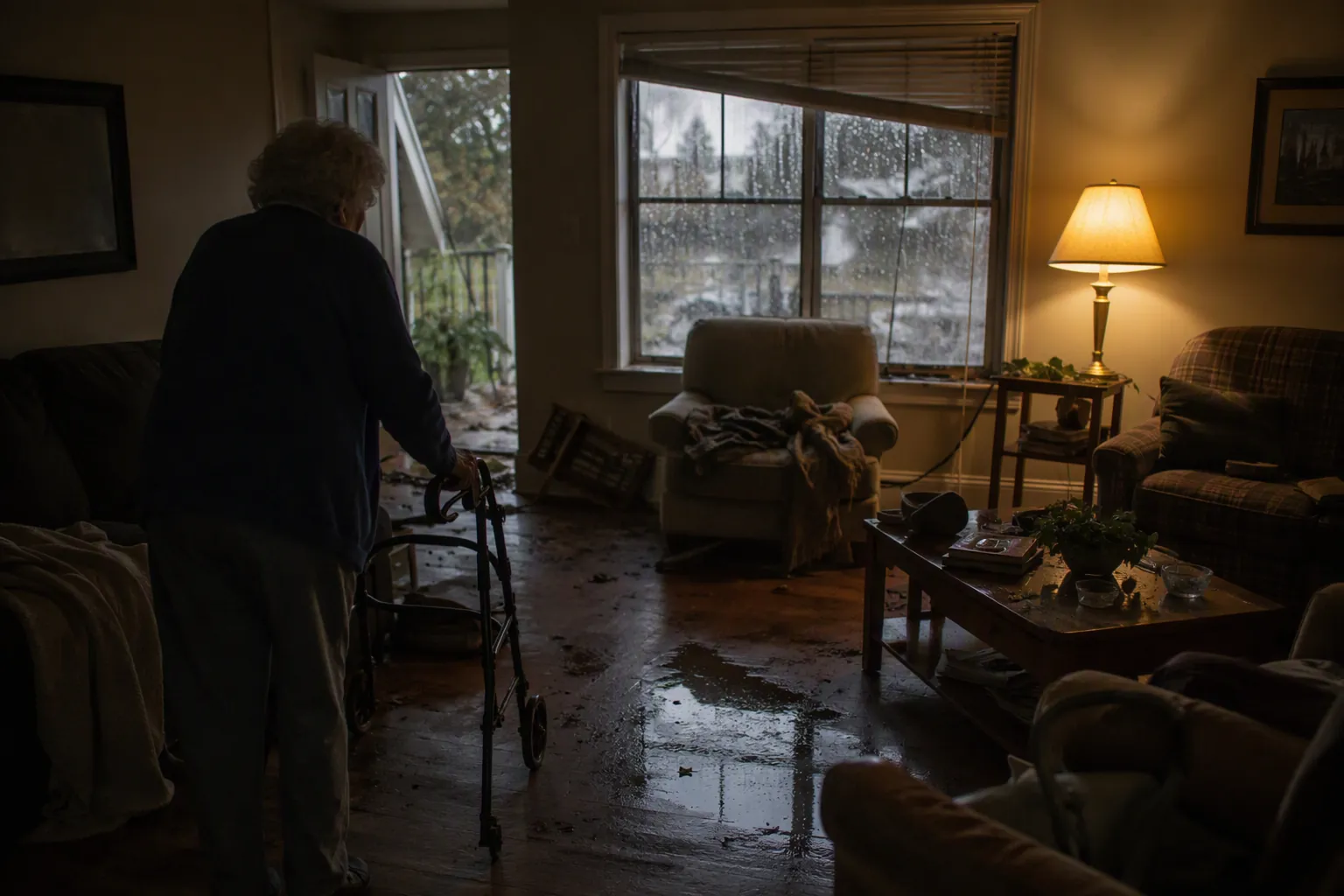
For an older adult living alone, the most dangerous part of a hurricane may begin after the wind quiets. The house is darker than usual. A towel is on the floor because water came in under the door. The walker is not where it was because a chair was moved away from a window. The phone is low on battery. The bathroom is still down the hall.
That is not just a worried caregiver’s imagination. In a federal analysis of hurricanes from 2005 through 2016, injury-related emergency department visits that resulted in hospital admission rose 53.2% for adults 65 and older living in a hurricane’s direct path during the week of landfall. Treat-and-release injury visits rose 48.2%, and those visits were still 16.5% above baseline one week after the storm.[1]
Those numbers do not predict what will happen in every storm or every county. They do say something practical: the aftermath is not a loose cleanup period. It is a fall-risk period, especially for someone who is moving around alone in a changed home.
A hurricane preparedness checklist for elderly living alone has to do more than count water bottles and batteries. Those supplies matter, but they do not keep someone from crossing a wet kitchen in socks, reaching for medication in the dark, or going outside alone to see whether the fence is down. The checklist has to protect the routes the person will actually walk.
Why Falls Belong in the Hurricane Plan
Falls are already common before a storm changes the house. The CDC reports that more than 1 in 4 older adults falls each year, and falling once doubles the chance of falling again.[2] A hurricane piles extra hazards onto that baseline: lower lighting, slick floors, displaced furniture, blocked doorways, missing handholds, interrupted routines, and slower help if a fall happens.
Deaths after major storms show another hard truth: older adults carry a disproportionate share of disaster harm. AARP’s disaster resilience toolkit notes that during Hurricane Katrina, people 75 and older made up 6% of New Orleans’ population but 50% of deaths. For Hurricane Ian in 2022, 61 of 87 identified fatalities were age 60 or older, including 18 people in their 80s and 5 in their 90s.[3] Those figures come from different disasters and reporting systems, so they should not be treated as interchangeable. They still point in the same direction: age, isolation, mobility limits, and storm disruption are a dangerous mix.
Ready.gov and the Red Cross both tell older adults to plan for medical needs, communication, evacuation, supplies, and support networks.[4][5] That advice is necessary. It is also incomplete if nobody asks whether the person can safely get from the recliner to the bathroom at 2 a.m. when the power is out.
The Checklist Starts With the Walking Paths
Before the storm, do not start with the garage. Start with the route from the bed to the bathroom, the chair to the kitchen, the chair to the medication, and the safest exit. Those are the paths that will be used when someone is tired, anxious, stiff, and possibly without power.
| Phase | Fall-safety job |
|---|---|
| Before the storm | Clear walking routes, place lighting and mobility aids, organize medication, assign check-ins, and decide when evacuation is safer than staying. |
| During the storm | Stay in the safest room, keep movement minimal, keep lights and assistive devices within reach, and use scheduled check-ins. |
| First hour after landfall | Do not inspect, clean, or cross dark rooms alone; re-light the route, check the floor, call in, and move only through verified paths. |
| Next day and week | Recheck hazards as cleanup begins, keep help scheduled, and treat fatigue and routine changes as fall risks. |
For a deeper room-by-room preparation list, CareWise Guide’s Fall Prevention Tips for Caregivers Before a Tropical Storm can sit beside this checklist. Here, the focus is the full hurricane sequence: what has to be true before the storm so the first post-storm hour does not become the first emergency.
Before the Storm: Set Up the House for a Bad Hour
The best fall-prevention work happens while the lights are on and nobody is rushing. This is not the time to rearrange a whole house. It is the time to make the important paths boringly clear.
Clear the Routes That Will Be Used Half-Asleep
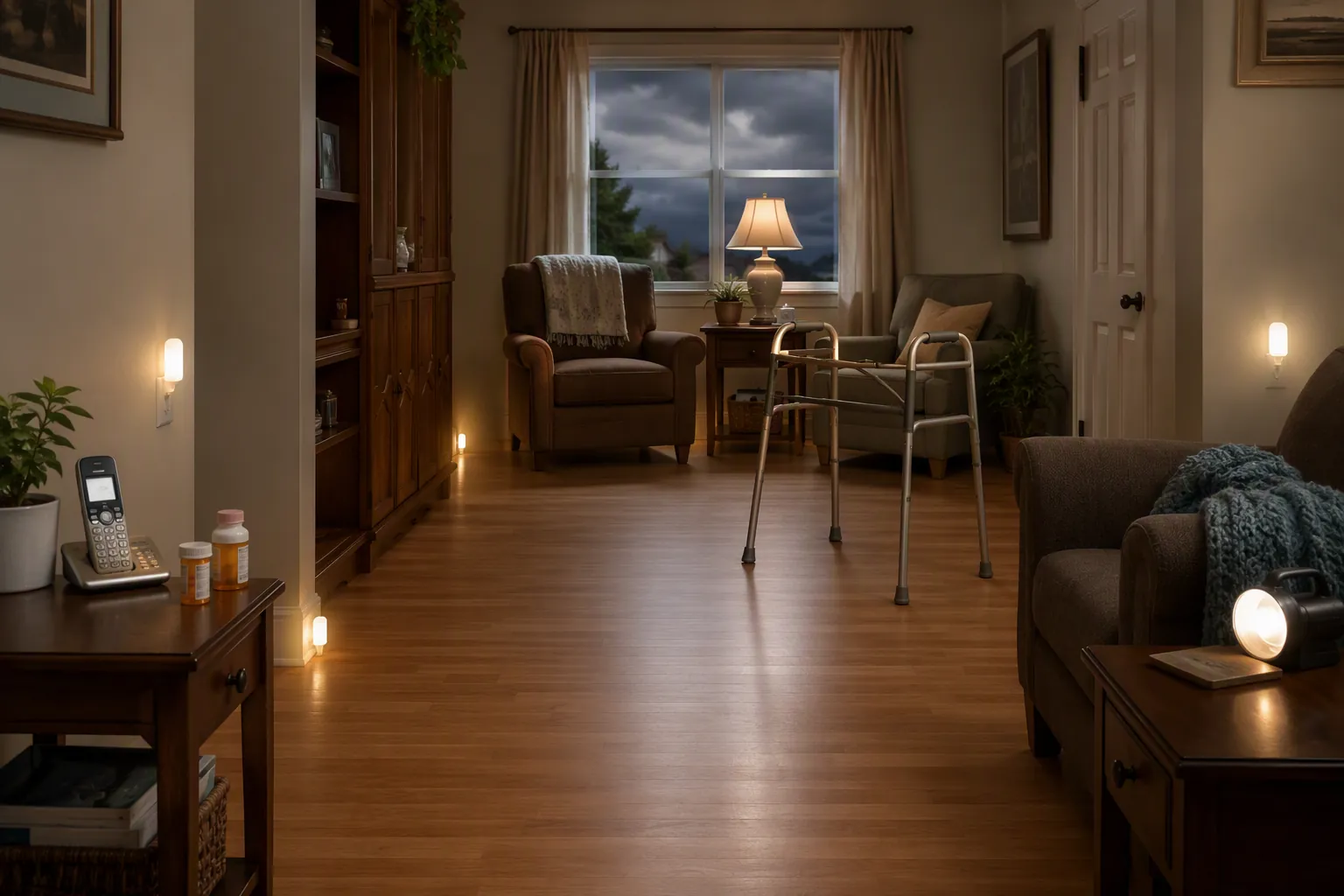
Walk the home as if the power is already out. From the main chair, go to the bathroom. From the bed, go to the bathroom. From the main chair, go to medication, water, phone charger, and the safest interior room. If a walker, cane, or rollator cannot pass without a hip turn or a sideways step, the path is not clear enough.
- Move loose rugs out of the main routes, not just flat against the floor.
- Push small tables, plant stands, baskets, and decorative items away from walking lanes.
- Tape down or reroute cords before chargers, lamps, radios, and medical devices multiply around the room.
- Leave doors either fully open or fully closed so they are not half-blocking a dark hallway.
- Put towels, buckets, and leak supplies where they can be reached without crossing a slippery area.
The small stuff matters because the home after landfall is not the tidy home someone remembers. One moved dining chair can trap a walker. One towel on tile can behave like a rug. One flashlight on the wrong side of the room might as well be outside.
Put Light Where the Hand Already Goes
Backup lighting should not be stored like camping gear. It should sit where the person’s hand naturally lands: bedside table, recliner table, bathroom counter, kitchen counter, and beside the mobility aid. If the person uses a walker, attach or place a small light so it can be reached before standing.
- Use battery nightlights or motion lights along the bed-to-bathroom route.
- Place flashlights at waist height or higher so nobody has to bend to the floor.
- Check that each flashlight turns on before the storm, not during the first outage.
- Keep one light with the phone and one with medication, because those are likely nighttime destinations.
A bright flashlight in a kitchen drawer is less useful than a modest light sitting beside the chair. The point is not having light somewhere in the house. The point is reaching it before the first step.
Park Mobility Aids Like They Are Emergency Equipment
Canes, walkers, rollators, shower chairs, grabbers, braces, and non-slip shoes should be treated as storm equipment. They do not belong behind a moved chair, in the car, or across the room from the bed.
- Place the main mobility aid within reach of the bed and main chair.
- Keep a backup cane or walker near the safest interior room if one is available.
- Set non-slip shoes beside the bed and chair; avoid walking in socks on damp floors.
- Keep a reacher or grabber nearby so dropped items do not require bending in the dark.
- If a walker has tennis balls, glides, brakes, or wheels, check them before the storm.
Make Medication Reachable Without a Search
Medication planning is usually discussed as a supply issue. For someone living alone, it is also a fall issue. Searching cabinets by flashlight, standing too long at a counter, or walking to another room because pills were left there can turn a medical routine into a mobility problem.
- Keep daily medications on a stable, uncluttered surface near water and a working light.
- Use a simple written medication list in large print, stored with the medications and go-bag.
- Avoid putting pills in a low cabinet, high shelf, or room that may be hard to reach during an outage.
- Keep glasses, hearing aids, and dentures in their normal nighttime location, not packed away too early.
If evacuation is possible or likely, pack medication and copies of key information in the go-bag. For a senior-specific packing list, including backup medical-device power and mobility tools, see What Seniors Must Pack in a Category 5 Hurricane Go-Bag.
Decide Beforehand What Requires Evacuation
A fall-safety checklist should not trap someone in a home that is unsafe for flooding, storm surge, medical needs, or power loss. Ready.gov advises older adults to make a plan that accounts for medical equipment, transportation, communication, emergency contacts, and local alerts.[4] The Red Cross also emphasizes planning around support networks, medical needs, and accessible emergency supplies.[5]
The decision should be made before the sky turns mean: if evacuation orders are issued, if the home is in a flood or surge zone, if oxygen or powered medical equipment cannot be supported, if the person cannot safely use the bathroom during an outage, or if there is no reliable check-in system, staying alone may not be the safer option.
What an Adult Child Can Verify From Far Away
Preparing from three states away is frustrating because the dangerous details are ordinary. A parent may honestly say, “I’m all set,” while the flashlight is in a drawer, the walker is behind a porch chair, and the bathroom path has a rug with a curled corner.
- Ask for a video walk-through from the bed to the bathroom, main chair to bathroom, main chair to medication, and main chair to safe room.
- Have the older adult point the camera at the floor, not just their face.
- Ask them to turn on each flashlight or battery light while you are on the call.
- Confirm the walker, cane, shoes, phone charger, medication, water, glasses, and hearing aids are reachable from seated positions.
- Write down the names and numbers of local neighbors, building staff, relatives, pharmacy, utility company, and non-emergency public safety line.
If the home has repeated hazards that cannot be solved by a quick storm setup, a broader home assessment may be needed. CareWise Guide’s 11 Red-Flag Signs Your Parent Needs a CAPS Specialist is useful when the same unsafe routes show up outside of storm season too.
A Check-In Plan Needs Names, Times, and Backups
“Someone will check on me” is not a plan. It is a hope with no clock attached.
In a national survey of adults age 50 and older, only 23.6% had a specific disaster response plan.[6] A 2024 Galveston County quality-improvement project found that only 33 of about 6,509 homebound adults age 65 and older were registered with Texas’s State of Texas Emergency Assistance Registry before the intervention, about 0.5%; the project itself involved a sample of 190 homebound seniors, so its results should not be treated as a national estimate.[7] The gap is still familiar: the people most likely to need help after landfall are often not formally connected to the systems meant to find them.
The Conversation’s 2026 guidance on hurricane planning with aging parents recommends a multiperson check-in system and notes that emergency plans often overlook elders living alone.[8] That is the right standard. One person may lose signal, evacuate, flood in, or assume someone else called.
- Primary caller: one named person who calls before the storm, during safe intervals, and after landfall.
- Backup caller: one named person who takes over if the primary caller cannot reach the older adult.
- Local eyes: a neighbor, building manager, nearby relative, faith-community contact, or home-care worker who may be able to check the property when it is safe.
- Escalation rule: a written decision about when missed contact leads to a welfare check or call to local non-emergency services.
- Registry step: if the county or state has an emergency assistance registry for older adults or people with access and functional needs, registration is assigned to a specific person before hurricane season.
The check-in script should include fall-safety questions, not just weather questions: Are you sitting down? Is your walker within reach? Do you have a light in your hand before standing? Is the bathroom path dry? Did anything fall or shift? Have you gone outside yet?
During the Storm: Keep the Safe Area From Becoming Cluttered
During the storm, the job is to reduce movement. The safest interior room is not safer if the floor fills with bags, cords, shoes, pets’ bowls, and loose blankets. Keep the room usable for the body that has to move through it.
- Stay in the chosen safe area unless there is a clear reason to move.
- Keep the phone, charger or power bank, flashlight, water, medication, glasses, hearing aids, and mobility aid within arm’s reach.
- Use shoes with grip if standing becomes necessary.
- Do not walk to windows, porches, garages, or yards to check sounds.
- Keep one clear path to the bathroom and one clear path to the safest exit.
- Follow scheduled check-ins when service is available, but conserve phone battery between calls.
If something leaks, falls, or breaks during the storm, the first question is not “Can I clean that now?” It is “Can I leave it alone without creating a bigger danger?” A wet towel can wait if stepping over it would be worse. Broken glass, water near electrical equipment, or blocked exits may need help, but that decision should be made seated, with light in hand, not while already halfway across the room.
The First Safe Hour After Landfall
The first hour after the worst wind passes is when many careful people get careless. They are relieved. They want to see what happened. They want to mop the water, move the branch, reset the breaker, open the freezer, call the neighbor, feed the cat, and prove they are fine.
For a senior living alone, the first job is not inspection. It is controlled movement.
- Stay seated for a moment. Put on glasses and hearing aids if they are used. Put on non-slip shoes before standing.
- Turn on a flashlight or battery light before taking a step. Do not walk into a dark room to find the light.
- Reach for the walker, cane, or rollator before standing. If it is not where it should be, call someone before trying to cross the room without it.
- Check the floor immediately around the chair or bed: water, cords, glass, fallen objects, shifted rugs, pet items, and towels.
- Make the first check-in call or text while seated. Say whether there is power, whether anything is blocking the path, and whether help is needed before moving around.
- Use only the pre-cleared route to the bathroom or medication. If that route is blocked, stop and call; do not improvise through debris.
This is where stubborn independence and good planning can work together. The person is not being told to sit helplessly. They are being asked to make the first moves in an order that does not turn a survivable storm into a hip fracture, head injury, or long wait on the floor.
Do Not Go Outside Alone to Inspect Damage
The yard after a hurricane is a trap for anyone with balance problems: uneven ground, wet steps, loose railings, broken branches, standing water, hidden debris, and poor lighting. Even the porch can change. A mat may be soaked. A screen door may drag. A handrail may be loose.
If damage has to be checked, ask for a neighbor, relative, building staff member, or emergency responder to look when conditions are safe. Photos can wait. Fence panels can wait. A branch can wait. The first outdoor inspection should not be a solo balance test.
Do Not Rush the Water Cleanup
Water on the floor feels urgent because it is visible and annoying. For someone at high fall risk, mopping can be more dangerous than the puddle if it means bending, twisting, carrying a bucket, or walking backward on tile.
- Mark the wet area with a towel only if the towel does not create a tripping edge.
- Close off the route if there is another safe path.
- Call the check-in person and describe where the water is.
- Wait for help if cleanup requires bending, lifting, wringing, or crossing the wet area repeatedly.
A damp floor near the bathroom or kitchen deserves special caution because those are not optional rooms. If the route to either one is unsafe, the check-in plan should move from casual contact to active help.
Treat the Familiar Hallway as Unfamiliar
After landfall, memory is not enough. The hallway that was clear yesterday may have a picture frame on the floor, a rug corner lifted by moisture, a charger cord stretched to a power bank, or a laundry basket moved out of a leaking room.
Before each necessary trip, light the full path as much as possible. Move slowly enough to see the floor. If the light does not reach the turn, stop before the turn. If a handrail, wall, or furniture edge is normally used for balance, check that it is still stable before leaning on it.
The Next Day: Cleanup Changes the Fall Risk Again
The day after a storm can be riskier than it looks because people begin fixing things. Furniture moves. Extension cords appear. Coolers sit in walking paths. Neighbors knock. Insurance photos need taking. The older adult may be tired from poor sleep, heat, noise, worry, or missed routines.
This is the time for a second pass through the home, not a full cleanup campaign. The person who lives there, the local helper, or the adult child on video call should look again at the same routes: bed to bathroom, chair to bathroom, chair to medication, chair to kitchen, chair to exit.
- Remove new clutter created by cleanup: towels, cords, buckets, boxes, fans, tarps, and tools.
- Put the walker or cane back in its normal reachable place after anyone moves furniture.
- Keep medication, water, phone, and lights in the same locations each day until power and routines return.
- Schedule help for outdoor tasks, freezer cleanup, branch removal, trash hauling, and breaker checks.
- Ask directly about dizziness, weakness, missed meals, missed medication, or near-falls.
Near-falls count. Grabbing a counter, stumbling over a cord, sitting down suddenly, or deciding not to go to the bathroom because the path feels unsafe all mean the plan needs to change. Waiting for an actual fall is poor storm management.
What Belongs in the Go-Bag for Fall Safety
A go-bag is usually described as what someone needs if they leave. For an older adult living alone, some of it also supports safer movement whether they evacuate or shelter in place.
- Small flashlight or headlamp with batteries, packed where it can be reached without unpacking the whole bag.
- Medication list, emergency contacts, pharmacy information, and key medical conditions in large print.
- Non-slip socks or shoes, with shoes preferred for wet floors and evacuation settings.
- Backup glasses, hearing-aid batteries or charger, and any brace or support normally used for walking.
- Portable phone charger or power bank, especially if the phone is the only way to call after a fall.
- A whistle or simple alert device if calling loudly may be difficult.
Documents, water, food, radio, cash, and hygiene supplies still matter. They belong in the larger hurricane plan. Here, the test is narrower: if the bag is needed at night, in a shelter, or during an outage, can the person see, stand, walk, communicate, and take medication without digging through a dark pile of supplies?
For Older Adults Who Refuse to Be Fussed Over
Many older adults do not want a hurricane plan that makes them feel managed. Fair enough. A good fall-safety plan should not require surrendering independence. It should protect the ordinary movements that make independence possible.
There is nothing childish about putting a flashlight next to the chair. There is nothing dramatic about asking a neighbor to check the porch before stepping onto it. There is nothing helpless about saying, “I am not crossing that wet floor until someone helps me move the rug.” Those are adult decisions made under bad conditions.
For families building disaster plans across different hazards, the same principle applies beyond hurricanes. CareWise Guide’s Complete Tornado Safety Guide for Seniors Living Alone uses a similar lens for a different kind of emergency: the plan has to match how a person actually moves when time, light, and help are limited.
The Short Version Worth Posting on the Fridge
A full plan can live in a folder. The part that gets used during an outage should be short enough to read tired.
- Before the storm, clear the bed-to-bathroom, chair-to-bathroom, chair-to-medication, and chair-to-safe-room paths.
- Put lights, phone, charger, medication, water, glasses, hearing aids, shoes, and mobility aid within reach.
- Assign check-in people by name, time, and backup plan.
- During the storm, stay put unless moving is necessary, and keep the safe area uncluttered.
- After landfall, turn on a light before standing, put on shoes, use the mobility aid, and call in before inspecting or cleaning.
- Do not go outside, cross wet floors, step over debris, or enter dark rooms alone.
- Recheck the routes every day until power, furniture, lighting, and routines are back to normal.
A hurricane checklist for an older adult living alone is incomplete unless it protects the walk to the bathroom, the path to medication, the reach for a flashlight, the first look outside, and the first call for help after the storm.
References
- HCUP Statistical Brief #267, AHRQ.
- CDC Falls Facts, CDC.
- AARP Disaster Resilience Tool Kit, AARP.
- Ready.gov Older Adults, Ready.gov.
- Red Cross Older Adults guide, American Red Cross.
- Al-Rousan et al. national survey, American Journal of Public Health, 2015.
- Galveston County PMC study, 2024.
- 5 tips for hurricane disaster planning with aging parents, starting now before the storms, The Conversation, 2026.
Related reading
Noticed something outdated or inaccurate on this page? Flag a correction. We review every report against CDC, NIA, and AARP HomeFit guidance before updating a page.
Part of the Fall Prevention section.