
STEADI: intervene
Earthquake Safety Tips for Seniors Living Alone
This guide walks seniors living alone through the critical hours after an earthquake stops shaking, when broken glass, darkness, and displaced furniture create new fall hazards. Learn an immediate after-shaking protocol and a room-by-room hazard sweep to prevent secondary injuries.
When the shaking stops, the first earthquake safety tip for an elderly person living alone is not to get up. Stay where you are for 60 seconds so loose debris can finish falling and the room can settle around you.[1] That minute can feel too long, especially if glass broke or the power went out, but standing too soon is how a survivable earthquake turns into a fall.
Use that minute on purpose. Keep one hand on something solid if you can. Notice pain before you move. Notice dizziness before you stand into it. If you use a cane, walker, or wheelchair, do not assume it is still where it was before the quake. It may have rolled, tipped, or been pushed behind a chair. Your first job is to become safe enough to move, not to inspect the house.
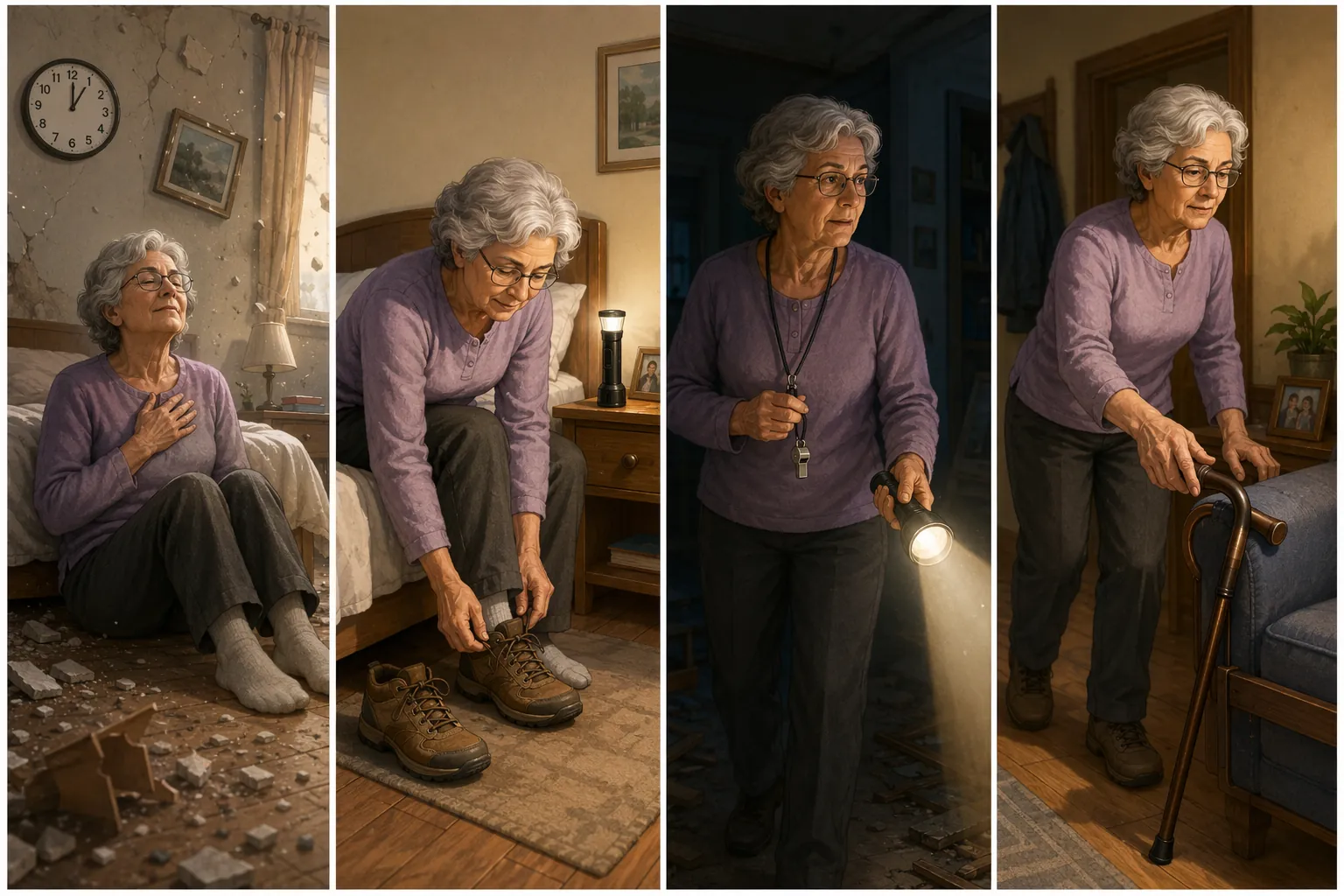
The first five minutes after the shaking stops
Falls are already common before a disaster enters the room. The CDC reports that 1 in 4 older adults falls each year, about 3 million older adults are treated in emergency departments for falls annually, and more than 38,000 older adults died from falls in 2021.[2] An earthquake does not create a new weakness in the body; it changes the floor, the light, the furniture, and the route to the phone.
For a senior living alone, the safest first sequence is short enough to rehearse and specific enough to use in the dark.
| Order | Action | Why it matters |
|---|---|---|
| 1 | Wait 60 seconds before moving. | Debris, glass, ceiling material, and unsecured objects may still be falling. |
| 2 | Check your body before you check the house. | Pain, dizziness, numbness, or confusion changes whether standing is safe. |
| 3 | Put on sturdy closed-toe shoes before stepping. | Broken glass and ceramic can be invisible in dim light. |
| 4 | Reach for flashlight, whistle, and glasses if they are within arm's reach. | Light and signaling reduce the need to walk before you are ready. |
| 5 | Locate your cane, walker, or wheelchair before standing. | A displaced mobility aid can turn the first step into the first fall. |
| 6 | Move only to a safer seated position unless there is an immediate danger. | A chair, bed edge, or stable wall gives you time to reassess. |
The body check comes before the room check. Move your ankles. Wiggle your fingers. Turn your head slowly. If you feel sharp pain, chest pain, severe shortness of breath, new weakness, heavy bleeding, or confusion, use the whistle, phone, medical alert device, or prearranged signal instead of trying to walk through damage. This article is about preventing falls after a quake; it is not a substitute for emergency medical care.
Shoes are not a comfort item here. They are floor protection. A senior who keeps slippers by the bed may still need a second pair of sturdy, closed-toe, non-slip shoes within reach because broken glass behaves differently from a normal nighttime trip to the bathroom. If the quake happens while you are barefoot, do not take one careful step to find shoes across the room. Use a flashlight first. If shoes are not reachable, stay seated and signal.
If you use a walker, do not lean forward into the dark to find it. Sweep with the flashlight. Call out if a neighbor may hear you. If the walker is tipped over and you cannot safely right it from a seated position, that is a reason to wait for help, not a reason to furniture-walk across a room that may be covered in debris.
Aftershocks belong in this first-minute plan, too. If shaking starts again, return to drop, cover, and hold on as best you can from your current position. If you are seated, lock the brakes on a wheelchair or rollator if you can do so safely, cover your head and neck, and hold on to a stable object. The goal is not elegant movement; it is staying off the floor.
Do not turn the house inspection into a walking tour
Older adults have been disproportionately harmed in major earthquakes. After the 1995 Kobe earthquake, more than half of fatalities were people over 60.[3] That does not mean every older adult is helpless after shaking. It means the plan has to respect slower balance reactions, poor night vision, hearing changes, mobility devices, medications, and the ordinary fact that a familiar room can become unfamiliar in seconds.
According to EarthquakeCountry.org, citing a UCLA study of the 1994 Northridge earthquake, 55% of earthquake-related injuries were caused by falling furniture and objects.[4] That statistic is usually used to argue for anchoring furniture before an earthquake, and it should be. After the earthquake, it also tells you where not to walk without thinking: near bookcases, televisions, cabinets, lamps, mirrors, hanging plants, and shelves that may still be unstable.
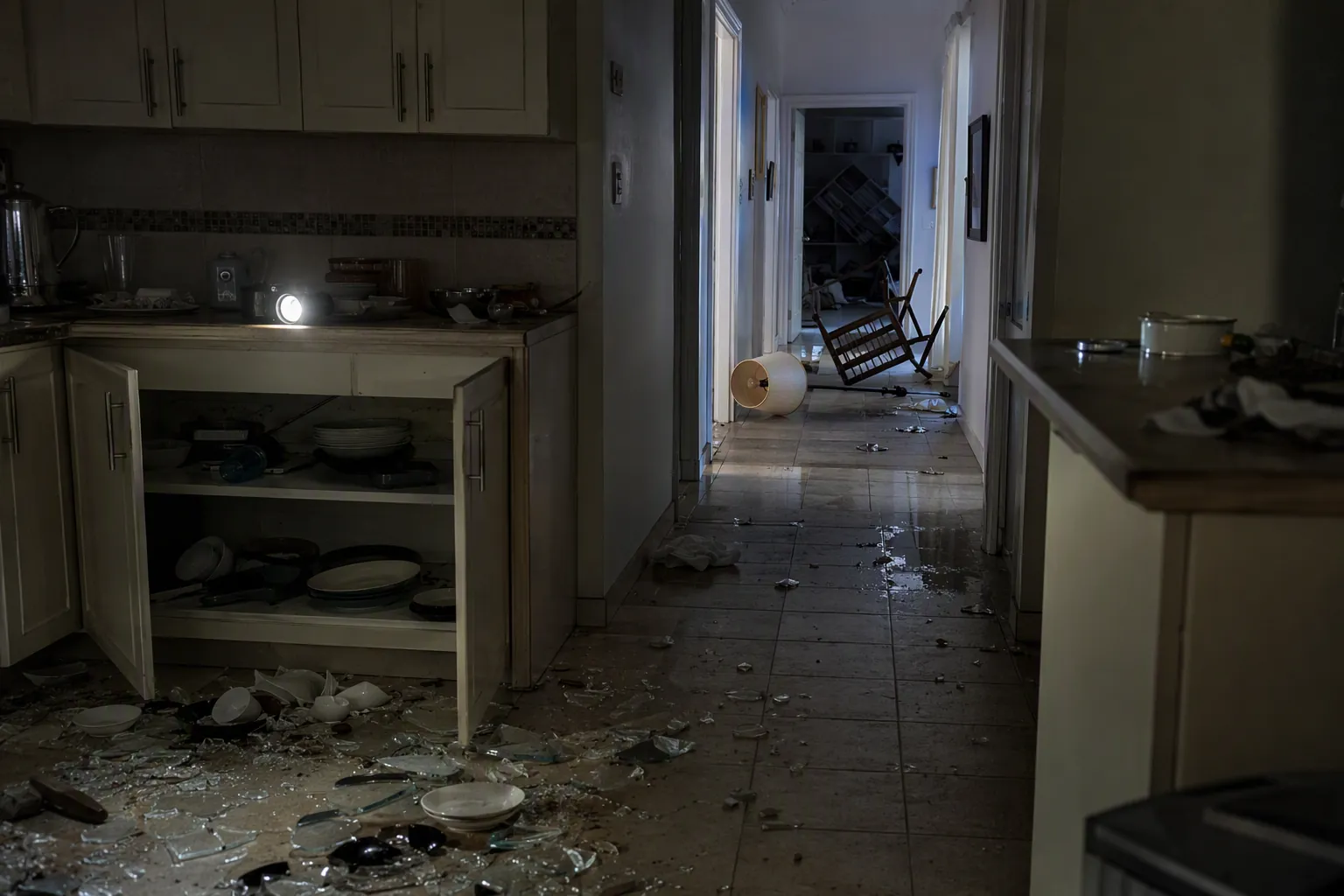
The right inspection is not room by room in the real-estate sense. It is path by path. A senior living alone needs to know whether there is one safe route to a seated place, one safe route to the phone or charger, one safe route to the bathroom if needed, and one safe route out if the home becomes unsafe. Everything else can wait.
Kitchen and bathroom: assume glass until proven otherwise
The kitchen and bathroom are the two rooms where seniors often underestimate the floor. Dishes, spice jars, light bulbs, mirror glass, shower doors, medicine bottles, and tile fragments can scatter farther than they look from a doorway. A flashlight held low can catch the shine of glass better than overhead light, if the power is still on.
If there is visible glass, do not sweep it in socks, slippers, or bare feet. Put on sturdy shoes and work gloves first. If you cannot do that safely, close the door if possible, mark the area with a towel or chair from a safe position, and use another route. Cleaning can wait for someone with gloves, shoes, light, and balance.
Hallways and familiar paths: look for what moved
Many post-quake falls will not happen because the senior took a reckless route. They will happen because the usual route changed. The floor lamp is down. The side table moved two feet. A drawer opened into the walkway. Books spilled where a walker normally turns. A cane that always leans against the recliner is now under the chair.
Use the flashlight before each change in direction. Do not step over cords, books, or small furniture with a walker. Do not move a heavy bookcase or cabinet by yourself to open a path. If a familiar path is blocked, sit down and make the communication plan do its job.
Darkness and wet floors: treat them as separate hazards
Power loss removes the visual cues many older adults use for balance: door frames, rug edges, thresholds, furniture outlines. A bright flashlight with fresh batteries is not just for finding supplies; it is a fall-prevention tool. If the home has automatic security lights or plug-in lights that turn on during power loss, they are useful because they reduce the number of dark steps between the bed, bathroom, and exit route.[5]
Wet floors need the same respect as glass. A burst pipe, spilled water storage container, toppled vase, or leaking refrigerator can make tile and vinyl slick enough to defeat good shoes. If you see shine on the floor, stop. Test with the end of a cane only if you are already stable. Do not carry towels across a slick room to fix the problem unless you have a safe handhold and a clear route.
The emergency kit items that matter in this moment
A large emergency kit in a closet is helpful only if the senior can reach it after the quake. For fall prevention, the most important supplies are the ones that make the first movement safer.
- Sturdy closed-toe shoes with non-slip soles beside the bed, not across the room.
- A heavy-duty flashlight within reach of the bed and the usual daytime chair, with fresh batteries.
- Work gloves near the flashlight, so broken glass and sharp debris are not handled barehanded.
- A whistle on the nightstand, walker, wheelchair, or lanyard for signaling when shouting is not enough.
- A backup cane, walker, or reacher placed where it will not be buried by a bookcase, cabinet, or loose storage.
- A laminated contact card in more than one room, because the phone may not be in the room where the senior ends up.
California Department of Aging disaster tip sheets recommend keeping sturdy shoes and a whistle next to the bed and identifying two people who will check on you after a disaster.[5] Those are not decorative preparedness habits. They answer the exact questions that come after shaking: Can I step? Can I signal? Who is supposed to notice if I do not answer?
For a fuller supply list, a separate earthquake kit plan can cover water, medications, documents, food, radio, and batteries. In this after-shaking plan, keep the focus narrower: light, footwear, hand protection, signaling, and mobility support.
Communication is fall detection
A senior who falls after a quake may not be able to crawl to the phone, and phone or internet service may be unreliable. Ready.gov's older adult preparedness guidance emphasizes building a support network and planning for communication needs before disasters occur.[6] For someone living alone, that support network should not be vague goodwill. It should have names, timing, and a backup signal.
- Choose two check-in people, not one. One may be out of town, injured, asleep, unreachable, or dealing with their own damage.
- Set a check-in window. For example, the first person calls or comes by after strong shaking when it is safe to do so; the second follows if there is no contact.
- Use a neighbor signal that does not require walking to the front door, such as a certain curtain position, porch light, or sign in a window.
- Place laminated contact cards by the bed, the usual chair, the refrigerator, and the main exit route.
- If using an emergency check-in app or medical alert system, choose one the senior has practiced with, and do not make it the only plan.
The neighbor signal needs a sentence attached to it: “If this curtain is still closed after a quake and I have not answered, please knock and call my daughter.” Without that agreement, a closed curtain is just a closed curtain. Adult children often buy devices because devices feel decisive. The harder and more useful task is getting two humans to know what silence means.
A laminated card should include the senior's name, emergency contacts, medication allergies, mobility needs, preferred hospital if relevant, veterinarian or pet contact if needed, and the location of spare keys or lockbox instructions if the senior has chosen to share that information. Keep the print large enough to read without glasses if possible.
What adult children can rehearse without taking over
The most respectful way to help an older parent is to rehearse the sequence with them in their own home. Do not begin with a lecture about risk. Begin in the chair where they watch television or beside the bed where they would wake at night. Ask them to show you, without rushing, where their shoes are, where the flashlight is, how they would reach the whistle, and what they would hold before standing.
Then turn off the lights for a short practice if they agree. That one step reveals more than a checklist. The flashlight may be too far from the bed. The cane may lean where a nightstand could block it. The walker may be parked in a spot that works on an ordinary day but would trap the person if a lamp fell. A parent who resists “preparedness” may accept moving a pair of shoes when the reason is immediate and visible.
Keep the rehearsal brief enough that it can be repeated. The point is not to perform independence for the adult child. The point is to make the first five minutes familiar before the room is dark, noisy, and changed.
Pre-quake changes that prevent post-quake falls
Furniture anchoring, pathway clearance, bed placement, and automatic lighting can sound like general earthquake chores until you picture the person standing up after midnight with no power. Then they become fall-prevention work.
- Anchor bookcases, televisions, tall cabinets, and heavy furniture so they are less likely to fall into walking paths.
- Move the bed away from windows, heavy mirrors, shelves, and objects that could fall onto the bed or block the exit side.
- Keep the path from bed to bathroom, bed to exit, and favorite chair to phone free of cords, small tables, stacked boxes, and loose rugs.
- Use cabinet latches where dishes, glassware, or heavy items could spill into the kitchen path.
- Add automatic lights or battery-powered motion lights along the bedroom, bathroom, hallway, and exit route.
- Store the backup walking aid in a protected place, not beside tall furniture that may fall over it.
Ready.gov advises people who use canes, walkers, or wheelchairs to adapt protective actions to their mobility needs during earthquakes.[7] That adaptation should continue after the shaking. A walker user needs wider cleared turns. A cane user needs a cane that is still reachable. A wheelchair user needs brakes, transfer surfaces, and paths that are not blocked by furniture.
The room-by-room work can be handled in a dedicated pre-earthquake checklist, and a power-outage plan can go deeper on lighting and medical devices. For this article's purpose, the test is simple: if the object fell, slid, opened, shattered, or went dark, would it make the senior take an unsafe step?
When staying put is no longer the safe plan
In-place fall prevention only applies if the home is safe enough to remain in. If there is a gas smell, fire, smoke, major structural damage, a wall or ceiling failure, floodwater, exposed electrical hazards, or official evacuation instruction, the problem has changed. The priority is getting emergency help and leaving by the safest available route if evacuation is possible.
Do not use matches, candles, or switches if gas is suspected. Do not move through heavy debris to “make sure everything is okay.” Do not send an older adult into a damaged stairwell alone if there is another option. If evacuation leads to a shelter, fall prevention continues there, but the hazards are different: unfamiliar bathrooms, crowded aisles, cots, cords, and poor sleep.
If the home is stable enough to remain in, the safest senior after an earthquake is not the one who moves fastest. It is the one who waits, checks their body, puts on shoes, finds light, locates the mobility aid, signals early, and moves only along a route they have already practiced.
References
- Earthquake Safety Guidelines, CDC
- CDC Falls Facts, CDC, January 2026
- Kobe earthquake fatality study, PubMed
- Step 1: Secure Your Space, EarthquakeCountry.org
- Disaster Tip Sheets, California Department of Aging
- Older Adults, Ready.gov, March 2026
- Earthquakes, Ready.gov
Related reading
Noticed something outdated or inaccurate on this page? Flag a correction. We review every report against CDC, NIA, and AARP HomeFit guidance before updating a page.
Part of the Fall Prevention section.