
STEADI: Intervene
Earthquake Evacuation Safety Checklist for Elderly Parents
After an earthquake, moving an older adult through debris and stairs can create new fall risks. This checklist helps you decide whether your elderly parent should shelter in place or evacuate, and what to arrange in advance so either choice is safe.
The stay-or-go checklist, immediately after the shaking stops
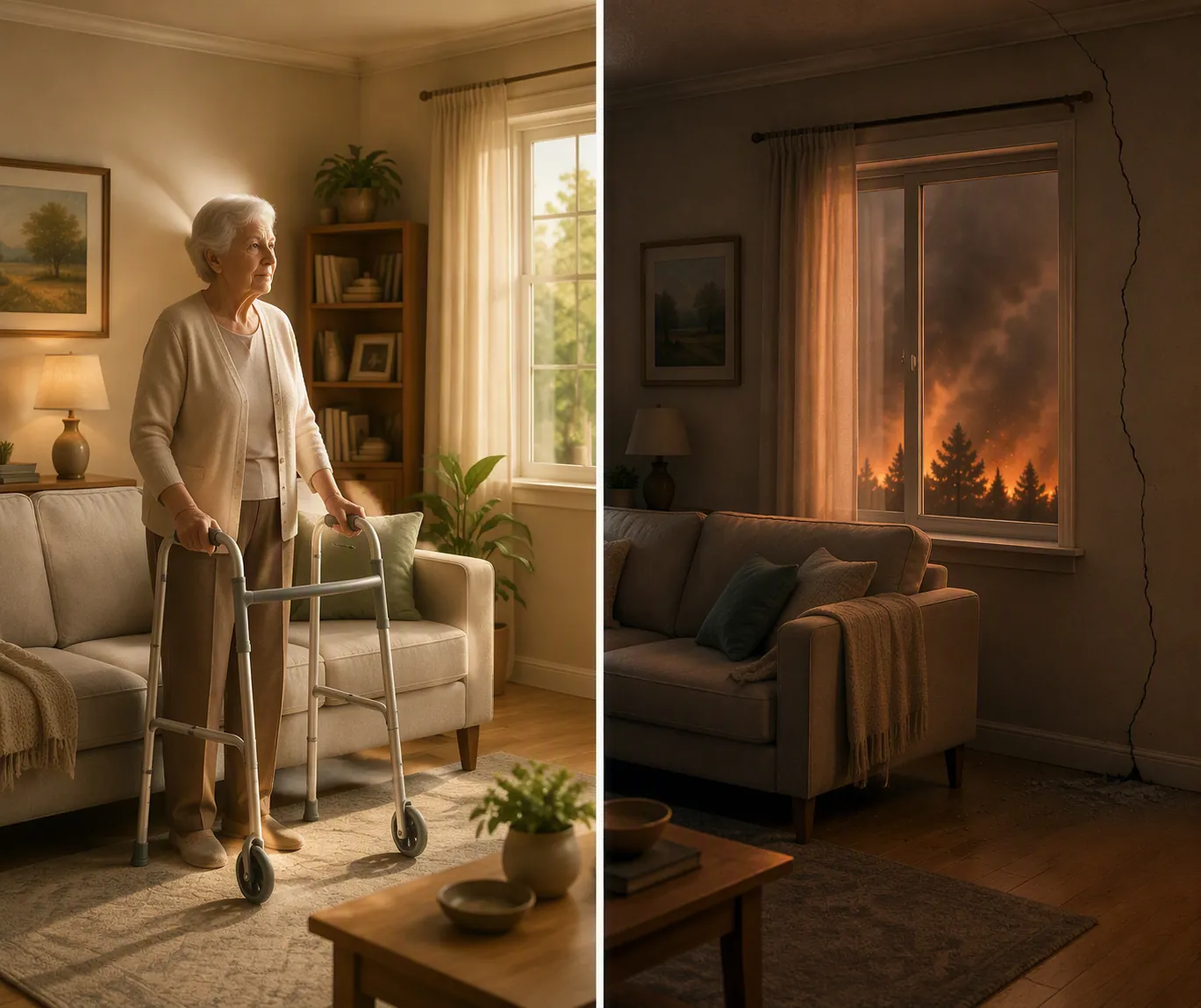
The earthquake is over. Your parent is upright, scared, and standing beside a walker in a room that may have broken glass, shifted furniture, and another aftershock coming. The first decision is not “How fast can we get Mom out?” It is: “Is moving her through this damaged space safer than keeping her where she is while we assess?”
Use this earthquake evacuation safety checklist for elderly parents before anyone starts steering a walker toward the door. If there is no fire or smoke, no gas smell, no visible structural damage that makes the room or building unsafe, and no tsunami evacuation order for the area, the safer default for a parent at fall risk is to stay put long enough to check for injuries and hazards. Ready.gov’s post-earthquake guidance includes expecting aftershocks, checking for gas or water leaks and downed power lines, and using text messages when voice calls fail; those checks should happen before a fall-risk parent is moved through debris unless immediate danger forces the move [1].
| What you see, smell, or are told | Default decision | What the caregiver or helper does |
|---|---|---|
| Fire, smoke, or active burning in the home | Evacuate if there is a usable route | Use the preplanned exit route, bring the mobility aid, and call emergency services when safe. |
| Gas smell, suspected gas leak, or damaged utilities | Leave the immediate area if it can be done without creating a greater fall danger | Do not send a parent alone across glass, stairs, or rubble. A helper should guide the exit and avoid damaged utility areas. Ready.gov specifically names leaking gas and water and downed power lines as post-quake hazards to check [1]. |
| Visible structural damage: major wall cracks, leaning walls, sagging ceiling, shifted foundation, jammed doors with new damage | Evacuate or move to a safer nearby location if staying in that spot is unsafe | Keep the parent away from unstable areas. If stairs or hallways are blocked, call for help rather than forcing a risky descent. |
| Tsunami evacuation order or official instruction to leave the zone | Evacuate | Follow official instructions. The fall risk still matters, but it does not cancel an evacuation order. |
| No immediate danger inside, but glass, books, pictures, or small debris are on the floor | Stay put and assess first | Clear a short path only if movement is necessary. Put shoes on the parent before any steps. Keep the walker, cane, or wheelchair within reach. |
| Parent is hurt, dizzy, pinned, or unable to stand safely | Do not improvise an evacuation unless the room itself is dangerous | Call emergency services, text the support network, and keep the parent still unless fire, smoke, gas, collapse risk, or an official order changes the balance. |
The American Red Cross frames emergency planning for older adults as a decision made in advance: plan either to stay home for at least two weeks or to evacuate, identify who will help with evacuation, and know two ways out of every room [2]. That matters because the minutes after a quake are a bad time to discover that the walker cannot pass the bookcase that just shifted, or that the only person with a car is across town.
For securing furniture, packing supplies, and adapting Drop-Cover-Hold-On for a cane, walker, or wheelchair, use the Earthquake Preparedness Checklist for Seniors. The question here is narrower and more urgent: after the shaking stops, should this parent move at all?
A safer post-quake sequence: pause, check, then decide
A frightened adult child may want the parent outside immediately. That fear is understandable. A damaged house feels untrustworthy. But a hallway after an earthquake is not the same hallway it was ten minutes earlier. A parent who normally walks slowly on a clear floor may now be asked to step over glass, around a fallen lamp, through a dark doorway, and down stairs while helpers are rushing.
Start with stillness, not delay. Tell the parent to stay where they are unless the room is unsafe. Expect aftershocks. A second jolt can knock over someone who has just stood up, especially if they are reaching for a cane, pushing a walker, or transferring from a chair [1].
- Check the parent before the room. Ask if they hit their head, feel chest pain, feel dizzy, have new hip or back pain, or cannot bear weight. If you are on the phone, ask them to stay seated while they answer. Pain and dizziness change the plan.
- Check the room from where they are. Look for smoke, sparks, fire, ceiling damage, broken glass, tipped furniture, spilled liquids, and blocked exits. Smell for gas. Do not ask a parent in slippers to “just go look.”
- Check utilities and outside hazards without sending the parent into them. Ready.gov names leaking gas or water and downed power lines as hazards to watch for after an earthquake [1]. If power lines are down outside, the front yard is not automatically safer than the living room.
- Use text if calls fail. Voice networks may be congested after a disaster; Ready.gov advises texting instead of calling when possible [1]. A distance caregiver should have a short text script ready: “Are you hurt? Fire/smoke/gas? Stay seated. I’m calling Maria next door.”
- If the parent is trapped, conserve movement. Ready.gov advises texting or banging on a pipe or wall, and using a whistle if trapped [1]. A whistle is not a decoration in the emergency kit; it is for the parent who cannot shout long enough to be found.
The decision should be made from the parent’s position in the room, not from a caregiver’s panic at a distance. If the parent is safe on a sofa, wearing sturdy shoes, with a walker beside them, a flashlight within reach, and no immediate danger present, that may be the safest place for the next few minutes. If the room has smoke, gas smell, or collapse signs, then staying has become the greater danger.
When evacuation is necessary, the exit has to be treated as a fall hazard
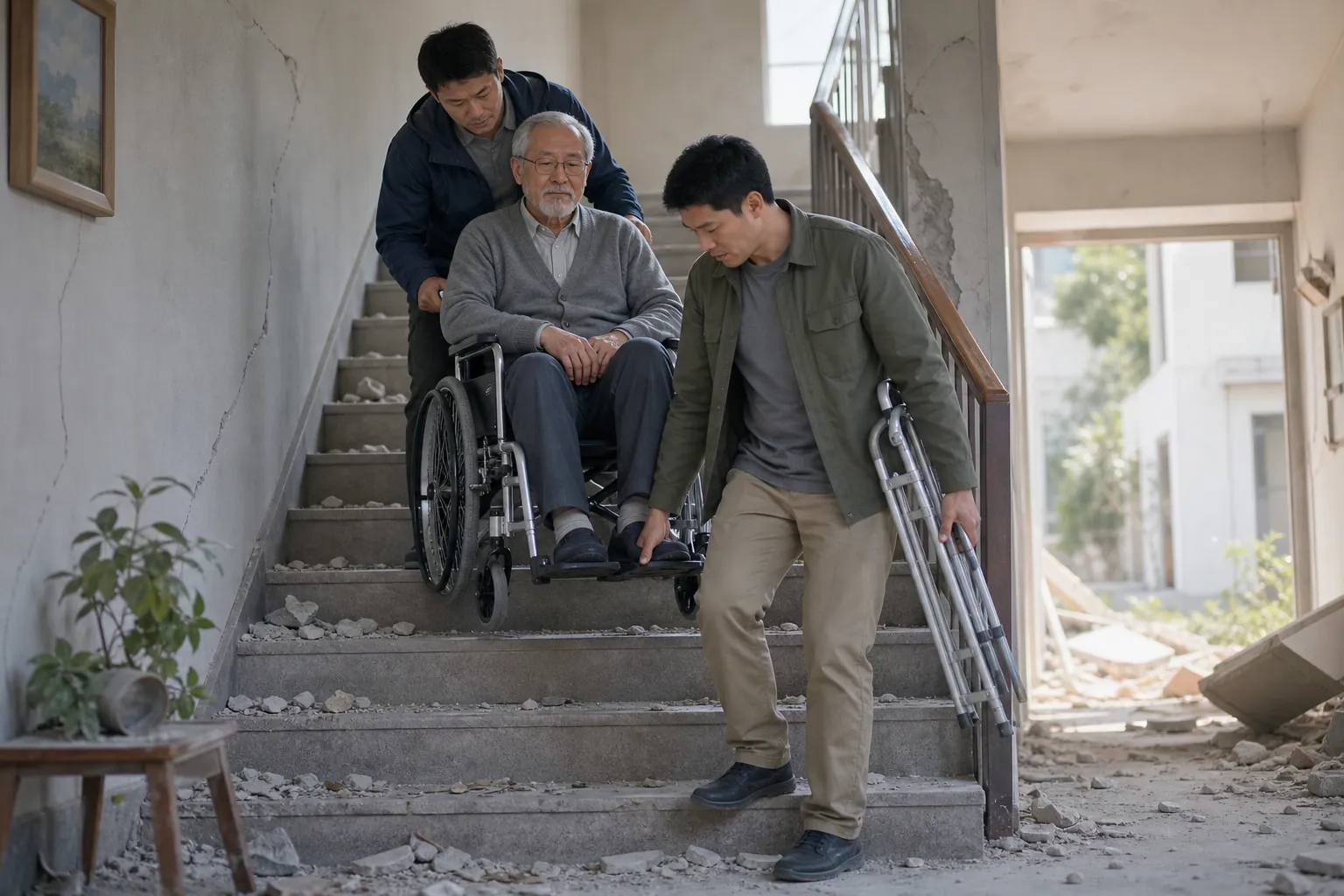
Evacuation is not just “leaving.” For an older adult with limited mobility, evacuation is a sequence of transfers, thresholds, turns, surfaces, and decisions. The cracked threshold matters. The missing cane matters. The helper who grabs under the armpits and pulls too fast matters.
A safe exit begins before the quake. The Red Cross advises older adults to plan who will help them evacuate and to identify two ways out of every room [2]. That cannot remain a line in a notebook. The helper needs to know which door fits the walker, where the wheelchair footrests are, whether the porch has a step, and where the parent keeps shoes.
Assign the helper before you need the helper
For a parent who lives alone, “someone will check” is not a plan. Name the first checker and the backup checker. Give both people permission to enter if the parent cannot reach the door. Make sure they know whether the parent uses a walker, cane, wheelchair, oxygen equipment, hearing aids, or a medical alert device.
California Department of Aging disaster tip sheets, offered as regional guidance rather than national law, recommend designating two people to check on an older adult after an earthquake, keeping walking aids near the person at all times, placing extra walking aids in different rooms, keeping a whistle available, and using battery security lights in each room that can last four to six hours [3]. Those are small arrangements until the floor is covered with glass and the lights are out.
Bring the mobility aid, even if it slows the exit
If evacuation is triggered, the walker, wheelchair, or cane goes too unless there is an immediate life threat that makes carrying it impossible. A caregiver-practice article from Midnight Sun Home Care makes the point plainly: if a person with limited mobility is safe where they are, staying put may be safer than moving; if they must move, bring the walker, wheelchair, or cane because it cannot be easily replaced after the disaster [4]. This is not official policy, but it is the kind of practical detail that prevents a second emergency outside the house.
A parent who uses a walker indoors may not be able to cross gravel, broken pavement, wet grass, or a curb without help. A wheelchair user may need more than one helper on stairs; Midnight Sun’s reduced-mobility guidance describes two-person assistance for moving a wheelchair user [4]. If only one neighbor is available and the stairs are dusty, narrow, or cracked, the safer move may be to relocate the parent to a safer part of the same floor while calling for trained help—unless fire, smoke, gas, structural danger, or an evacuation order removes that option.
Test the route like the walker is actually there
Do not test an exit route with an able-bodied adult walking empty-handed. Test it with the walker opened. Test it with the wheelchair turning through the hallway. Test it with the porch light off. Test whether the parent can step over the threshold in shoes, not slippers. If a helper would need to move a plant stand, unlock a side gate, or lift the walker over a cracked entry, that belongs in the written plan.
The same route-testing habit appears in wildfire planning for seniors at fall risk, but the default decision differs by hazard. In a wildfire evacuation plan for seniors at fall risk, leaving early can keep smoke, road closures, and panic from trapping the parent. After an earthquake, the danger may be created by the exit itself, so the default is to stay unless immediate danger makes staying unsafe.
Transportation and contacts should not depend on memory
Family Caregiver Alliance’s emergency preparedness checklist for caregivers includes transportation planning, knowing shut-off valves, and identifying an out-of-area contact [5]. For an elderly parent after an earthquake, put that into plain household terms: who drives, whose car can take the walker or wheelchair, where the parent will go, who receives the first text, and who calls if the local caregiver cannot get through.
- Write the first helper’s name and number.
- Write the backup helper’s name and number.
- Write the out-of-area contact’s name and number.
- Name the evacuation destination: relative’s home, accessible hotel, community shelter, or another agreed location.
- Note whether the vehicle must fit a folded walker, wheelchair, oxygen equipment, or service animal.
- Keep a paper copy where the parent, neighbor, and distance caregiver can all find it.
Do not import the wildfire rule into an earthquake
If your family has already built a senior wildfire evacuation checklist or set an elderly parent’s wildfire evacuation trigger, keep that work—but do not copy the wildfire rule onto earthquakes.
Wildfire planning often favors leaving early, before smoke thickens, roads close, and evacuation traffic slows. Post-earthquake planning often favors staying in place unless the building or surrounding hazard has become dangerous. The difference is not philosophical. It is physical. In wildfire, the home may become more dangerous as conditions move toward it. After an earthquake, the path out of the home may already be dangerous under the parent’s feet.
That does not mean ignoring evacuation orders or staying in a damaged building. It means the family rule has to name the triggers. “Evacuate if needed” is too soft. “Stay seated unless there is fire, smoke, gas smell, visible structural danger, or an official evacuation order; if one is present, Maria comes through the side door with the walker and texts Daniel” is the kind of instruction a frightened household can use.
Why written planning matters more for parents who live alone or use mobility aids
The people most likely to need help may also be the people whose plan is least visible to the family. In a peer-reviewed analysis of 2,256 adults ages 50 to 80, Bell and colleagues found that older adults living alone had lower odds of having had evacuation-plan conversations and lower odds of having a stocked emergency kit; the adjusted odds ratios were 0.59 and 0.64, respectively [6]. The same study found that mobility-aid users were less confident about being prepared for power outages and severe weather, with adjusted odds ratios of 0.65 and 0.63 [6].
Those numbers do not prove that every older adult living alone is unprepared. They do show why distance caregivers should not assume that a parent has talked through who comes, who drives, where the walker is, or what happens if the phone call does not connect.
AARP, summarizing a July 2023 AARP/NORC survey of 1,012 adults age 50 and older, reported that less than a third had an emergency plan [7]. The same AARP article notes that in the 2018 Camp Fire, only 6 of 85 fatalities were younger than 50 [7]. The Camp Fire was a wildfire, not an earthquake, so it should not be used as an earthquake evacuation rule. It is still a harsh reminder that older adults pay heavily when disaster plans depend on last-minute improvisation.
International disability-disaster data point in the same direction, with the same caution about boundaries. A Japan Disability Forum report on the 2011 Great East Japan Earthquake reported a 2.06% mortality rate among disabled persons compared with 1.03% in the general population; along the Miyagi coast, it reported 3.5% versus 0.8% [8]. Those are not U.S. earthquake statistics. They are context for a practical conclusion: if a person will need assistance to move, communicate, hear instructions, manage equipment, or cross damaged ground, that assistance has to be arranged before the shaking.
A compact before-the-quake list for this specific decision
This is not a full emergency-kit guide. The supplies that matter here are the ones that keep the parent from being forced into a dangerous move or stranded after a necessary one. The Red Cross advises older adults to review supplies and documents every six months and includes planning for medications and personal needs as part of older-adult preparedness [2].
| Prepare this | Why it matters after the shaking |
|---|---|
| Shoes beside the bed and favorite chair | Broken glass turns a short walk into a foot injury and a fall risk. |
| Walker, cane, or wheelchair kept reachable | A parent should not have to cross the room unsupported to reach the device. |
| Backup cane or walking aid in another room, if available | A shifted bookcase or jammed door can separate the parent from the usual device; California aging guidance recommends extra walking aids in different rooms [3]. |
| Flashlight or battery security light in each key room | The parent needs to see glass, cords, water, and thresholds before moving; California aging guidance specifically mentions battery security lights lasting four to six hours [3]. |
| Whistle within reach | If trapped, Ready.gov advises using a whistle or banging on a pipe or wall to signal for help [1]. |
| Written contact card | If the parent is shaken, injured, or conserving phone battery, a helper should not have to ask for numbers. |
| Medication list, essential medical information, and copies of key documents | A necessary evacuation may separate the parent from the home for days; the Red Cross recommends reviewing supplies and documents regularly [2]. |
| Phone charger and backup power plan | Texting may work when calls do not; a dead phone turns a manageable shelter-in-place decision into isolation [1]. |
| Transportation note | The driver needs to know whether the walker folds, whether the wheelchair fits, and where the parent can safely go. |
For households that already maintain supplies for outages, fold this plan into the 72-hour power outage safety checklist for seniors. Just keep the earthquake decision separate: supplies support staying safely, but they do not override fire, smoke, gas smell, structural danger, or an official evacuation order.
The household rule to write down
Write the rule in the parent’s home, not just in the caregiver’s phone:
After an earthquake, stay where you are and assess unless there is fire or smoke, a gas smell, visible structural damage, or an official evacuation order. If evacuation is triggered, use the named helper, the accessible route, the mobility aid, the transportation plan, and text the contact list if calls fail.
This guide is for general safety planning and is not medical, legal, engineering, or emergency-response advice. Follow instructions from emergency officials, utility providers, building inspectors, and the parent’s health professionals when they apply.
Sheltering in place is not passivity. Evacuation is not bravery by default. For an elderly parent at fall risk, the safer choice depends on whether the home has become dangerous enough to justify moving through the damaged environment.
References
- Earthquakes, Ready.gov.
- Emergency Preparedness for Older Adults, American Red Cross.
- Disaster Preparedness Disaster Tip Sheets, California Department of Aging.
- Earthquake Safety with Reduced Mobility, Midnight Sun Home Care.
- Emergency Preparedness Checklist for Caregivers, Family Caregiver Alliance.
- Emergency Preparedness Among Older Adults, Disaster Medicine and Public Health Preparedness, 2021.
- Older Adults Need a Disaster Plan, FEMA Says, AARP.
- The Great East Japan Earthquake and Disabled Persons, Japan Disability Forum / DINF.
Related reading
Noticed something outdated or inaccurate on this page? Flag a correction. We review every report against CDC, NIA, and AARP HomeFit guidance before updating a page.
Part of the Fall Prevention section.