
STEADI: intervene
Wildfire Evacuation Checklist for Elderly Parents
Generic wildfire checklists miss the items that delay a senior's exit — medication supply, oxygen and CPAP power, walker and wheelchair transport, and spare glasses and hearing-aid batteries. This stage-by-stage checklist shows family caregivers what to ready at each alert level and why leaving before a mandatory evacuation order is the safer call.
A standard wildfire kit may say “medications,” “phone charger,” and “important papers.” That is not enough for an older parent who needs oxygen tubing untangled, a walker folded into a trunk, hearing aids found before the smoke gets thick, and a family member willing to make the leaving decision before everyone is frightened.
The safest working rule for a wildfire evacuation checklist for elderly parents is this: if officials issue an evacuation warning, or if local authorities tell residents to consider leaving, treat that as the time to leave with an older adult who needs help. CAL FIRE warns that fast-moving fires may leave no time for door-to-door notification, and its evacuation guidance tells residents not to wait until the last minute. [1]
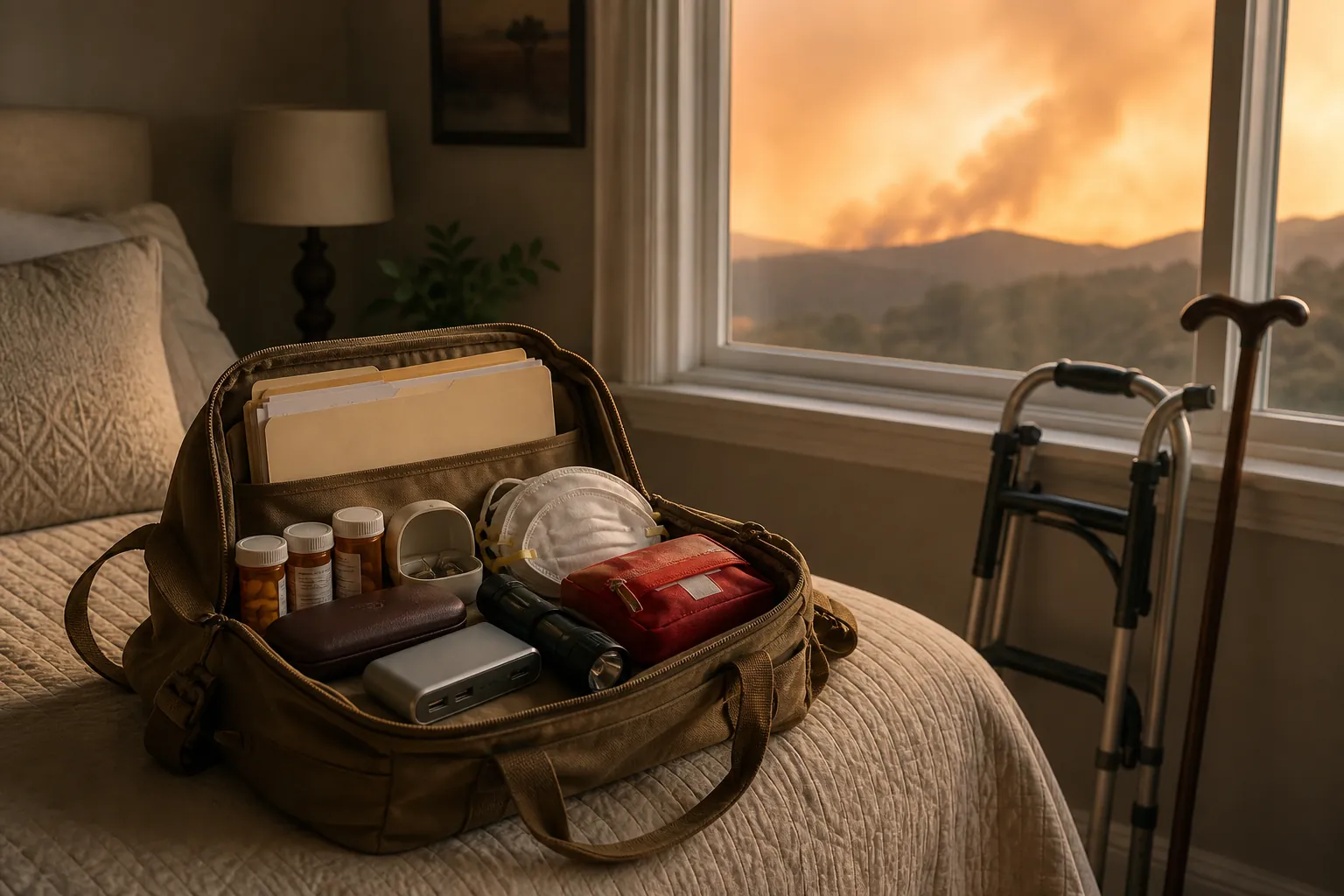
That rule is not an overreaction. In the 2018 Camp Fire, Places Journal reported that 80% of those killed were over 65, and more than a dozen were physically or mentally impaired. [2] After the January 2025 Los Angeles fires, Los Angeles County Aging & Disabilities reported that 26 of 31 deaths were people age 65 or older or people living with a disability. [3] AARP reported that nearly three-quarters of identified victims in the 2023 Lahaina fire were over 60. [4] Fatality totals can vary by source timing, but the pattern is not subtle: delayed evacuation hits older adults hard.
The four-stage checklist
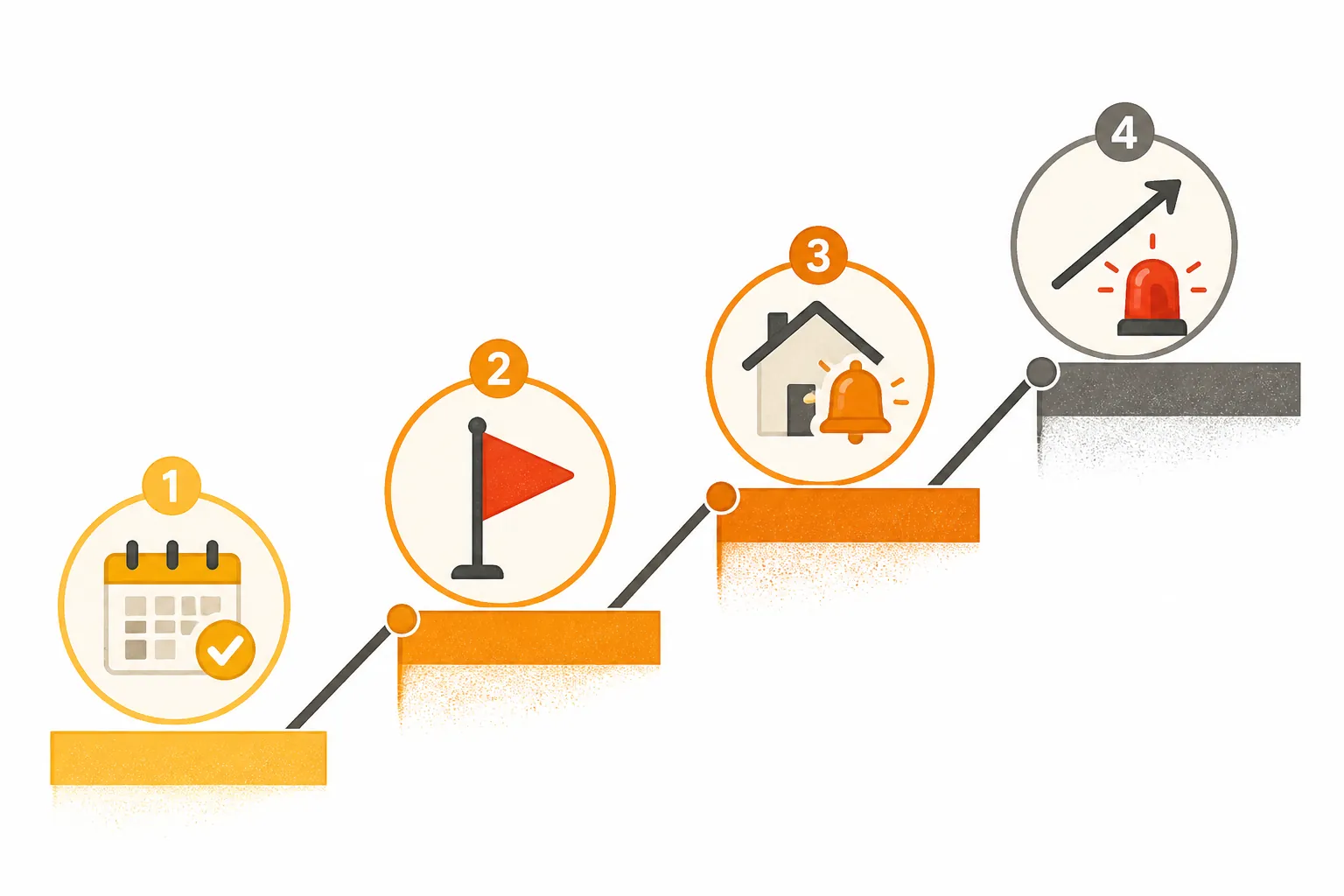
Use this as the quick version. The sections that follow explain the parts that usually cause delay: medical supplies, mobility transport, alerts, destination, and family agreement.
| Stage | What the caregiver does | Decision rule |
|---|---|---|
| Before fire season | Build the parent’s medical and mobility profile; stage a senior-specific go-bag; confirm medication refill plan; test medical-device power; practice loading the walker, rollator, wheelchair, oxygen, or cane; choose destination and backup driver; sign up for alerts. | Do not wait for smoke to solve family disagreements. |
| Red-flag warning or very high fire danger | Charge phones, hearing aids, medical devices, and battery packs; fill the gas tank; face the car outward; check garage door manual release; move shoes, glasses, cane, walker, medication list, and go-bag near the exit. | Prepare as if an evacuation warning could arrive while the parent is tired, alone, or hard to reach. |
| Evacuation warning | Leave early if the parent needs help walking, driving, hearing instructions, using medical equipment, managing medications, or staying calm. Load mobility aids first, then medications, documents, chargers, masks, pets, and essential devices. | For many older adults, this is the leaving stage, not the thinking stage. |
| Mandatory evacuation order | Go now. Do not search for extras. If the parent cannot be moved safely without help, call local emergency services and give the exact address, mobility limitations, medical-device needs, and number of people present. | The checklist is over. The task is exit. |
Before fire season: build the parent-specific plan
A senior evacuation plan starts with a plain profile of how your parent actually gets through a day. Not their diagnosis list alone. The useful question is: what would stop this person from leaving the house and staying away for several days?
- Medication profile: drug names, doses, prescribing clinicians, pharmacy, prescription numbers, allergies, and the earliest refill dates.
- Medical-device profile: oxygen, CPAP, nebulizer, insulin refrigeration, powered recliner, hospital bed, hearing aids, mobility scooter, or any device that needs charging or backup power.
- Mobility profile: whether the parent can stand from a chair without help, manage porch steps, transfer into a car, sit upright for a long drive, or use a public shelter bathroom.
- Vision and hearing profile: glasses, spare glasses, hearing aids, hearing-aid batteries or charger, written instructions if phone calls are hard to understand.
- Cognition and communication profile: whether the parent may become confused, refuse to leave, forget instructions, wander, or stop answering the phone under stress.
- Transportation profile: who drives, who is the backup driver, whether a wheelchair fits in the vehicle, whether oxygen can travel safely, and whether the garage door can open without power.
The medication piece deserves more than a line in a kit list. Guidance differs. CDC emergency guidance uses a 7- to 10-day benchmark. The American Red Cross tells older adults to include at least a 30-day supply of medications in emergency planning. [6] Fire Help Center recommends 7 to 14 days for seniors and caregivers preparing for wildfire. [7] Treat those as source-specific benchmarks, then ask your parent’s clinician and pharmacist what is realistic for controlled substances, refrigerated drugs, insurance refill limits, and mail-order delays. This is emergency planning, not medical advice; do not change medication schedules, oxygen settings, CPAP use, or insulin storage without clinician or pharmacist direction.
For the go-bag, add the items that change whether an older adult can function away from home: medications with prescription information, copies of medical documents, spare glasses, hearing-aid batteries or charger, phone chargers, a battery pack, N95 masks, a flashlight, sturdy comfortable shoes, and any device instructions a helper would need. University of Nevada Reno Extension includes medications, eyeglasses, hearing-aid batteries, dust masks, chargers, and important documents in its wildfire evacuation checklist. [5]
Do not pack the go-bag and then leave it in the wrong place. If the parent’s bedroom is upstairs and the exit is through the garage, the bag belongs where someone can grab it on the way out. The same goes for shoes. Many older adults can shuffle around the house in slippers; they cannot safely cross a smoky driveway, shelter parking lot, or hotel hallway that way.
Transportation has to be tested, not assumed
The last ten minutes often fail at the car. The rollator does not fold the way the adult child remembers. The wheelchair fits only if the trunk is empty. The parent cannot climb into the neighbor’s SUV. The oxygen concentrator is ready, but the tubing and backup cylinder are not together.
Practice once in daylight: parent, walker or wheelchair, oxygen if used, go-bag, pet carrier, and the actual vehicle. If the parent does not drive, assign a primary driver and a backup. If the driver lives across town, name a neighbor or nearby relative who can start the exit while the adult child coordinates by phone.
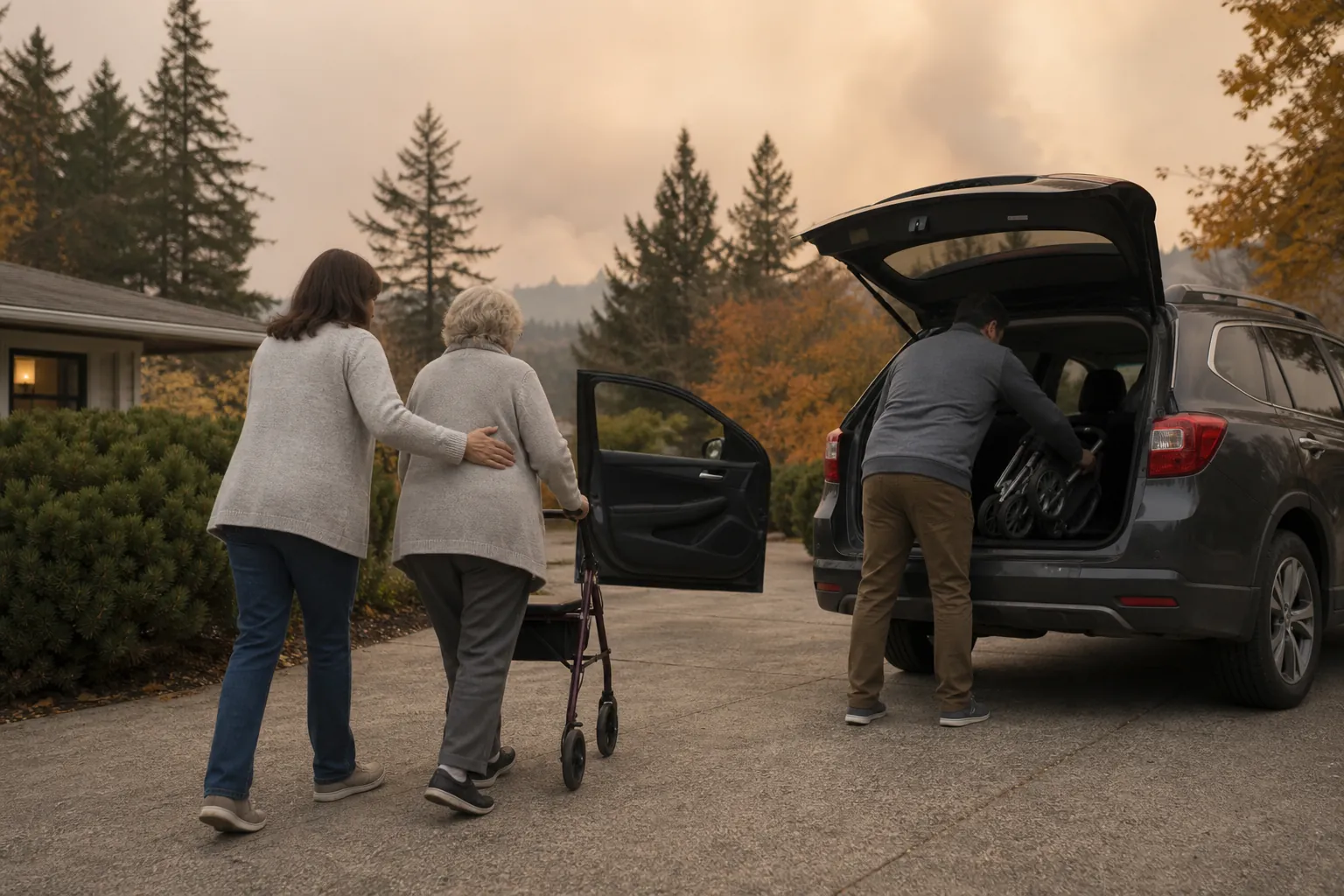
Vehicle readiness is not decorative here. CAL FIRE advises keeping the vehicle fueled and ready, and University of Nevada Reno Extension includes keeping the car filled with gas and positioning it for fast departure. [1][5] For an older parent, add two more tests: whether the garage door can be opened by hand during a power outage, and whether the parent can get from bed or chair to car without a fall.
If power loss is a serious risk for your parent’s house, connect this plan with a separate power-outage safety setup. The same issues show up there: lighting, trip hazards, powered medical equipment, refrigerator-dependent medication, and phones that die before the family can coordinate. See How to Fall-Proof a Senior’s Home Before a Power Outage and What to Do During a Power Outage for an Elderly Person if outages are common in your area.
Choose the destination before anyone is under stress
“We’ll go to a shelter” may be the right answer for some families. It is not a complete plan for a parent who needs a flat entry, a bathroom close to the bed, a place to plug in medical equipment, room for a walker, refrigeration for medication, or a calm space because confusion worsens in crowds.
Pick a first destination and a backup. For each one, confirm the address, driving route, parking, stairs, pets, smoke exposure, bathroom access, and outlet access. If the destination is a relative’s home, ask the awkward practical questions now: Can the parent sleep on the first floor? Can the walker move between bed and bathroom? Who is responsible for oxygen deliveries or medication pickup if the evacuation lasts longer than expected?
Ready.gov’s older-adult preparedness guidance emphasizes support networks, transportation planning, emergency contacts, and planning for medical and assistive needs. [8] That is the part many families skip because it feels less urgent than buying supplies. In a wildfire, it is often the part that decides whether leaving is simple enough to happen early.
Make the alert system redundant
Your parent should not depend on one phone, one app, one television station, or one adult child who may be in a meeting. Sign up for local emergency alerts where the parent lives, enable wireless emergency alerts on the phone, and add a second channel: a neighbor, landline call, weather radio if appropriate, local emergency management notifications, or a family group text that includes someone nearby.
For long-distance caregivers, this is where the plan becomes real. Keep the county emergency alert page bookmarked. Know the parent’s evacuation zone if local officials use zones. Put the neighbor’s number in your phone under a name you can find quickly. If you need to talk a parent through leaving by phone, you do not want to spend the first five minutes asking which shelf holds the hearing-aid charger.
At a red-flag warning: shorten the exit
A red-flag warning is not an evacuation order. It is the time to remove friction. The parent may still be safe at home, but the household should look different by evening.
- Charge phones, battery packs, hearing aids, medical-device batteries, and mobility-scooter batteries.
- Put glasses, spare glasses, hearing aids, ID, medication list, wallet, keys, and phone in one reachable place.
- Move the go-bag, sturdy shoes, cane, walker, rollator, wheelchair, oxygen supplies, and pet carrier close to the exit.
- Fill the gas tank if it is not already full enough for a long detour.
- Park facing out. Clear the trunk or back seat so the mobility aid can be loaded without unloading groceries, golf clubs, or storage boxes first.
- Check that the garage door manual release works and that the parent or helper knows how to use it.
- Call the backup driver and destination contact. Do not assume they remember the plan.
This is also the right time to reduce fall risk at the exit route. Smoke, urgency, poor sleep, and dim light make a familiar hallway less safe. Clear cords, throw rugs, stacked boxes, and patio clutter from the path between bed, bathroom, front door, garage, and car. The same crisis-path thinking applies in heat, power-grid, and earthquake planning; for related home setup, see Your 72-Hour Heat Dome Fall Prevention Checklist for Parents, What a Power Grid Emergency Order Means for Older Adults, and Earthquake Preparedness Checklist for Seniors Living Alone.
At an evacuation warning: leave with the older adult
This is the stage families are most tempted to negotiate. Maybe the fire will turn. Maybe the order will not come. Maybe Dad will be angry if we make him leave. That delay has a cost, and older adults pay it in slower movement, medication gaps, power-dependent equipment, panic, poor visibility, and crowded roads.
If your parent needs help walking, driving, hearing instructions, managing medication, operating medical equipment, or making calm decisions under stress, an evacuation warning should trigger departure. The family can always come home if officials lift the warning. They cannot get back the half hour spent arguing while the wheelchair is still in the hall closet.
Load in the order that protects survival and function
- Parent first if conditions are already deteriorating. A bag can be replaced. A parent standing in smoke while people pack cannot.
- Mobility aid: cane, walker, rollator, wheelchair, scooter charger, transfer board, or portable ramp if one is already part of the plan.
- Medical essentials: medications, medication list, oxygen supplies, CPAP, device chargers, backup batteries, glucose supplies, incontinence supplies, and any clinician instructions.
- Vision, hearing, and communication: glasses, spare glasses, hearing aids, hearing-aid charger or batteries, phone, charger, battery pack, and written contact list.
- Documents: photo ID, insurance cards, Medicare or Medicaid cards, advance directive, power of attorney copies if relevant, medical summary, and emergency contacts.
- Protective items: N95 masks, sturdy shoes, jacket, water, flashlight, and pet supplies if pets are evacuating.
Keep this order visible. In a calm room, every item seems important. Under an evacuation warning, the question is narrower: what does this parent need to breathe, move, hear, see, communicate, take medication, and avoid a fall tonight?
Use less persuasion and more pre-decided language
A parent who wants to stay is not always being irrational. Home is familiar. Leaving can feel humiliating. Pets, photographs, routines, and fear of looting all matter. Still, the evacuation-warning stage is a poor time for a family debate.
Before fire season, agree on the sentence the family will use: “When our zone is under an evacuation warning, we go to Lisa’s house. We do not wait for the mandatory order.” Put it in writing. Share it with siblings, neighbors, and the parent’s usual helpers. The goal is not to overpower the parent; it is to remove a decision that becomes harder when smoke, fear, and spotty phone service are already present.
For a long-distance adult child, the phone script should be specific: “Put on your shoes. Put in your hearing aids. Take your cane. The blue medication folder is on the kitchen counter. Maria is coming to the front door. I will stay on the phone until you are in the car.” Step-by-step beats a lecture.
If the parent has dementia or cognitive decline
Do not leave the person alone during an evacuation. Use calm, concrete instructions, one step at a time. Keep identification on the person, not only in a bag. Carry a recent photo, medication list, emergency contacts, and power of attorney copies if those documents are part of the care plan. The Alzheimer’s Association’s disaster guidance emphasizes preparation, supervision, identification, and caregiver planning for emergencies. [9]
If wandering is already a concern, assign one person to stay physically near the parent while another person loads the car. A caregiver cannot safely be both the loader and the supervisor at the same moment. For home-safety planning outside wildfire season, see A Room-by-Room Safety Checklist for Alzheimer’s Caregivers.
At a mandatory evacuation order: stop collecting and go
A mandatory order is not the time to find the second pair of glasses, look for the insurance folder, call three siblings for permission, or try to make the walker fit into a car that has never carried it before. Those were pre-season and evacuation-warning jobs.
If the parent can move, leave. If the parent cannot be moved safely without help, call local emergency services and give practical information immediately: exact address, closest entrance, whether anyone is bedbound, wheelchair-dependent, oxygen-dependent, cognitively impaired, hard of hearing, or unable to open the garage manually. Keep the phone charged and stay reachable.
If the family left at the warning stage, this paragraph becomes less important. That is the point.
Before the next alert
Do four things before the next red-flag warning: choose the leave-early trigger, confirm the driver and destination, stage the senior-specific go-bag, and make sure your parent can be reached through at least two alert channels.
For an older parent, waiting for a mandatory evacuation order is often waiting until the hardest version of every task arrives at once.
References
- Go! Evacuation Guide — CAL FIRE Ready for Wildfire
- Lessons from Paradise on Fire — Places Journal
- Lessons from the January Wildfires: Why Preparedness Matters — LA County Aging & Disabilities
- Extreme Weather Is Killing Mostly Older Adults — And Has Been for Decades — AARP
- Wildfire Evacuation Checklist — University of Nevada Reno Extension
- Older Adults — American Red Cross
- Seniors & Caregivers — Fire Help Center
- Older Adults — Ready.gov
- Preparing for Emergencies — Alzheimer’s Association
Related reading
Noticed something outdated or inaccurate on this page? Flag a correction. We review every report against CDC, NIA, and AARP HomeFit guidance before updating a page.
Part of the Fall Prevention section.