
STEADI: Intervene
Post-Earthquake Fall Hazard Checklist for Seniors at Home
A room-by-room guide for adult-child caregivers to systematically identify and fix new fall hazards created by an earthquake—broken glass, shifted furniture, water leaks, and dark stairways—before a senior takes a step.
Start at the threshold. Before an older adult walks through the house after an earthquake, the first rule is simple: shoes on, exit path checked, mobility aid found, and the home judged safe enough to enter at all. This checklist is not a structural inspection. It is a fall-hazard sweep for the next few minutes and the next few rooms.
If the senior is reachable, ask them to stay seated until someone has checked the path. If they must move, have them put on sturdy, thick-soled shoes first. The American Red Cross names broken glass as one of the most common earthquake injuries, which makes bare feet, slippers, and socks a bad gamble even when the room looks mostly intact.[1]
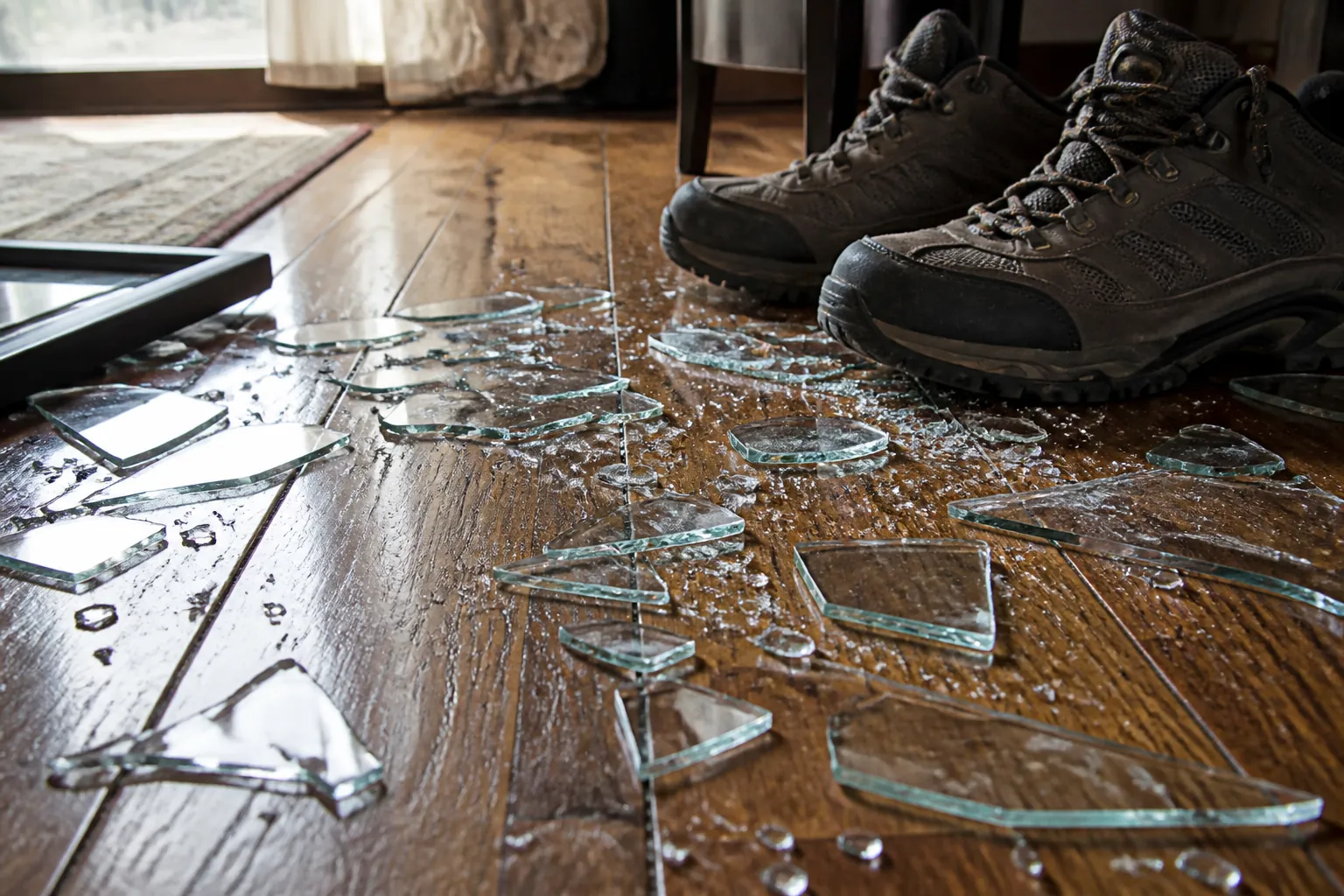
Do not turn this into a cleanup project yet. The question is narrower: can the senior get from where they are to a safe exit, bathroom, bed, and phone without stepping on glass, slipping on water, reaching for a missing cane, or turning into a dark hallway?
First decide whether anyone should stay inside
A fall-hazard checklist only matters if the home is safe enough to occupy. Leave immediately, or keep the senior out, if there is fire, a suspected gas leak, a gas smell, visible structural damage, sparking wires, flooding, or an evacuation order. Cal OES advises checking for gas leaks after an earthquake and leaving the area if gas is smelled or heard escaping.[2]
If voice calls are failing, text. Ready.gov recommends using text messages after a disaster because phone systems may be busy and texts may get through when calls do not.[3] A useful first text is not "Are you okay?" It is more specific: "Stay seated. Put on hard shoes if you can reach them. Do not walk to the kitchen or bathroom yet. Text me where you are."
| Decision | What to do before the senior walks |
|---|---|
| Gas smell, fire, visible major damage, flooding, sparking wires, or evacuation order | Leave or keep them out. Call emergency services if needed. Do not perform a room-by-room sweep. |
| Senior is inside and reachable | Ask them to stay seated, put on sturdy shoes if within reach, and wait while the exit path is checked. |
| Senior is inside and not reachable by voice | Text short instructions. Ask a nearby trusted person to check from the exit inward if it is safe to enter. |
| Home appears stable enough to enter | Check the exit route first, then the rooms the senior must use soonest. |
This is safety guidance, not medical advice or engineering advice. If the senior fell, hit their head, has chest pain, new confusion, trouble breathing, severe pain, weakness on one side, or cannot stand normally, treat that as a medical problem, not a housekeeping problem.
Why the ordinary hazards deserve priority
Earthquake damage can look dramatic on television. Inside an older adult’s house, the more immediate injury often starts smaller: a picture frame that shattered near the recliner, a walker shoved behind a chair, a rug curled into a ridge, water running from under the refrigerator, or a hallway light out just before a bathroom trip.
The available evidence does not give a clean national count of earthquake-specific senior fall injuries. It does show why the baseline risk matters. The CDC reports that about 3 million older adults are treated in emergency departments for falls each year in the United States.[4] After an earthquake, the house has just added the things that make walking worse: debris, darkness, slick floors, blocked paths, and missing supports.
That is the working standard for the sweep: remove the new hazards from the routes the senior will actually use, before pride, habit, or urgency gets them standing too soon.
The sweep starts with the exit route, not the messiest room
Begin where an evacuation would begin. The exit route is the path from the senior’s current location to the safest usable door. Do not start by picking up the living room or checking every cabinet. If conditions change, the senior needs a clear way out.
- Put on sturdy shoes before entering or moving through debris.
- Find the senior’s cane, walker, wheelchair, scooter, or transfer device before asking them to stand.
- Open the exit door and confirm it is not jammed, blocked, or leading into obvious danger.
- Move glass, fallen pictures, lamps, books, shoes, plants, and shifted rugs out of the walking line.
- Check the floor with a flashlight, especially near windows, shelves, mirrors, and framed art.
- Do not drag the senior through a narrow path that only works for a younger person taking long steps.
A path is not clear until it works for the person using it. A walker needs width. A cane needs a stable surface. A wheelchair needs turning space. A person who shuffles cannot be asked to "just step over" a cord, broken frame, or folded rug.
Entryway and front door
At the entryway, look for the things that will matter if the senior has to leave quickly: a door that sticks, a mat that slid into a lump, shoes scattered across the threshold, broken porch lights, fallen packages, or glass from a sidelight window. If there are stairs outside, check them from the top and bottom before anyone uses them.
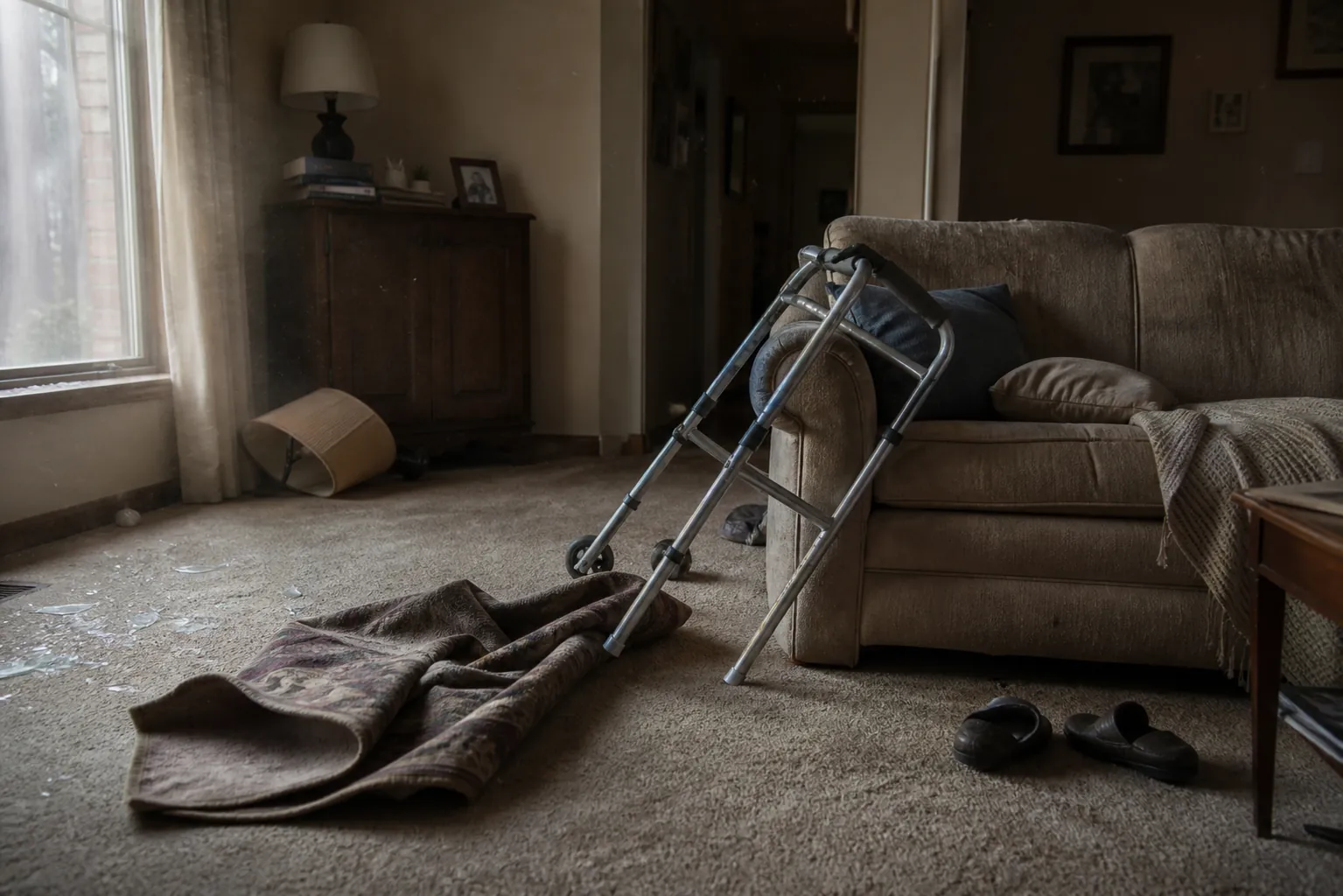
If the senior normally keeps a walker or cane near the door, confirm it is still there. Earthquakes move light furniture and loose objects in boring, inconvenient ways. The cane that was always by the umbrella stand may now be under a coat, behind a chair, or on the floor where it has become its own trip hazard.
Hallways
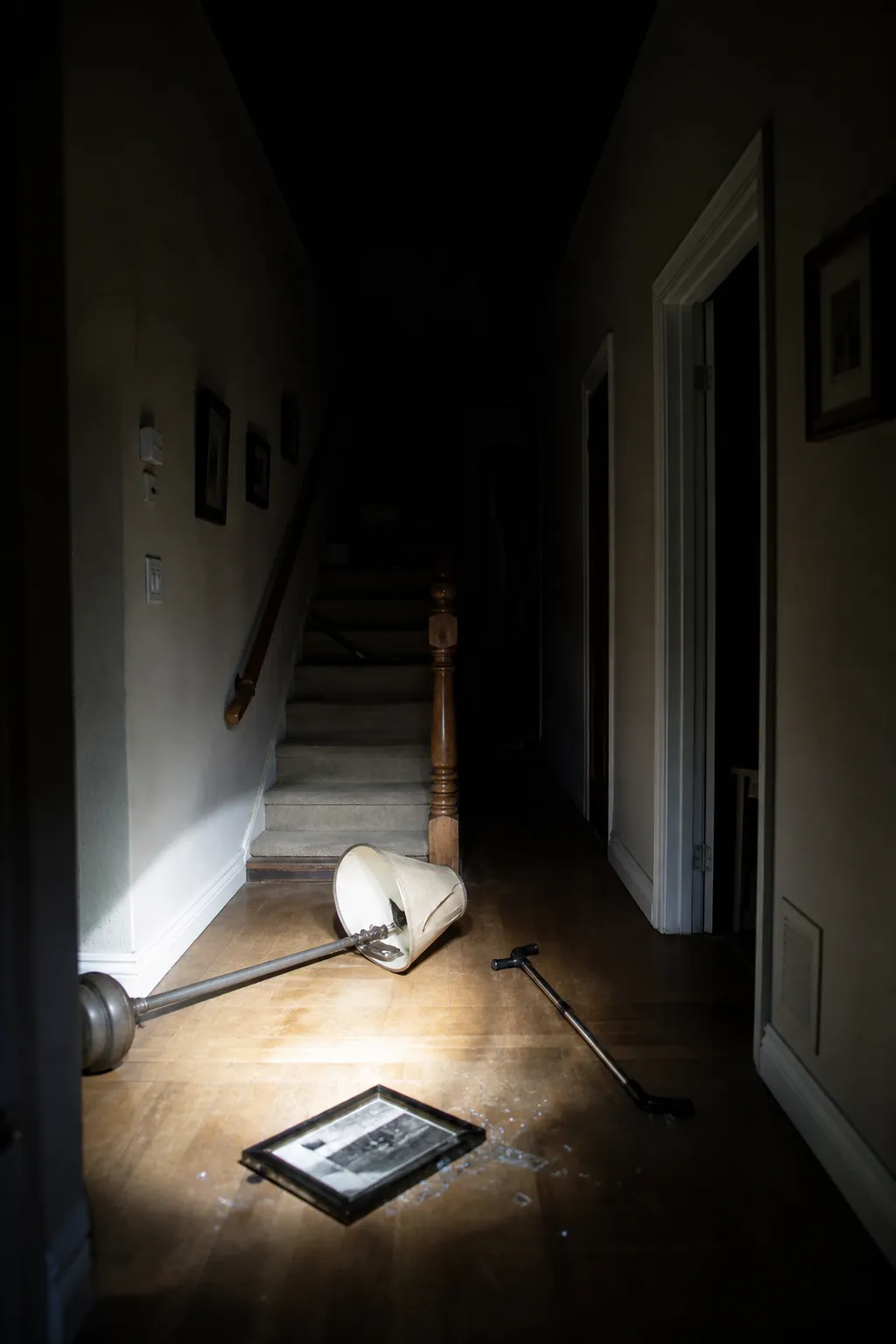
Hallways matter because seniors use them on autopilot. They also collect exactly the wrong objects after shaking: fallen picture frames, loose nails or hooks, toppled lamps, book stacks, plant pots, and shifted runners. Sweep the center walking line first, then the edges where a cane tip or walker leg may land.
Do not rely on memory. The senior may know the hallway well enough to walk it in the dark on an ordinary night, but this is not the ordinary hallway. A mirror can shed tiny glass pieces across several feet. A floor runner can slide just enough to catch a toe. A lamp cord can cross the path at ankle height.
Stairs and landings
Stairs get a stricter rule: no senior uses them until they are lit, cleared, and checked from both ends if possible. Look for fallen wall art, loose carpet edges, cracked stair treads, broken glass from nearby frames or windows, and objects that rolled onto a lower step. Check the handrail before it is trusted.
Power loss changes the risk fast. IEMA’s Planning Guide for Seniors notes that security lights can be set to turn on automatically when power fails and may operate for 4 to 6 hours.[5] That time window is useful, but it is not a permanent lighting plan. If the outage continues, place flashlights or battery lights where the senior can reach them without crossing the room in the dark.
Then clear the rooms the senior will use first
After the exit path is usable, move inward by need, not by neatness. Most seniors will soon need the bathroom, bedroom, kitchen, medication area, phone charger, or medical equipment. Those routes come before closets, guest rooms, decorations, and cabinets that can wait.
| Area | New earthquake hazards to check |
|---|---|
| Bathroom route | Glass, hallway debris, shifted rugs, water on tile, blocked grab bars, low light |
| Bathroom | Wet floors, fallen toiletries, loose bath mats, broken mirror glass, toilet access, shower chair position |
| Bedroom | Clear path from bed, lamp or clock on floor, broken glass, slippers underfoot, walker or cane location |
| Kitchen | Broken dishes, refrigerator leaks, spilled food or liquids, cabinet contents on floor, shifted appliances |
| Medication and medical equipment area | Tipped oxygen equipment, displaced CPAP or cords, scattered pills, blocked outlet access |
| Living room | Bunched rugs, moved chairs, fallen lamps, blocked recliner path, remote or phone out of reach |
Bathroom route and bathroom
The bathroom route deserves early attention because people do not wait politely for hazard checks when they need it. Clear the path wide enough for the senior’s real gait or device. If they use a walker at night, clear for the walker, not for your shoulders.
Inside the bathroom, assume tile hides water until you prove otherwise. Look around the toilet base, sink, tub, shower, and any cabinet that opened. Move toiletries and towels off the floor. Check whether the bath mat folded, slid, or became wet. If a mirror cracked, treat the whole nearby floor as unsafe until swept and inspected with light.
Grab bars, raised toilet seats, shower chairs, and commodes are only helpful if they are still positioned correctly. If a shower chair shifted, do not let the senior use it casually "just this once." Reset it or keep the shower off-limits until someone can check it properly.
Bedroom and bed-to-bath path
The bedroom check should start at the bed, because that is where the next unsafe step often begins. Clear the path from bed to door, then bed to bathroom. Check for fallen lamps, glass from frames, a shifted nightstand, loose charging cords, slippers in the walking line, and bedding dragged onto the floor.
Place the cane, walker, glasses, phone, flashlight, and water within easy reach, but not on the floor. If the senior uses a bedside commode, make sure the transfer path is clear and the commode did not move. If they use a wheelchair, check that the brakes work and that the chair is not blocked by fallen furniture. Ready.gov includes specific preparedness guidance for people who use wheelchairs and walkers, including planning for mobility needs after an earthquake.[3]
Kitchen
The kitchen is a glass-and-water problem until proven otherwise. Dishes, jars, mugs, small appliances, refrigerator contents, and pantry items can all land where a senior would normally step. Do not send the senior into the kitchen for a drink, snack, medication, or flashlight until the floor has been checked.
Look under the refrigerator, sink, dishwasher, ice maker line, and water dispenser. A small leak on kitchen flooring can matter as much as visible debris. If water is present near electrical cords or outlets, keep the senior away and get appropriate help.
Open cabinets cautiously only if you need something from them. Items may have shifted against the doors. The fall-prevention priority is not restoring the kitchen; it is keeping the senior from crossing broken dishes or a slick patch in a routine trip for water.
Living room and main sitting area
In the main sitting area, check the route between the chair, phone, bathroom, and exit. Recliners and sofas can hide glass under the front edge. A rug can look mostly flat while one corner has folded under a walker wheel. A side table can shift just enough that the senior reaches for it and misses.
Reset the chair area as a temporary safe station: shoes on or within reach, phone charged or charging, flashlight nearby, mobility aid parked on the stronger side if the senior has one, and the floor cleared for standing. If aftershocks occur, the senior should not have to search for the walker in the dark.
Medication, oxygen, CPAP, and other equipment
Medical equipment creates two problems after shaking: the device may not be where it belongs, and its cords or tubing may now cross a walking path. Check oxygen tubing, CPAP cords, power strips, medication organizers, glucose supplies, hearing aid chargers, and any equipment the senior uses before bed or after waking.
Do not leave scattered pills on the floor for later. They are both a medication problem and a slip problem. If labels, pill boxes, or bottles were disturbed and there is any doubt about what was taken or spilled, pause and verify before the senior resumes the normal schedule.
If you are guiding the sweep by phone
Remote caregiving after an earthquake is mostly about slowing the next movement down. The senior may say they are fine because they are upright, embarrassed, or trying not to worry anyone. Fine is not the same as having a clear path to the bathroom.
- Ask where they are sitting or lying down.
- Ask whether they smell gas, see fire, see major cracks, hear water running, or are being told to evacuate.
- Tell them not to walk yet unless they must leave for immediate safety.
- Ask whether sturdy shoes are within reach. If yes, have them put the shoes on before standing.
- Ask where the walker, cane, wheelchair, glasses, phone, and flashlight are.
- If someone nearby can enter safely, have that person clear the exit route first, then the bathroom route.
Keep instructions short. In a power outage or aftershock sequence, a long explanation is less useful than one safe instruction: "Stay in the chair. Shoes on. Wait for Ana to clear the hallway."
Reset the home for the next 24 to 72 hours
The first sweep gets the senior through the next movement. The next pass makes the home safer for repeated trips while utilities, lighting, nerves, and routines are still unsettled. Aftershocks, power outages, cleanup piles, and temporary repairs can keep creating new hazards.
- Keep sturdy shoes beside the bed and main chair, not by the door only.
- Leave flashlights or battery lights at the bed, bathroom route, hallway, kitchen entrance, and main sitting area.
- Park walkers, canes, wheelchairs, and transfer devices in predictable places after every use.
- Remove loose rugs from the main routes instead of trying to flatten them repeatedly.
- Keep cleanup bags, buckets, tools, and boxes out of walking paths.
- Recheck the bathroom and kitchen for slow leaks before bedtime and again in the morning.
If the senior has reduced mobility, do not improvise an evacuation sequence at the last minute. Midnight Sun Home Care emphasizes accounting for mobility aids and evacuation order for people with reduced mobility after an earthquake.[6] In practical terms, that means the wheelchair, walker, cane, transfer board, or backup device is part of the exit path, not an accessory to find later.
The house is not back to normal when the shaking stops. It becomes safer after someone has removed the new fall hazards from the routes the senior will actually use: exit, bathroom, bed, kitchen, medical equipment, and the chair where they are trying to prove they can get up by themselves.
References
- American Red Cross, Earthquake Safety
- Cal OES, Essential Earthquake Safety Tips
- Ready.gov, Earthquakes
- CDC, Facts About Falls
- IEMA, Planning Guide for Seniors
- Midnight Sun Home Care, Earthquake Safety with Reduced Mobility
Related reading
Noticed something outdated or inaccurate on this page? Flag a correction. We review every report against CDC, NIA, and AARP HomeFit guidance before updating a page.
Part of the Fall Prevention section.