
STEADI: intervene
Fire Weather Watch Fall-Safe Checklist for Seniors
This phased 3-day checklist helps seniors and caregivers prepare safely during a Fire Weather Watch, with every step designed to prevent falls — from go-bag assembly and mobility aid testing to defensible space tasks and final readiness checks.
A Fire Weather Watch is the preparation window. It is usually issued 12 to 72 hours before critical fire weather conditions may develop. A Red Flag Warning is different: it means those conditions are occurring or imminent. That distinction matters for seniors because the Watch is the time to do the slow, awkward, necessary work before anyone is rushing through a doorway with a walker or trying to lift a bag from the floor. The shortest answer to what to do during a fire weather watch for seniors is this: prepare to leave, but prepare in a way that does not create a fall first. [1]
| Alert | What it means | Best senior-safe response |
|---|---|---|
| Fire Weather Watch | Critical fire weather conditions may develop within the watch window. | Use the lower-pressure time to assemble supplies, confirm help, clear exits, and test mobility routes. |
| Red Flag Warning | Critical fire weather conditions are occurring or imminent. | Stop optional preparation and be ready to follow local evacuation instructions immediately. |
The urgency is real, even if the work should be calm. Adults 65 and older have 2.5 times the fire death risk of the general population, and adults 85 and older have 3.4 times the risk; over the 2014–2023 period, the fire death rate for older adults increased by 26%. [2] The places at risk are changing, too: a 2025 USDA Forest Service finding reported that 87% of recent population growth in moderate-to-high wildfire risk areas has been among people over age 60. [3]
Those numbers are not a reason to panic. They are a reason to keep the work at counter height, avoid climbing, keep mobility aids within reach, and let another person handle anything heavy or unstable. NFPA’s Steps to Safety program for older adults treats fire safety and fall prevention as connected problems, which is exactly how this checklist handles the Watch window. [4]
Day 1: Set up the things that are hardest to fix later
The first day of a Fire Weather Watch is the best time to do the work that requires thought: medication, documents, alerts, exit routes, and the go-bag. Do not start by dragging storage bins out of closets. Start at a table or kitchen counter, with a chair nearby, good light, and the walker, cane, or wheelchair where it normally belongs.
Sign up for alerts before sorting supplies
Make sure the senior receives official county or city emergency alerts, not just neighborhood texts. If a caregiver lives elsewhere, that person should sign up for the same local alerts, too. Check that the phone can make a loud sound, that emergency notifications are allowed, and that the senior knows which call or message deserves immediate attention.
This is also the time to identify who will help if leaving becomes necessary. The Red Cross recommends older adults plan who will help them evacuate, sign up for local registries when available, and prepare 7 to 14 days of medications. [5] A plan that depends on “someone will come” is too thin. Write down the person’s name, phone number, backup phone number, and the time they can realistically arrive.
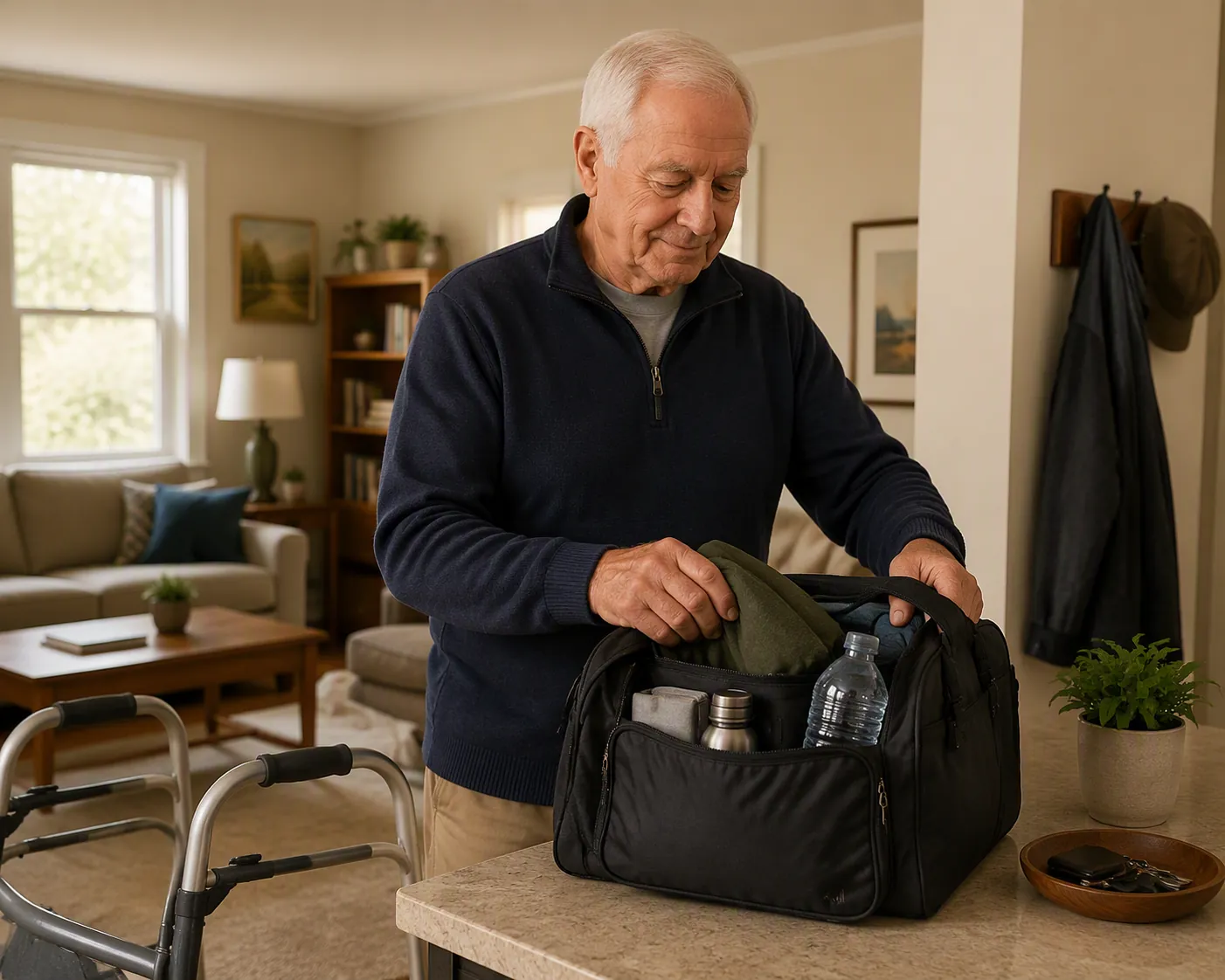
Build a senior-specific go-bag at waist height
Put the bag on a counter, sturdy table, or bench near the main exit while packing it. Do not pack it on the floor. Bending down repeatedly while anxious is exactly the sort of small hazard that turns a good preparation step into a fall risk.
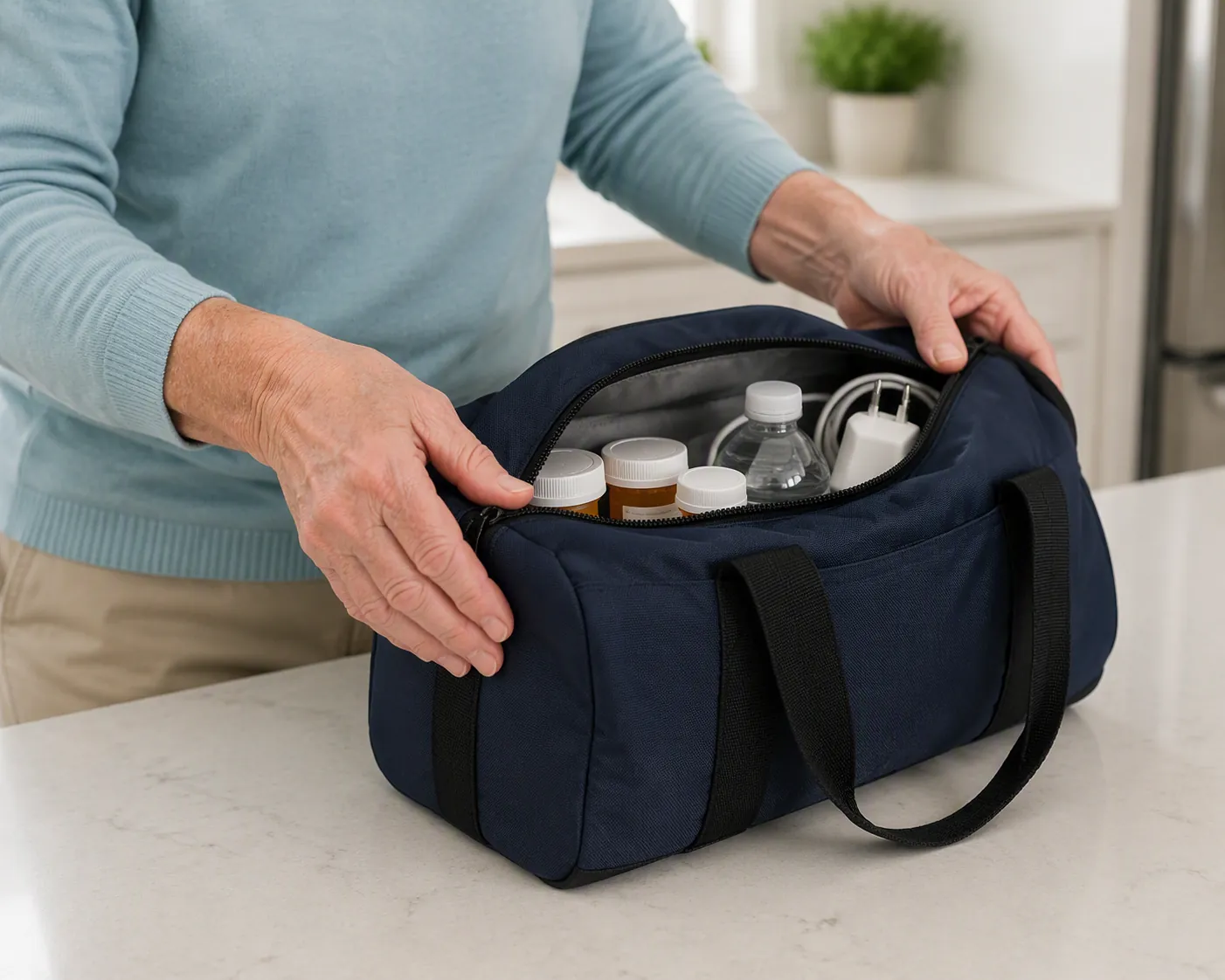
For an older adult, a useful go-bag is not just a generic emergency kit. It should protect medication routines, hearing, vision, mobility, phone access, and paperwork. Pack the items in smaller pouches so nobody has to dump the whole bag out on a shelter cot or car seat.
- Medications in their original bottles, with enough supply for 7 to 14 days when possible. [5]
- A typed medication and dose list, including the prescribing doctor and pharmacy phone number.
- Spare glasses, hearing aids, hearing-aid batteries, and any small cleaning tools needed for them.
- Mobility aid spare parts that are realistic to use: cane tips, walker glide caps, wheelchair cushion, or a small tire pump if already familiar.
- NIOSH-approved N95 respirators for smoke protection. [7]
- Phone charger, wall plug, charging cable, and a charged power bank.
- Insurance cards, Medicare card, photo ID copy, emergency contacts, and a basic medical summary in a waterproof pouch.
- Small water bottles instead of one large heavy bottle.
- No-cook food that is easy to open and does not require strong grip strength.
- A small flashlight or headlamp, placed in an outside pocket rather than buried at the bottom.
Keep the bag light enough that the senior does not have to twist, lean, or lift with both hands while also managing a cane or walker. If the needed supplies make the bag too heavy, split them: one small personal bag for the senior, and a second supply tote for the caregiver or driver. A bag that cannot be carried safely is not ready.
Store the bag where the body can reach it safely
The bag belongs near the primary exit, but not on the floor and not in the path of the walker. A waist-height shelf, entry table, sturdy chair seat, or counter edge is better than a closet, garage shelf, or hallway corner. The test is simple: the senior should be able to reach the handle without bending below the knees, stepping around clutter, or pulling the bag from behind another object.
If an adult child is preparing a parent’s house after work, this one detail deserves attention before leaving: where exactly is the bag sitting tonight? A well-packed bag on the floor beside the door can still trip the person it is supposed to help.
Test the exit with the real mobility aid
Do not assume the walker, rollator, cane, or wheelchair will clear the exit route just because everyone knows the way out. Test it slowly, in daylight, using the same door that would be used to leave. The U.S. Fire Administration specifically tells walker and wheelchair users to check all exits to be sure they can get through the doorways. [6]
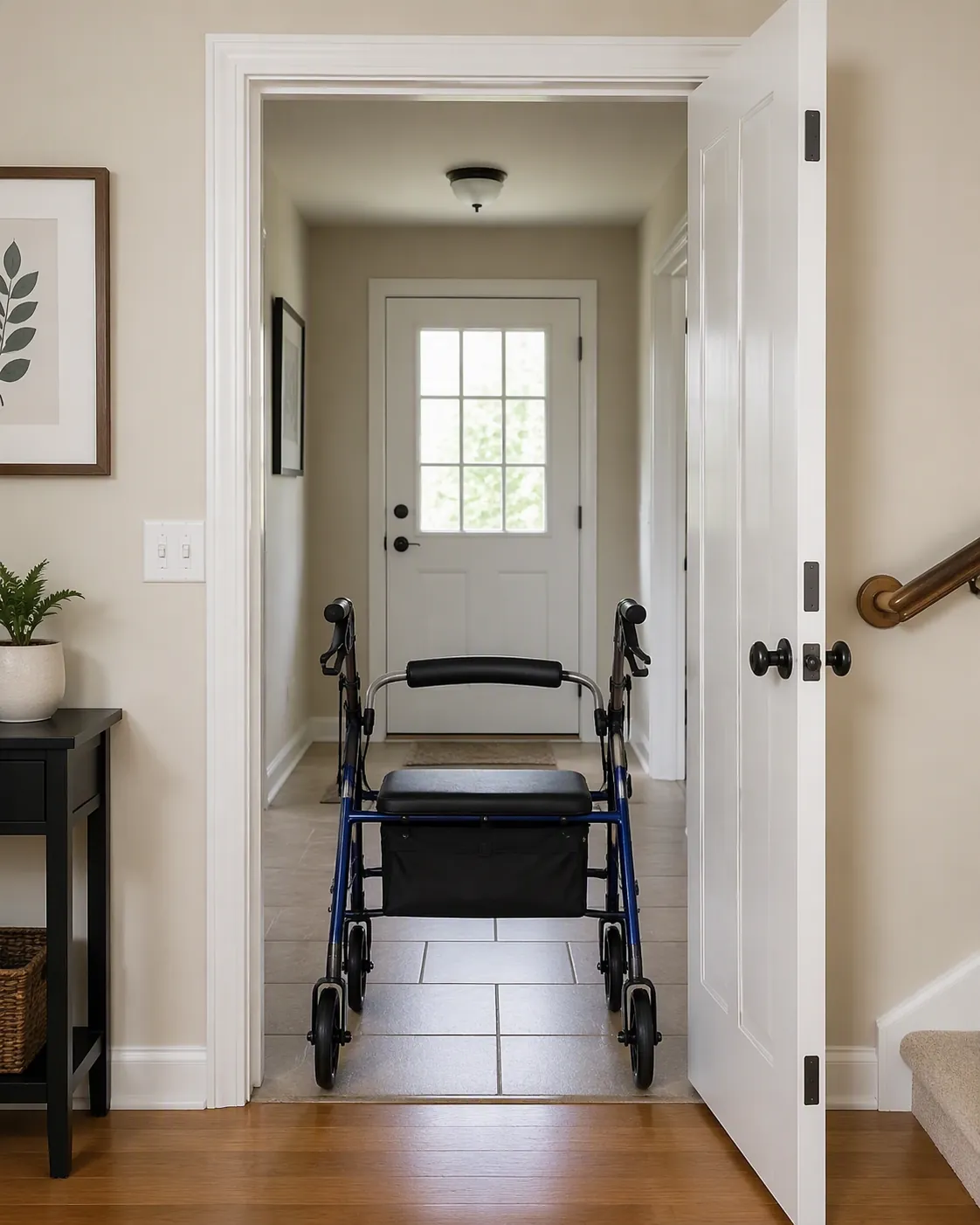
Roll the walker through the bedroom door, hallway, main exit, porch, garage door, and path to the car. Notice the small things: a throw rug that catches the rear wheels, a narrow turn by the laundry basket, a screen door that swings back, a threshold that requires a lift, a plant stand that steals two inches of clearance. Move those obstacles now, while the Watch is still only a Watch.
If the senior uses a wheelchair, check whether the chair clears the doorway with hands safely on the rims or controls, not scraped against the frame. If a caregiver must push, the caregiver should practice the turn once without carrying bags. The point is not speed. The point is learning where the difficult spot is before smoke, darkness, or sirens make it worse.
Review the route, but keep it practical
Choose the primary way out of the neighborhood and at least one backup route. Write them down in large print or save them on the phone. If the senior does not drive, write the driver’s name next to the route. If there is already a family evacuation plan, this is the time to check it against the current Watch, not rewrite the whole thing.
For a fuller household plan, use this emergency evacuation plan guide for aging parents after the immediate Watch tasks are handled.
Day 2: Clear departure problems without turning it into a yardwork marathon
By the middle of the Watch, the job is to reduce the things that would slow leaving: blocked walkways, an empty gas tank, an unavailable driver, an uncharged phone, or a pet with nowhere to go. This is not the day for a frail person to climb a ladder, haul branches, or bend over a slope with a rake.
Some National Weather Service offices describe Fire Weather Watch conditions with criteria such as sustained winds of at least 15 mph, relative humidity at or below 25%, and dry fuels, but thresholds vary by local office. Use your local NWS office and local emergency management messages for the actual decision-making in your area. [1]
Do only the defensible-space tasks that can be done steadily
If light outdoor work is safe for the senior, keep it to stable, upright tasks: move a lightweight doormat away from the door, use a long-handled broom to clear dry leaves from the entry, move a small plastic chair away from the wall, or bring in a light cushion from a porch chair. Wear sturdy shoes, use the mobility aid, and stop before fatigue changes posture.
Anything that requires a ladder, roof access, bending from the waist, lifting heavy pots, dragging hoses, or walking on uneven ground should go to someone else. A neighbor, adult child, property manager, or local assistance program may be able to help. If no help is available, leave the heavy work undone and focus on leaving safely if ordered. A preventable fall on the driveway does not make the house safer.
Confirm the ride, then make the car easy to leave in
Transportation is often the weak point in a senior’s Watch plan. Confirm the primary driver and the backup driver. If the senior still drives, decide honestly whether driving under smoke, wind, traffic, or night conditions is realistic. If the answer is no, the backup driver is not optional.
Fill the gas tank if it can be done without rushing or standing in unsafe conditions. Back the car into the driveway or parking space so it can pull forward when leaving. Put the garage opener, car keys, and house keys in one predictable place at waist height. If the car is in a garage, make sure everyone knows how to open the garage door manually in case power fails.
If power instability is common during fire weather in your area, review power-outage fall risks for senior caregivers. A dark hallway, a dead garage opener, and an oxygen concentrator without backup can turn a delayed decision into a dangerous one.
Decide where pets and medical equipment are going
Find out which shelter, hotel, relative, or out-of-area host can accept pets. Put leashes, carriers, food, and vaccination records near the go-bag, but do not pile them in the walking path. If the senior uses oxygen, a CPAP machine, a power wheelchair, or refrigerated medication, confirm who can transport the equipment and where it can be used. This is also a good time to label chargers and cords with tape so the right ones leave with the right devices.
Day 3: Shift from prepared to ready
On the final day of the Watch, or anytime officials say conditions are likely to worsen, stop adding new projects. The useful work now is quiet and close to the body: charge devices, place mobility aids, pre-load what can be safely pre-loaded, and confirm the person who will help.
Put mobility aids where they will be reached half-awake
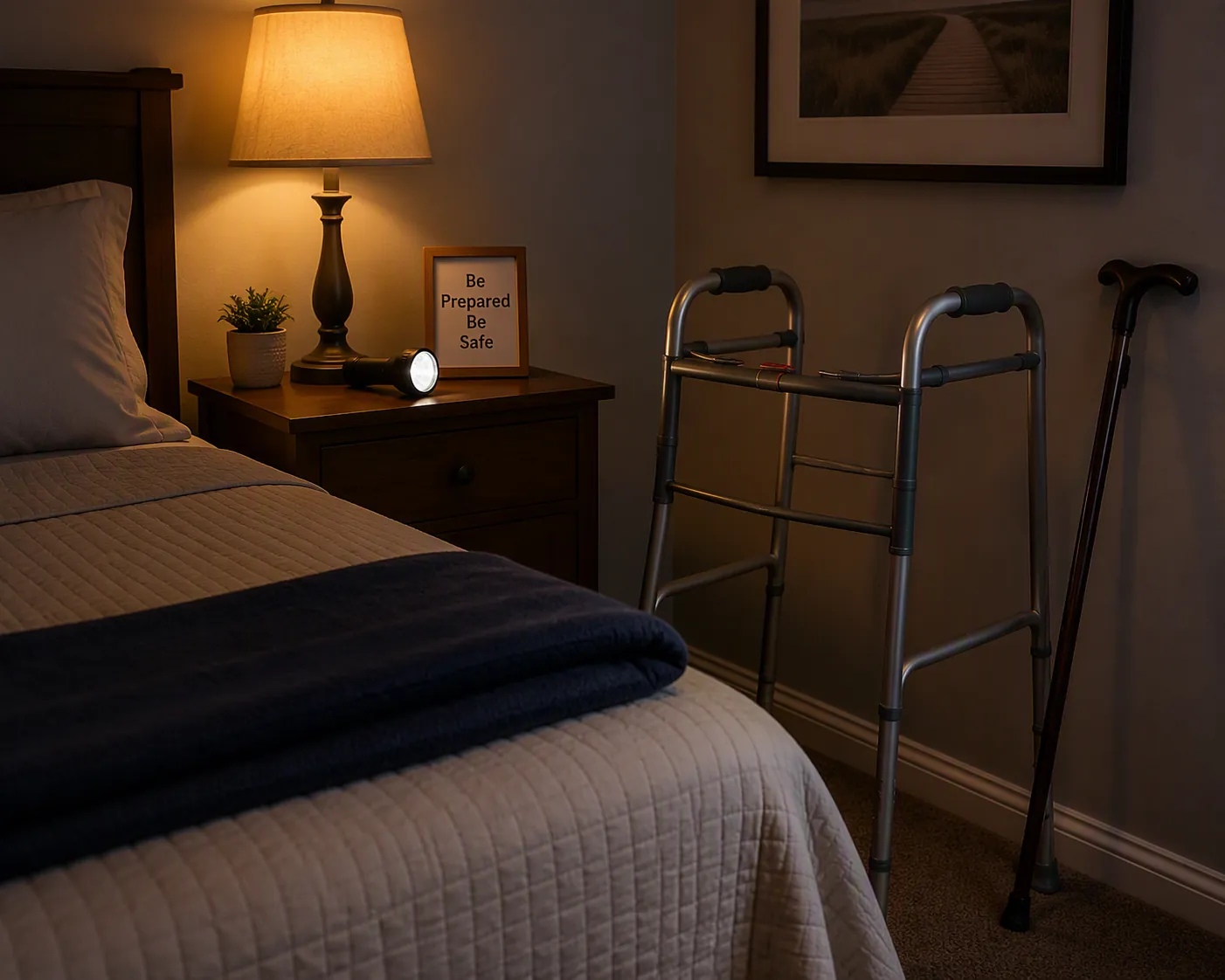
Before bedtime, place the walker, cane, wheelchair, or rollator within arm’s reach of the bed. Put a flashlight on the nightstand, not across the room. Shoes should be sturdy, closed-heel, and set where they can be put on without walking barefoot to a closet. If glasses or hearing aids are normally removed at night, keep them in the same bedside spot every time.
This is not fussy housekeeping. It is evacuation preparation. Many departures start with a phone alert, a knock on the door, or a caregiver calling before dawn. The senior should not have to stand up and search for the cane in the dark.
Pre-load the car only if it is safe
If conditions outside are still safe, place the go-bag in the car before evening. The person who is steadiest should carry it. If the senior uses a walker, do not ask them to carry the bag and manage the walker at the same time. Use several small trips, or have the driver load the bag.
If smoke, wind, darkness, or nearby fire activity makes a trip to the car unsafe, leave the bag at its waist-height exit spot. Do not trade one hazard for another. The goal is to reduce the number of decisions and heavy movements required if leaving becomes necessary.
Make one confirmation call
Call or text the support person and say exactly what is expected: “If this becomes a Red Flag Warning or evacuation order, you are my ride,” or “If I call, you will come to the front door and carry the second bag.” This avoids the polite but dangerous assumption that everyone understands the plan. Red Cross older-adult guidance emphasizes planning who will help during evacuation, which is especially important when mobility, medication, pets, or medical equipment are involved. [5]
If the support person cannot commit, find out now. A maybe-driver is not the same as a driver. If no family member is available, contact local emergency management, a senior services agency, a residence manager, or a trusted neighbor before the situation escalates.
Charge, monitor, and protect breathing
Charge the phone, power bank, hearing aids, medical devices, wheelchair battery, and any backup communication device. Keep charging cords plugged in where they can be reached without crawling behind furniture. If smoke begins affecting the area, follow local public health guidance and use NIOSH-approved N95 respirators when appropriate; CDC wildfire safety guidance recommends N95 respirators for smoke protection. [7]
Monitor the Air Quality Index through a local weather, public health, or air-quality source. For a senior with asthma, COPD, heart disease, or limited stamina, smoke can change the plan before flames are nearby. If breathing is already strained, waiting for a formal evacuation notice may not be the safest choice; call a clinician, local emergency management, or the support person for help deciding whether to leave earlier.
If the Watch becomes a Red Flag Warning or evacuation notice
When a Fire Weather Watch becomes a Red Flag Warning, the operating mode changes. Conditions are no longer only possible; they are occurring or imminent. [1] Stop optional preparation. Do not start yardwork, reorganize supplies, search for extra keepsakes, or make one more difficult trip to the garage. Put on shoes, take the go-bag, use the mobility aid, and follow local instructions.
If an evacuation notice is issued, use these wildfire evacuation tips for family caregivers of seniors as the next step. The Watch window was for reducing physical risk in advance: the bag is reachable, the doorway has been tested, the ride is confirmed, the car is easier to leave in, and the walker is not across the room. That is what makes the Watch valuable for seniors. It gives the time to prepare without hurrying the body into a fall.
References
- Fire Weather Definitions — National Weather Service
- Older adults fire death and injury statistics — U.S. Fire Administration
- Population growth in moderate-to-high wildfire risk areas — USDA Forest Service, 2025
- Steps to Safety — NFPA
- Disaster Preparedness for Older Adults — American Red Cross
- Fire safety for older adults — U.S. Fire Administration
- Wildfire Safety — Centers for Disease Control and Prevention
Related reading
Noticed something outdated or inaccurate on this page? Flag a correction. We review every report against CDC, NIA, and AARP HomeFit guidance before updating a page.
Part of the Fall Prevention section.