
STEADI: intervene
Post-Earthquake Fall Prevention Checklist for Seniors
After an earthquake, your older parent's home can become a maze of new fall hazards. This room-by-room checklist helps you systematically inspect each area — from broken glass to shifted rugs — to prevent a secondary fall injury that can be more serious than the quake itself.
After the shaking stops, the first fall-prevention rule is simple: do not let your older parent walk through the home as if the home is unchanged. The floor is the first thing to doubt. Shoes go on before standing. A flashlight comes out before anyone crosses a dark hallway. The first look is not for sentimental damage; it is for glass, shifted rugs, broken fixtures, loose handrails, cracked flooring, blocked doors, and anything that can make one ordinary step fail.
That order matters because broken glass is listed by the American Red Cross as the most common earthquake-related injury, and the CDC’s after-earthquake guidance starts with sturdy shoes, flashlights instead of candles, and checking walls, floors, doors, windows, and staircases for damage before normal movement resumes. [1][2]
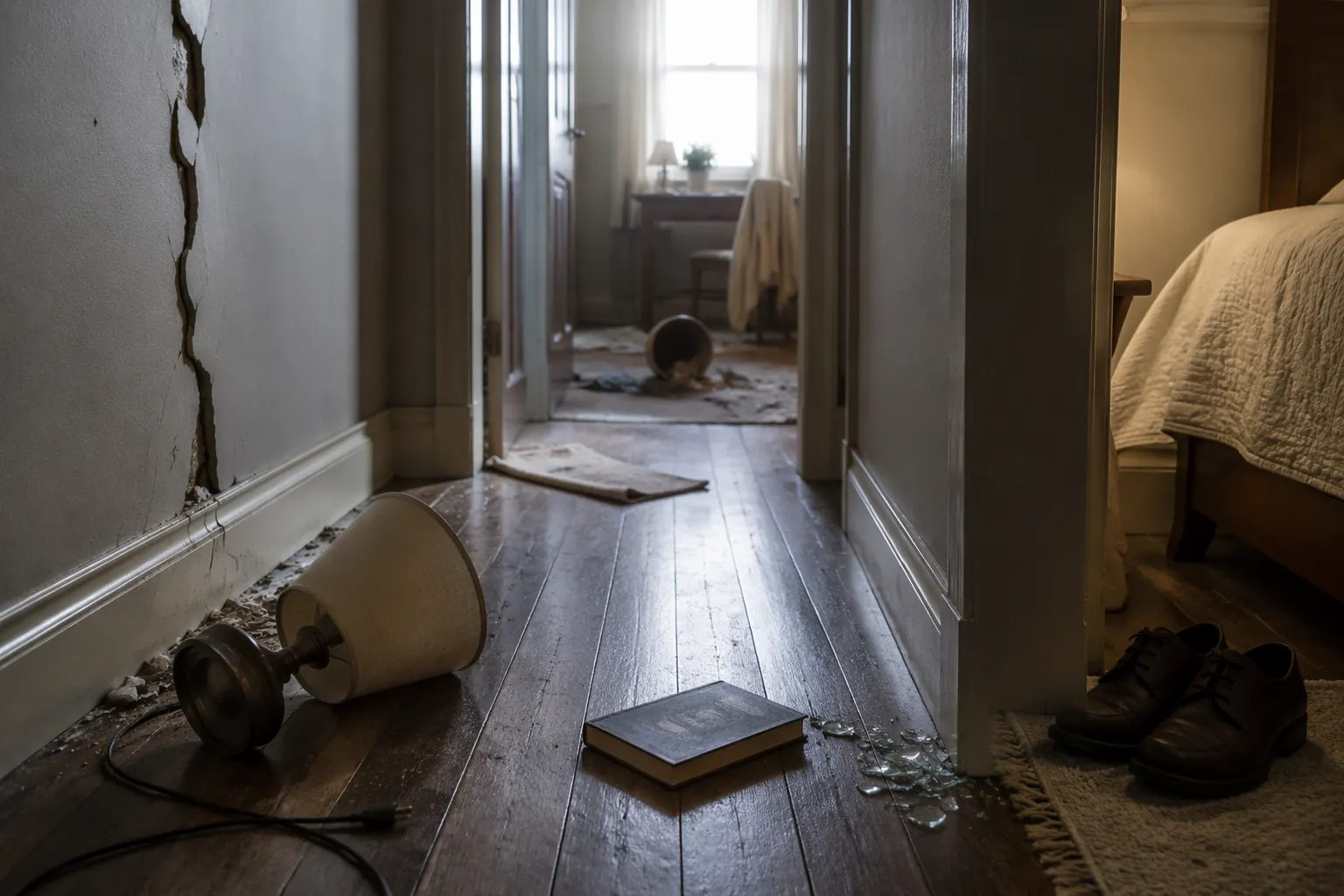
Before anyone walks: stabilize the next five minutes
If you are with your parent, ask them to sit or stay seated until the first path has been checked. If you are guiding them by phone, slow the situation down: “Stay where you are. Put on shoes if they are within reach. Use a flashlight if you have one. Do not cross the room yet.” This is not overcaution. A cane, walker, or familiar wall route may now lead across glass, a loose rug edge, or a fallen object.
- Wait for the shaking to stop, and expect aftershocks. If your parent uses a wheelchair and is still in it, the Red Cross advises locking the wheels and remaining seated during shaking. [1]
- Put on sturdy shoes before standing or walking. Socks and slippers are not enough protection from glass shards. [2]
- Use a flashlight, not candles, because the CDC warns against open flames after an earthquake due to fire risk from gas leaks. [2]
- Before crossing rooms, check for obvious structural danger: damaged walls, floors, doors, windows, and staircases. [2]
- If the route is blocked or unsafe, do not improvise a risky walk. Keep your parent seated, call a nearby check-in person, neighbor, building staff member, or emergency help as appropriate.
The useful question is not “Is the house okay?” It is “Can this person safely take the next ten steps?” Start with the steps that would get them out of the room, to the bathroom, or to the safest seated place.
Start at the path of egress, then work inward
The exit path deserves the first and slowest inspection. In many homes, that path is not a grand evacuation route. It is the strip from bed to doorway, the hallway to the bathroom, the turn around the sofa, the stair landing, the front entry mat. If that strip is unsafe, the rest of the room can wait.
| Inspection order | What you are trying to decide |
|---|---|
| Bed or chair to doorway | Can your parent stand and reach the door without stepping on glass, cords, books, lamp parts, or shifted rugs? |
| Doorway and entry path | Can the door open fully, and is there debris, a fallen fixture, or a displaced mat in the first few steps? |
| Hallway | Is the walking line clear, lit, and wide enough for a walker or cane? |
| Bathroom route | Can your parent reach the toilet without crossing spilled liquid, cracked tile, toiletries, or loose rugs? |
| Stairs or steps | Are the treads clear, the handrail secure, and the stairwell lit? |
| Mobility aids | Is the cane, walker, or wheelchair still safe to use, and is a backup aid reachable? |
Entry path and doorway
Open the door slowly. Doors can stick after shifting, and items behind them may have fallen. Look down first: glass near the baseboard, a fallen porch light, a displaced doormat, wet leaves or dust dragged inside, mail on the floor, cracked threshold tile. A mat that was harmless yesterday can bunch under a walker leg today.
Clear only what must be cleared first. Use a broom, dustpan, cardboard, or stiff paper to move glass and sharp debris away from the walking line. Do not ask your parent to “step around” glass if balance or vision is already limited. A narrow safe path is better than a half-cleaned room.
Hallways
Hallways become dangerous because they look familiar. The hand goes to the same wall. The foot expects the same rug edge. After a quake, inspect the walking line at ankle height and hand height.
- Move fallen pictures, books, lamps, shoes, plant pots, and loose cords out of the center line.
- Check whether runner rugs shifted, curled, or slid onto a slicker floor surface.
- Look for broken glass from frames, light fixtures, or nearby cabinets.
- Test lighting before your parent walks. If the power is out, place a flashlight so it lights the floor, not the person’s face.
- If the hallway is too narrow for a walker after debris has shifted, do not force the walker through at an angle. Clear more space or choose another route.
The California Department of Aging recommends battery-operated security lights that plug into outlets and turn on automatically during power outages for 4–6 hours. For an older adult who uses the bathroom at night, that is not a convenience item; it is a way to keep the first half-asleep step from happening in the dark. [3]
Stairs and steps
Stairs should be treated as a separate hazard, even if there are only two steps into a garage or one step down into a living room. Check the stair treads for debris, plaster, broken glass, or objects that rolled there. Then check the handrail. Do not rely on it until someone has pulled gently and confirmed it is still anchored.
If stairwell lighting is out, do not send your parent down with a phone screen as the only light while also holding a rail, cane, or bag. A flashlight needs to illuminate the tread edges. If the stair surface, railing, or wall looks damaged, keep your parent off the stairs until the route is assessed and made safer. The CDC specifically includes staircases in the post-earthquake structural check. [2]
Room-by-room fall hazard check
Once the first movement path is controlled, inspect the rooms your parent is most likely to enter in the next few hours. Do not inspect for neatness. Inspect for the things that change footing, block turning space, or make a handhold unreliable.
Bedroom
Begin where your parent may stand up: beside the bed, recliner, or favorite chair. Clear the floor where their feet will land. Look for a lamp that fell but is still plugged in, a clock or glass of water knocked onto the floor, a drawer that slid open, bedding hanging into the walking path, slippers thrown under the bed, or medication bottles scattered where they can roll underfoot.
Find the walking aid before asking them to stand. If the walker is across the room, your parent may try to reach it without support. If their glasses or hearing aids fell, locate those too; poor vision and missed instructions turn a partly cleared route into a guessing exercise. The California Department of Aging recommends keeping extra emergency supplies at the bedside, which is especially useful when the safest instruction is to stay seated until help arrives. [3]
Bathroom
The bathroom is where a careful older adult can still fall quickly: hard surfaces, water, low light, urgency, and small objects on the floor. Check cracked tile, loose bath mats, broken fixtures, spilled shampoo or lotion, fallen towels, toilet paper rolls, and cabinet items that landed near the toilet or sink. If a grab bar is present, test it before your parent uses it. If it moves, treat it as decoration, not support.
Wipe up liquids before clearing less urgent clutter. A dry towel pressed over a slick area is sometimes the fastest temporary control, but do not leave a loose towel where it becomes the next trip hazard. If the bathroom floor is cracked, wet, or dark, help your parent use an alternative only if that route has also been checked.
Kitchen
The kitchen is the glass room. Plates, mugs, jars, spice bottles, light covers, and framed items can break and scatter farther than expected. Before your parent enters, look under the table, near the refrigerator, around the sink, and along the toe-kick under cabinets. Glass near cabinet bases is easy to miss and easy to step into.
Close cabinet doors and drawers that opened during shaking, especially at face, hip, and walker height. Mop or cover spilled liquids. Move rolling items—cans, fruit, bottles—out of the walking line. If the power is out, do not let your parent search cabinets by candlelight; use a flashlight and keep the floor visible. [2]
Living room and sitting areas
In the living room, the main risks are displaced furniture, shifted rugs, fallen objects, and new obstacles in turning space. A walker needs room to turn without catching on a rug corner or side table. A cane user may reach for a sofa arm that has shifted away from its usual position.
- Straighten or remove rugs that slid, curled, or overlapped.
- Move fallen books, remotes, picture frames, plant soil, and lamp parts out of the path.
- Check whether side tables, ottomans, oxygen tubing, power cords, or pet items now block the route.
- Make sure the chair your parent will use is stable and reachable without a sideways shuffle.
Check the mobility aid as carefully as the floor
A cleared hallway does not help if the walker is damaged, the cane tip is split, or the wheelchair brake no longer holds. Mobility limitations are a primary risk factor for injury during and after disasters, according to the American Association for Geriatric Psychiatry, so the aid needs its own inspection before normal movement resumes. [4]
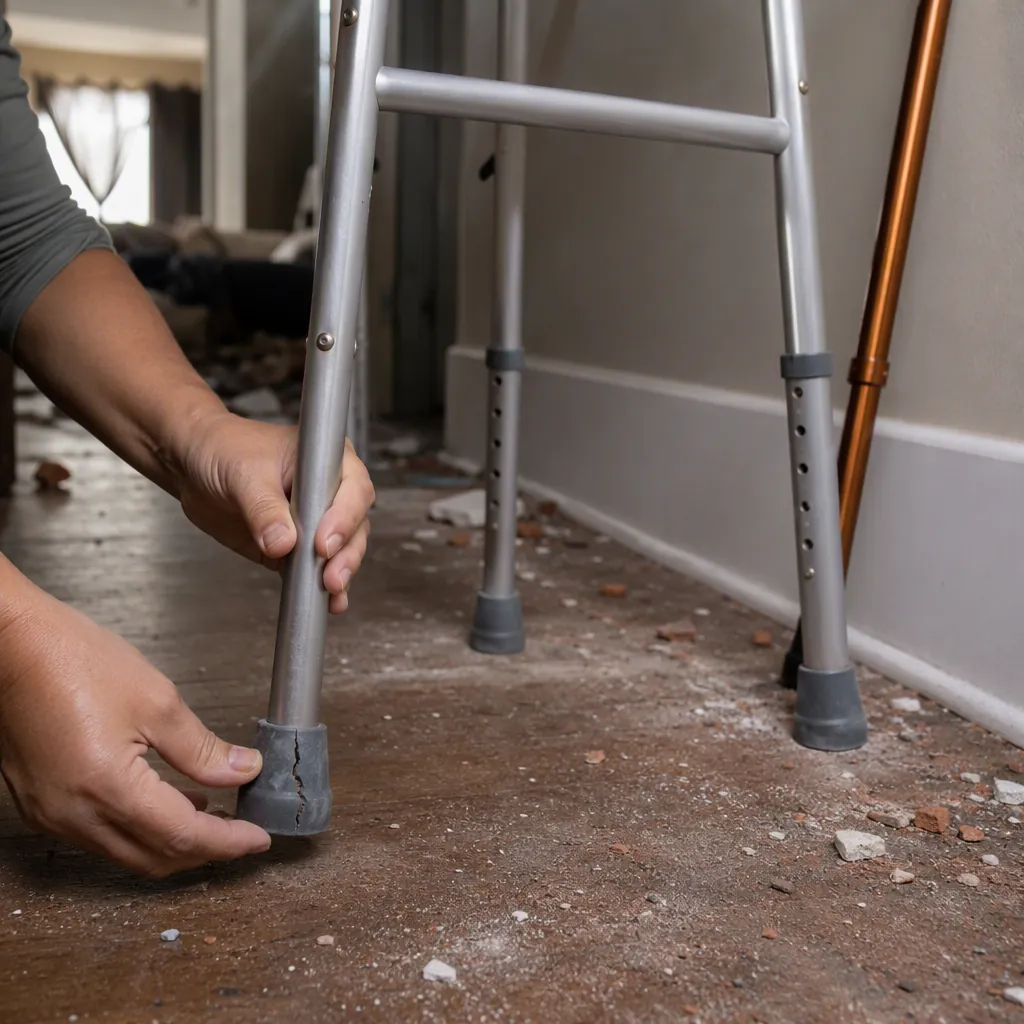
Walker
- Lift each leg and inspect the rubber tip. Look for embedded glass, gravel, plaster, or splinters.
- Check whether a tip is cracked, loose, worn through, or missing. A damaged tip can slide on tile or wood.
- Press down on the frame to feel for wobbling.
- If the walker has wheels, spin them and remove debris before use.
- Make sure the walker is on the same side of the room as your parent before they stand.
Cane
Turn the cane over and inspect the tip. A cane tip can pick up a shard, crack at the edge, or lose grip from dust and grit. Wipe the bottom before use. If the cane was leaning against a wall, check that it did not slide behind furniture or land under debris where your parent might bend and reach for it.
Wheelchair or transport chair
Test the brakes before transferring. Test them where the chair is, then again on the surface your parent will use next if that surface changes from carpet to tile, wood, or an entry ramp. Look for glass or debris around the wheels, footrests, and caster forks. Make sure footrests are not bent into the transfer path.
Backup matters because a quake can separate a person from the one aid they rely on. The California Department of Aging recommends keeping multiple walking aids, such as canes or walkers, in different rooms so a displaced aid does not strand someone. [3]
If you are guiding from a distance
Phone instructions have to be shorter than in-person help. The older adult may be frightened, tired, hard of hearing, or trying to prove they are fine. Give one instruction at a time and keep them seated if the route has not been checked.
- Ask: “Are you sitting down?” If not, ask them to sit in the nearest stable chair if it is safe to do so.
- Ask: “Do you have sturdy shoes on?” If shoes are not reachable without walking, do not have them cross the room barefoot.
- Ask: “Do you have a flashlight?” If not, ask whether lights are working before they move.
- Ask them to describe the floor between their feet and the door, not the whole house.
- If they use a cane, walker, or wheelchair, ask where it is and whether it is reachable without bending, twisting, or stepping over debris.
- Call one of the designated check-in people if the path cannot be confirmed as clear.
The California Department of Aging recommends identifying two people who will check on an older adult after a disaster. In this moment, that is a fall-prevention tool, not just a contact-list item. One person may be unavailable, delayed, or outside the damaged area. [3]
If your parent cannot safely move and may need to signal from a room, the Red Cross recommends older adults keep a whistle for signaling if trapped. [5]
Why interrupted support raises the stakes
There is limited direct research in the available materials on fall rates among older adults specifically after earthquakes. The practical guidance here is stitched from earthquake safety instructions, senior disaster recommendations, and ordinary fall-prevention logic. That is worth saying plainly because a checklist should not pretend the evidence is more specific than it is.
Still, disrupted support is not a small issue. A 2026 Journal of the American Geriatrics Society study by Hoffen and colleagues found a 25% increase in fall-related deaths inside homes during the COVID-era period of disrupted care access. That is not earthquake data, and it should not be used as an earthquake statistic. It does show why a sudden interruption in help, routines, and safe movement inside the home can make falls more dangerous for older adults. [6]
The American Association for Geriatric Psychiatry also notes that forced relocation can be a severe stressor for frail older adults and can hasten decline, which is one reason safe shelter-in-place matters when the home can be made safe enough. [4]
When the home is clear enough for cautious movement
The home does not have to be restored before your parent can move. It does have to have a verified route. Clear enough means: shoes are on, lighting is working or a flashlight is placed, the path from bed or chair to bathroom and exit is free of glass and loose objects, stairs are avoided or checked, rugs are flat or removed, spills are controlled, the mobility aid has been inspected, and someone is available if the older adult becomes unsteady.
If any of those pieces are missing, keep movement limited. Close off unsafe rooms. Bring water, medications, glasses, hearing aids, phone, charger, and a light to the safest seated area if you can do so without creating another hazard. If the bathroom route is unsafe, do not ask your parent to hurry across it. If the walker tip is damaged, use a backup aid or wait for help.
After an earthquake, caring for an elderly parent starts at floor level. Work from the exit path inward, then through the rooms they actually need, then through the cane, walker, or wheelchair that must carry their weight. At the end of that route, the decision is practical: cautious movement can resume, or the home still needs assistance, check-ins, and avoided areas until the next step is safe.
References
- Earthquake Safety, American Red Cross.
- Safety Guidelines: After an Earthquake, Centers for Disease Control and Prevention.
- Disaster Preparedness Tip Sheets for Seniors, California Department of Aging.
- Older Adults and Disaster Preparedness and Response, American Association for Geriatric Psychiatry.
- Older Adults Emergency Preparedness, American Red Cross.
- Hoffen et al., Journal of the American Geriatrics Society, Journal of the American Geriatrics Society, 2026.
Related reading
Noticed something outdated or inaccurate on this page? Flag a correction. We review every report against CDC, NIA, and AARP HomeFit guidance before updating a page.
Part of the Fall Prevention section.