
STEADI: Intervene
Earthquake Safety for Seniors Who Can't Drop to the Floor
Standard 'drop to the floor' earthquake advice may not be possible for older adults with balance or mobility limitations. Find the adapted Drop, Cover, and Hold On move for your situation — cane, walker, wheelchair, or in bed — plus first-minute-after-shaking steps and a simple practice drill.
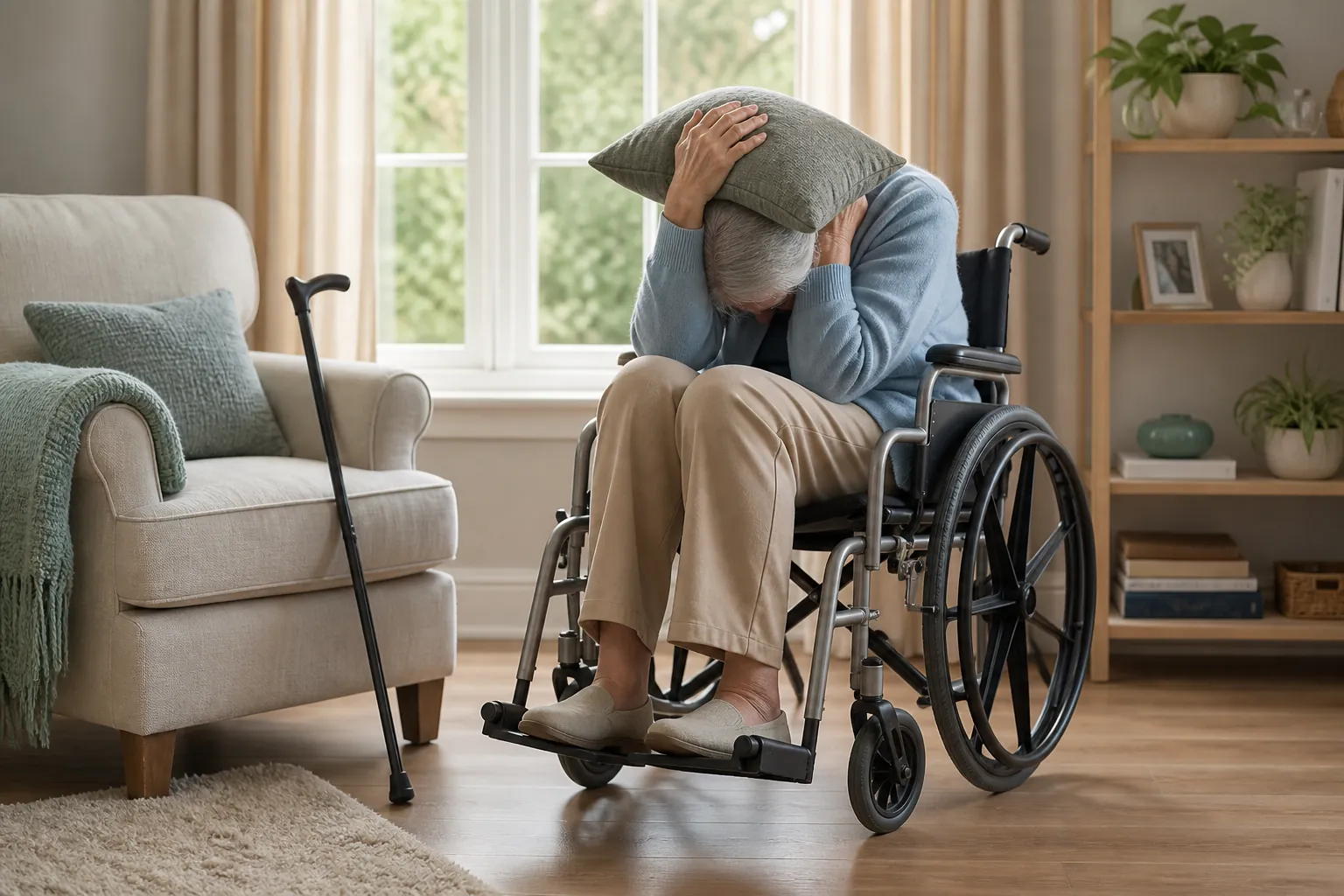
“Drop, Cover, and Hold On” is still the basic earthquake safety message. The problem is the word “drop” when dropping to the floor could become the injury. For earthquake safety for seniors with balance limits, a walker, a wheelchair, a painful knee, dizziness, or slow transfers, the safer move is the version you can actually perform during shaking: stay seated, lock wheels when applicable, get as low as you safely can, and cover your head and neck until the shaking stops.
Ready.gov gives adapted instructions for people who use canes, walkers, wheelchairs, and power chairs, including sitting on a chair or bed if getting to the floor is not possible, keeping the cane nearby for after the shaking, locking wheels where applicable, staying seated, and covering the head and neck with arms, a pillow, or a book until the shaking stops.[1] That is the practical starting point: do not turn an earthquake into a fall by trying to cross the room for a “better” spot.
The American Red Cross names the danger plainly: earthquake deaths and injuries happen when people fall while trying to walk or run during shaking, or when falling debris hits them.[2] For an older adult, the half-second decision to stand, step, pivot, or reach can matter as much as the falling object.
Choose the adapted move before the room starts moving
The right earthquake move is not based on what looks best in a diagram. It is based on what the person can do without losing balance while the floor, furniture, and walls are moving. Use the closest match below, then practice that exact move from the chair, bed, or mobility aid the person normally uses.
| Situation when shaking starts | Safer adapted move | What not to do |
|---|---|---|
| Using a cane | Drop, Cover, and Hold On if that is truly safe; otherwise sit on a chair or bed, cover head and neck with both hands, and keep the cane nearby for after shaking.[1] | Do not walk across the room to retrieve the cane or reach a preferred table. |
| Using a walker or rollator | Stay where you are if moving would be unsafe; lock wheels where applicable, stay seated if already seated, get as low as safely possible, and cover head and neck.[1] | Do not try to roll or step quickly to another room. |
| Using a wheelchair or power chair | Lock wheels where applicable, stay seated, get as low as possible, and cover head and neck with arms, a pillow, or a book until shaking stops.[1] | Do not transfer out of the chair during shaking. |
| In bed | Stay in bed if standing would be unsafe; cover head and neck with a pillow or your arms until shaking stops, then wait before getting up. | Do not rush to stand in the dark or reach for items on the floor. |
| Unable to get to the floor or reach a safer spot | Sit down or stay sitting where you are and cover your head with your arms until shaking stops.[3] | Do not keep moving because the “safe spot” is a few steps away. |
If you use a cane
- If you can safely get down, use the standard Drop, Cover, and Hold On position.
- If getting to the floor is unsafe, sit on a chair or bed instead.
- Cover your head and neck with both hands.
- Keep the cane nearby for after the shaking stops, not as a reason to walk during shaking.[1]
The cane is for the next movement, not the first one. If it is already in your hand or within easy reach, fine. If it is leaning against the dresser six feet away, the safer earthquake response is usually to stay put and cover.
If you use a walker or rollator
- Stop where you are instead of trying to steer to another room.
- If your walker or rollator has wheels and brakes you can secure without bending or lunging, lock them.
- If you are already seated, stay seated.
- Get as low as your position safely allows.
- Cover your head and neck with your arms, a pillow, or a book until the shaking stops.[1]
A walker can give stability in ordinary movement, but during an earthquake it can also tempt a person into taking “just a few steps.” Those few steps are exactly where many falls begin. If the walker is not already positioned for safe use, do not chase it.
If you use a wheelchair or power chair
- Stay in the chair.
- Lock the wheels where applicable.
- Get as low as possible while remaining safely seated.
- Cover your head and neck with your arms, a pillow, or a book.
- Hold that position until the shaking stops.[1]
This is one of the clearest places where adapted guidance is better than a slogan. A transfer during shaking adds a new hazard. The safer action is to make the chair as stable as possible, stay seated, and protect the head and neck.
If you are in bed
- Stay in bed if standing would be unsafe.
- Use a pillow or your arms to cover your head and neck.
- Stay there until the shaking stops.
- After the shaking stops, do not swing your feet to the floor automatically. Pause, look, and put on sturdy shoes before walking if shoes are within safe reach.[2]

The bed is a common place for bad instructions to sneak in. “Get under something sturdy” may sound sensible, but it may require a half-awake older adult to sit up, stand, step around bedding, and move in the dark while the floor is shaking. If that sequence is not safe on an ordinary night, it is not safer during an earthquake.
If you cannot get to the floor or reach a safer spot
- Sit down, or stay sitting if you are already seated.
- Cover your head with your arms.
- Stay there until the shaking stops.[3]
This instruction is plain, and that is why it is useful. It removes the pressure to find the “perfect” place after the earthquake has already started. If the safer spot is not reachable without a risky transfer or several unsteady steps, it is not reachable for this earthquake.
The first minute after shaking stops is still fall prevention
The shaking stops, and the urge is to stand immediately: check the house, find the phone, get to the door, reach the walker. That first push upward deserves as much caution as the shaking itself.
- Stay still for a moment and check your body position. Are your feet planted? Is the walker or cane actually within reach? Are you dizzy?
- Wait about a minute before getting up. The Red Cross specifically advises waiting about a minute after shaking stops before getting up.[2]
- Before walking, put on sturdy shoes. Broken glass is one of the most common earthquake injuries, according to the Red Cross.[2]
- Use the mobility aid that belongs to that spot: the cane by the chair, the walker by the bed, the wheelchair brakes, the bedside shoes.
- Move slowly enough that a caregiver, neighbor, or support person can assist if one is part of the plan.
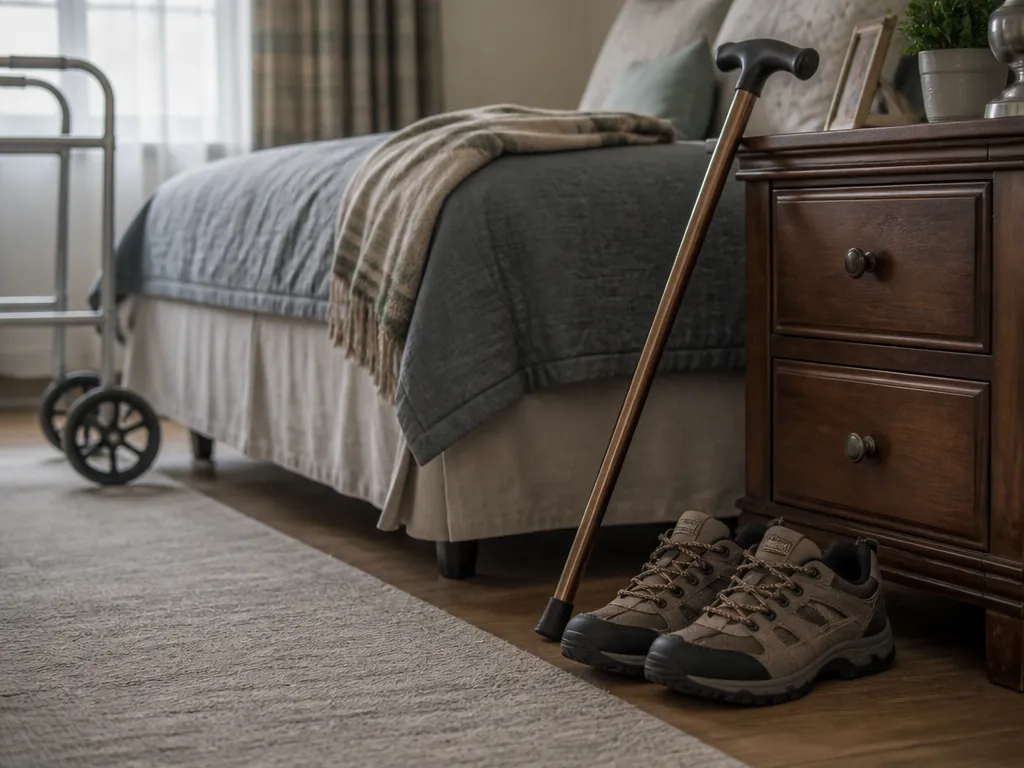
This is where the cane, walker, and shoes matter most. During shaking, they should not become bait across the room. After shaking, they become the difference between a controlled first step and a barefoot walk through debris.
If power is out or the home may be unsafe, emergency supplies become part of the next problem, not the first movement. A practical companion step is to keep a senior-focused backup kit where it can be reached without climbing, bending, or crossing clutter; this 72-hour senior power outage safety kit is a better next read than trying to build an entire disaster plan in the middle of this one decision.
Set up each room around the move you will actually use
Preparedness advice gets more useful when it starts with the body in the room. Ready.gov’s older-adult planning guidance emphasizes assessing needs, making a plan, and engaging a support network.[5] For earthquake response, that can be as simple as walking through the home and asking: if shaking began here, where would I sit, what would cover my head and neck, and what would I need after the shaking stops?
Earthquake Country Alliance also provides free video adaptations for wheelchair, power wheelchair, cane, crutches, walker, and rollator users.[4] Those videos are worth using because the difference between “cover your head” and “cover your head from this seated position” is not small for someone with limited balance.
Room setup does not have to be dramatic. It usually means putting the ordinary objects in the right ordinary places: the cane beside the bed instead of against a far wall, the walker parked where it does not block the path, sturdy shoes within reach, and a pillow or firm cushion close to the chair where the person spends the evening.
If a room has no realistic seated safe spot, that is a home-arrangement problem to solve before an earthquake. The same thinking used for prioritizing aging-in-place modifications applies here: reduce the movements that require fast balance corrections, reaching, twisting, or stepping around obstacles.
A simple practice drill
Practice should be short enough that it actually happens. The goal is not to simulate panic. The goal is to remove the first unsafe improvisation.
- Choose one room where the older adult spends the most time.
- Name the exact move for that room: “stay in the recliner and cover with the pillow,” “lock the wheelchair and cover head and neck,” or “sit on the bed and cover with both hands.”
- Place the head-and-neck cover where it can be reached without standing.
- Place the cane, walker, wheelchair, and sturdy shoes for after the shaking, not across the room.
- Practice once from the usual chair and once from bed.
- If there is a caregiver, neighbor, or family contact, have that person watch the drill and fix anything that requires a risky reach or transfer.
- Repeat the same process for the next room only after the first room has a move that works.
The finished plan should sound almost boring: stay seated, lock wheels if needed, cover head and neck, wait before standing, put on shoes, then use the mobility aid. Boring is good. It means the first movement has already been decided.
References
- Earthquakes | Ready.gov (FEMA). Ready.gov.
- Earthquake Safety | American Red Cross. American Red Cross.
- Planning Guide for Seniors | Illinois IEMA-OHS. Illinois IEMA-OHS.
- Resources for People With Disabilities and Other Access or Functional Needs | Earthquake Country Alliance. Earthquake Country Alliance.
- Older Adults | Ready.gov (FEMA). Ready.gov.
Related reading
Noticed something outdated or inaccurate on this page? Flag a correction. We review every report against CDC, NIA, and AARP HomeFit guidance before updating a page.
Part of the Fall Prevention section.