
STEADI: Intervene
Heat Wave Safety Checklist for Seniors
A heat wave safety checklist for seniors: how to prepare before the heat arrives, run a daily cooling and hydration routine, and recognize when heat stroke means calling 911.
When a heat advisory is already on the screen, a heat wave safety checklist for seniors has to answer one question fast: what needs to happen today, before the apartment gets hot and everyone starts negotiating by phone? The danger is not only the number in the forecast. It is the missing routine: an air conditioner nobody has tested, a parent who says a fan is fine, a medication list that has not been reviewed since spring, and a “check-in” promise that has no time attached to it.
The urgency is real, but it does not need to be inflated. CDC identifies adults 65 and older as higher risk because older bodies adjust to temperature changes less quickly, and chronic medical conditions and some medicines can interfere with cooling, thirst, or sweating.[1] In the United States, 3,066 heat-related deaths were recorded for 2018 through 2020.[2] A study of older Medicare beneficiaries with chronic conditions, using 2007–2012 data, found heat waves were associated with a 21% to 33% rise in heat-related hospitalizations; that is direction and magnitude evidence, not a current personal forecast for any one parent.[3]
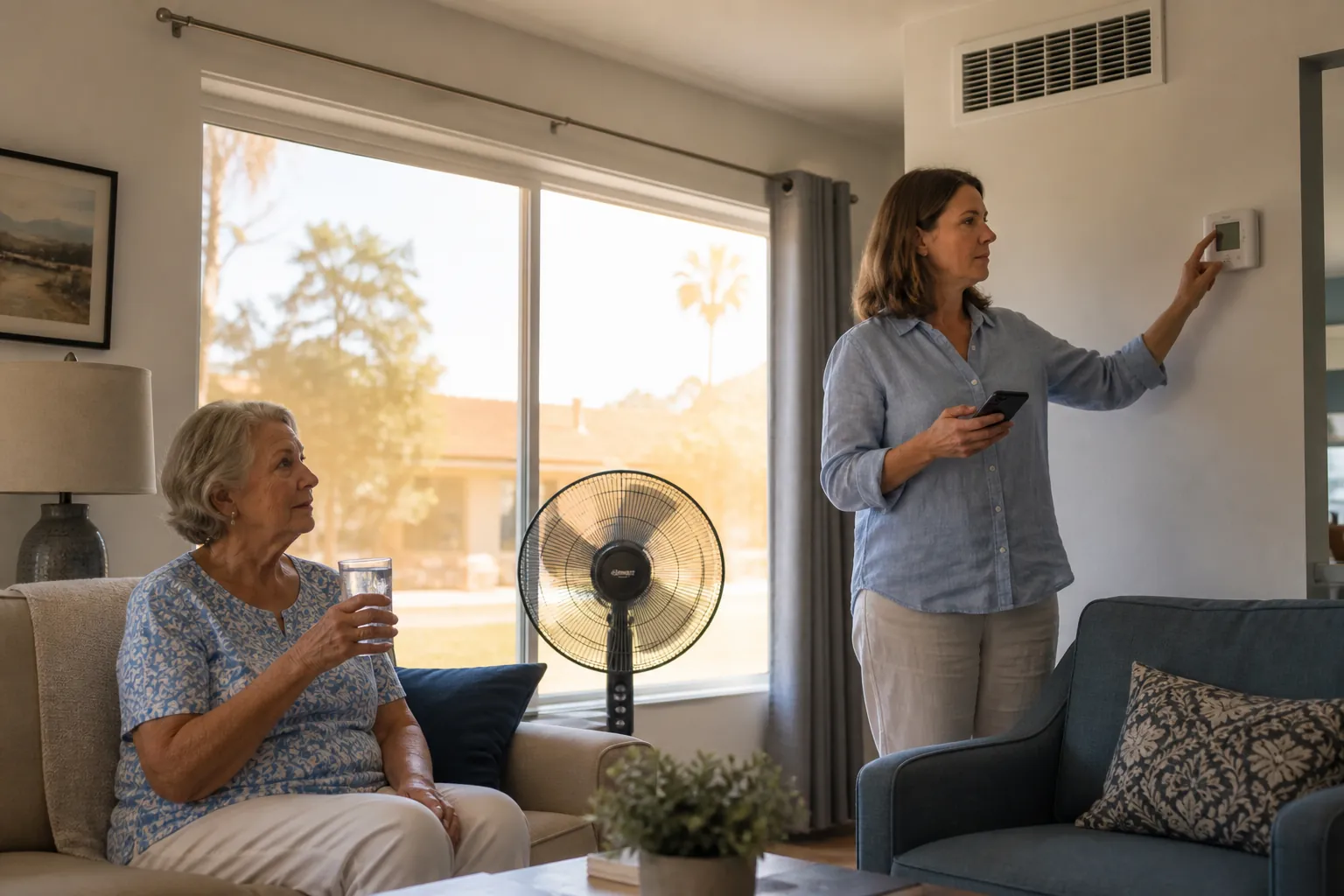
The checklist in one pass
| Phase | What has to be true |
|---|---|
| Plan ahead | The home is pre-cooled, AC works or a cooling place is chosen, medicines are supplied and reviewed, hydration limits are confirmed, and two daily check-ins have names and times. |
| During the heat | The day is built around cooling the body: steady fluids if allowed, light clothing, no stove or oven heat, cool showers or wet cloths, and no false confidence in a fan. |
| Act now | Cramps, exhaustion, and heat stroke are treated as a ladder. Confusion with hot dry or damp skin and a rapid pulse ends home care and starts a 911 call. |
If the heat is already here, do not wait to complete the whole plan perfectly. Start with the person, the room, and the symptoms: get them into the coolest available space, check whether they are acting like themselves, and decide whether this is still a home-cooling situation or an emergency.
Plan ahead: make the cool place real before it is needed
“Stay in air conditioning” is useful only if someone has confirmed where that air conditioning is. The Red Cross describes air-conditioned buildings as the safest place during extreme heat.[4] For an older adult at home, that means the plan starts with a specific room, a working AC unit, and a backup location.
- Turn on the AC before the heat peaks. Make sure cool air actually comes out, the filter is not obviously clogged, and the room temperature drops.
- Choose the coolest room for daytime use. Close curtains or blinds before direct sun hits the windows.
- Move water, medications, phone chargers, a thermometer, and a chair with arms into or near that room.
- If the home has no reliable AC, identify the cooling center, library, senior center, mall, or relative’s home before transportation becomes urgent.
- Write down who drives, who calls the ride, and what time the move happens if the home is not staying cool.
Room-by-room cooling can get fussy, and that is better handled before the forecast turns ugly. Use a fuller home cooling plan for seniors for the thermostat, curtains, window timing, and backup-room details. For this checklist, the test is simple: if the senior cannot spend the hottest hours in a cool place, the plan is not done.

Medication and hydration checks belong in the plan-ahead phase
Heat advice often says “drink more water” and then walks away from the hard part. Some older adults are on fluid restrictions. Some take water pills. Some have heart, kidney, or blood pressure conditions where the right amount of fluid is not a guess.
CDC clinician guidance flags several medication groups that can affect heat response, including diuretics, anticholinergics, some psychotropic medicines, and ACE-inhibitor-plus-diuretic combinations. It also directs clinicians to consider individualized fluid guidance for people on fluid restrictions or water pills.[5] AARP’s medication guidance for heat includes common categories caregivers recognize on real pill lists, such as diuretics, antihistamines, antidepressants, antipsychotics, blood pressure drugs, and stimulants.[6]
The practical step is not to stop medicines because the forecast is bad. The step is to call the doctor, pharmacist, or prescribing office before the hottest stretch and ask three plain questions:
- Does anything on this medication list increase heat risk or reduce sweating, thirst, alertness, or blood pressure stability?
- How much fluid should be taken each day during the heat wave, given this person’s diagnoses and prescriptions?
- What symptoms should trigger a call to the office, urgent care, or 911 for this specific person?
Refill enough medicine to avoid a pharmacy trip during the worst heat. A one-month supply is a practical target when the prescription and insurance situation allows it. Put the current medication list, pharmacy number, doctor number, allergies, and emergency contacts in the same place as the thermometer and phone charger.
Assign check-ins that have a name and a clock time
CDC’s caregiver checklist for older adults during heat includes visiting or calling at least twice a day and checking whether the person is drinking enough water, has access to air conditioning, knows how to keep cool, and has signs of heat stress.[1] “Someone will check on her” is not that.
- Choose the morning check-in person and time.
- Choose the late-afternoon or evening check-in person and time.
- Decide what happens if there is no answer: second call, neighbor knock, building staff call, or wellness check.
- Ask observable questions: What room are you in? Is the AC on? When did you last drink? Are you dizzy, nauseated, cramping, weak, confused, or unusually sleepy?
For an older adult living alone, the details matter enough to deserve their own routine. Use the twice-daily heat wave check-in plan to set scripts, missed-call rules, and escalation contacts.
During the heat: run the day around cooling, not errands
The daily routine should be boring on purpose. It reduces decisions when everyone is tired.
- Drink regularly, using the amount confirmed by the doctor if there is fluid restriction, kidney or heart disease, or a water pill.
- Wear loose, lightweight, light-colored clothing.
- Keep meals simple and avoid using the stove or oven during the hottest part of the day.
- Use cool showers, cool baths, or wet cloths on the neck, wrists, and underarms if the person is warm but alert.
- Stay in the coolest available room, preferably air conditioned.
- Postpone errands, laundry, yard work, and appointments that require waiting outside or sitting in a hot car.
A fan is not a cooling plan by itself. CDC warns that when indoor temperatures are above about 90°F, fan use can increase body temperature instead of lowering it.[1] The National Weather Service and Red Cross both caution not to rely on electric fans as the main cooling method in very hot conditions, often described as the high 90s.[7][4] The exact cutoff is less useful than the practical rule: if the air in the room is hot and the person is getting weaker, sweatier, more confused, or more uncomfortable, do not keep troubleshooting the fan.
Heat also changes fall risk. Nighttime bathroom trips increase when someone is drinking more, moving in a dim room, or feeling lightheaded after a hot day. For that specific problem, use the heat wave nighttime bathroom fall plan rather than trying to solve it at 2 a.m.
Act now: the warning-sign ladder
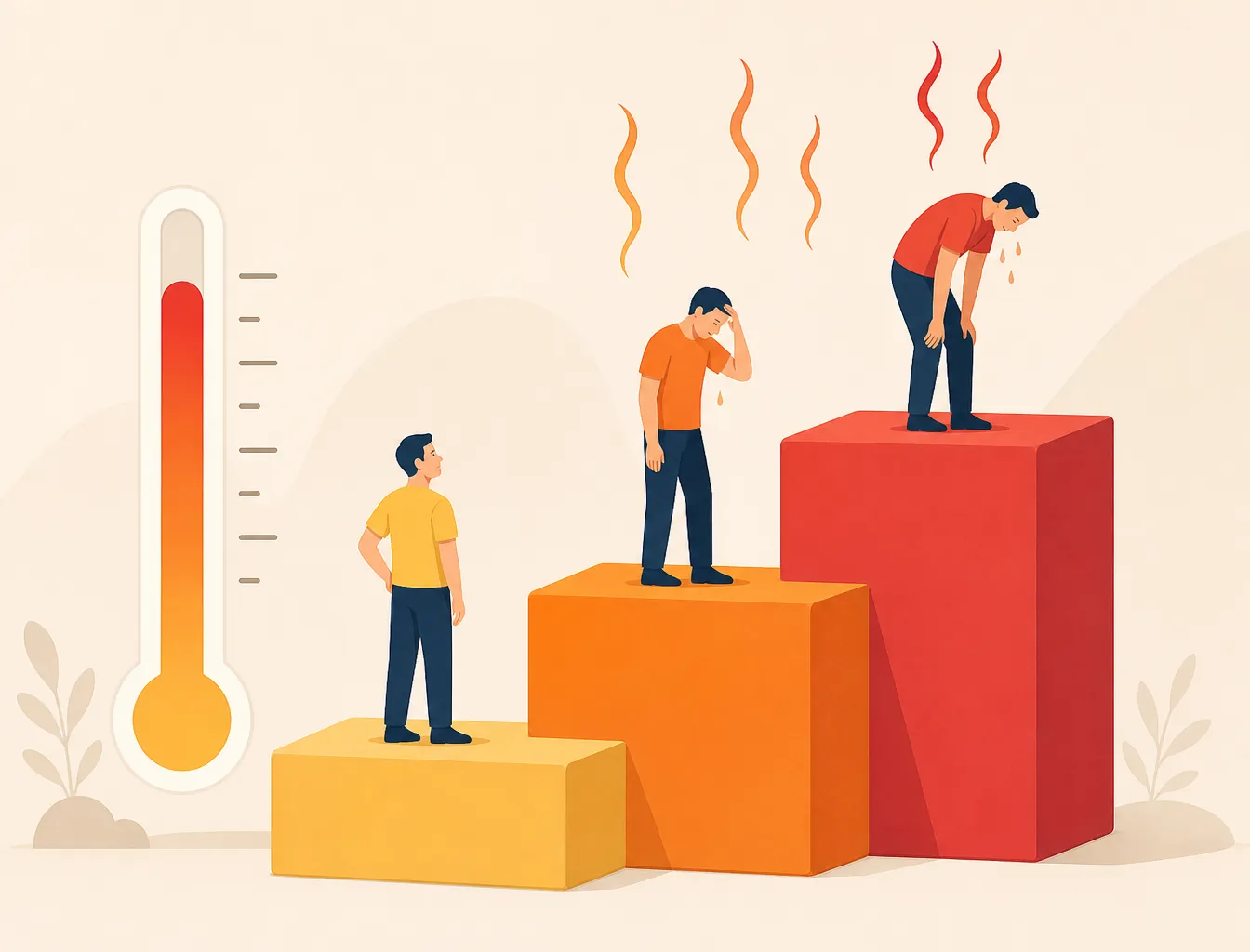
Heat illness often gives caregivers a little time at the lower steps and no room for delay at the top. CDC NIOSH and the National Weather Service describe a progression that includes heat cramps, heat exhaustion, and heat stroke.[8][7]
| Level | What you may see | What to do |
|---|---|---|
| Heat cramps | Painful muscle cramps or spasms, often in the legs or abdomen, after heat exposure. | Stop activity, move to a cool place, sip fluids if allowed, and monitor closely. If cramps last longer than 1 hour, seek medical care. |
| Heat exhaustion | Heavy sweating, cool pale clammy skin, fast weak pulse, dizziness, weakness, headache, nausea or vomiting, fainting. | Move to a cooler place, loosen clothing, cool the body with wet cloths or a cool bath, and sip water if fully awake and allowed. Get medical help if symptoms worsen or do not improve. |
| Heat stroke | Confusion, altered behavior, loss of consciousness, hot dry or damp skin, and a rapid strong pulse; body temperature may be very high. | Call 911. Move the person to a cooler place and cool with wet cloths or a cool bath while waiting. Do not give fluids. |
At the cramps stage, home action can still make sense if the person is alert, improving, and able to drink within their medical limits. The National Weather Service advises getting medical help if heat cramps last more than 1 hour.[7] That one-hour mark is useful because it keeps “let’s wait and see” from stretching through the hottest part of the day.
Heat exhaustion is more serious. The National Weather Service lists warning signs including heavy sweating, cool pale clammy skin, a fast weak pulse, nausea or vomiting, muscle cramps, tiredness or weakness, dizziness, headache, and fainting.[7] This is the point for active cooling, not a casual reminder: move the person to air conditioning, loosen clothing, use cool wet cloths or a cool bath, and stay with them.
Heat stroke is different. This is where home care ends. The National Weather Service uses a body temperature threshold of 103°F for heat stroke, while the Red Cross and Mayo Clinic use 104°F.[7][4][9] Do not make the thermometer the only gatekeeper. If an older adult is confused or not acting right, has hot dry or damp skin, and has a rapid pulse, call 911.
While waiting for emergency responders, move the person to a cooler place and start cooling with wet cloths or a cool bath if it can be done safely. The Red Cross says not to give fluids to someone with suspected heat stroke.[4] That can feel wrong when every other part of the day has been about hydration, but the priority has changed: airway, consciousness, emergency response, and rapid cooling.
If the AC is out, the apartment is heating up, and symptoms are already appearing, use the heat wave power outage safety plan for seniors. No-AC heat is not just an inconvenience for an older adult; it removes the main protective layer the plan depends on.
One-page heat wave safety checklist for seniors
Before the heat arrives
- Test the AC and confirm the coolest room.
- Close curtains or blinds before direct sun hits.
- Set up the cool room with water, medications, phone charger, thermometer, emergency contacts, and a sturdy chair.
- Choose a backup air-conditioned location and transportation plan.
- Refill medications, aiming for a one-month supply when possible.
- Ask the doctor or pharmacist which medications increase heat risk.
- Confirm the safe daily fluid amount if there is fluid restriction, heart or kidney disease, or a water pill.
- Assign two daily check-ins with names, times, and a missed-call backup.
Every day during the heat wave
- Stay in air conditioning during the hottest hours.
- Drink regularly within clinician-approved limits.
- Wear loose, light clothing.
- Avoid stove and oven use when the home is hot.
- Use cool showers, baths, or wet cloths if warm but alert.
- Do not rely on a fan as the only cooling method when indoor air is hot.
- Cancel or move errands that require heat exposure.
- Keep bathroom paths lit and clear for extra hydration-related trips.
Call for help
- For cramps: stop activity, cool down, sip fluids if allowed, and seek medical care if cramps last more than 1 hour.
- For exhaustion signs: heavy sweating, cool clammy skin, fast weak pulse, dizziness, nausea, vomiting, headache, weakness, or fainting means active cooling and close monitoring.
- For heat stroke signs: confusion, not acting right, loss of consciousness, hot dry or damp skin, and a rapid pulse mean call 911 now.
- While waiting for 911: move to a cooler place, cool with wet cloths or a cool bath if safe, and do not give fluids.
For related seasonal planning, use the winter storm safety checklist for seniors and the power outage safety checklist for seniors.
References
- Heat and Older Adults (Aged 65+) — CDC
- QuickStats: Number of Deaths from Heat-Related Causes, by Sex — National Vital Statistics System, United States, 2018–2020 — CDC MMWR
- Heatwaves, medications, and heat-related hospitalization in older Medicare beneficiaries with chronic conditions — PLoS ONE
- Extreme Heat Safety — American Red Cross
- Heat and Medications – Guidance for Clinicians — CDC
- 8 Types of Medications That Can Make It Harder to Handle the Heat — AARP
- Heat Cramps, Exhaustion, Stroke — National Weather Service
- Heat-related Illnesses — CDC NIOSH
- Heatstroke — Mayo Clinic
Related reading
Noticed something outdated or inaccurate on this page? Flag a correction. We review every report against CDC, NIA, and AARP HomeFit guidance before updating a page.
Part of the Fall Prevention section.