
STEADI: intervene
How Seniors Living Alone Can Stay Safe in a Flash Flood
A step-by-step flash flood safety checklist designed for seniors living alone, with every evacuation and supply step adapted to reduce fall risk and accommodate mobility limitations.
Six inches of fast-moving water is not “just ankle-deep” when the person stepping into it is holding a cane, carrying a medication bag, or trying to keep balance on a dark porch. The Red Cross warns that 6 inches of moving water can knock a person down, and 12 inches can carry away a vehicle.[1] For seniors living alone, that makes the flash flood checklist a fall-prevention plan as much as an evacuation plan.
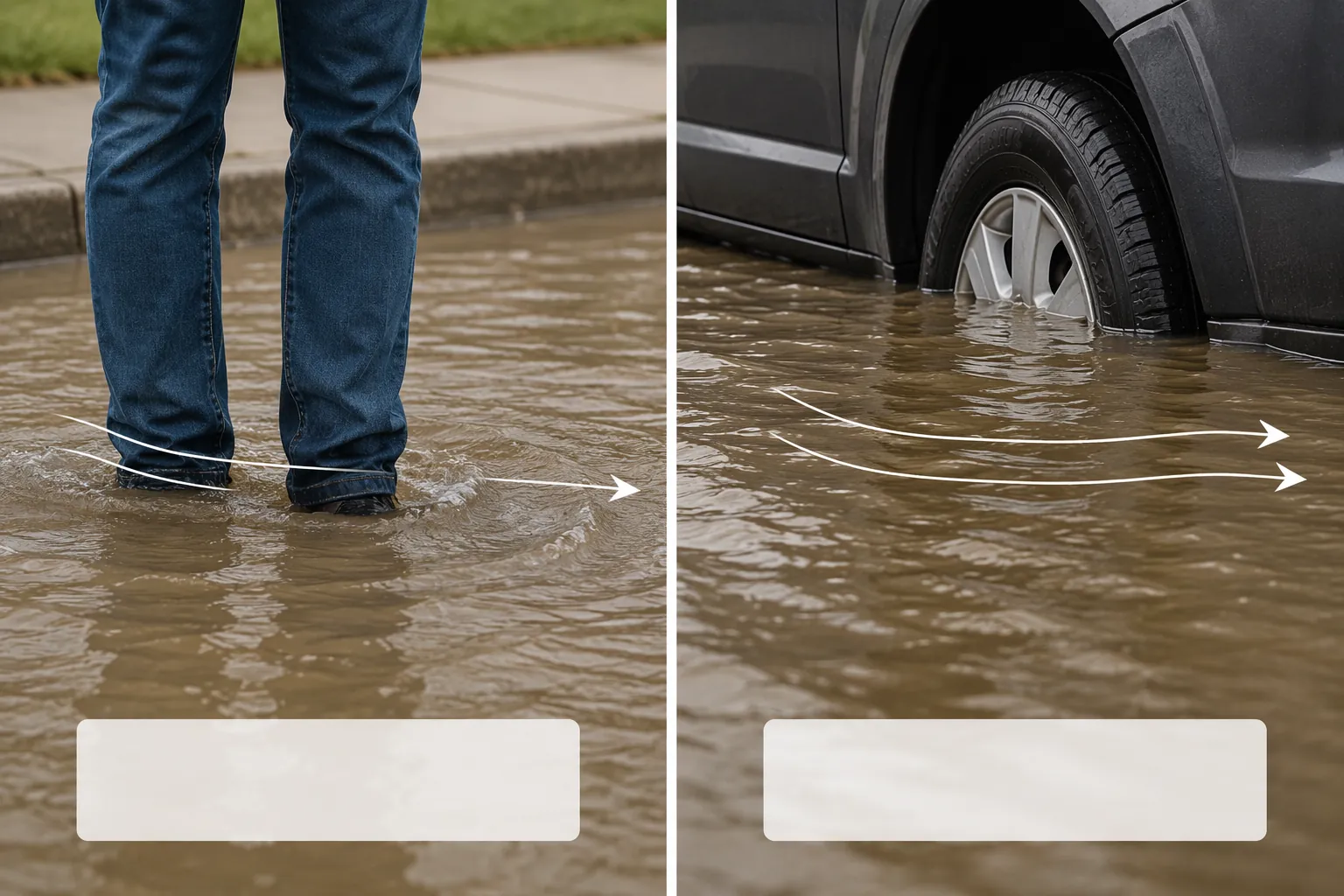
The first rule is simple: do the gathering before the warning. NOAA distinguishes a flash flood watch from a flash flood warning in plain terms: a watch means flooding is possible and you should be prepared; a warning means flooding is imminent or already happening and you should act now. NOAA also notes that a watch may offer 30 to 60 minutes of lead time, which is not much, but it is enough to put on shoes, call a contact, move a walker to the door, and leave before the floor is wet.[2]
That distinction matters because a person living alone cannot assume someone will arrive in time to search for glasses, lift a supply bin, or decide which doorway is safest. Ready.gov’s older-adult guidance reduces preparedness to three workable duties: assess your needs, make a plan, and engage your support network.[3] The checklist below follows that order, but it treats every step as something that may have to be done in low light, under stress, with one hand on a rail.
The Printable Timeline
| When | Main job | Fall-prevention rule |
|---|---|---|
| Before flood season | Write the plan, stage supplies, assign contacts | Keep paths clear; place items where they do not become trip hazards |
| When a watch is issued | Dress, call contacts, move essentials to the exit | Shoes and walking aid come before bags |
| When a warning hits | Leave immediately if evacuation is ordered or water threatens the home | Do not step into moving water; possessions wait |
| During evacuation or sheltering | Stay on the safest available route or highest safe level | Keep hands free; use rails, walls, or a stable walking aid |
| After water recedes | Delay re-entry until it is safe; check for injuries and contamination | Assume wet floors, mud, and debris can cause a fall |
AARP has reported a stubborn preparedness gap among adults 50 and older: 60% say they feel prepared, but fewer than 3 in 10 have a written emergency plan, 1 in 3 do not have extra prescription medicine, and only 12% follow local authorities on social media.[4] Confidence is useful only if it can be found when the lights are out. A paper plan on the refrigerator, in large print, beats a plan remembered vaguely while rain is hitting the windows.
Before Flood Season: Make the Plan Boring Enough to Use
The best time to decide what to carry is when nothing is beeping, leaking, or floating. Start with the house itself. Mark the safest exit that does not require crossing a low spot, stepping over loose thresholds, or using porch steps without a rail. If the house has more than one door, choose the route that gives the best footing, not the shortest route.
- Post one large-print page on the refrigerator with evacuation address, local emergency numbers, medication list, allergies, mobility limits, and contact names.
- Put a second copy in a sealed plastic bag inside the go-bag, along with copies of insurance cards, ID, and medical contacts.
- Stage slip-resistant shoes, a flashlight, glasses, hearing aids, phone charger, and walking aid near the exit, but outside the walking path.
- Choose two check-in people: one nearby person who can knock or call, and one out-of-area person who can keep calling if local lines are busy.
- Write down the rule for each contact: who calls at a watch, who calls at a warning, and who calls emergency services if there is no answer.
Medication deserves its own small system. The Red Cross recommends older adults keep a 30-day supply of medications on hand when possible and use a cooler with ice packs for medicines that need refrigeration.[1] That does not mean lifting a heavy cooler into a hallway during a warning. It means deciding ahead of time what goes in the cooler, where the ice packs are, and whether the medicine can be carried safely by one person.
Do not let the go-bag become a weightlifting test. A smaller crossbody bag or backpack is often safer than a tote because it leaves both hands available. If a walker is used, do not hang a heavy bag from one side where it can tip the frame. Use a basket or pouch designed for the walker, and keep the total load light enough that turning around does not pull the body off balance.
When a Flash Flood Watch Is Issued
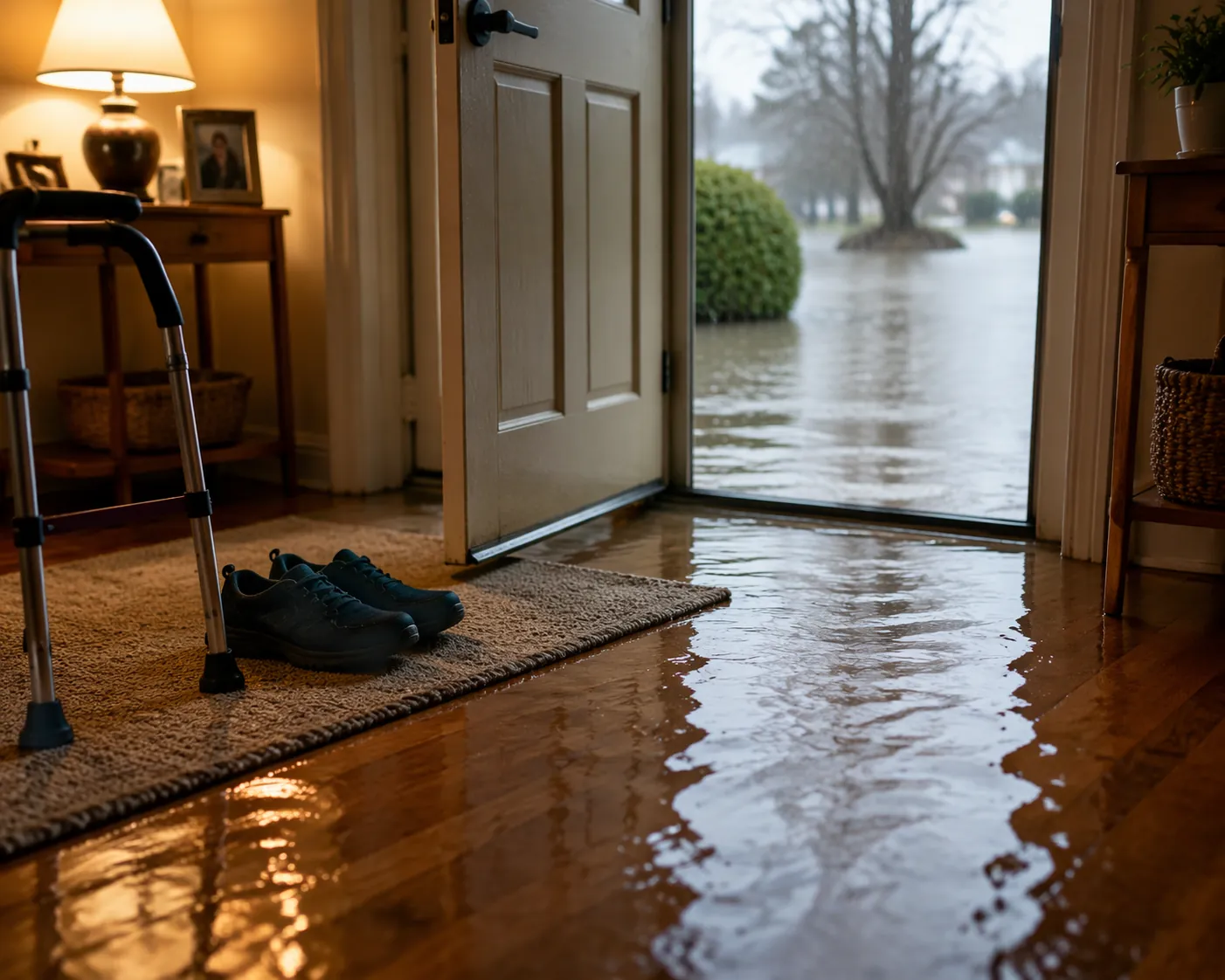
A watch is the last useful preparation window. It is not the time to wait and see whether the creek looks high. It is the time to move slowly while slow movement is still possible.
- Put on closed-toe, slip-resistant shoes before touching the go-bag.
- Put on glasses and hearing aids, then put backup batteries or a charging case in the bag.
- Place the cane, walker, or rollator at the chosen exit, pointed in the direction of travel.
- Call or text the assigned watch contact: “Flash flood watch here. I am dressed, packed, and monitoring.”
- Move medications, phone, charger, wallet, keys, and waterproof document pouch into the carry bag.
- Bring pets into one room if they are part of the plan, but do not chase an animal into a garage, yard, ditch, or flooded area.
- Check the local emergency alert source, weather radio, or local authority feed; do not rely on one app alone.
This is also the moment to reduce bending. Put the phone in a pocket, not on a counter. Put keys on a lanyard or in the same zipped pocket every time. If sandbags, outdoor furniture, or trash bins are still outside, leave them unless they can be moved without stepping onto slick ground. A sprained wrist from a rushed porch chore can ruin the evacuation that follows.
Adult children who live elsewhere can help most at this stage by calling early and sticking to the written plan. A useful call sounds like: “Do you have shoes on? Is your cane at the door? Is your medication bag zipped? Are you leaving if the warning comes?” It does not require arguing over radar images from another city.
When a Flash Flood Warning Hits
A warning changes the job. Gathering is over. If local officials order evacuation, or if water is entering the street, yard, garage, or house, leave by the safest dry route if that route still exists. If there is no dry route, move to the highest safe interior level or location available and call for help.
The hard rule is worth writing in thick marker: do not step into moving water. Not to move the car. Not to retrieve a purse. Not to test whether the driveway is still passable. The 6-inch rule is not a scare line; it is a balance rule.[1]
- If the floor is dry: leave with shoes on, walking aid in hand, phone on body, and bag secured close to the body.
- If the floor is wet but water is not moving: take shorter steps, keep one hand on a stable surface when available, and avoid carrying anything loose.
- If water is moving across the floor or porch: do not cross it; call 911 or local emergency services and move higher if possible.
- If using a walker: do not push it into moving water, mud, or debris; wheels can catch and pitch the body forward.
- If using a cane: do not use it to “test” flowing water from an unstable position; probing only helps when both feet are on secure ground.
Do not lock the door at the cost of balance. Do not turn back for photo albums, laundry, frozen food, mail, or a better coat. A checklist cannot remove the anger of leaving things behind, but it can settle the order of importance before pride starts negotiating.
Evacuating Without Creating a Second Emergency
Evacuation instructions often say “go to higher ground,” as if everybody can climb quickly, see well in rain, and carry supplies without changing balance. For a senior alone, higher ground must be reached by the safest surface available, not the most direct one.
- Use the route chosen before flood season unless it is already wet, blocked, or dark enough to hide hazards.
- Keep both hands as free as possible; wear the bag instead of carrying it by hand.
- Turn on the flashlight before stepping out, not after reaching the porch.
- Step down one step at a time, leading with the stronger leg when descending if that is the usual safe pattern.
- Avoid grass, slopes, ditches, curb cuts, and painted concrete when a dry sidewalk or ramp is available.
- If a neighbor is the planned ride, call before opening the door and wait inside on dry flooring until the ride is visible.
Driving is not automatically safer than walking. NOAA’s warning language means the hazard is imminent or occurring.[2] If water covers the road, the curb, or the low bridge that usually looks harmless, do not drive into it. If the car is already surrounded by water, stay out of the water and call for help rather than trying to wade to it.
For a fuller look at leaving home without falling during a fast-moving evacuation, the same movement principles appear in this wildfire evacuation guide: how to help your elderly parent evacuate without falling. The hazard differs, but the body mechanics are familiar: shoes first, hands free, route chosen before panic.
If Sheltering Is Safer Than Leaving
Sometimes the safe evacuation window closes. If moving outside would require stepping into moving water, sheltering in place may be the safer immediate choice while calling for rescue or emergency instructions.
- Move to the highest safe level or highest dry room available without using flooded stairs.
- Keep phone, charger, medication, water, flashlight, shoes, and walking aid within arm’s reach.
- Call the warning contact and state location clearly: “I am inside, in the front bedroom, water outside, not going out.”
- If calling emergency services, describe mobility needs plainly: cane, walker, wheelchair, oxygen, hearing loss, or inability to climb.
- Do not enter an attic unless there is a safe exit route; being trapped above rising water creates another danger.
Keep the door unlocked only if local conditions and personal safety make that sensible; otherwise, be ready to tell responders how to enter. If hearing is limited, keep a light near a window and the phone close enough to feel vibration. The goal is not to appear self-sufficient. The goal is to be found without falling while trying to signal.
Why Older-Adult Planning Cannot Be Generic
Older adults have been overrepresented in major storm deaths. AARP’s Disaster Resilience Tool Kit reports that adults 75 and older were 6% of New Orleans’ population but accounted for 50% of Hurricane Katrina deaths; during Hurricane Ian, 61 of 87 identified fatalities were age 60 or older.[5] Those numbers do not mean every older person is helpless. They mean evacuation timing, transportation, mobility, medication, communication, and re-entry rules have to be planned before the water rises.
Flash floods also differ from slower-moving storms. A hurricane may give days of notice; a flash flood may give minutes. If you are preparing for a multi-day warning event as well, keep a separate companion plan such as this hurricane preparedness checklist for seniors living alone. The flash flood version should stay shorter, more visible, and more ruthless about timing.
After the Water Recedes
The danger does not end when the street looks passable. A July 2025 Harvard T.H. Chan School of Public Health report found that flood exposure was associated with older-adult hospitalization increases of up to 1.7% for injuries and up to 5.6% for musculoskeletal diseases in the 4 weeks after a flood.[6] That finding should be read carefully: it does not predict what will happen to one person after one flood. It does support a practical warning that falls, strains, contaminated cuts, and cleanup injuries can show up after the dramatic part has passed.
Do not re-enter the home until local officials say it is safe and the structure appears stable from outside. If water entered the house, assume the floor is slick, uneven, and contaminated. The CDC warns that floodwater can contain sewage, chemicals, sharp debris, and other hazards; it recommends protective gear such as rubber boots, waterproof gloves, and an N95 respirator for cleanup, and says cuts or puncture wounds should prompt a tetanus check.[7]
- Do not enter alone if floors are wet, warped, muddy, or covered with debris.
- Do not carry wet boxes, rugs, or appliances; water weight changes balance quickly.
- Photograph damage from the doorway or another stable place before stepping farther inside.
- Throw away contaminated soft goods only when help is available to lift and bag them safely.
- Check feet, shins, hands, and arms for cuts, blisters, punctures, swelling, or new pain after any contact with floodwater.
- Call a clinician, pharmacist, or local health department if medication, medical equipment, oxygen supplies, or refrigerated drugs were exposed to heat or floodwater.
Cleanup can wait for stronger backs, better light, and dry footing. A chair pulled onto a wet floor, a rug half-floating at the threshold, or a swollen door that has to be forced open can cause the fall that the evacuation avoided.
The Refrigerator Version
- Before season: write the plan, name two contacts, stage shoes, walking aid, flashlight, phone charger, medication list, and light go-bag.
- At watch: put on shoes, secure hearing and vision aids, move the walking aid to the exit, call the watch contact, and gather only the listed essentials.
- At warning: leave immediately if the dry route is open and evacuation is ordered; if moving water blocks the route, stay out of it and call for help.
- During movement: keep hands free, use the safest dry surface, avoid slopes and ditches, and never step into moving water.
- If sheltering: move to the highest safe dry place, keep supplies within reach, state mobility needs when calling for help, and stay visible.
- After flood: wait for clearance, do not re-enter alone on wet floors, wear protective gear if cleanup is necessary, and check every cut or new pain.
The finished plan should be visible, specific, and a little strict: named contacts, staged supplies, dry-route choices, medication instructions, and one rule that does not change under pressure. No possession, shortcut, car, porch chore, or re-entry task is worth a fall in floodwater.
References
- Older Adults, American Red Cross, https://www.redcross.org/get-help/how-to-prepare-for-emergencies/older-adults.html
- Flood Watch vs. Warning, National Weather Service, https://www.weather.gov/safety/flood-watch-warning
- Disaster Preparedness Guide for Older Adults, Ready.gov, https://www.ready.gov/older-adults
- AARP 2023 Preparedness Survey, AARP
- Disaster Resilience Tool Kit, AARP, 2022, https://www.aarp.org/livable-communities/tool-kits-resources/info-2022/disaster-risks-to-older-adults.html
- Flooding increases hospitalization risks in older adults, Harvard T.H. Chan School of Public Health, July 2025, https://hsph.harvard.edu/news/flooding-increases-hospitalization-risks-in-older-adults/
- Flood Safety, Centers for Disease Control and Prevention, https://www.cdc.gov/floods/safety/index.html
Related reading
Noticed something outdated or inaccurate on this page? Flag a correction. We review every report against CDC, NIA, and AARP HomeFit guidance before updating a page.
Part of the Fall Prevention section.