
STEADI: intervene
Tornado Safety Checklist for Seniors Living Alone
This step-by-step checklist helps seniors living alone and their caregivers prepare for tornadoes — from three-layer alert systems to senior-specific emergency kits and safe sheltering with mobility limits.
A tornado safety checklist for seniors living alone has to start with the clock. If the warning gives only roughly 5 to 15 minutes, there may not be time to find shoes, charge a phone, move a walker, call a daughter, read small print on a pill bottle, and decide which room is safest while the house is shaking with sirens and fear.[1] The checklist has to be built into the home before the alert sounds.
That matters because older adults and people with disabilities are not facing the same storm on paper that they face in a hallway at midnight. One secondary source attributes research to the National Weather Service suggesting adults over 65 have roughly twice the tornado fatality rate of the general population, though that exact claim should be verified against current primary NWS or NOAA data before publication.[1] Broader disability-disaster research cited by United Spinal Association reports that people with disabilities are 2 to 4 times more likely to die or be injured in a disaster than people without disabilities.[2] The practical lesson is already clear: slower movement, hearing loss, vision loss, medication dependence, and living alone all have to be planned for directly.
The checklist that has to be finished before the warning
| When | What must already be decided | What must already be reachable |
|---|---|---|
| Before storm season | The alert system, safe room, route, backup shelter, caregiver check-in, medication plan, and mobility-aid position | NOAA weather radio, charged phone, shoes, flashlight, whistle, helmet, glasses, hearing-aid supplies, medications, walker or cane |
| When a tornado watch is issued | Whether to move closer to the safe room early, charge devices, put on shoes, and tell the check-in person you are home | Phone, radio, medication list, keys, glasses, mobility aid, water |
| When a tornado warning is issued | Go to the preselected shelter immediately; do not gather items from other rooms | Head protection, flashlight, phone, whistle, blanket or pillow |
| After the storm | Whether it is safe to stand, whether gas or electrical hazards are present, and who confirms you are safe | Phone, flashlight, shoes, medication list, emergency contacts |
The table is short on purpose. A senior who lives alone should not have to remember a long script during a warning. The work is to make the right action almost automatic: hear the alert, put on the shoes already there, take the walker already there, go to the room already chosen, sit in the place already cleared, cover the head with the protection already waiting.
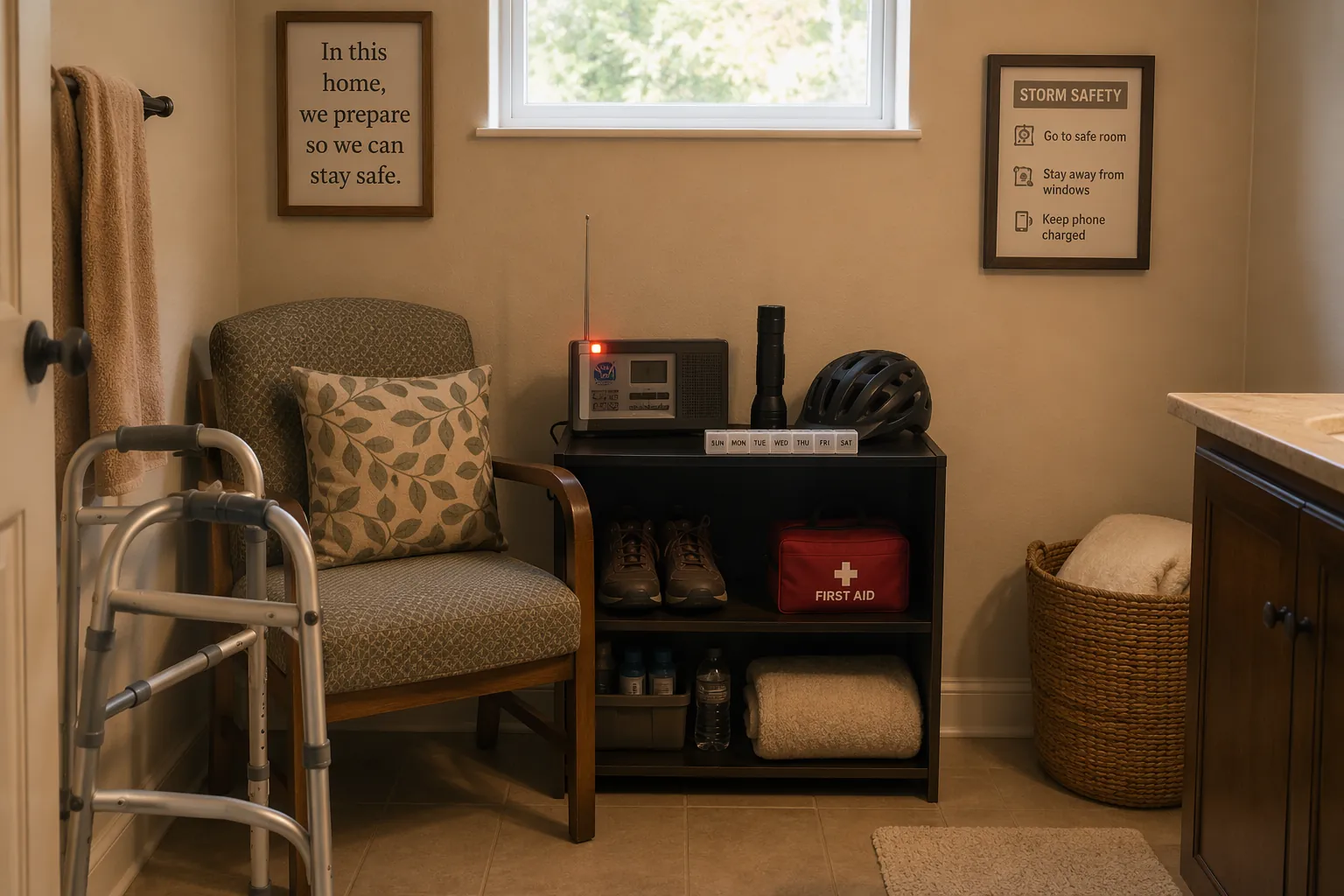
Before storm season, build the plan into the house
The strongest tornado plan for an older adult living alone is not a folder in a drawer. It is a set of visible, reachable decisions: the radio plugged in near the bed, the walker on the route instead of across the room, the shoes beside the shelter chair, the pill list in a waterproof bag, the neighbor already assigned to call.
For caregivers helping from a distance, this is the visit that matters. Walk the route at the same speed the older adult actually moves. Turn off the lights and try it with a flashlight. Notice whether the hearing aids are charging in the kitchen while the person sleeps in the bedroom. Notice whether the cane gets left by the recliner. Notice whether a bathroom rug, laundry basket, oxygen tubing, pet bowl, or threshold sits in the path to the safe room.
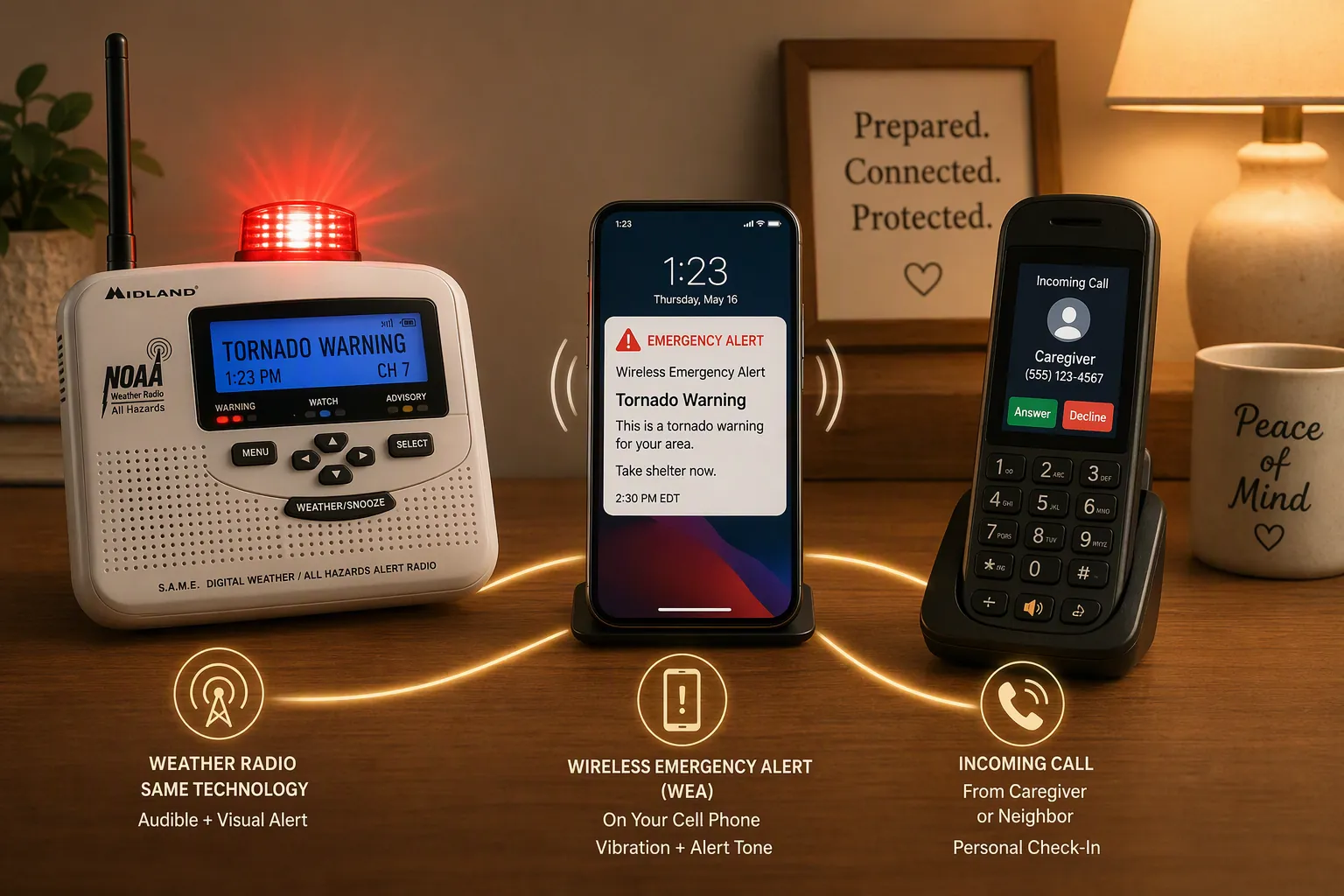
Set up three ways to receive the warning
Outdoor sirens are not enough for a person who may be asleep, hard of hearing, watching television, or running a fan or CPAP machine. The alert system should have at least three layers.
- A NOAA Weather Radio with SAME technology, programmed for the local county and kept plugged in with backup batteries.
- Wireless Emergency Alerts on the smartphone, with emergency alerts turned on, volume up, vibration enabled, and the phone kept charged near the bed.
- A human check-in plan: one caregiver, neighbor, building manager, or nearby friend who calls when a tornado watch or warning is issued and knows what to do if the call is not answered.
For hearing loss, add a visual or tactile alert when possible: a NOAA weather radio compatible with a strobe light, a bed shaker, or another alerting accessory. Older adults with sensory impairment may need emergency information delivered in more than one format, not simply louder.[3]
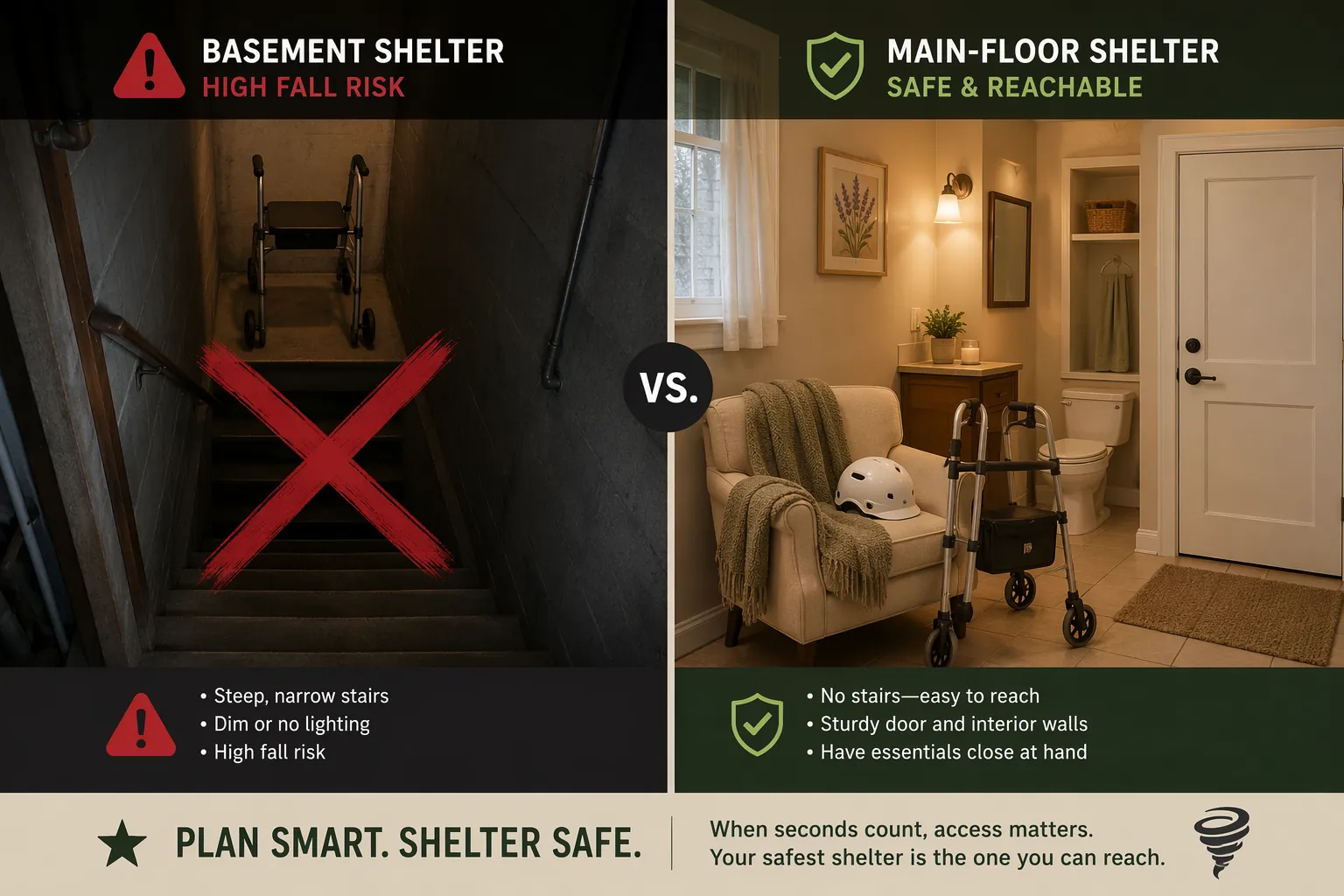
Choose the shelter the senior can actually reach
Standard tornado guidance points people toward a basement, storm cellar, safe room, or small interior room on the lowest level, away from windows.[4] That guidance is sound, but the word "lowest" can become dangerous when it sends an 82-year-old with a walker toward steep stairs in the dark.
If the basement stairs are unsafe, the better plan may be an interior main-floor bathroom, closet, hallway, or small room with as many walls as possible between the person and the outside. The safest room is not the one that looks best in a diagram. It is the most protective room the person can reach without falling.
Mobile homes need a different decision. United Spinal Association cites NWS/NOAA data reporting that 43% of tornado deaths over a 21-year period occurred in mobile homes.[2] A senior living in a mobile home should have an alternative shelter identified before storm season: a community storm shelter, neighbor’s site-built home, nearby public shelter, or another accessible location that can be reached before a warning is issued. Waiting until the phone screams is too late.
Pre-position the senior-specific kit in or beside the safe room
Emergency kit lists often say food, water, flashlight, radio, and batteries. For an older adult living alone, that is only the beginning. Ready.gov’s older-adult guidance emphasizes planning for medications, assistive devices, communication needs, and support networks.[5] The Red Cross also advises older adults to consider medical needs, mobility, support people, and supplies when preparing for emergencies.[6]
- Medications: a current medication list, pharmacy information, prescriber names, allergy list, and a rotated backup supply when medically and legally possible.
- Medical equipment: hearing-aid batteries, spare glasses, denture supplies, oxygen or CPAP instructions, and backup power planning for essential devices.
- Fall prevention: sturdy closed-toe shoes, a flashlight with fresh batteries, a whistle, a cane or walker parked on the route, and a chair or stable place to sit in the shelter room.
- Debris protection: a bicycle helmet or other protective helmet if available, plus a thick blanket, pillows, or a small mattress pad kept in the room.
- Communication: charged phone, power bank, printed emergency contacts in large type, house key location instructions, and the name of the person responsible for post-storm confirmation.
Keep the kit where the person shelters, not in the garage, basement, car trunk, or high closet. A pill organizer on the kitchen counter may be useful on an ordinary Tuesday and useless after wind-driven water, broken glass, or a blocked doorway. Put a smaller duplicate medication list and a few critical supplies in a waterproof bag inside the safe room.
This is also where broader emergency planning overlaps with fall prevention. Just as extreme heat creates hidden fall risks for seniors, tornado season turns ordinary home details into safety decisions: footwear, lighting, hydration, medication access, and whether someone knows to check in.
When a tornado watch is issued, reduce the number of things left to do
A tornado watch does not mean a tornado is happening at the house. It does mean the older adult should move from casual readiness to near-readiness. This is the time to charge the phone, turn up alert volume, put on sturdy shoes, bring the walker or cane within arm’s reach, check that the weather radio is on, and tell the check-in person, "I am home and I know where I will shelter."
For someone who moves slowly, the watch may also be the time to relocate closer to the safe room. A person who needs several minutes to rise from a recliner, use the bathroom, collect glasses, and cross the house should not wait until a warning to begin basic positioning.
When the tornado warning arrives
A warning is not the time to confirm the plan. It is the time to execute it.
- Go immediately to the chosen shelter room using the pre-cleared route.
- Take only what is already in hand or already positioned on the route: phone, walker or cane, glasses, flashlight.
- Put on the shoes kept near the shelter area if they are not already on.
- Sit low, away from windows, with as many walls as possible between the body and the outside.
- Cover the head and neck with a helmet, pillow, blanket, or arms.
- Keep the phone close, but do not leave shelter because a caregiver calls.
The CDC specifically advises people to protect the head and neck during a tornado, using arms, a coat, a blanket, or pillows if no helmet is available.[7] For an older adult, that instruction deserves to be physical and visible: the pillow cannot help if it is on the bed down the hall.
If the ideal shelter is not reachable
Some tornado plans fail because they pretend the person will move like a younger neighbor. A basement may be the best shelter in the house structurally and still be the wrong instruction for a senior who cannot safely descend stairs under stress. The fall on the stairs is not a side issue; it may be the first injury of the storm.
Use this order of judgment before storm season, not during the warning: first, choose a FEMA-rated safe room or storm shelter if one is accessible; second, choose a basement only if the person can reach it safely and quickly; third, choose a small, windowless, interior main-floor room if stairs create a realistic fall risk; fourth, if the person cannot move from a bed or chair, plan for in-place debris protection.
The CDC gives a conditional instruction that belongs in every senior-specific plan: if a person cannot move from a bed or chair, they should stay there and cover up with blankets and pillows to protect against flying debris.[7] That does not make the bed the preferred shelter. It gives a safer fallback for the person who cannot transfer, walk, or reach the room in time.
Write that fallback in plain language and put it where the person can see it. For example: "If I cannot reach the bathroom safely, I stay in my recliner, pull the blanket over my head and neck, keep my phone beside me, and blow the whistle if I need help." That example is hypothetical; the exact instruction should be adjusted to the person’s room layout, mobility, and medical equipment.
After the tornado, the house may be a fall hazard
The first post-storm rule is not "go look." It is "stay still long enough to know what you are stepping into." Red Cross tornado guidance warns about hazards after a storm, including damaged structures, debris, downed power lines, gas leaks, and injuries.[4] For an older adult living alone, broken glass on the bathroom floor or wet insulation in a hallway can be as consequential as the storm itself.
- Before standing, use the flashlight to check the floor for glass, nails, water, loose boards, and shifted rugs.
- If gas is smelled, do not turn switches on or off; leave if it can be done safely and call emergency services.
- Do not walk outside barefoot or in slippers; use the sturdy shoes kept in the shelter area.
- If medications are wet, missing, contaminated, or trapped in another room, call the pharmacy, prescriber, caregiver, or emergency services rather than guessing doses.
- Avoid signing urgent repair contracts at the door; storm damage often brings contractor-fraud risk, especially for isolated homeowners.
Mental strain also matters. Clinical disaster guidance for older adults notes that disasters can worsen anxiety, confusion, grief, and other mental health concerns, especially when people are isolated or medically vulnerable.[3] A post-storm call should ask more than "Are you alive?" It should ask whether the person has fallen, whether medications are available, whether the house smells like gas, whether the person can get to the bathroom safely, and whether they need someone to come in person.
The caregiver or neighbor check-in plan
A check-in plan should name people, times, and escalation steps. "Someone will call Mom" is too soft. The plan should say who calls during a watch, who calls during a warning if it is safe to do so, who checks after the warning expires, who has a key or lockbox code, and when to request a welfare check.
| Role | Assigned task | Backup if no answer |
|---|---|---|
| Primary caregiver | Calls when a tornado watch is issued; confirms the senior is home, alert system is on, shoes are on, and shelter route is clear | Texts neighbor or backup caregiver |
| Nearby neighbor | Checks after the warning passes if conditions are safe | Calls emergency services if there is visible damage, distress, or no response |
| Backup caregiver | Keeps medication list, pharmacy number, insurance information, and shelter location | Contacts pharmacy, prescriber, or utility company as needed |
| Senior living alone | Goes to the preselected shelter during a warning and keeps phone close | Uses whistle, phone, or medical alert device if trapped or injured |
The plan should be printed in large type and posted in two places: near the usual sitting or sleeping area and inside the shelter room. If the older adult has memory problems, hearing loss, low vision, or panic during storms, rehearse the route when the weather is calm. A calm practice walk often reveals what a phone conversation will miss.
This article is general preparedness information, not medical, legal, engineering, or emergency-management advice. Local emergency management offices, clinicians, pharmacists, utility companies, and building professionals may need to be involved when a person depends on powered medical equipment, oxygen, complex medications, mobility devices, or an accessible storm shelter.
A tornado plan for a senior living alone is trustworthy only when the alert system, shelter route, supplies, medication backup, mobility aids, and check-in roles are already in place before the siren, radio, or phone alert sounds.
References
- Elderly Tornado Preparedness When Living Alone, imalive.co
- Tornado Preparedness for the Disability Community, United Spinal Association
- Older Adults and Disaster: Preparedness and Response, AAGP
- Tornado Safety Tips, Red Cross
- Older Adults, Ready.gov
- Older Adults Emergency Preparedness, Red Cross
- Safety Guidelines: During a Tornado, CDC
Related reading
Noticed something outdated or inaccurate on this page? Flag a correction. We review every report against CDC, NIA, and AARP HomeFit guidance before updating a page.
Part of the Fall Prevention section.