
STEADI: intervene
Winter Safety Tips for Seniors Living Alone — Stop the Shivering Myth
Hypothermia is especially dangerous for seniors living alone because the classic warning sign—shivering—often doesn't occur. This article explains a two-part passive prevention system that works without relying on self-recognition, including thermostat settings, draft blocking, and a daily check-in protocol.
The winter safety tip that gets repeated too easily is also the one I would not build a plan around: watch for shivering. For many older adults, that warning may not show up. The American Geriatrics Society warns that people over 65 tend to shiver less, or may not shiver at all, when body temperature drops.[1]
That matters most when the person lives alone. No one is standing in the kitchen noticing that speech has slowed. No one is there to see that the afternoon nap has turned into unusual sleepiness, or that the house feels colder than the person sitting in it realizes. A senior can be chilled, losing judgment, and still say, quite honestly, “I’m fine.”
Good winter safety tips for older adults living alone have to start there. The plan cannot depend on the older adult feeling cold enough, recognizing it early enough, and calling for help before confusion or weakness sets in. The safer plan is less dramatic and more reliable: keep the home from getting too cold in the first place, then add a check-in routine that notices trouble before the senior has to name it.
The Thermostat Trap
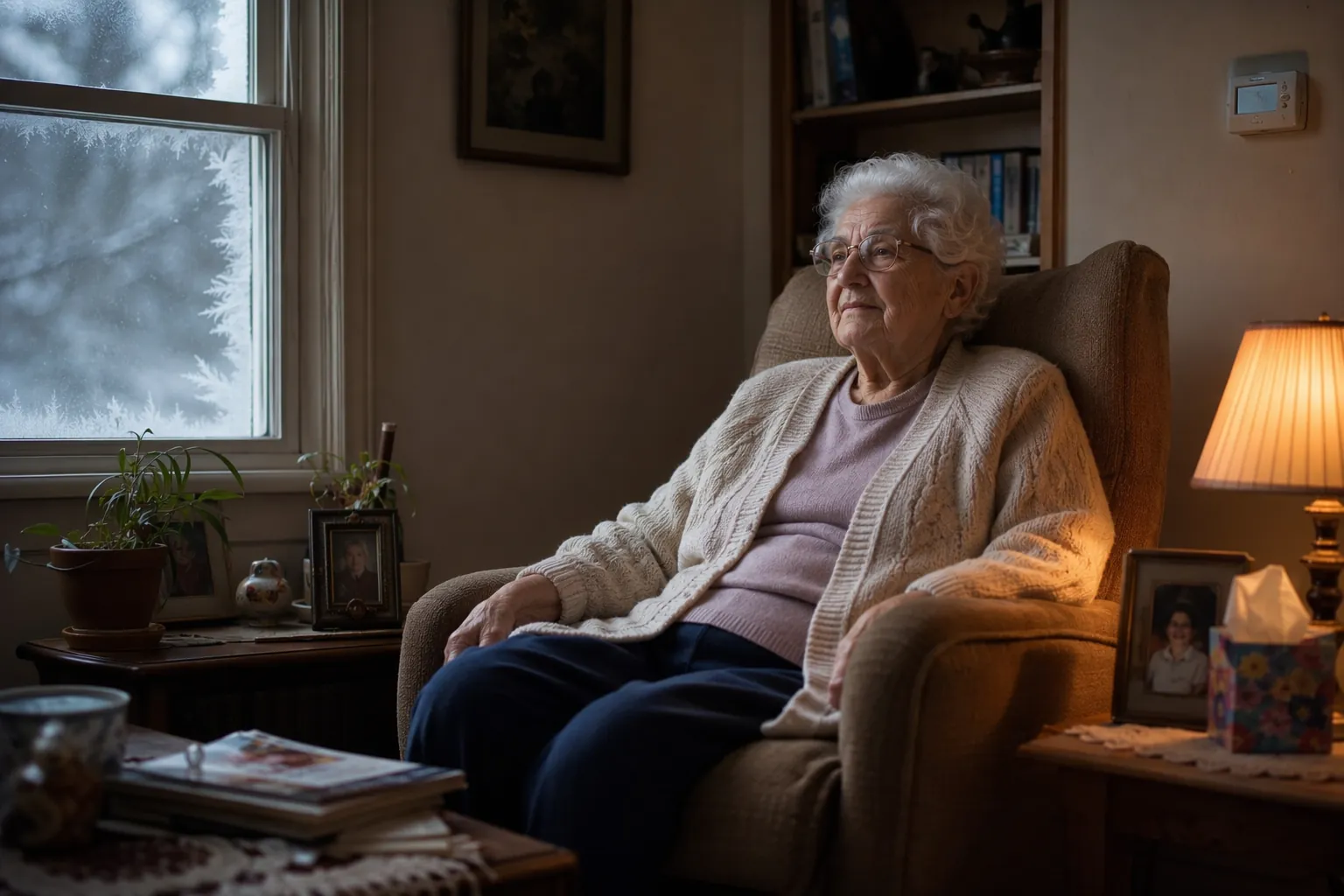
The dangerous winter house is not always the one with a broken furnace. More often, it is the house where the thermostat has been nudged down a few degrees to save money, then down a little more because the heating bill is irritating, and finally left there because nothing feels urgent.
The National Institute on Aging recommends keeping the indoor temperature at least 68°F for older adults, and warns that even indoor temperatures in the 60°F to 65°F range can be dangerous for them.[2] That range is the trap. To a younger visitor wearing shoes and moving around, 64°F may feel merely chilly. To an 82-year-old sitting still after dinner, taking medications, with less body fat and a slower ability to regulate temperature, it can be enough to start a slide.
This is also where pride and budgeting collide. Many older adults are not being careless. They are trying to keep control of their home, their bills, and their routines. A thermostat set below 68°F can look like discipline, not risk. The problem is that hypothermia does not require an arctic scene in the living room; for an older body, a cool house over time can be enough.
The public-health numbers are not comforting. A 2024 report on JAMA findings noted that the cold-related death rate among adults 75 and older reached 42 per 1 million in 2022, compared with about 4 per 1 million in 1999.[3] CDC data reported 1,024 hypothermia deaths in 2023.[4] Those numbers do not mean every cold room becomes an emergency. They do mean indoor cold exposure in older adults deserves a more serious plan than “put on a sweater if you feel cold.”
Build the House So It Defaults Warm
The first half of the system is environmental: make the home safer before anyone has to make a good decision on a bad day. That means the thermostat, drafts, clothing, and backup heat all get settled in advance.
| Part of the home setup | Winter-ready default |
|---|---|
| Thermostat | Set the home no lower than 68°F, and verify the setting rather than guessing by comfort. |
| Drafts | Block cold air at doors and windows with simple, nonflammable draft control. |
| Indoor clothing | Make warm layers the normal indoor outfit, not an emergency response. |
| Space heaters | Use only with strict clearance and shutoff rules; never as a casual substitute for safe central heat. |
| Check-ins | Schedule a daily routine that does not rely on the senior noticing symptoms. |
Set 68°F as the floor, not the aspiration
For winter 2026–2027, the most useful thermostat rule is plain: 68°F is the minimum indoor target for an older adult’s living space, not a number to dip below overnight or when no one is visiting.[2] If the house has colder rooms, the number on the hallway thermostat may overstate how warm the chair by the window actually feels.
Caregivers who live separately should verify the actual setting before winter settles in. That can be as simple as standing with the parent at the thermostat during a visit and agreeing, out loud, that the heat stays at or above 68°F. If a smart thermostat is already in the home, set a low-temperature alert. If there is no smart thermostat, a basic indoor thermometer in the main sitting area can make the cold visible without turning the home into a monitored ward.
The wording matters. “You have to keep the heat up because you don’t know what’s good for you” will go badly in many families, and deservedly so. “Let’s make 68 the house rule so neither of us has to worry about guessing” is more respectful and more likely to last past the first cold snap.
Stop drafts where the person actually sits and sleeps
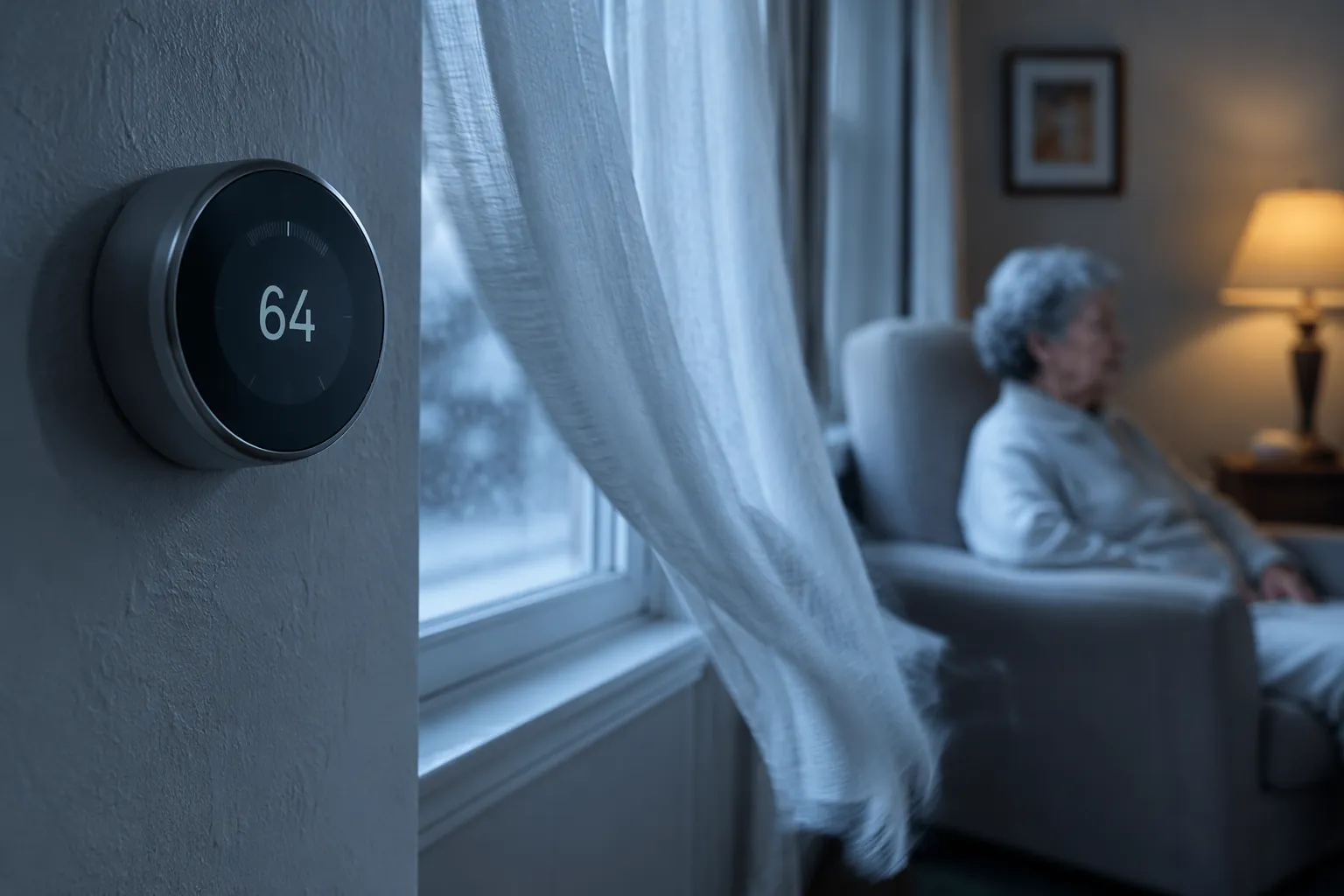
Draft blocking does not need to become a home-renovation project. The priority is the path between cold air and the older adult’s usual body position: the chair used for television, the kitchen table, the bed, the bathroom doorway, and the front door. A rolled towel at the base of a door is not elegant, but it may matter more than a perfect window project in a room no one uses.
Look for the ordinary leaks: a door sweep that no longer touches the threshold, a window that rattles in wind, a thin curtain near the favorite chair, a mail slot that pours cold air into the hallway. Weatherstripping, draft stoppers, insulated curtains, and closing off unused rooms can reduce the amount of heat the furnace has to keep replacing. The goal is not a sealed house at any cost; it is fewer cold streams hitting an older person who may not respond by shivering.
Make warm indoor layers automatic
Indoor layers should not depend on someone deciding, “I feel cold now.” By the time that thought forms, the person may already be slower, sleepier, or less clear. A better winter default is a warm base layer, socks or slippers with safe soles, a sweater or fleece, and an easy robe or vest kept near the chair.
This is not permission to turn the thermostat down and compensate with clothing. Layers help the body keep heat; they do not make a 62°F living room safe. They work best as part of the same default as the thermostat: the house is warm enough, and the person is dressed for a quiet winter day indoors.
Treat space heaters as controlled tools
Space heaters can solve one problem while creating another. If one is used, it should have an automatic shutoff, sit on a level surface, and stay at least 3 feet from bedding, curtains, papers, furniture, clothing, and anything else that can burn. It should not run unattended, and it should not be plugged into a power strip or extension cord.
The safer question is not “Does Dad own a heater?” but “Can this heater be used correctly on a tired evening?” If the answer is no, the plan needs to rely on central heat, draft reduction, room choice, and check-ins rather than a device that requires perfect habits.
Add a Check-In That Does Not Feel Like Surveillance
The second half of the system is a scheduled check-in. This is the part that protects the person who lives alone, because the missing safety feature in the house is another set of eyes and ears.
A good check-in is not a competence test. It is not a daily interrogation about whether the older adult has made a mistake. It is a routine agreed on before the weather turns, with the senior choosing as much as possible: the time of day, the preferred contact method, and what happens if the call is missed.
- Phone call: same time each day, short enough that it does not become a burden.
- Video call: useful when the caregiver needs to see alertness, clothing, and room conditions.
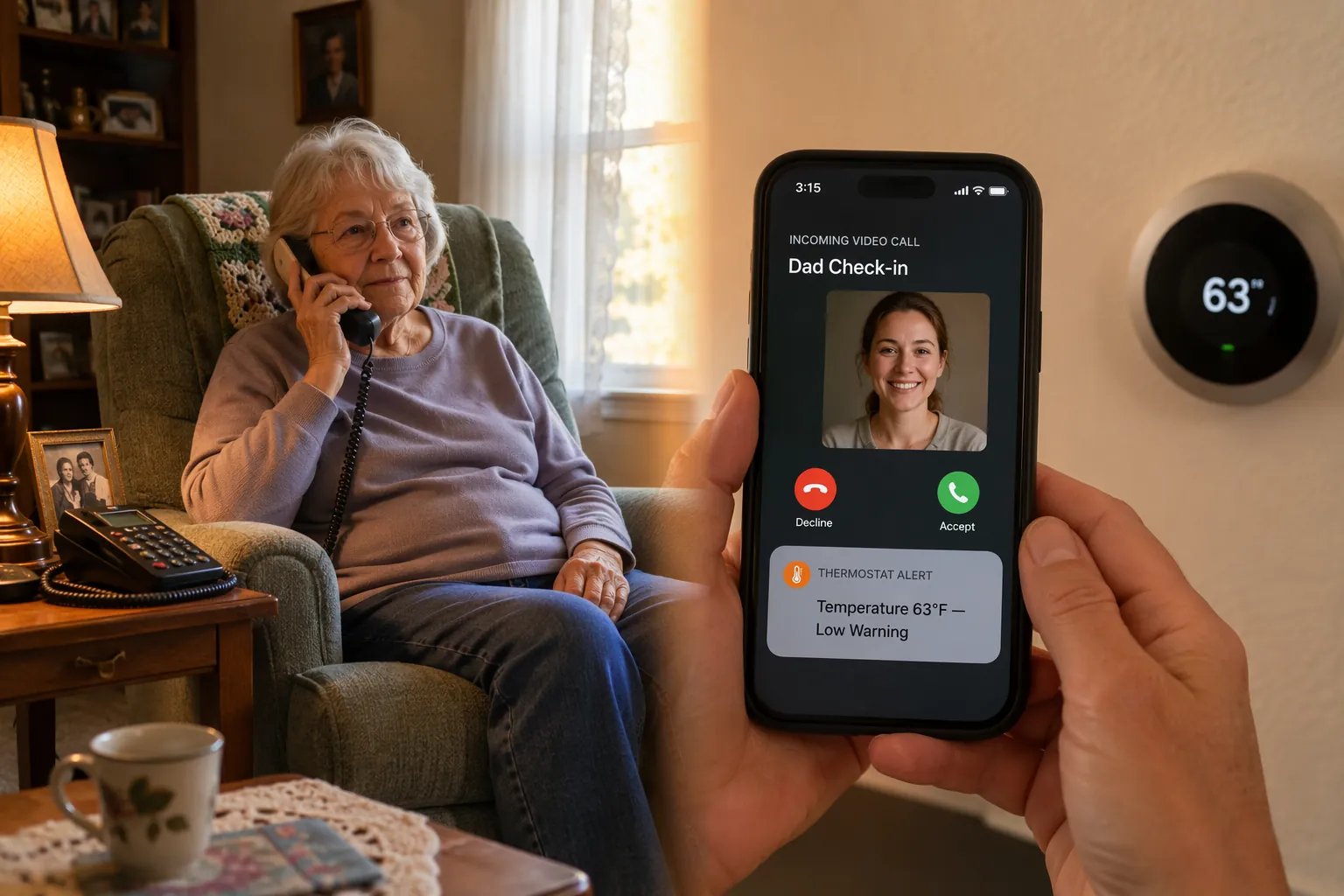
- Smart thermostat alert: useful when a low indoor temperature should notify someone outside the home.
- Neighbor drop-in: best for missed calls, power outages, or a parent who dislikes devices.
The check-in should be designed around what hypothermia can hide. Instead of asking only, “Are you cold?” ask questions and listen for function: “What does the thermostat say right now?” “Have you eaten?” “Are you dressed in your warm layers?” “Are you feeling more tired than usual?” The answer matters, but so does the pace of the answer.
If the older adult sounds unusually slow, confused, drowsy, or unlike themselves, the next step should already be decided. That may be a second call in 10 minutes, a neighbor knocking on the door, or a caregiver calling local emergency services if the person cannot be reached or seems unsafe. Families should not be inventing that sequence for the first time during a storm.
A no-shame script helps
Many older adults will accept a routine if it is framed as winter logistics, not personal decline. A caregiver might say: “Let’s do a quick call after dinner while it’s cold out. You tell me the thermostat number, I’ll stop worrying, and if I don’t reach you I’ll ask Mrs. Lee to knock. No lectures.”
That kind of agreement gives the older adult control where control is reasonable. They can choose the call time. They can choose the neighbor. They can choose whether the backup is a landline call, video call, or thermostat alert. What should not be negotiable is having no backup at all when the house is cold and the body may not send a clear warning.
What to Watch For When Shivering Is Absent
Shivering may be absent, but other signs can still appear. The difficulty is that several look like ordinary tiredness, aging, or a quiet winter evening. That is why these signs should trigger action when they are new, unusual, or paired with a cold room.
- Slurred, slowed, or unusually vague speech.
- Confusion, poor judgment, or answers that do not fit the question.
- Unusual sleepiness or difficulty staying awake.
- Clumsiness, weakness, or trouble walking steadily.
- Cold skin, pale skin, or a room temperature below the agreed minimum.
The fall-prevention connection sits right here. A chilled, sleepy, or confused person is less steady getting up from a chair, walking to the bathroom, or reaching for a blanket. Winter hypothermia prevention is not only about avoiding a medical emergency; it also reduces the kind of weakness and impaired judgment that can turn a familiar hallway into a fall risk.
Older adults have long been recognized as a major share of hypothermia victims, although some commonly repeated figures come from older public guidance and should be treated as broad context rather than current measurement.[5] The more practical takeaway has not changed: a senior living alone needs a plan that does not wait for obvious distress.
A Winter-Ready Protocol for 2026–2027
Before the first serious cold stretch, put the system in writing. It does not need to be elaborate. A one-page note on the refrigerator and a shared version on the caregiver’s phone is enough if everyone knows what it means.
- Set the thermostat rule: the main living area stays at or above 68°F.
- Place an easy-to-read thermometer where the senior actually spends time.
- Block the worst drafts at the chair, bed, bathroom, and entry door.
- Choose the default indoor winter outfit and keep warm layers within reach.
- Decide whether any space heater is allowed, and write down the safety rules.
- Schedule the daily check-in and name the backup person for a missed call.
- Set the escalation rule for confusion, unusual sleepiness, low indoor temperature, or no answer.
The protocol should be boring on purpose. Boring is what works when the older adult is tired, proud, chilled, or trying not to be a bother. It also works for the adult child two towns away who cannot drive over every time the wind picks up.
National winter preparedness guidance rightly treats cold exposure as a serious hazard, and broader data show that cold accounts for a large share of temperature-related deaths.[6] In an older person’s home, though, the best prevention often looks small: a thermostat that does not dip into the danger range, a draft that no longer crosses the favorite chair, a fleece that is worn before anyone feels chilled, and a call that happens whether or not there is a complaint.
If the body may not shiver, and no one may be in the room to notice the early slide, winter safety has to be built into the room and the routine. The safest senior is not the one who promises to call when something feels wrong. It is the one whose home and check-in system are already set up for the day something feels normal when it is not.
References
- Tip Sheet: Winter Safety for Older Adults — Health in Aging, link
- Cold Weather Safety for Older Adults — National Institute on Aging, link
- Cold-related deaths are on the rise in the U.S. — Science News, link
- QuickStats: Number of Hypothermia Deaths, by Year — National Vital Statistics System, United States, 1999–2023 — CDC MMWR, February 2025, link
- Hypothermia Risk Higher for Seniors — UGA Cooperative Extension, link
- Winter Ready — Ready.gov, link
Related reading
Noticed something outdated or inaccurate on this page? Flag a correction. We review every report against CDC, NIA, and AARP HomeFit guidance before updating a page.
Part of the Fall Prevention section.