
STEADI: Intervene
Salmonella Symptoms in Seniors After the 2026 Egg Recall
A practical guide for caregivers monitoring an older adult who may have consumed recalled eggs — covering the five CDC urgent symptom thresholds, how dehydration from salmonella increases fall risk, and concrete fall-prevention steps to take during the illness.
If an older adult may have eaten recalled eggs, there are two jobs tonight. One is to confirm whether the carton is part of the 2026 egg recall. The other is to monitor the person, not just the refrigerator.
For carton details, use the site’s egg recall identification guide or the brand-focused guide to eggs seniors should avoid in the 2026 recall. This article stays with the next problem: salmonella symptoms in elderly adults after the egg recall, and the fall risk that can arrive before anyone has decided the illness is serious.
The July 22, 2026 recall from Midwest Poultry Services covered 1,589,577 dozen eggs, more than 19 million eggs, sold under Kroger, Brookshire’s, Simple Truth, Country Morning, and Sunups brands in Texas, Louisiana, Oklahoma, Arkansas, Mississippi, and New Mexico; the listed plant codes were P-1950 or 0840962, with Julian dates 157–184 and best-by dates from July 20 through August 17, 2026.[1] As of July 24, FDA and CDC reported 98 illnesses across 17 states, 26 hospitalizations, and no deaths, while describing the investigation as ongoing.[2] The recall and the outbreak are overlapping but not identical; investigators may update the counts or identify other sources.
Those numbers help explain why families are searching, but they do not tell you whether your parent is safe walking to the bathroom at 2 a.m. The practical monitoring window matters more at home: salmonella symptoms most often begin 12 to 72 hours after exposure.[3]
What to Watch for During the 12- to 72-Hour Window
Typical salmonella illness can include diarrhea, fever, stomach cramps, nausea, vomiting, and headache. In an older adult, the same symptoms deserve closer attention because the consequences of fluid loss can arrive quickly. A parent who says “I’m fine” but is making urgent bathroom trips, eating little, and standing more slowly is not in the same safety situation they were in yesterday.
The CDC’s urgent symptom thresholds give caregivers a defensible line for when home monitoring is no longer enough. Seek medical guidance promptly if any of these appear: fever over 102°F, diarrhea lasting more than two days without improvement, bloody diarrhea, vomiting that prevents fluids from staying down, or signs of dehydration such as reduced urination, dry mouth or throat, or dizziness when standing.[4]
| CDC urgent sign | What it means for the caregiver tonight |
|---|---|
| Fever over 102°F | Do not treat this as routine stomach upset; call for medical guidance. |
| Diarrhea for more than two days without improvement | Home monitoring has reached its limit, especially if the person is weak, eating little, or needing frequent bathroom trips. |
| Bloody diarrhea | Escalate promptly; do not wait to see whether the next episode looks better. |
| Vomiting that prevents fluids from staying down | Hydration is no longer reliable at home; the fall risk rises because fluid volume is dropping. |
| Reduced urination, dry mouth or throat, or dizziness when standing | Treat the person as dehydrated or at risk of dehydration until a clinician advises otherwise. |
Diarrhea can last up to 10 days in salmonella illness, but the caregiver decision should not wait for day 10.[5] The important question is whether symptoms are improving, whether fluids are staying down, and whether the person can stand and walk safely.
Why Seniors Can Become Unsafe Before They Feel Thirsty
Older adults have less room for fluid loss. Body water reserve drops to about 40% to 45% in older adults, compared with about 70% at birth, and age-related changes can blunt thirst perception and kidney response.[6] That is why waiting for a parent to ask for water is a poor safety plan.
Salmonella does not need to cause dramatic collapse to raise fall risk. Diarrhea and vomiting reduce fluid volume. Lower fluid volume can contribute to dizziness and orthostatic hypotension, the blood pressure drop that may happen when someone stands. The dangerous moments are ordinary ones: rising from bed, turning toward the bathroom, standing from the toilet, reaching for a towel, or walking back through a dim hallway.
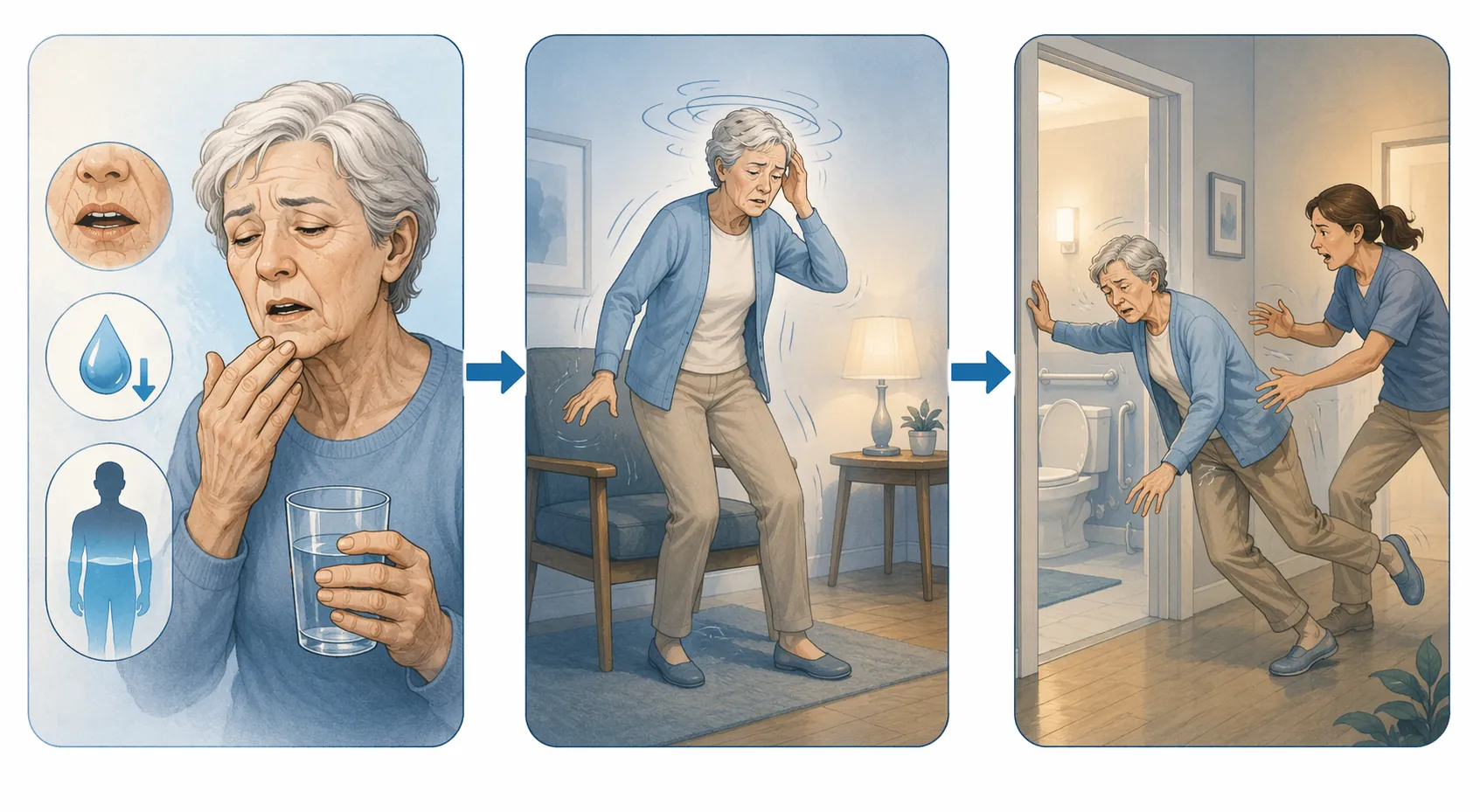
The best fall evidence here is not a salmonella-specific fall study. It is dehydration and falls research that fits the physiology of a diarrheal illness. In a cohort of 30,634 older adults, Hamrick and colleagues found that 37.9% were dehydrated at baseline; dehydrated seniors had higher odds of falling, with an odds ratio of 1.13, and 13.3% of dehydrated seniors fell compared with 10.2% of non-dehydrated seniors.[6]
That study does not prove a direct salmonella-to-fall causal chain, and its cohort was predominantly white non-Hispanic and Midwestern, which limits generalization.[6] It still gives caregivers something useful: dehydration is measurable, common, and associated with more falls. During a stomach illness, that is enough reason to change the home environment before the next urgent bathroom trip.
When “Just Diarrhea” Is Not a Safe Home-Monitoring Situation
For an older adult, the severity question is not only how many bathroom trips happened. It is whether those trips are draining enough fluid to change balance, attention, strength, or blood pressure. Nearly half, 48%, of adults 65 and older with lab-confirmed salmonella are hospitalized, according to USDA FSIS material citing CDC FoodNet data.[7] That does not mean every exposed senior will become severely ill. It means a caregiver should not dismiss worsening symptoms because the first few hours looked manageable.
Some warning signs are easy to miss because they look like fatigue. Watch for a parent who stops getting up for usual activities, urinates less often, has a dry mouth, seems newly confused, grips furniture while walking, pauses after standing, or says they feel “weak” rather than “dizzy.” If diarrhea urgency is making them rush, the fall risk is higher even when the illness still seems mild.
Canadian surveillance data from 2000 to 2010 found that older adults accounted for 23% of salmonella cases but 50% of adult hospitalizations and 82% of adult deaths; those exact percentages reflect Canadian data, but the older-adult severity pattern is consistent with U.S. FoodNet findings.[8] For a deeper medical-risk discussion, see why salmonella is more dangerous for seniors and when to act.
Before the Next Bathroom Trip, Change the Fall Risk
The fall-prevention work should start while symptoms are possible, not after the first stumble. If the older adult may have eaten recalled eggs and is within the symptom window, set up the bedroom, hallway, and bathroom as if diarrhea, weakness, or dizziness could begin overnight.
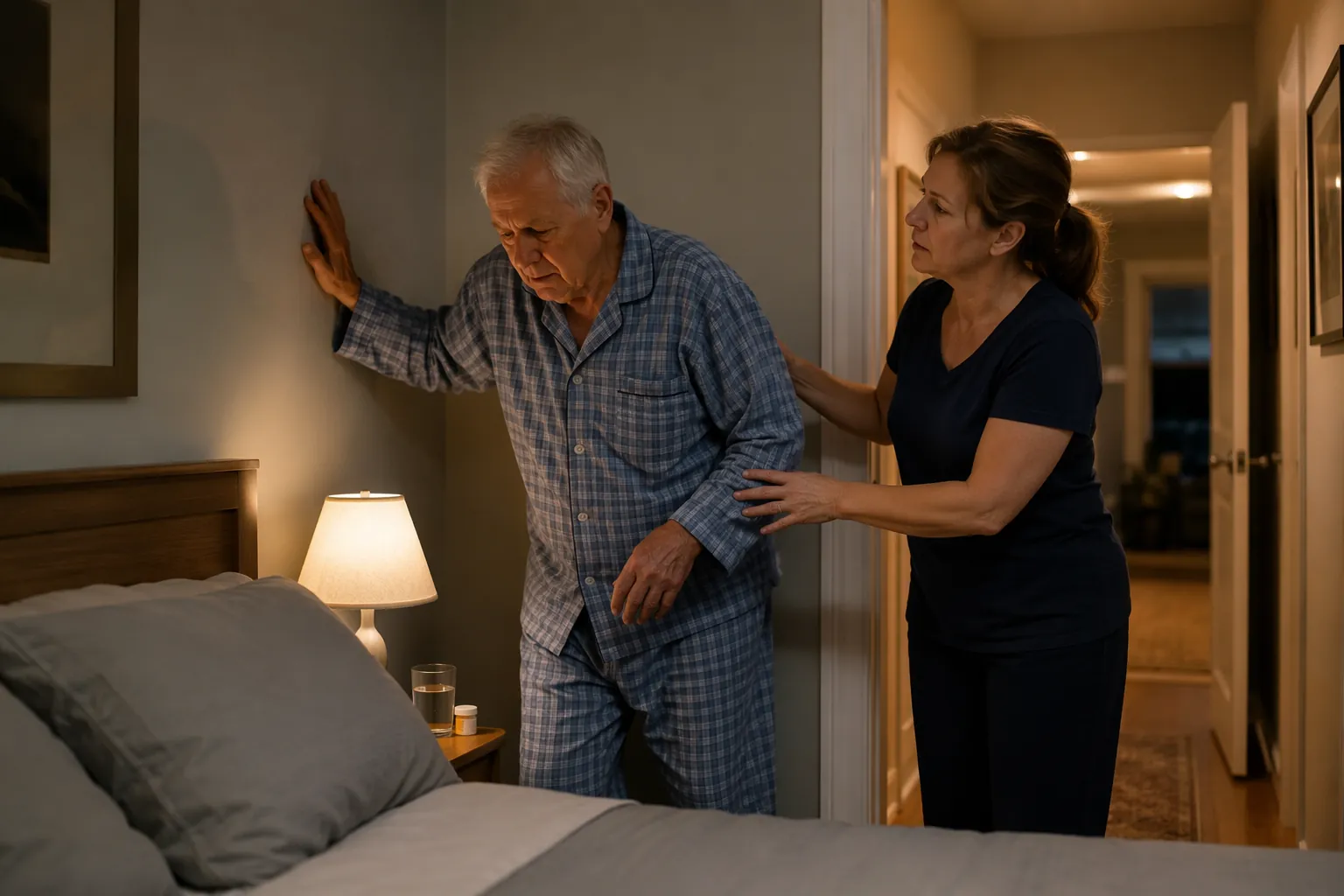
- Clear the route from bed or chair to the bathroom before bedtime: shoes, cords, laundry, pet bowls, and small rugs should not be in the path.
- Improve lighting where the person will actually walk, including the bedside, hallway, bathroom entrance, and path back to bed.
- Keep fluids, a phone, glasses, and any needed walking aid within reach so the person does not stand suddenly to search for them.
- Supervise bathroom trips when dizziness, weakness, diarrhea urgency, vomiting, nighttime symptoms, or new unsteadiness is present.
- Have a fall-response plan ready: who to call, how to unlock the door for help, and when not to lift the person without medical assistance.
If the caregiver has the right equipment and knows how to use it, checking sitting and standing blood pressure can help identify a concerning drop after standing. Do not turn that into a home diagnosis. Use it as one more reason to call a clinician if the person is dizzy, weak, faint, confused, or unable to keep fluids down.
The bathroom deserves special attention because diarrhea changes behavior. People hurry. They skip the walker. They stand before they are steady. They may be embarrassed and wave help away. A caregiver can preserve dignity and still reduce risk by staying nearby, leaving the door partly open if the person agrees, and making sure the path back to bed is lit and dry.
This same dehydration-to-fall pattern appears with other foodborne illnesses too. The site’s article on cyclosporiasis prevention and fall risk explains the same practical bridge: gastrointestinal illness can become a mobility problem when fluid loss affects balance.
If Symptoms Are Mild, Still Treat the Person as Temporarily Higher Fall Risk
A mild case can still produce a bad fall. The caregiver does not have to predict whether salmonella will become severe. The safer frame is simpler: if urgent symptoms appear, seek medical guidance promptly; if symptoms are present but mild, reduce fall exposure while dehydration is possible; if the eggs have not been confirmed, use the linked recall-identification guide instead of guessing from memory.
For broader context on how this recall connects to fall prevention, see why the 2026 egg recall matters for fall prevention in seniors.
This is fall-prevention guidance, not medical advice. Caregivers should contact a healthcare provider for medical decisions, especially when urgent symptoms, dehydration signs, frailty, immune compromise, or worsening weakness are present. Outbreak counts and recall investigations were still ongoing as of July 27, 2026.
References
- FDA recall notice. U.S. Food and Drug Administration. July 22, 2026.
- FDA/CDC outbreak investigation update. U.S. Food and Drug Administration and Centers for Disease Control and Prevention. July 24, 2026.
- Salmonella infection. Centers for Disease Control and Prevention.
- Symptoms of Salmonella infection. Centers for Disease Control and Prevention.
- Salmonella infection. Mayo Clinic.
- Association Between Dehydration and Falls. Mayo Clinic Proceedings. 2020.
- People at Risk: Older Adults. USDA Food Safety and Inspection Service.
- Hospitalizations and Deaths Attributable to Salmonella Infections, Canada, 2000–2010. Canadian surveillance study.
Related reading
Noticed something outdated or inaccurate on this page? Flag a correction. We review every report against CDC, NIA, and AARP HomeFit guidance before updating a page.
Part of the Fall Prevention section.