
STEADI: Intervene
How Europe's 2026 heat wave increases fall risk for senior travelers
Learn how Europe's 2026 heat wave creates a compound fall hazard for older travelers through dehydration, orthostatic hypotension, slowed reflexes, and medication interactions, and get a practical prevention system for before departure and on the ground.
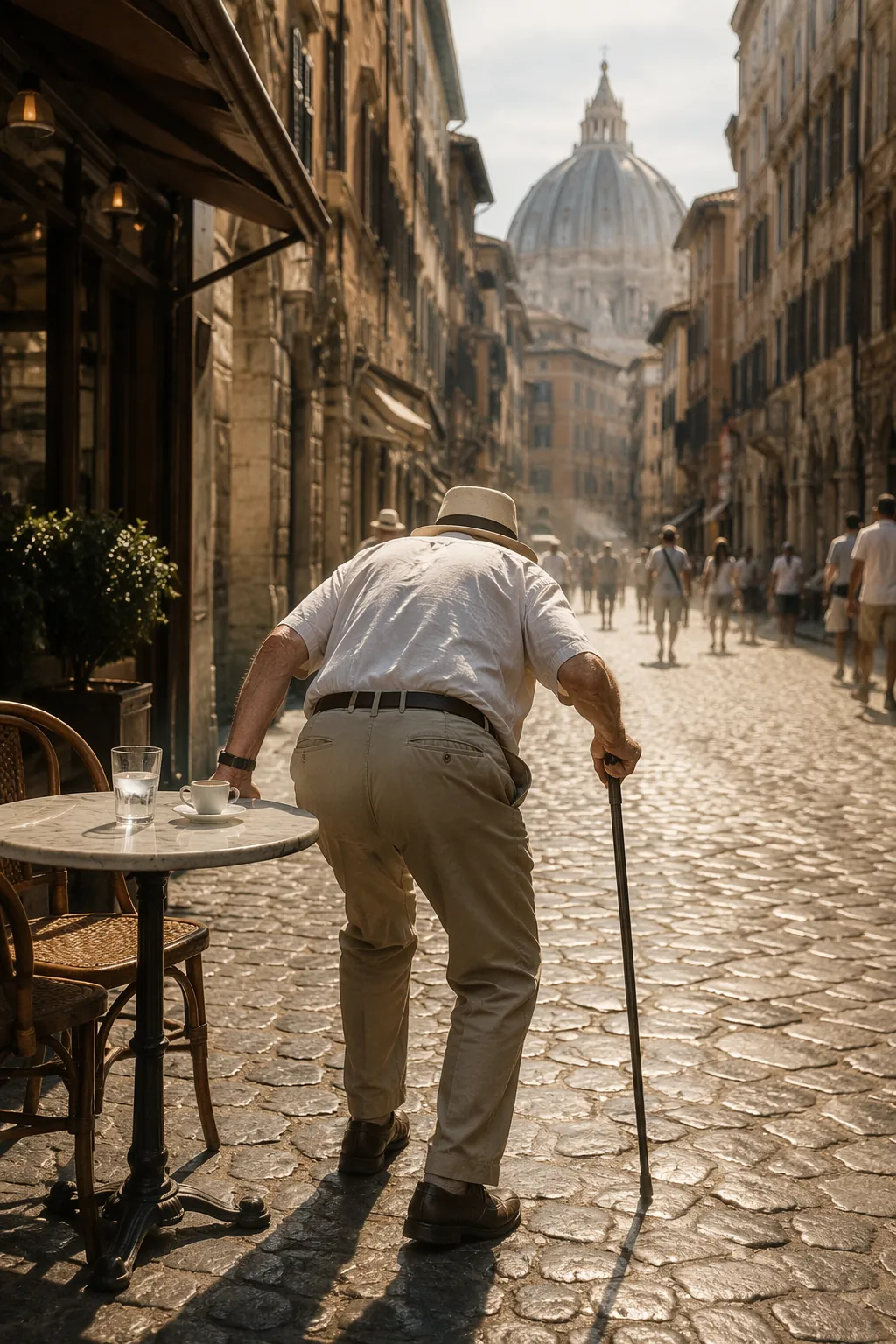
The risky moment may not look dramatic. An older traveler finishes lunch on a hot European afternoon, stands from a cafe chair, pauses because the street tilts for half a second, then has to manage a curb, cobblestones, a staircase into the metro, and a crowd moving faster than they are. That pause is not weakness. In extreme heat, it can be the first visible sign that balance, blood pressure, hydration, and medication effects are starting to collide.
That is why summer travel safety tips for seniors in Europe’s heat wave need to be more specific than “drink water” and “take breaks.” During Europe’s early 2026 heat wave, EuroMOMO estimated 14,260 excess deaths in one week across Europe, with more than 12,000 among people age 65 and older; in Germany, the Robert Koch Institute attributed 6,830 deaths to heat through early July, with 95% among people 65 and older.[1] Those are population estimates, not a prediction for any one traveler, and early excess-death figures can be revised. Still, they make one point hard to dismiss: older bodies are carrying a larger share of the physiological strain.
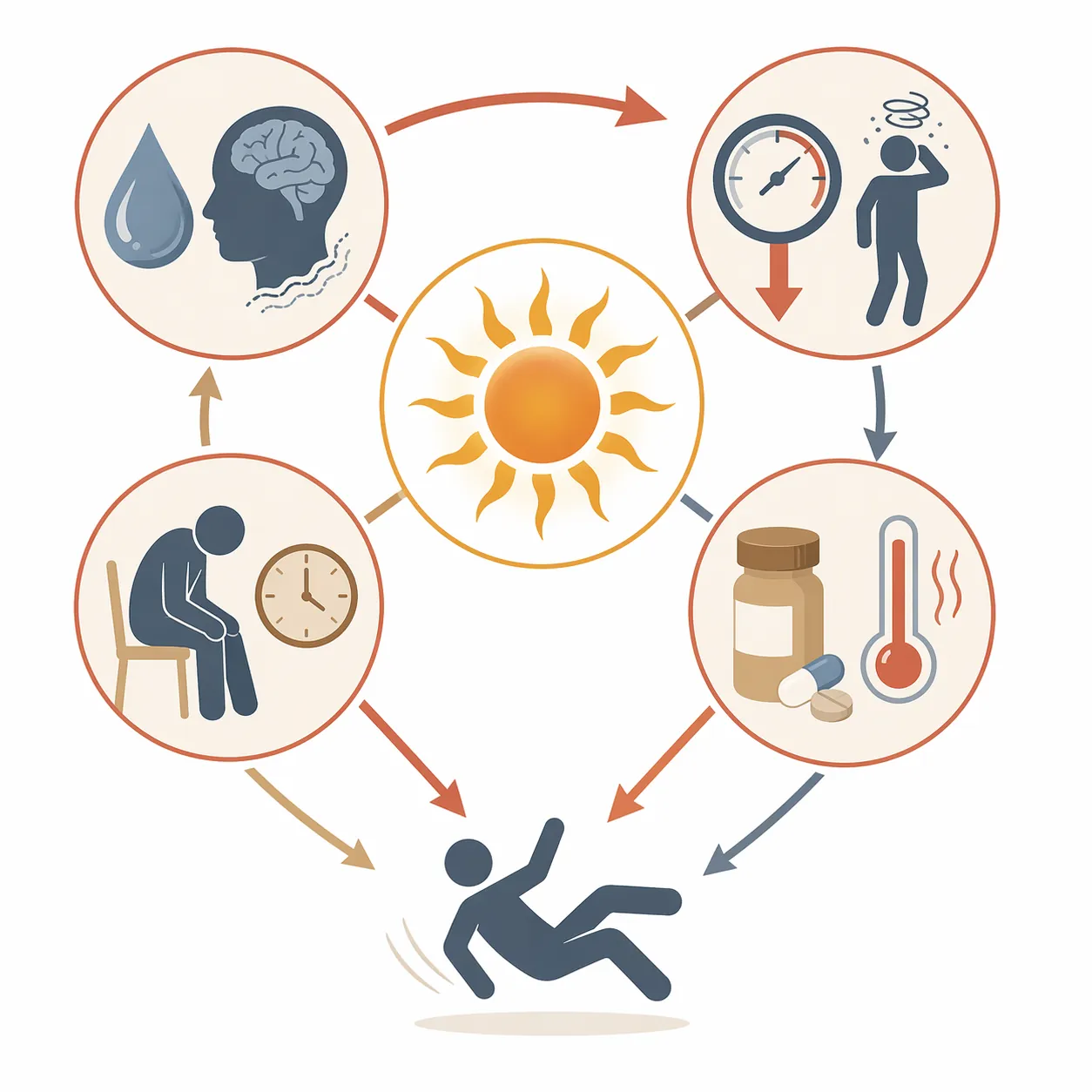
For a traveler, the most practical question is narrower: how does heat turn into a fall? The answer is usually not one single cause. It is a chain.
Heat Turns Ordinary Travel Tasks Into Balance Tests
A fall-prevention view starts with the body, not the itinerary. Heat can reduce fluid reserves before thirst feels urgent, widen blood vessels so blood pressure drops, wear down attention and reaction time, and interact with common medications. Each mechanism is familiar on its own. Together, they make ordinary travel tasks less forgiving: standing after a meal, stepping from sun into shade, lifting luggage onto a train, walking down worn stone steps, or searching for a restroom while trying not to slow everyone else down.
A 2025 study in npj Climate and Atmospheric Science found that, among 860,724 fall-related deaths analyzed in China, each 1°C increase above the optimal temperature was associated with a 1.48% increase in fall mortality risk among older adults.[2] That does not mean the same percentage applies to a healthy visitor walking through Madrid, Rome, Athens, Paris, or Berlin. The study population and the traveler population are not identical. But it is useful directional evidence: hotter conditions can worsen fall outcomes, and fall prevention plans that ignore temperature are missing part of the risk.
The Four Mechanisms That Matter Most
1. Dehydration can affect balance before thirst catches up
Older adults do not always receive the same early warning from thirst that younger travelers do. The CDC notes that people age 65 and older do not adjust as well to sudden temperature changes and are more likely to have chronic medical conditions that change normal responses to heat.[3] Harvard Medicine Magazine also describes impaired thermoregulation in older adults and reports that more than 80% of the estimated 12,000 annual heat-related deaths in the United States occur among people over 60.[4]
On a trip, mild dehydration does not announce itself politely. It can show up as slower thinking, a dull headache, irritability, unsteady walking, or a sudden need to sit down. The traveler may be avoiding fluids because the next restroom is unknown. A caregiver may see the water bottle still full and assume the person simply is not thirsty. Both can be true, and neither makes the sidewalk safer.
2. Heat can drop blood pressure at exactly the wrong moment
When the body tries to cool itself, blood vessels near the skin widen. That helps release heat, but it can also lower blood pressure. Add a long lunch, alcohol, a diuretic, a crowded museum room, or a steep walk back to the hotel, and the vulnerable moment often arrives when the person stands.
Orthostatic hypotension is the drop in blood pressure that can happen after standing. The travel version is easy to miss because it may last only seconds: a hand goes to the table, the person says “I’m fine,” and everyone keeps moving. But those seconds matter if the next step is onto uneven pavement or down stairs without a railing.
3. Heat fatigue slows the reflexes that prevent a stumble from becoming a fall
Most older travelers do not fall because they never noticed the hazard. They fall because the body has less time or power to correct after noticing it. Heat fatigue narrows that margin. A toe catches on a raised paving stone; a train door opens and the crowd moves; a suitcase wheel sticks; a shower floor is slick. On a cooler day, a quick hand, a side step, or a stronger leg may recover the situation. In sustained heat, reaction time and muscle steadiness can be less reliable.
This is where “we’ll just push through and rest later” becomes a fall-prevention problem. Rest later does not help the missed step now. The protective reflex has to be available at the moment the body needs it.
4. Common medications can make heat harder to tolerate
Medication is the part many travel articles treat too lightly. The CDC’s heat-and-medications guidance identifies several drug classes that can increase heat-related harm risk, including diuretics, anticholinergics, antipsychotics, beta blockers, ACE inhibitors and ARBs, SSRIs and SNRIs, and tricyclic antidepressants.[5] AARP’s July 2026 update similarly flags heart medications such as diuretics, beta blockers, ACE inhibitors, and ARBs, along with antidepressants, antipsychotics, central nervous system stimulants, anticholinergics, antihistamines, decongestants, and dopaminergics as medication types that may impair heat tolerance in older adults.[6]
The point is not to stop a medication before a trip. That can be dangerous. The point is to recognize that the medication list belongs in the fall-risk conversation before departure. A traveler taking a diuretic may have a different hydration problem than a traveler who is not. A traveler taking a beta blocker may not respond to heat stress in the same way. A traveler taking a sedating antihistamine or certain antidepressants may have added dizziness or slower reactions. The safe move is a clinician review, not self-adjustment.
For a deeper medication-focused checklist, use A Caregiver's Guide to Medication Review for Fall Prevention as a companion resource. Heat adds urgency to that review, but it does not replace medical judgment.
Before Departure: Build the Fall-Prevention System While Choices Are Still Easy
The best heat-wave fall prevention happens before anyone is tired, embarrassed, overheated, or trying to make a decision on a train platform. A good plan does not have to make the trip smaller. It should make the risky moments less improvised.
| Pre-trip task | Fall-risk reason |
|---|---|
| Ask a clinician or pharmacist to review the medication list for heat sensitivity, dizziness, dehydration risk, and blood-pressure effects. | Medication effects can overlap with heat stress and standing-related blood pressure drops. |
| Discuss any history of fainting, light-headedness, recent falls, near-falls, neuropathy, or balance changes. | A heat wave can expose a balance problem that is manageable at home but risky on stairs, curbs, and cobblestones. |
| Plan routes around shade, benches, transit elevators, and indoor cooling stops. | The safest route may not be the shortest route. |
| Make hydration bathroom-aware rather than vague. | Some travelers restrict fluids when restroom access is uncertain, which can worsen dehydration. |
| Leave open time around arrivals, museum visits, meals, and transfers. | Rushing after sitting, eating, or waiting in heat creates a high-risk standing-and-moving moment. |
The medication review should be practical. Bring the full list, including prescriptions, over-the-counter sleep aids, allergy medications, decongestants, supplements, and as-needed pills. Ask which medications could increase dizziness, dehydration, heat intolerance, sedation, or blood-pressure drops. Ask what symptoms should trigger a call to the clinician. Do not change doses, skip doses, or stop medication unless the prescribing clinician gives that instruction.
A broader fall plan is also worth building before the trip. The CDC STEADI-based fall prevention action plan can help families organize risk factors such as strength, vision, footwear, home habits, and prior falls. For a simpler shareable overview, the fall prevention handout for seniors can sit next to the travel itinerary rather than in a medical folder no one opens.
On the Ground: Change the Pace Before the Body Forces the Issue
Once in Europe, the useful question is not “Can we still do the plan?” It is “Which part of the plan creates the next unstable moment?” Heat makes transitions more important than destinations: bed to standing, cafe chair to curb, train seat to platform, shower to towel, sun to stairs.
- Stand in stages: sit upright, place both feet flat, pause, stand with a hand on a stable surface, pause again, then walk.
- Treat the first few steps after meals, naps, long rides, or museum seating as higher risk.
- Use benches, walls, railings, and shaded edges early, not only after dizziness starts.
- Choose elevators, taxis, or shorter walking segments when heat and fatigue are already accumulating.
- Move water planning closer to restroom planning: identify toilets before encouraging more fluids.
Bathroom-aware hydration deserves special attention because it respects the reason many older travelers restrict water. “Drink more” is not a plan if the person is worried about being trapped in a ticket line, on a bus, or far from an accessible restroom. A better plan is to drink steadily when restrooms are predictable: before leaving the hotel, at museums, at restaurants, at train stations, and during planned cooling stops. The goal is not to flood the body at once. It is to avoid drifting through the day on too little fluid because every restroom feels uncertain.
Cooling stops should be named in the itinerary, not left as a hopeful idea. In some European cities, including Barcelona, travelers may find municipal climate shelters or cooling spaces such as libraries, civic centers, museums, parks, or other public facilities. Availability, hours, and eligibility can vary, so check the city’s current local map rather than assuming every neighborhood has the same option. In EU countries, 112 is the common emergency number; in non-EU European destinations, emergency numbers and response systems may differ, so confirm the local number before the trip.
Caregivers Should Watch the Pattern, Not Police Every Sip
The adult child’s job is not to turn a parent’s vacation into a medical inspection. It is to notice patterns early enough that the traveler keeps independence. A full water bottle, slower answers, a hand reaching for furniture after standing, unusual irritability, a shuffling gait, or repeated “I’m fine” after visible unsteadiness are all reasons to slow the next hour down.
That conversation usually works better when it is framed around the shared plan rather than the person’s age. “Let’s use the shaded route and sit before the cathedral steps” lands differently than “You’re getting too old for this.” The goal is to protect the trip the older traveler wants, not to win an argument about risk.
If the traveler has chest pain, confusion, fainting, severe weakness, signs of heat stroke, a head injury after a fall, or symptoms that feel urgent, use local emergency services. This article is about prevention, not emergency triage.
What to Skip, Shorten, or Move
In a heat wave, fall prevention may require spending money or social capital on changes that look unnecessary from a distance. Skip the climb if the railing is poor and the shade is gone. Shorten the walking tour if the traveler is already light-headed before it starts. Move the museum visit to the morning. Take the taxi for the uphill return. Leave the suitcase at storage instead of dragging it over stone streets for one more stop.
Travel insurance questions belong to a different decision track, but they can matter when heat disrupts flights, trains, or hotel plans. If schedule changes are becoming part of the safety plan, see weather delay coverage for seniors before assuming a policy will cover a change.
None of this means older adults should not travel in Europe in summer. It means Europe’s 2026 heat wave should be treated as a fall-risk environment, not just a hot vacation. The safer trip is the one that plans for fluids, blood pressure, fatigue, and medication effects together—then gives the traveler enough time, shade, and dignity to keep moving.
References
- Europe's early heat wave led to spike in deaths and killed mostly elderly people, estimates show, ABC News/AP, July 2026.
- Association between ambient temperature and fall-related mortality among older adults, npj Climate and Atmospheric Science, 2025.
- Heat and Older Adults Aged 65+, CDC.
- The Effects of Heat on Older Adults, Harvard Medicine Magazine.
- Heat and Medications – Guidance for Clinicians, CDC, updated September 2025.
- 8 Types of Medications That Don't Mix With Heat, AARP, updated July 2026.
Related reading
Noticed something outdated or inaccurate on this page? Flag a correction. We review every report against CDC, NIA, and AARP HomeFit guidance before updating a page.
Part of the Fall Prevention section.