
STEADI: screen
Egg Recall Brands Seniors Should Avoid Now
Find out if your eggs are part of the July 2026 Salmonella recall by checking brands and carton codes, and learn why seniors need to act quickly given their higher risk of severe illness.
Last updated: July 25, 2026.
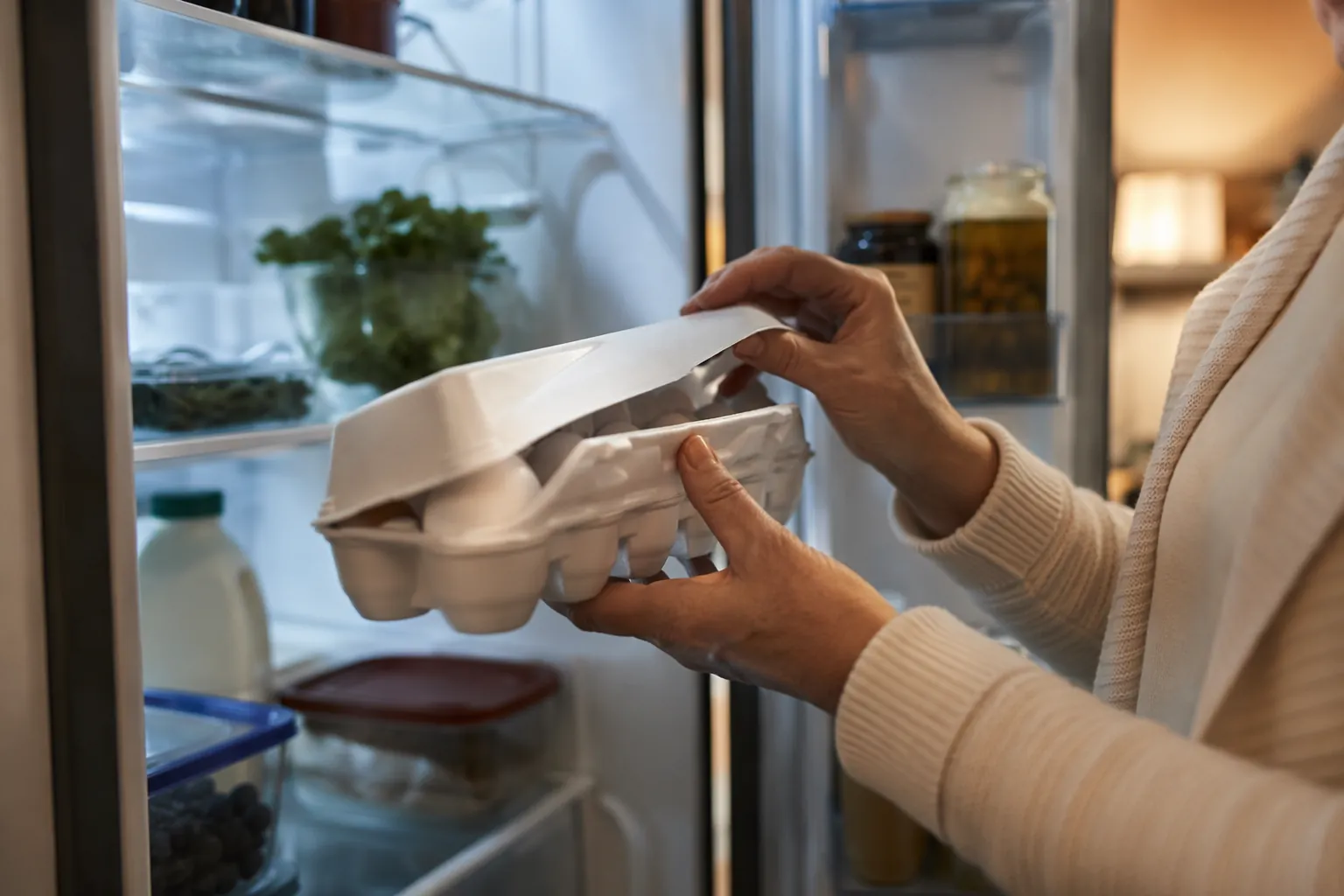
If you are standing at an older adult’s refrigerator with an egg carton in your hand, start with the carton, not the headline. The July 2026 egg recall applies only if the eggs line up with the affected brand or store route, the affected states, and the printed carton identifiers. Midwest Poultry Services, L.P. recalled 1,589,577 dozen shell eggs on July 22, 2026, because of possible Salmonella Enteritidis contamination; as of the FDA recall notice, no illnesses had been confirmed in connection with the recall.[1]
For senior safety, the egg recall brands to avoid are Kroger, Simple Truth Cage Free, Brookshire’s, Country Morning, and Sunups — but only when the package size, store geography, plant code, Julian date, and sell-by or best-by date also match the recall details.[2][3]
First, Check Whether This Carton Could Even Be in the Recall
A carton outside the affected stores and states is very unlikely to be part of this recall. The recalled eggs were sold through Kroger stores in Texas and Louisiana, and through Brookshire Grocery stores in Texas, Oklahoma, Arkansas, Louisiana, New Mexico, and Mississippi.[2][3]
That means a carton bought from an unrelated store in another state does not need to be treated as suspect just because it has eggs in it. If the older adult buys groceries through delivery, curbside pickup, a relative, or a neighbor, check the receipt or ask where the carton came from before making a decision.
| Check | Recall match |
|---|---|
| Store route | Kroger stores in TX or LA; Brookshire Grocery stores in TX, OK, AR, LA, NM, or MS |
| Brands | Kroger, Simple Truth Cage Free, Brookshire’s, Country Morning, or Sunups |
| Plant code | P-1950 or 0840962 |
| Julian date | 157 through 184 |
| Sell-by or best-by date | July 20 through August 17, 2026 |
The Brands and Package Sizes Named in the Recall
The affected brand families and package sizes are specific. A familiar brand name alone is not enough. A Kroger carton, for example, still has to match the recalled plant code, Julian date range, and sell-by or best-by date before it belongs in the recall.
- Kroger: 24-count, 18-count, 12-count, 8-count, and 6-count cartons.[2][3]
- Simple Truth Cage Free: 12-count and 6-count cartons.[2][3]
- Brookshire’s: 12-count and 6-count cartons.[2][3]
- Country Morning: 12-count cartons.[2][3]
- Sunups: 12-count cartons.[2][3]
If the carton brand is not one of these, the carton is not named in the recall materials used here. If it is one of these, keep going. The code check is what separates a recalled carton from an unaffected carton of the same brand family.
How to Read the Carton Codes Without Guessing
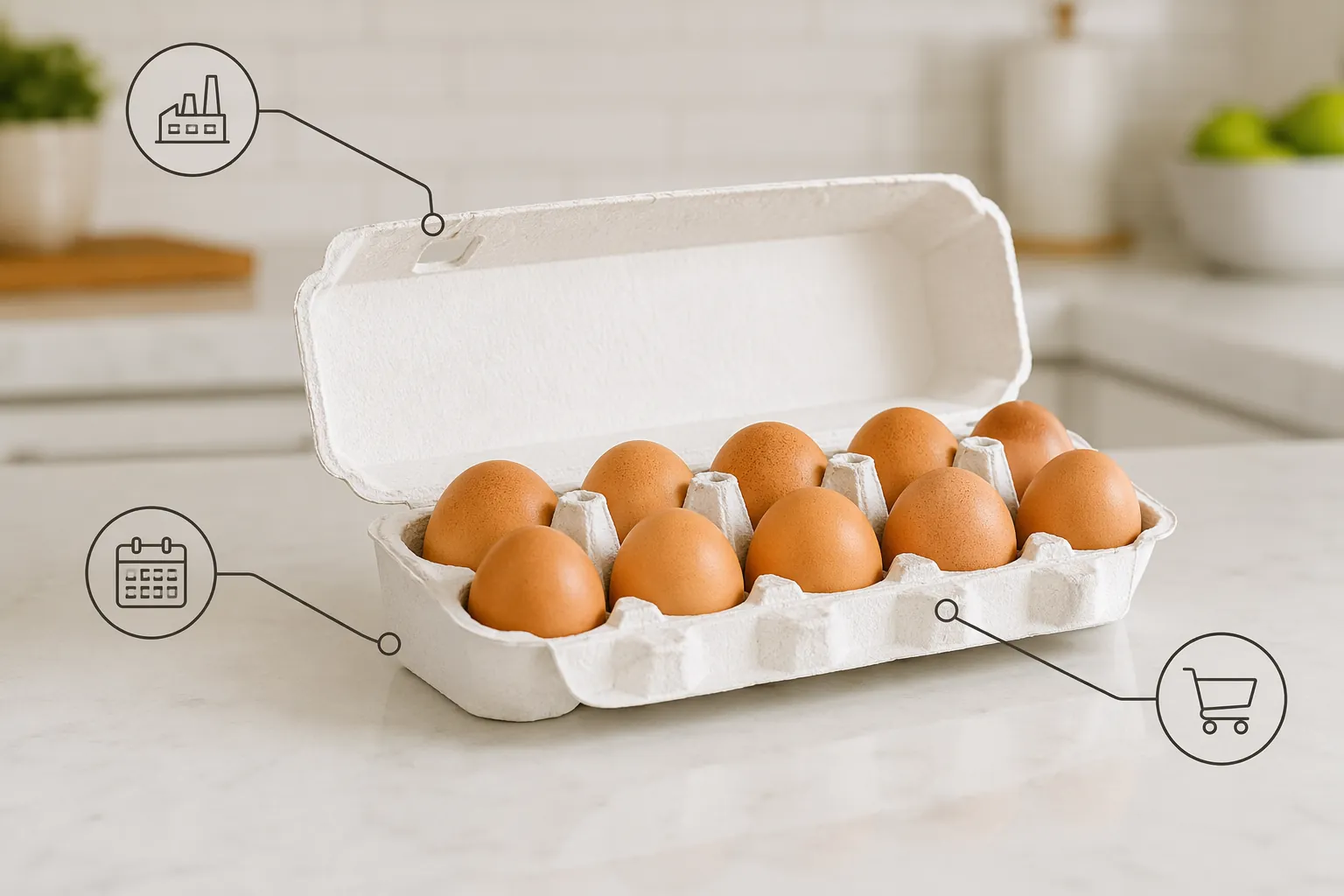
Look on the carton flap, side panel, or top label area for the plant code, the Julian date, and the sell-by or best-by date. The exact placement can vary by carton design, so turn the carton slowly and check every printed panel before deciding the code is missing.
For this recall, the plant code must be P-1950 or 0840962. The Julian date must be 157 through 184. The sell-by or best-by date must fall from July 20 through August 17, 2026.[4]
All three printed conditions must match. If the carton has the right brand but the wrong plant code, it is not part of this recall. If it has the right plant code but a Julian date outside 157–184, it is not part of this recall. If it has the right plant code and Julian date but a sell-by or best-by date outside July 20 through August 17, 2026, it is not part of this recall.[4]
Do not fill in a missing identifier from memory, a receipt, or the fact that the carton “looks like” another one. A carton missing any one of these three identifiers is not part of the recall as described in the available recall-identification guidance.[4]
A Practical Fridge-Door Sequence
- Confirm where the eggs were bought. Focus on Kroger in Texas or Louisiana, and Brookshire Grocery stores in Texas, Oklahoma, Arkansas, Louisiana, New Mexico, or Mississippi.[2][3]
- Check the brand and size. Match it against Kroger, Simple Truth Cage Free, Brookshire’s, Country Morning, or Sunups in the listed sizes.[2][3]
- Find the plant code. It must be P-1950 or 0840962.[4]
- Find the Julian date. It must be 157, 158, 159, or any number through 184.[4]
- Find the sell-by or best-by date. It must be July 20 through August 17, 2026.[4]
- If the brand or store route and all three printed identifiers match, do not use the eggs.
This is the point where a caregiver can stop alarming the household if the codes do not match. Keep the carton only if it is clearly outside the recall; set it aside if it clearly matches; and if the print is damaged or unreadable on a carton from the affected store route, take the safer route and avoid serving it to an older adult until the retailer or recall contact can clarify.
If the Carton Matches, Do Not Try to Cook Around the Recall
A recalled carton should not be served to an older adult. Do not taste, soft-scramble, bake with, or “use up” the eggs because they look and smell normal. Salmonella contamination is not something a home cook can reliably detect by appearance.
Follow the recall handling instructions from the store or FDA notice: return the carton if that is the instructed route, or dispose of it so no one else eats from it. If an older adult is attached to not wasting food, this is the moment to be matter-of-fact rather than dramatic. The decision is about a recalled product, not about whether the kitchen is clean or whether the eggs “seem fine.”
After moving the carton, clean any refrigerator shelf, counter, bowl, utensil, or hand-contact surface that may have touched raw egg or egg packaging. Wash hands after handling the carton. If eggs were cracked before the recall was checked, clean the surrounding prep area and discard any food that may have been contaminated by raw egg.
Why the Senior Risk Changes the Response
The recall has no confirmed illnesses as of the FDA notice, so this is not evidence that every affected carton has made someone sick.[1] It is still worth acting quickly in a senior’s kitchen because Salmonella can hit older adults harder once infection occurs.
CDC food-safety guidance says nearly half of adults 65 and older with lab-confirmed Salmonella infections are hospitalized.[5] That statistic refers to lab-confirmed cases reported through surveillance systems; it should not be read as the hospitalization rate for every mild stomach upset that never reaches a doctor. It does mean a recalled egg carton is not a good place to test anyone’s luck.
Salmonella symptoms can appear 6 hours to 6 days after ingestion.[5] Watch for diarrhea, fever, stomach cramps, vomiting, or signs of dehydration, especially if the older adult ate eggs from a matching carton during that window. If symptoms are severe, persistent, or concerning for that person’s medical situation, contact a healthcare professional promptly.
The broader national burden is substantial — CDC estimates Salmonella causes about 1.35 million illnesses and 420 deaths each year in the United States — but the useful household fact today is narrower: an older adult who ate from a matching recalled carton deserves closer attention than someone who simply has unrelated eggs in the refrigerator.[5]
If the Carton Does Not Match, Keep Normal Egg Safety in Place
If the carton does not match the affected brand or retail geography and all three identifying code/date conditions, it is not part of this recall based on the available information. There is no need to throw away unrelated eggs just to feel thorough.
For older adults, ordinary egg safety still matters. USDA FSIS advises cooking eggs until yolks and whites are firm, with a 160°F internal temperature, and notes that pasteurized egg products are a safer alternative when a recipe calls for eggs that may not be fully cooked.[6]
So the household decision is simple enough to make with the refrigerator door open: if the carton matches the affected store route, named brand and size, plant code P-1950 or 0840962, Julian date 157–184, and sell-by or best-by date July 20 through August 17, 2026, keep it off the plate and handle it under the recall guidance. If it does not match, return to normal senior-safe egg handling.
References
- Midwest Poultry Services, L.P. Recalls Shell Eggs Due to Possible Salmonella Enteritidis Contamination — FDA
- Eggs recalled over salmonella risk were sold at Kroger and other stores. See the brands — TODAY
- Egg recall products, states list — USA TODAY
- Egg Recall: What to Know About Midwest Poultry Services — Good Housekeeping
- Safer Food Choices for Adults 65 and Older — CDC
- Adults 65 and Older: An At-Risk Population, but Why? — USDA FSIS
Related reading
Noticed something outdated or inaccurate on this page? Flag a correction. We review every report against CDC, NIA, and AARP HomeFit guidance before updating a page.
Part of the Fall Prevention section.