
STEADI: Intervene
How Permanent DST Affects Seniors' Sleep and Fall Risk
This article explains why proposed permanent daylight saving time (DST) disproportionately disrupts older adults' sleep and how the resulting chronic sleep fragmentation directly increases fall risk at home through balance impairment, reduced morning visibility, and medication timing errors. Caregivers will learn practical mitigation steps regardless of which way the legislation goes.
At 4:30 in the morning, the house is not ready for anyone to be graceful. The bedroom is dark, the bathroom light feels too bright, the dog may already be restless, and the pill organizer is waiting on the kitchen counter. For many older adults, this is not an occasional odd hour. Sleep timing often shifts earlier with age, especially beginning around ages 60 to 65, so the body may wake earlier and become sleepy earlier than it used to.[1] That is where the question of how permanent daylight saving time affects seniors' sleep health stops being abstract.
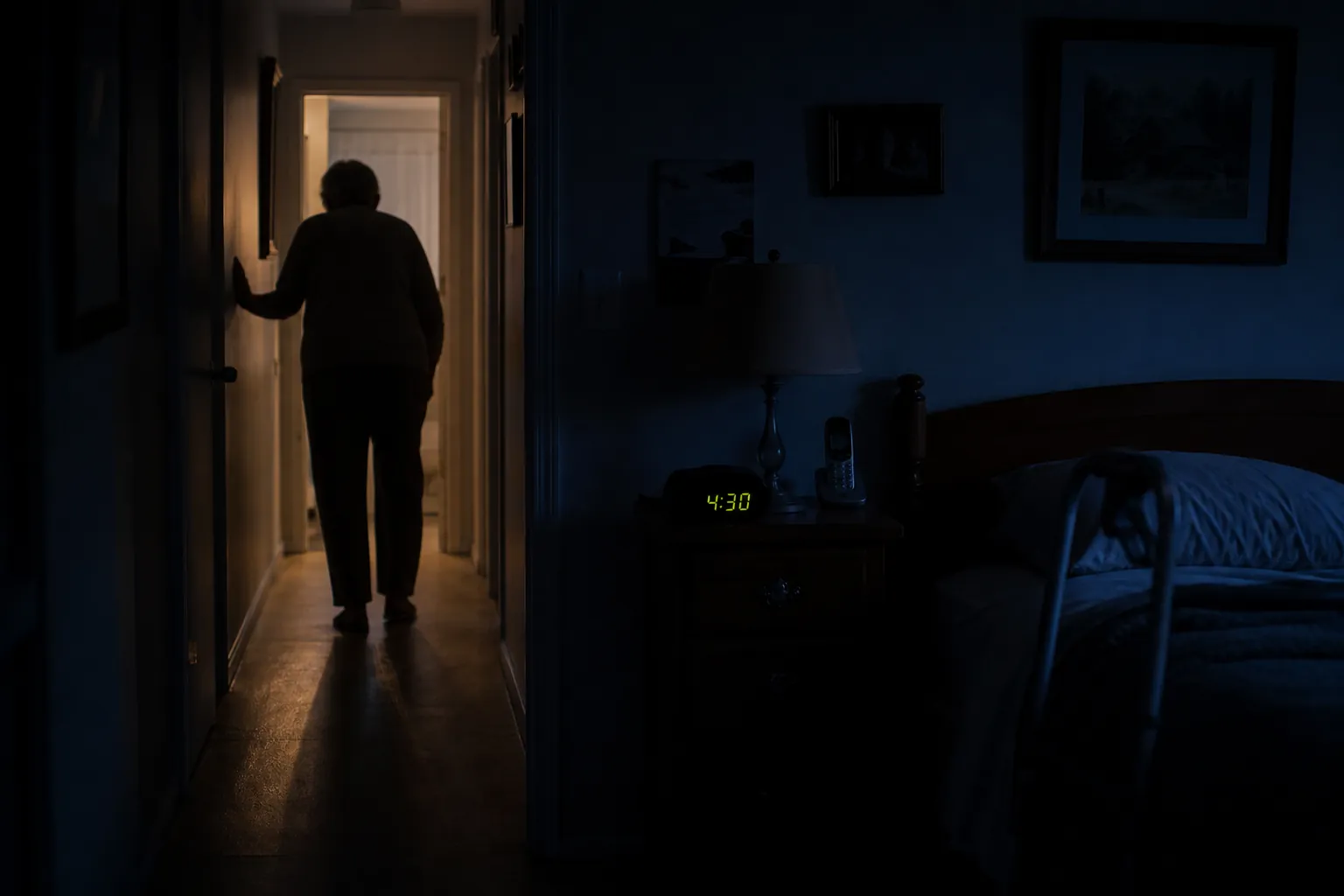
Permanent daylight saving time would not merely give everyone brighter evenings. It would move more winter-morning clock time into darkness. For an older person whose body already wants to start the day early, that means more of the real morning routine—bathroom trips, medication, breakfast, letting a pet out, walking to the mailbox—can happen before the home and street are safely lit.
Last updated July 25, 2026: the national policy discussion is active. Sleep Foundation's 2026 legislation update reports that the House passed a permanent daylight saving time bill in July 2026, with Senate action still pending.[2] The status may change, but the practical health question for older adults is already clear enough to examine: which clock better matches aging biology and morning safety?
Older Body Clocks Do Not Bend Easily
The older adult who wakes at 3 or 4 a.m. is not simply being stubborn, anxious, or “used to the old days.” Circadian rhythms change with age. Sleep Foundation describes an age-related phase advance: older adults commonly feel sleepy earlier in the evening and wake earlier in the morning, with the shift becoming more noticeable from about ages 60 to 65.[1]
That matters because daylight saving time pushes clock time later relative to the sun. Under permanent DST, the clock may say morning, but the body and the sky can still be arguing. Younger adults may also feel that mismatch, but older adults have less flexibility in the system that regulates sleep timing. A schedule that tells them to “just sleep later” can run straight into biology.
The American Academy of Sleep Medicine has taken the position that permanent standard time is better aligned with human circadian biology. Its position statement notes that the body clock does not fully adjust to daylight saving time even after several months, a point that matters more when the proposal is not a one-week nuisance but a year-round clock setting.[3]
So the usual reassurance—people will adapt—does not settle the senior-safety problem. It skips the person who is awake before sunrise because her body is already done sleeping. It skips the man who takes a diuretic early and needs the bathroom before the hallway is bright. It skips the caregiver who gets the phone call after a “small stumble” that somehow left a bruise.
The Fall-Risk Chain Starts Before the Fall
A fall rarely begins at the moment a foot catches the rug. It often begins with poorer sleep, poorer lighting, an urgent bathroom trip, or a medication routine that has become a little less predictable. Permanent DST can press on all of those points at once.
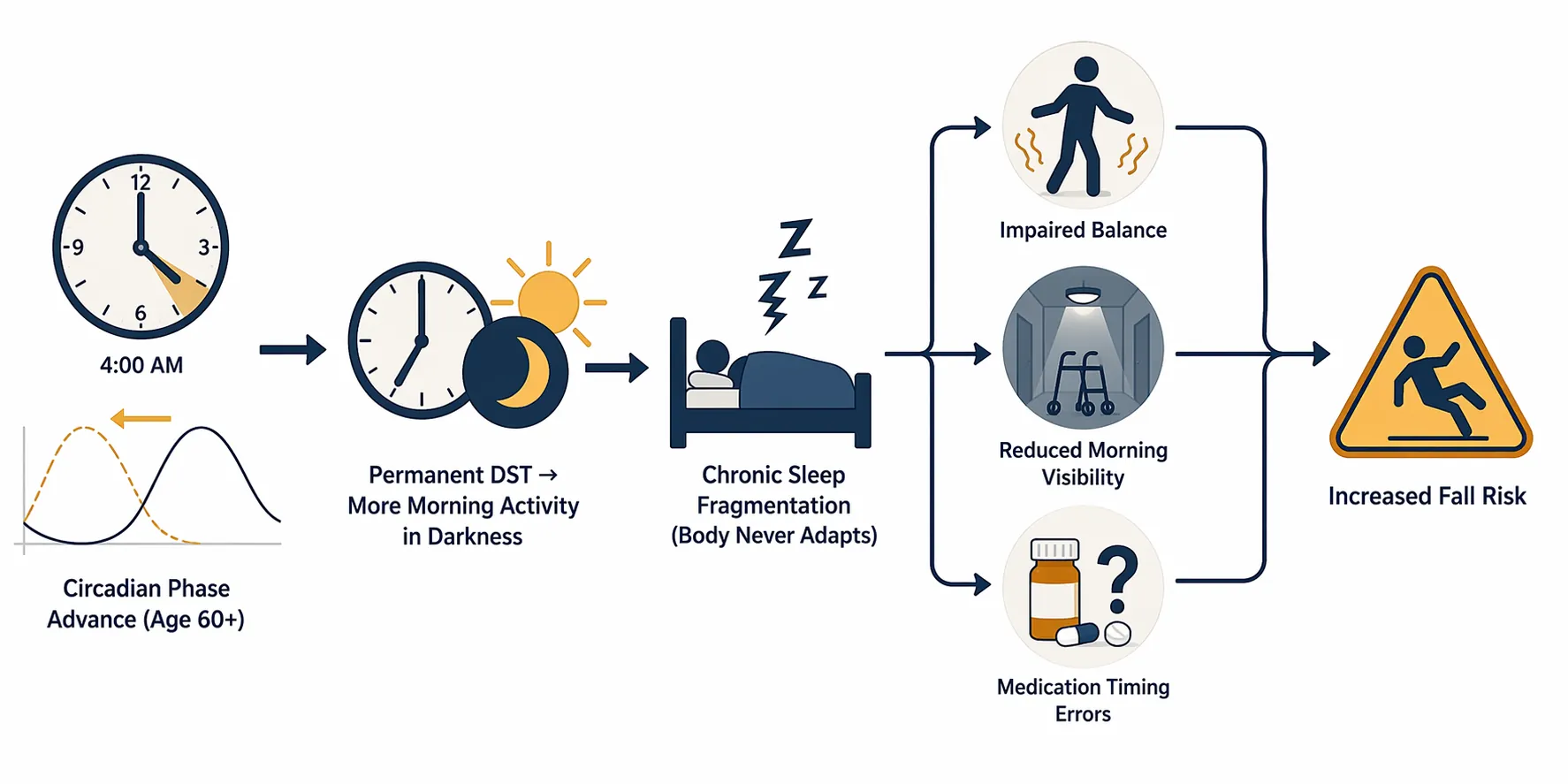
The most direct chain looks like this: aging shifts sleep earlier; permanent DST places more clock-morning activity in darkness; circadian mismatch contributes to fragmented sleep; and fragmented sleep shows up in the body as groggier balance, slower reaction, and less reliable attention during ordinary movements.
The National Committee to Preserve Social Security and Medicare makes the senior-specific concern plainly: “Disrupting normal sleeping and waking patterns can increase the risk of falls for older people.” The same analysis cites Dr. Benjamin Liptzin’s concern that darker winter mornings could be especially dangerous for older adults navigating icy sidewalks and that falls can lead to hip fractures.[4]
The sidewalk example is easy to picture, but many dangerous mornings never reach the sidewalk. They happen between the bed and the bathroom. A person wakes earlier than the household, stands too quickly, reaches for a robe, turns toward the hallway, and makes the first steps of the day while still sleep-heavy. If the clock has made sunrise later, the home-safety margin gets thinner.
Balance is a sleep issue, not only a strength issue
Caregivers are often told to look for loose rugs, poor shoes, and weak legs. They should. But sleep belongs on that list. A fragmented night can leave an older person less steady before anyone has had a chance to notice a “medical” problem. The person may still insist she is fine because nothing dramatic happened: she just grabbed the wall, sat back down, or waited for the room to stop feeling uneven.
Permanent DST does not have to cause a fall by itself to be a bad bargain. Fall prevention is about reducing stacked risks. If an older adult already has neuropathy, low vision, arthritis, nighttime bathroom urgency, blood-pressure medication, or a history of near falls, adding chronic circadian strain and darker mornings is not a neutral change.
Visibility is part of the morning routine
Even good indoor lighting is often designed for people who are fully awake. Early-morning movement is different. The eyes are adjusting, the person may be rushing to the bathroom, and small obstacles are harder to judge: slippers not lined up, a cane just out of reach, a laundry basket left near the doorway, a dog lying in the hall.
Outdoors, later sunrise has its own hazards. The mailbox, trash bins, driveway, porch steps, and icy walkway become part of the sleep-health discussion because that is where the older person may be walking while the neighborhood still looks like night. Evening daylight may be pleasant. It does not help much if the fall-risk window is before breakfast.
Medication timing can drift when sleep timing drifts
Medication routines are another place where clock policy becomes household reality. Many older adults tie pills to waking, breakfast, a blood-pressure reading, a glucose check, or a caregiver call. If sleep becomes more fragmented, the first waking of the day may no longer be the true start of the day. Was the pill taken at 4:15 or only moved from one hand to the other? Did breakfast happen early enough for the medication that should be taken with food? Did a second dose get taken because the first one was forgotten?
Those are not arguments against every morning medication. They are reasons to treat schedule disruption as a safety issue. A clinician or pharmacist can help decide whether a medication time should be anchored to clock time, meals, wake time, or another stable cue. Caregivers should not quietly rearrange prescription timing on their own.
What the Big Studies Can and Cannot Prove
The strongest health argument against permanent DST does not rest on a single fall study in seniors. It rests on several strands that point the same way: aging shifts circadian timing earlier, daylight saving time is misaligned with human biology, disrupted sleep can increase fall risk, and darker mornings make ordinary movement less safe.
A 2025 Stanford Medicine report on modeling by Jamie Zeitzer and Erik Weed gives the debate useful scale. The modeling estimated that permanent standard time would produce population-level health benefits compared with permanent daylight saving time, including 2.6 million fewer obesity cases and 300,000 fewer strokes.[5] Those are not senior-fall numbers, but they are a serious reminder that clock time is not just a lifestyle preference.
The caveat is important. The Stanford model used assumed sleep schedules and light-exposure patterns, including a 10 p.m. to 7 a.m. sleep window.[5] That does not match many older adults who are awake much earlier. For seniors, the concern may be even more practical than the model captures: their active day often begins before the modeled day begins.
A review of common daylight saving time misconceptions also supports the broader conclusion that standard time better aligns with human biology.[6] Harvard’s Petrie-Flom Center has likewise argued the legal and policy case for permanent standard time on health grounds.[7] Still, the honest boundary remains: most available evidence measures circadian effects, health associations, or the twice-yearly clock transition. There is not one definitive trial proving that permanent DST, by itself, causes a specific increase in senior falls.
That limitation should make the claim more careful, not weaker than common sense allows. Fall prevention often works from risk patterns before disaster supplies the final proof. If a policy predictably shifts older adults' early routines into darker, more biologically strained mornings, it deserves scrutiny before the emergency room visit.
Permanent Standard Time Fits Senior Sleep Better
The health-aligned choice for aging adults is permanent standard time. It keeps clock time closer to solar time, gives morning light a better chance to reach the body when it is trying to start the day, and avoids making winter mornings artificially darker for the people most likely to be moving early.
That does not mean evening light has no value. Some people feel safer driving after work in more light, enjoy outdoor activity later in the day, or prefer a brighter dinner hour. Those preferences are real. They are just not the same as asking how a 78-year-old with early waking, low vision, and a bathroom urgency problem gets through the first hour of the day.
For older adults, morning light is not decorative. It helps anchor the sleep-wake rhythm. It also illuminates the exact spaces where falls begin: bedroom edges, bathroom thresholds, stair landings, porch steps, and uneven pavement. A clock policy that protects those hours deserves more weight in a senior-safety discussion than one that mainly improves evening convenience.
What Caregivers Can Do Now
Families do not control Congress, but they do control some of the first steps an older adult takes each morning. If permanent DST becomes law, these steps matter. If it does not, they still matter for winter darkness, poor sleep, and ordinary aging.
- Light the route before wake time. Use motion-activated night lights or scheduled lamps from the bed to the bathroom, kitchen, and main door. The goal is not a pretty glow; it is enough light to see feet, floor edges, pets, cords, and thresholds.
- Make the first path of the day boring. Keep glasses, cane, walker, robe, slippers, and phone in the same reachable places. Remove anything that requires stepping around, twisting, or bending before balance has warmed up.
- Review medication timing with a professional. Ask whether key medicines should follow clock time, meal time, or wake time, especially if sleep becomes more fragmented or the person wakes for long periods before dawn.
- Treat near falls as data. A hand on the wall, a sudden sit-down, a missed step, or a new fear of the hallway is not “nothing.” It is the warning before the injury.
- Watch the first two morning hours. New grogginess, confusion about pills, skipped breakfast, dizziness on standing, or reluctance to walk outside may show that sleep and lighting are now part of the fall-risk picture.
A room-by-room approach helps because most risks are embarrassingly ordinary. For a structured home review, use a CDC STEADI-style home fall prevention checklist or a room-by-room fall prevention checklist. If there has already been a fall, a broader fall prevention action plan is more appropriate than another reminder to “be careful.”
Dementia adds another layer, especially when evening agitation or sundowning is already present. That is related, but not identical, to the permanent-DST question. For the twice-yearly clock change and dementia-specific routines, see the daylight saving dementia caregiver guide or the overnight dementia care guide.
The Practical Bottom Line
Permanent daylight saving time asks older adults to carry more morning darkness at the exact age when many bodies are already waking earlier and adjusting less easily. The likely consequence is not just feeling tired. It is fragmented sleep showing up as unsteady balance, poorer visibility, and less reliable medication routines.
Permanent standard time better matches aging biology. Until policy catches up—or if it does not—caregivers can reduce risk by treating early-morning darkness and broken sleep as fall-risk factors, not minor sleep complaints.
References
- How Circadian Rhythms Change as We Age, Sleep Foundation.
- Latest Updates on DST in 2026, Sleep Foundation.
- Daylight saving time: an American Academy of Sleep Medicine position statement, Journal of Clinical Sleep Medicine.
- Is Permanent Daylight Savings Time Healthy for Seniors?, National Committee to Preserve Social Security and Medicare.
- Permanent standard time would be healthier than daylight saving time, Stanford Medicine scientists say, Stanford Medicine, September 2025.
- Debunking myths about daylight saving time: ten things everyone should know about changing the clock, Sleep Medicine.
- An End to Springing Forward? The Case for Permanent Standard Time, Petrie-Flom Center, Harvard Law School, February 26, 2025.
Related reading
Noticed something outdated or inaccurate on this page? Flag a correction. We review every report against CDC, NIA, and AARP HomeFit guidance before updating a page.
Part of the Fall Prevention section.