
STEADI: intervene
Tornado Watch Checklist for Caregivers of Older Adults
This printable checklist guides caregivers step by step through the actions to take during a tornado watch to prepare an elderly loved one safely before a warning forces a scramble.
A tornado watch was just issued for your older parent’s area. Start now, before the siren or phone warning forces everyone to move fast.
A watch means conditions are favorable for tornadoes; it is the preparation window. A warning means a tornado has been sighted or indicated by weather radar, and the priority changes to taking shelter immediately.[1] If your loved one uses a walker, takes daily medications, depends on oxygen or powered medical equipment, or needs help getting from a recliner to an interior room, the watch is when you make that movement safer.
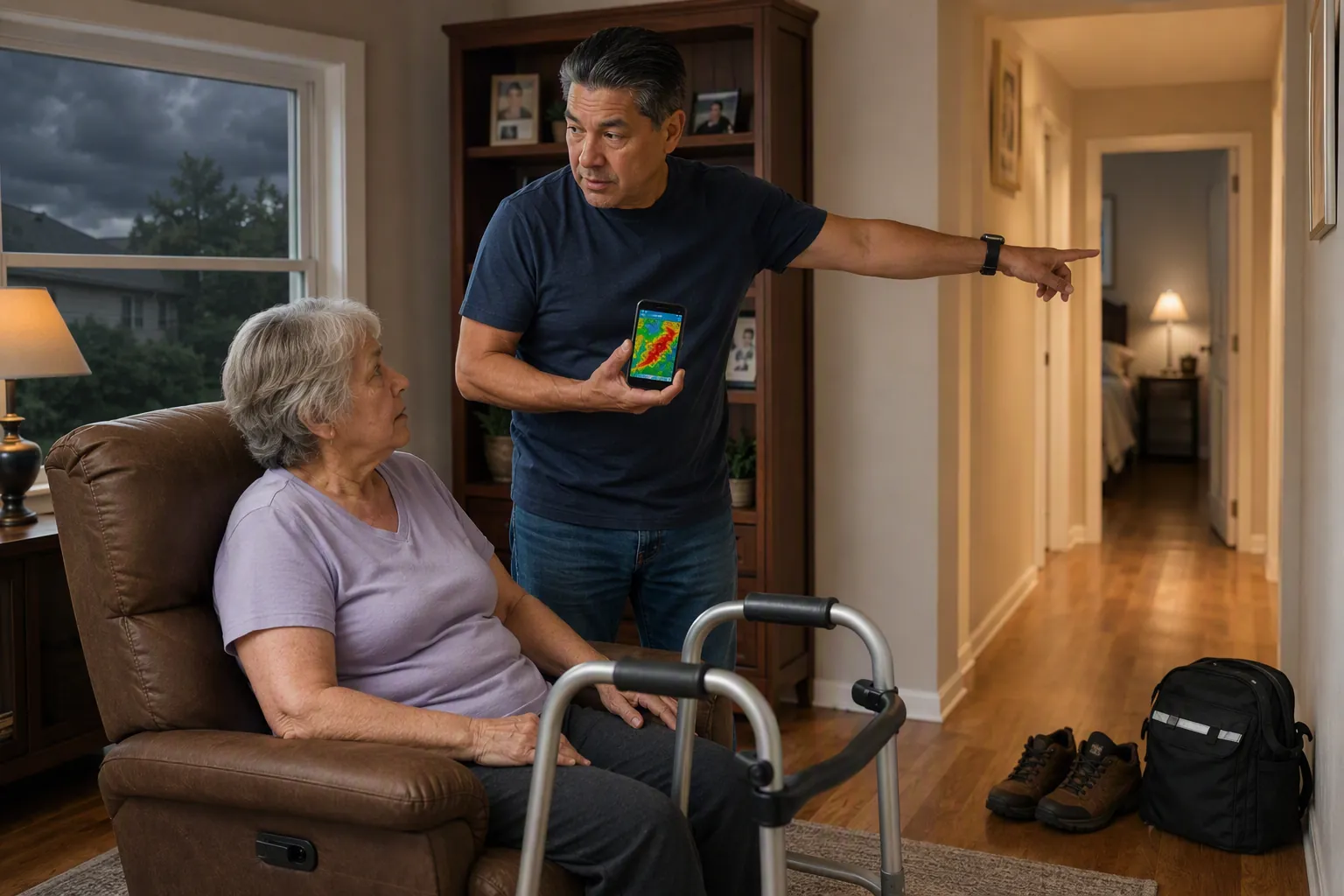
The uncomfortable gap is that many families feel ready without having a plan they can actually carry out. An AARP 2023 survey found that 60% of adults age 50 and older felt prepared for a natural disaster, but fewer than 3 in 10 had an actual plan; 36% did not have extra prescription medications for emergencies, 56% had not saved vital documents digitally, and only 1 in 5 had downloaded disaster apps or signed up for text alerts.[2] Those are not abstract preparedness problems during a watch. They become the missing pill bottle, the dead phone, the blocked hallway, and the adult child who cannot confirm whether Mom heard the alert.
For older adults with mobility limitations or disabilities, the margin is smaller. United Spinal Association notes that people with disabilities are 2 to 4 times more likely to die or be injured in a disaster than people without disabilities, and it also highlights that 43% of tornado deaths over a 21-year period occurred among people in mobile homes.[3] That does not mean every older adult faces the same risk. It does mean the caregiver checklist should start with the person’s actual location, mobility, shelter access, and ability to receive alerts.
| If the alert says... | What it means | Caregiver priority |
|---|---|---|
| Tornado watch | Conditions are favorable for tornadoes. | Prepare the person, route, supplies, communication, and backup power now. |
| Tornado warning | A tornado has been sighted or indicated by radar. | Stop organizing. Move to shelter immediately and follow the warning-phase plan. |
If you need the longer mobility-focused distinction, use Tornado Watch vs Warning for Older Adults With Walkers. This page stays on the watch-phase job: getting ready while slow, safe preparation is still possible.
Tornado watch checklist for caregivers of older adults
Work in this order. If you are remote, do the phone and helper steps first, then talk the person through the route, supplies, and alerts.
| Order | Caregiver action | Done |
|---|---|---|
| 1 | Confirm the watch area, your loved one’s exact location, and whether the home is included in the watch area or county. | □ |
| 2 | Call or text the older adult. If they do not answer, contact the nearest helper, neighbor, building staff, or family member. | □ |
| 3 | Ask where they are sitting right now and how long it usually takes them to reach the shelter area without rushing. | □ |
| 4 | Identify the safest reachable shelter: basement if safely accessible, otherwise a small interior room or hallway on the lowest level, away from windows. | □ |
| 5 | Clear the path from chair, bed, bathroom, and kitchen to the shelter area. Remove rugs, cords, pet bowls, laundry, and small furniture. | □ |
| 6 | Stage shoes, walker, cane, wheelchair, glasses, hearing aids, and any transfer equipment at the start of the shelter route. | □ |
| 7 | Move essential medications, medication list, water, glasses, phone, charger, flashlight, and keys into or beside the shelter area. | □ |
| 8 | Check medical devices: oxygen, CPAP, nebulizer, glucose supplies, hearing-aid batteries, mobility-device batteries, and backup power. | □ |
| 9 | Charge phones and portable power banks. Plug in mobility-device batteries if safe to do so. | □ |
| 10 | Turn on multiple alert layers: Wireless Emergency Alerts, weather app, local text alerts, NOAA Weather Radio if available, and a nearby helper’s alerts. | □ |
| 11 | Confirm a communication plan: who calls whom, what to do if the line drops, and when the helper should go over before conditions worsen. | □ |
| 12 | Decide now what changes if the watch becomes a warning: no more gathering supplies, no more checking rooms, move to shelter immediately. | □ |
First confirm the alert, the address, and who can physically help
Do not start by asking, “Are you worried?” Start with location and contact. Confirm the city, county, and address where your loved one is right now. Older adults may hear “watch” on television for a broad region and assume it is either far away or already over. A remote caregiver needs the actual address matched against the current alert area, then a live person on the phone if possible.
If your loved one answers, keep the first call short and concrete:
- “Where are you sitting right now?”
- “Is your walker, cane, or wheelchair within reach?”
- “Are your shoes on or beside you?”
- “Can you get to the interior room without going near windows?”
- “Is anyone nearby who can come over if this becomes a warning?”
If they do not answer, call the backup contact immediately. That may be a neighbor, apartment manager, home health aide, nearby relative, faith-community contact, or front desk in a senior building. Ready.gov advises older adults to build a support network that can help before, during, and after an emergency; during a tornado watch, that network is not a nice-to-have list in a notebook—it is the next phone call.[4]
Make the shelter route usable before anyone has to hurry
This is where a tornado watch becomes a fall-prevention window. The practical risk is not only the storm outside. It is the older adult trying to stand quickly from a recliner, find shoes, reach for a walker, step over a rug, dodge a pet bowl, and get into a hallway while a warning is already sounding.
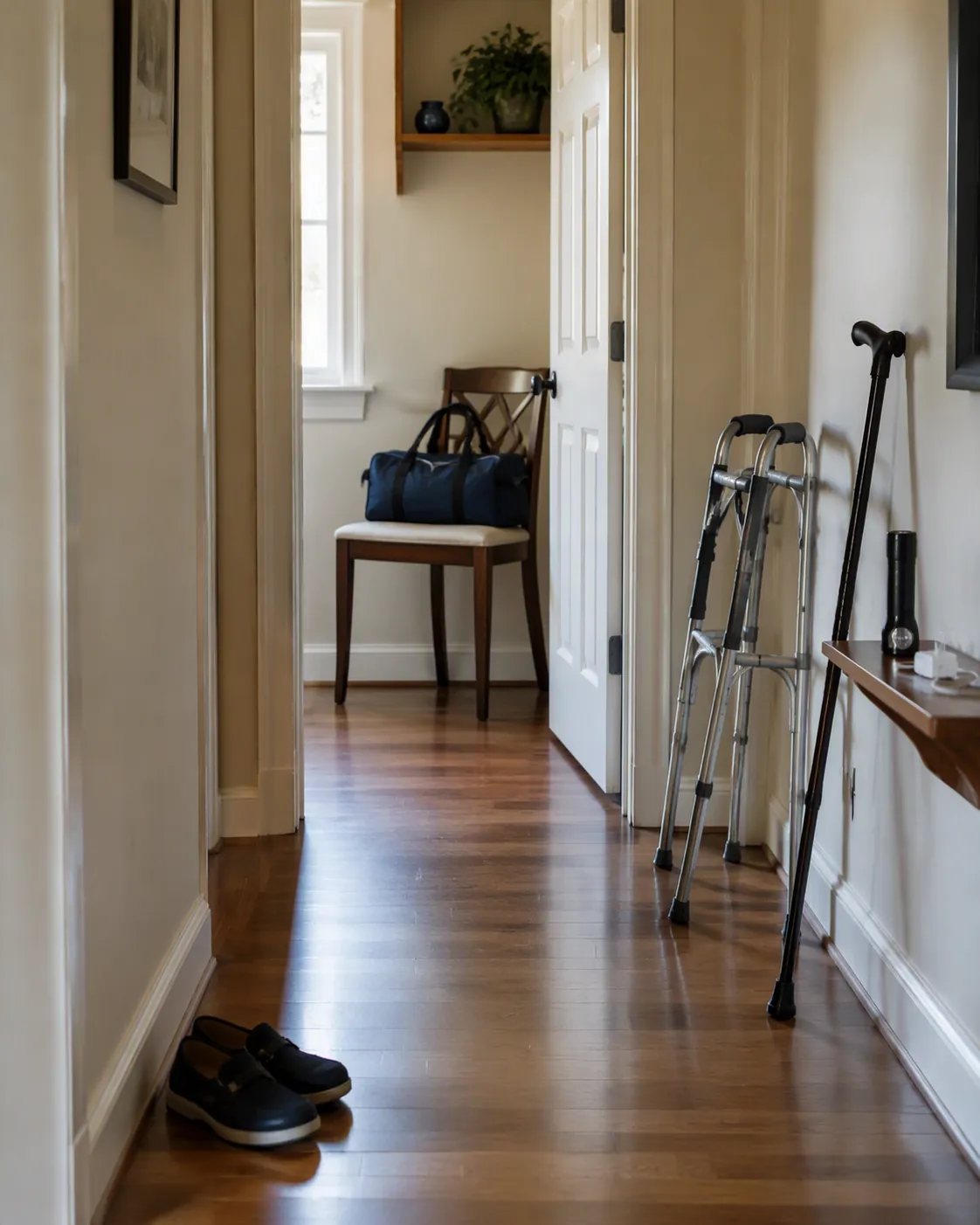
Ask the person or nearby helper to walk the route once now, slowly, if it is safe. Start from the place they are most likely to be when the warning comes: recliner, bed, bathroom, kitchen table. Then clear the path to the shelter area. If the person cannot walk it safely during a watch, they are unlikely to move through it safely during a warning.
- Remove loose throw rugs or tape down edges if removal would create another hazard.
- Move electrical cords, oxygen tubing slack, pet bowls, shoes, laundry baskets, and small tables out of the route.
- Turn on lights in the hallway and shelter room while power is still available.
- Place nonskid shoes on the person or directly beside their feet.
- Put the walker, cane, wheelchair, transfer belt, or rollator on the side they normally use.
- Move a sturdy chair into the shelter area if they cannot sit on the floor and safely get back up.
- Keep glasses, hearing aids, and phone on the person or in a small bag that moves with them.
The safest shelter is not helpful if the person cannot reach it. A basement may be best in many homes, but stairs can make it unrealistic for someone with severe balance problems, oxygen tubing, or a wheelchair. Ready.gov’s tornado guidance points people toward a basement or an inside room without windows on the lowest level; the caregiver’s job during the watch is to choose the safest option the person can actually reach before the warning.[5]
For a deeper shelter-route walkthrough, use How Seniors at Home Can Reach Tornado Shelter Without Falling. During an active watch, stay focused on the route that matters tonight.
Stage medications and medical-device support where they can move with the person
Medication is not a later errand once storms are moving in. The Red Cross recommends that older adults keep a 30-day supply of medications, and its older-adult preparedness guidance uses both a Go-Kit for at least 3 days away from home and a Stay-at-Home Kit for at least 2 weeks at home.[6] During a tornado watch, you may not be building those kits from scratch. You are making sure tonight’s essentials are not left across the house when the warning comes.
The Centers for Disease Control and Prevention notes that 80% of older adults have at least one chronic condition, which is why the medication step belongs near the top of the watch checklist rather than buried in a general emergency kit.[7] Blood pressure pills, insulin supplies, inhalers, anticoagulants, seizure medications, oxygen equipment, and hearing-aid batteries are not interchangeable comfort items. Missing them can change what happens after the storm as much as during it.
- Move the next dose of time-sensitive medication into the shelter area or into a small zippered bag.
- Add a current medication list, allergies, pharmacy phone number, physician contacts, and insurance information.
- Place water beside the medication bag so pills can be taken if the person must remain sheltered.
- Check refrigerated medications and know how they will be protected if power fails.
- Move glucose tablets, testing supplies, inhalers, nebulizer parts, oxygen cannulas, hearing-aid batteries, and spare eyeglasses with the person’s shelter supplies.
- If a caregiver or helper is present, make sure they know which medication must not be missed and where it is located.
If the person already has a severe-weather kit, do not empty it across the kitchen counter to “check everything” while the sky is changing. Pull the critical medical items, documents, flashlight, water, and phone power into the shelter area. Broader kit-building can wait; if you need a fuller list later, use Build a Severe Weather Emergency Kit Your Older Parent Really Needs.
Prepare for power loss before the lights flicker
Power loss turns small household obstacles into bigger ones. A dark hallway, silent phone, uncharged scooter, or oxygen concentrator without a backup plan can undo the preparation you just made.
During the watch, plug in what can be charged without creating a trip hazard. Move charging cords against the wall, not across the route. Put flashlights where hands will actually reach them: beside the chair, in the shelter room, and near the bed if the watch extends overnight.
- Charge the older adult’s phone and your own phone.
- Charge portable power banks and keep one with the shelter supplies.
- Charge wheelchair, scooter, stair-lift, hearing-aid, and medical-device batteries if applicable.
- Check backup oxygen or battery instructions for powered medical equipment.
- Put fresh batteries in flashlights, weather radio, hearing aids, and other essential devices.
- Keep a flashlight in the shelter area rather than relying on a phone light.
Do not let power preparation create a new fall hazard. A charging cord stretched across the hallway may solve one problem and create another. For more detail on lighting, cords, medical devices, and nighttime outages, see Power Outage Fall Risks Every Senior Caregiver Should Know.
Set up more than one way to receive the warning
One alert is not enough for a person who may be napping, hard of hearing, away from the television, or unsure what a phone notification means. AARP’s finding that only 1 in 5 adults age 50 and older had downloaded disaster apps or signed up for text alerts is one of the simplest watch-phase gaps to close.[2]
Layer the alerts now:
- Make sure Wireless Emergency Alerts are enabled on the older adult’s phone.
- Turn on a trusted weather app with location permissions for the correct address.
- Sign up for local emergency text alerts if the community offers them and time allows.
- Turn on a NOAA Weather Radio if one is available and programmed for the area.
- Ask a nearby helper to monitor alerts too, especially overnight.
- Keep the television or radio on only if it helps; do not depend on it as the only warning source.
Then set the communication rule. For example: “If a warning is issued, I will call once. If you do not answer, go to the hallway with your walker and phone. I will call Mrs. Lewis next.” The exact names will differ, but the rule must be simple enough to remember when the weather turns loud.
For a fuller alert setup, use Setting up emergency alerts for elderly during severe storms. During the watch, the goal is not a perfect alert system. It is enough redundancy that one missed sound does not become the only warning.
Decide now what happens if the watch becomes a warning
This decision should be made while everyone is calm: once the alert changes to a tornado warning, the checklist stops. No more gathering documents. No more looking for the good flashlight. No more moving laundry out of the hallway. The older adult moves to the shelter area immediately, using the route and supplies already prepared.
The Red Cross advises practicing tornado drills with the entire household, including moving to the safe place quickly.[8] For an older adult, the practice does not need to be dramatic. During the watch, it may simply mean confirming: “Your shoes are on, your walker is on your right, your phone is in your pocket, and if the warning comes you go to the interior hallway chair.”
If the home is a mobile home, an RV, or another structure that is not safe for tornado sheltering, the decision point is earlier. United Spinal’s tornado preparedness guidance emphasizes knowing accessible shelter options before the tornado is imminent, and the high share of tornado deaths in mobile homes makes this a serious watch-phase issue, not a warning-phase debate.[3] If relocation is part of the plan, it must happen while conditions still allow safe travel.
Once a warning is issued, hand off to the warning plan: A Fall-Safe Tornado Warning Plan for Seniors.
Printable one-page tornado watch card
Use this as the short version during the next watch.
| Priority | Do this during the watch |
|---|---|
| Confirm | Check the alert area and exact address. Call the older adult. If no answer, call the backup helper. |
| Locate | Ask where they are sitting, whether shoes are on, and whether their walker, cane, wheelchair, glasses, hearing aids, and phone are within reach. |
| Shelter | Choose the safest reachable shelter: basement if safely accessible, otherwise a small interior room or hallway on the lowest level, away from windows. |
| Clear | Remove rugs, cords, clutter, pet bowls, laundry, and small furniture from the route. |
| Stage mobility | Place shoes, walker, cane, wheelchair, transfer aid, sturdy chair, glasses, hearing aids, and phone at the start of the route or in the shelter area. |
| Stage medical needs | Move medications, medication list, water, oxygen supplies, glucose supplies, inhalers, hearing-aid batteries, and spare glasses into a small bag or shelter area. |
| Power | Charge phones, power banks, mobility-device batteries, and medical-device batteries. Put flashlights with fresh batteries in the shelter area. |
| Alerts | Turn on phone alerts, weather app alerts, local text alerts, NOAA Weather Radio if available, and a nearby helper’s alerts. |
| Communication | Set the rule for dropped calls: who calls, who checks in, and what the older adult does if they cannot reach anyone. |
| Warning handoff | If a tornado warning is issued, stop preparing and move to shelter immediately. |
The watch window matters because it is when slow preparation is still possible. Once the warning arrives, the job is no longer organizing. It is getting the older adult to the prepared shelter area without a last-minute scramble.
References
- Tornado During, NOAA
- AARP Survey Reveals Opportunities for Older Adults to Increase Disaster Preparedness and Stay Actively Informed During an Emergency, AARP, August 30, 2023
- Tornado Preparedness for the Disability Community, United Spinal Association
- Older Adults, Ready.gov
- Tornadoes, Ready.gov
- Older Adults Emergency Preparedness, American Red Cross
- Emergency Preparedness and Response: Older Adults, Centers for Disease Control and Prevention
- Tornado Safety, American Red Cross
Related reading
Noticed something outdated or inaccurate on this page? Flag a correction. We review every report against CDC, NIA, and AARP HomeFit guidance before updating a page.
Part of the Fall Prevention section.