
STEADI: Intervene
Winter Storm Safety Checklist for Seniors
A pre-storm checklist for a senior's home covering the 48–72 hours before a winter storm warning: indoor temperature targets, medications and medical equipment, food and water amounts, falls-proofing, and a check-in plan — with the exact numbers that stop cold, missed meds, icy walkways, and isolation from turning into a medical emergency. Closes with a one-page printable summary.
In the 48–72 hours before a winter storm warning turns into closed roads and unanswered delivery windows, the useful question is not whether an older adult is “prepared.” It is whether four predictable failures have already been blocked: the house gets too cold, medications or medical equipment are interrupted, ice or darkness turns an ordinary walk to the bathroom into a fall, and nobody notices when the phone battery dies.
This is a pre-storm checklist. It is not a guide to riding out the worst hour of the storm or cleaning up afterward. The work here is the grocery bag on the counter, the thermostat checked before bedtime, the refill requested before the pharmacy line is busy, the salt spread before the steps glaze over, and the neighbor who knows when to knock.
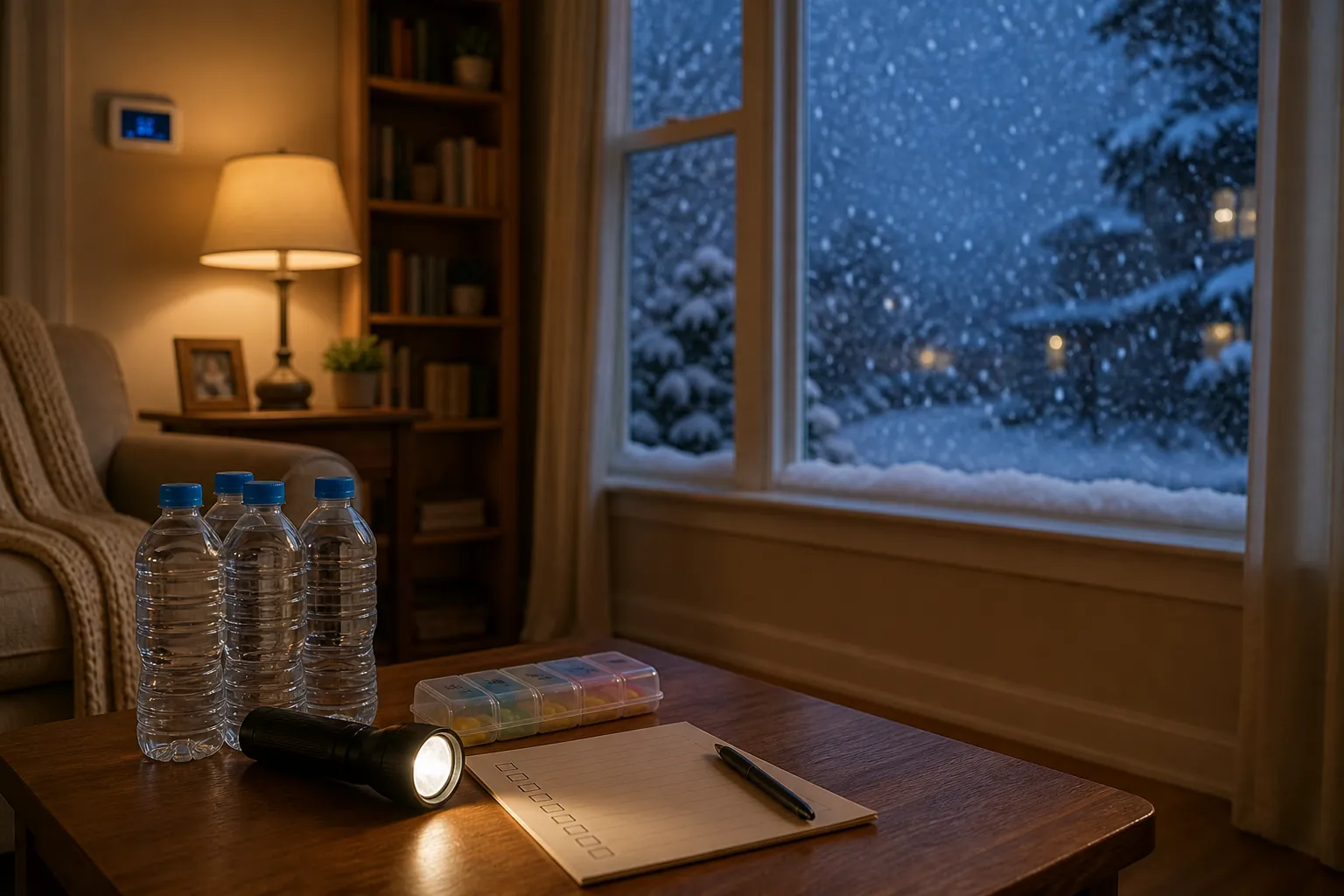
The numbers that make the checklist useful
A winter storm safety checklist for seniors has to force decisions. “Stock supplies” is too vague when the real question is whether there is enough water for the people in the home, whether the heat setting is high enough, and whether the backup plan still works if the power goes out.
| Pre-storm decision | Number or threshold to use |
|---|---|
| Indoor temperature | NIA and AARP advise keeping the home at 68°F or higher in cold weather; AGS HealthInAging says 65°F or warmer. Treat that as an attributed 65°F–68°F+ safety range, and lean higher for a frail older adult unless a clinician gives different instructions. [1][2][3] |
| Medication supply | Aim for a 1-month supply of medications before the storm window, using the Red Cross and Ready.gov preparedness norm. [4][5] |
| Stay-at-home supplies | Plan for at least 2 weeks of stay-at-home supplies, with 1 gallon of drinking water per person per day. [4] |
| Space heater clearance | Keep space heaters at least 3 feet from anything flammable. [6][7] |
| Generator placement | Run generators at least 20 feet from windows, doors, and vents. [6][7] |
| Carbon monoxide protection | Have carbon monoxide detectors with battery backup on every level, and never use an oven or stovetop to heat the home. [6][7] |
| Cold exposure emergency | A body temperature below 95°F is a medical emergency; hypothermia can occur even above 40°F if someone is chilled by rain or sweat. [8] |
| Food during an outage | If the power fails, refrigerated food is generally safe for about 4 hours and a full freezer for about 48 hours if doors stay closed. [9] |
Those numbers do not guarantee safety. They give the caregiver something better than a mood: a way to decide what has to be fixed before the storm arrives.
Heat comes first because cold becomes medical quickly
Set the thermostat before the weather turns, then look at the actual room where the older adult spends the most time. Guidance is not perfectly harmonized: the National Institute on Aging and AARP point to 68°F or higher, while AGS HealthInAging uses 65°F or warmer for older adults in winter conditions.[1][2][3] That difference should not be smoothed over. For a practical pre-storm check, use the range openly: do not let the home drift below the mid-60s, and aim for 68°F or higher when possible, especially for someone who is frail, sedentary, underweight, cognitively impaired, or less able to notice they are getting cold.
Do not rely only on the number shown on a hallway thermostat. The recliner near the picture window, the bedroom with the closed door, and the bathroom used at night may be colder than the thermostat area. Before the storm, check the places where the person actually sits, sleeps, dresses, and walks. If a programmable thermostat drops overnight, decide now whether that setback should be raised or turned off during the storm period.
If a space heater is part of the plan, the safety check is not optional. The CDC and Ready.gov say space heaters should be kept at least 3 feet from anything flammable.[6][7] That means curtains, bedding, papers, laundry, upholstered chairs, oxygen tubing, and the blanket that always slides off the lap. Measure the space as it is normally lived in, not as it looks after a quick cleanup.
If a generator is part of the backup plan, place it outside at least 20 feet from windows, doors, and vents.[6][7] “Outside” does not mean in the garage, near a cracked door, under an open window, or on a porch where exhaust can drift back in. Carbon monoxide is the winter-storm danger that gives very little warning, so check that carbon monoxide detectors with battery backup are installed on every level before the storm, while stores are still open and someone can help install batteries.[6][7]
There is also one shortcut to rule out completely: do not use an oven or stovetop to heat the home.[6][7] It is tempting in the exact kind of kitchen where someone is cold, worried about the utility bill, and trying not to be a bother. It is still the wrong plan.
Cold exposure should not be judged only by how dramatic the weather looks outside. The CDC states that a body temperature below 95°F is a medical emergency, and that hypothermia can occur even when temperatures are above 40°F if a person is chilled by rain or sweat.[8] If an older adult is cold, wet, unusually drowsy, confused, or not acting like themselves, treat the situation as urgent and contact medical or emergency help rather than trying to solve it with another blanket.
Medications and medical equipment need a deadline, not a wish
The medication check should happen early in the 48–72-hour window, because it depends on other people: pharmacies, prescribers, delivery drivers, insurance approvals, and sometimes a family member who can pick up a refill after work. The Red Cross and Ready.gov preparedness norm is a 1-month supply of medications.[4][5] That is the target to work toward before roads freeze, not something to discover is impossible after the warning becomes a lockdown.
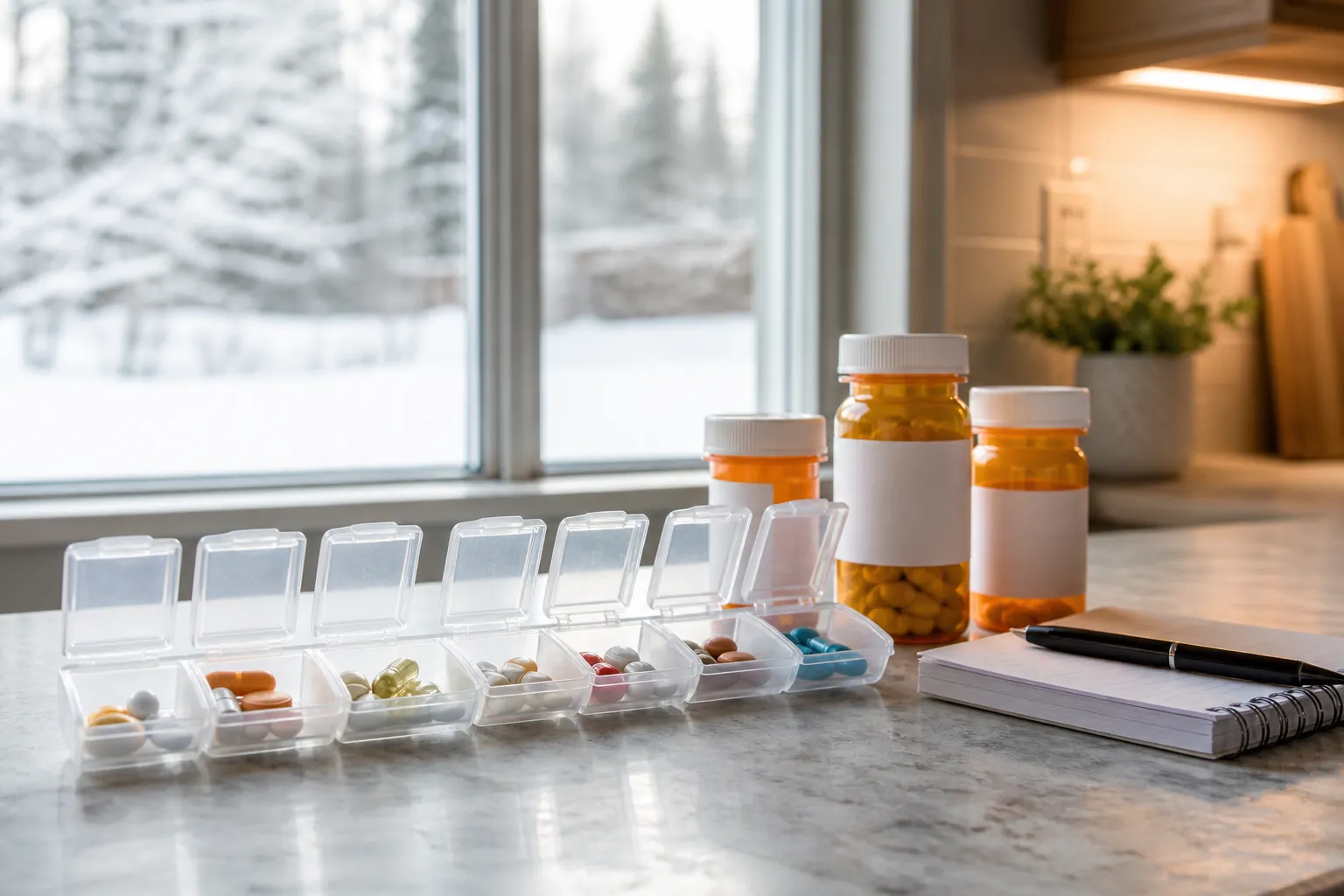
Put every daily medication in front of you and check the fill level, refill date, and delivery method. Do not stop at the pill organizer; look at the bottles, inhalers, eye drops, injectables, patches, testing supplies, and anything used only “as needed.” If the person takes a medication that cannot be skipped safely, call the pharmacy or prescriber before the storm and ask what can be filled, transferred, delivered, or documented for an emergency refill.
Medical equipment needs the same treatment. Write down what depends on electricity, batteries, deliveries, or a vendor call: oxygen equipment, a CPAP machine, a nebulizer, a power recliner used for safe transfers, a stair lift, a hospital bed, a phone-based medical alert device, or refrigerated medication. Then call the equipment supplier or utility before the storm if there is any doubt about batteries, backup power, oxygen delivery timing, or priority restoration programs. The person waiting for oxygen tubing or a charged battery is not helped by a beautifully stocked pantry.
Insulin needs a separate note because “keep it cold” can become “accidentally froze it” in winter outages. The CDC advises keeping insulin cool but never frozen during an emergency.[10] If insulin or another medication has storage limits, check the label and ask the pharmacist how to handle it during a power outage or a very cold home.
Food storage matters here only because it can collide with medication, nutrition, and power. Oregon emergency-management guidance says refrigerated food is generally safe for about 4 hours during an outage, and a full freezer for about 48 hours if the doors stay closed.[9] That should push two pre-storm decisions: what refrigerated medication or food needs a cooler plan, and what shelf-stable meals the person can actually prepare without standing at the stove, carrying heavy pots, or opening the refrigerator repeatedly.
Food and water: count the people, then count the days
For a stay-at-home winter storm kit, the Red Cross recommends at least 2 weeks of supplies and 1 gallon of drinking water per person per day.[4] That means the water count changes if a caregiver, spouse, aide, or visiting relative may be in the home. It also changes if pets are part of the household, even though the 1-gallon figure is a person-based planning number.
Do not make the food plan more athletic than the person using it. Choose meals and snacks that can be opened, chewed, and prepared with the lighting and mobility the person will have during the storm. If the older adult uses a walker, cannot stand long, or has poor grip strength, a pantry full of cans without an accessible opener is not a plan.
- Place drinking water where the older adult can reach it without carrying a heavy case across the room.
- Put a manual can opener, paper towels, trash bags, and any needed adaptive utensils in the same area as the food.
- Check whether the person can prepare the food if the microwave, stove, or electric kettle cannot be used.
- Keep the most important snacks and fluids outside the refrigerator so they remain available if the power fails.
Falls-proof the routes that will be used in bad light and bad weather
The CDC reports that more than 1 in 4 older adults falls each year.[11] Winter adds two blunt complications: the outdoor path can turn slick, and the indoor path can go dark. The pre-storm job is to make the ordinary trips safer before anyone is tired, cold, or rushing.
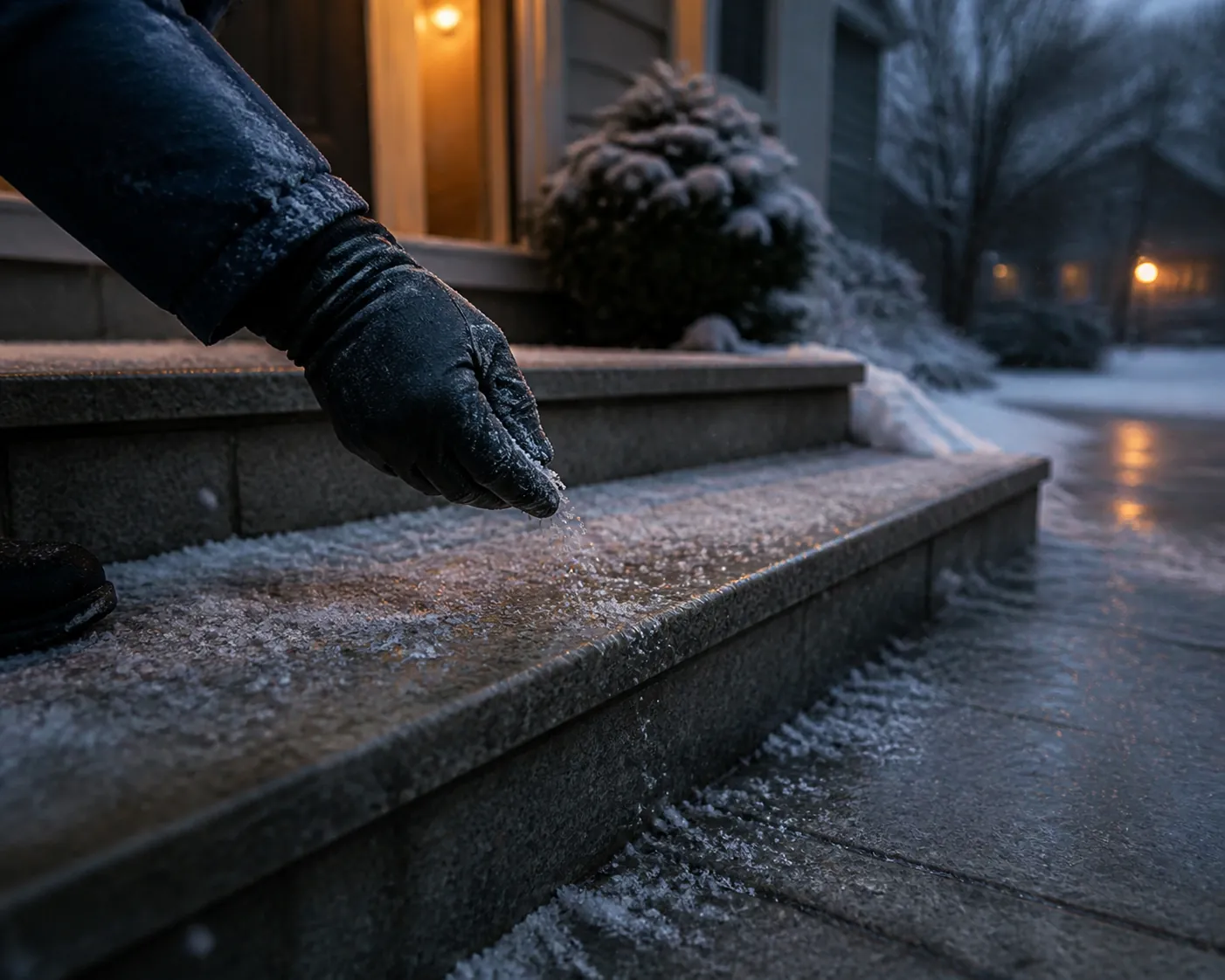
Start outside while the steps are still visible. NCOA points to rock salt, sand, and cat litter for traction, and winter-safety guidance also emphasizes rubber-soled boots and spike-style ice-gripper tips for canes.[12][13] Put the traction material where the person who will use it can reach it from inside the door. A bag of salt at the far end of the garage is a nice thought; it is not useful when the first icy patch is on the threshold.
Assign the outdoor work before the storm: who salts the front steps, who clears the ramp, who checks the handrail, who handles the trash path, and who comes back after freezing rain. If the older adult normally does this alone, that is the gap to close. Snow and ice are not just inconveniences; they can prevent help from arriving and can keep the older adult from safely opening the door when help does arrive.
Then walk the indoor route from bed to bathroom, bed to phone, favorite chair to kitchen, and chair to medication area. Move extension cords out of the walking line. Clear newspapers, shoes, pet bowls, laundry baskets, and small tables that make sense in daylight but become obstacles at 2 a.m. If a walker or cane is used, test the route with the device, not with a healthy adult’s stride.
Lighting needs a power-outage branch. Put a flashlight or battery lantern within reach of the bed, the main chair, the bathroom path, and the medication area. Check the batteries before the storm. If the older adult uses a walker, do not place the flashlight somewhere that requires carrying it in one hand while also managing the walker. For a deeper room-by-room pass, use Winter-Proof Your Parent's Home Room by Room. For the outage-specific version, see How to Fall-Proof a Senior's Home Before a Power Outage.
The check-in plan should name the person who acts
A check-in plan is not “we’ll call Mom.” It is a short chain of named people and actions. Decide who calls, when they call, what happens if there is no answer, and who is close enough to knock on the door if the phone is dead. Put that plan on paper in the older adult’s home and in the caregiver’s phone.
- Primary caller: name, phone number, and usual check-in times.
- Backup caller: the person who calls if the primary caller is working, sleeping, or unreachable.
- Nearby contact: neighbor, building staff, relative, faith-community contact, or friend who can physically check the home if appropriate.
- Escalation rule: what to do after a missed call, a confused conversation, a medical-equipment problem, a heat failure, or a suspected fall.
- Power rule: where the phone, charger, backup battery, and paper contact list are kept.
The escalation rule is the part people tend to leave fuzzy because it feels uncomfortable. Write it anyway. If the older adult does not answer, should the neighbor knock? If the neighbor cannot reach them, who calls local non-emergency services or 911? If the house is below the agreed temperature range, who brings the person somewhere warmer? If oxygen equipment fails, who calls the supplier and who stays on the phone with the older adult?
This is also the time to check whether the older adult can use the plan. A phone number saved in someone else’s contact list does not help if the older adult’s phone dies. A medical-alert device does not help if it is charging in another room. A neighbor’s kindness does not help if nobody gave the neighbor permission to knock when a call is missed.
If you already use emergency checklists for other hazards, keep the format familiar. The communication-plan logic in The Earthquake Checklist Seniors Living Alone Actually Need adapts well here: names, numbers, supplies, and a clear trigger for outside help.
What to finish in the 48–72 hours before the storm
The order matters because some tasks require open businesses, working roads, daylight, or another adult’s help. If the warning is two or three days out, spend the first round on calls and deliveries, not on rearranging the closet.
| When | Do this first |
|---|---|
| 48–72 hours before expected severe weather | Request medication refills; call medical-equipment suppliers; confirm oxygen, batteries, and delivery timing; check the thermostat plan; buy water, shelf-stable food, batteries, salt, sand, or cat litter. |
| 24–48 hours before | Set up the medication area; place water and food within reach; charge phones and backup batteries; test flashlights; move cords and clutter from walking paths; put traction material by the door. |
| Final daylight before ice or heavy snow | Salt steps and walkways; check railings; place boots and cane ice-gripper tips near the exit; confirm the check-in schedule; make sure the paper contact list is visible. |
| When the warning begins | Stop treating preparation as a shopping list. Shift to monitoring heat, power, medication access, fall risk, and check-ins. |
One-page printable winter storm safety checklist for seniors
Print this section or copy it onto one page. The point is not to make a perfect emergency binder. The point is to make the next decision visible.
| Area | Pre-storm check |
|---|---|
| Indoor temperature | Thermostat set and checked in the rooms actually used. Use the attributed guidance range: 68°F or higher from NIA/AARP, and 65°F or warmer from AGS HealthInAging. [1][2][3] |
| Cold emergency rule | If body temperature is below 95°F, treat it as a medical emergency. Hypothermia can occur even above 40°F when someone is chilled by rain or sweat. [8] |
| Space heaters | Heater has at least 3 feet of clearance from anything flammable; no bedding, curtains, papers, clothing, or oxygen tubing are in the heat path. [6][7] |
| Generator | Generator, if used, is outdoors and at least 20 feet from windows, doors, and vents. [6][7] |
| Carbon monoxide | CO detectors with battery backup are on every level; batteries checked. Oven and stovetop are never used for heat. [6][7] |
| Medications | Medication supply checked against a 1-month preparedness target; refills, deliveries, and prescriber calls handled before roads freeze. [4][5] |
| Medical equipment | Oxygen, CPAP, nebulizer, stair lift, power recliner, medical-alert device, refrigerated medication, and other equipment checked for power, battery, delivery, or vendor needs. |
| Insulin and temperature-sensitive medication | Storage plan reviewed; insulin kept cool but never frozen. Pharmacist contacted if storage is uncertain. [10] |
| Water | At least 1 gallon of drinking water per person per day counted and placed where it can be reached. [4] |
| Stay-at-home supplies | At least 2 weeks of stay-at-home supplies planned, with foods the older adult can actually open and prepare. [4] |
| Food outage timing | Refrigerator/freezer plan understood: refrigerated food about 4 hours, full freezer about 48 hours if doors stay closed. [9] |
| Outdoor fall prevention | Steps, ramp, walkway, and handrail checked; rock salt, sand, or cat litter placed by the door; rubber-soled boots and cane ice-gripper tips ready if used. [12][13] |
| Indoor fall prevention | Path cleared from bed to bathroom, bed to phone, chair to kitchen, and chair to medications; cords, shoes, pet bowls, and loose clutter moved. |
| Lighting | Flashlights or battery lanterns placed at bed, main chair, bathroom path, and medication area; batteries tested. |
| Check-in plan | Primary caller, backup caller, nearby contact, and escalation rule written down. Phone, charger, backup battery, and paper contact list are visible. |
| Help trigger | Clinician, utility, equipment supplier, emergency services, or a trusted nearby person is contacted when heat, medication, equipment, oxygen, mobility, or communication cannot be kept safe. |
Most of the danger in a winter storm is not mysterious. It is the space between a general warning and the actual conditions inside one older adult’s home: the cold bedroom, the empty inhaler, the icy step, the dark hallway, the phone that no longer rings. These thresholds and checks reduce risk, but they do not guarantee safety. For individual medical needs, equipment requirements, utility issues, or urgent symptoms, contact the appropriate clinician, supplier, utility, emergency service, or local authority.
References
- Cold Weather Safety for Older Adults, National Institute on Aging
- Why Cold Weather Is So Dangerous to Aging Bodies, AARP
- Tip Sheet: Winter Safety for Older Adults, HealthInAging.org
- Winter Storm Preparedness & Blizzard Safety, American Red Cross
- Older Adults, Ready.gov
- Safety Guidelines: During & After a Winter Storm, Centers for Disease Control and Prevention
- Winter Weather, Ready.gov
- Preventing Hypothermia, Centers for Disease Control and Prevention
- Navigating a Winter Power Outage, Oregon Department of Emergency Management
- Managing Insulin in an Emergency, Centers for Disease Control and Prevention
- Facts About Falls, Centers for Disease Control and Prevention
- Winterize to Prevent Falls, National Council on Aging
- Winter Weather Safety for Older Adults, Council on Aging of Southwestern Ohio
Related reading
Noticed something outdated or inaccurate on this page? Flag a correction. We review every report against CDC, NIA, and AARP HomeFit guidance before updating a page.
Part of the Fall Prevention section.