
STEADI: intervene
Long-Term Fall Prevention for Elderly Earthquake Survivors
After an earthquake, an older survivor's fall risk actually rises in the weeks and months that follow. This guide explains why—from PTSD and disrupted homes to untreated pain—and provides a practical 6-point checklist to prevent falls during the recovery period.
The shaking has stopped. Your parent is alive. The gas is off, the broken glass is swept into a bag, and someone has finally found a place for everyone to sleep. It is natural to feel that the worst part is over. But when you are caring for elderly earthquake survivors long term, the next danger often starts quietly: a parent who walks less, grips the wall more, leaves the cane in another room, or says the hip pain is “nothing” because everyone is exhausted.
In one study of survivors after the February 2023 Kahramanmaras earthquake in Turkiye, 19.6% of older adult survivors had already fallen after the earthquake, compared with 3.9% of younger adult survivors.[1] That is not a small afterthought to the disaster. It is a second risk period, and it can last into the months when families are dealing with repairs, insurance, relocation, medical appointments, and fatigue.
Longer follow-up points in the same direction. A 9-year study of older adults in Japan found that financial hardship after disaster damage was associated with 3.53 times higher odds of recurrent falls and 75% higher odds of fear of falling.[2] The study does not mean money alone causes a fall. It does show that the conditions around recovery — housing, resources, social support, and stress — can keep affecting mobility long after the event itself has left the news.
Why fall risk rises after an earthquake
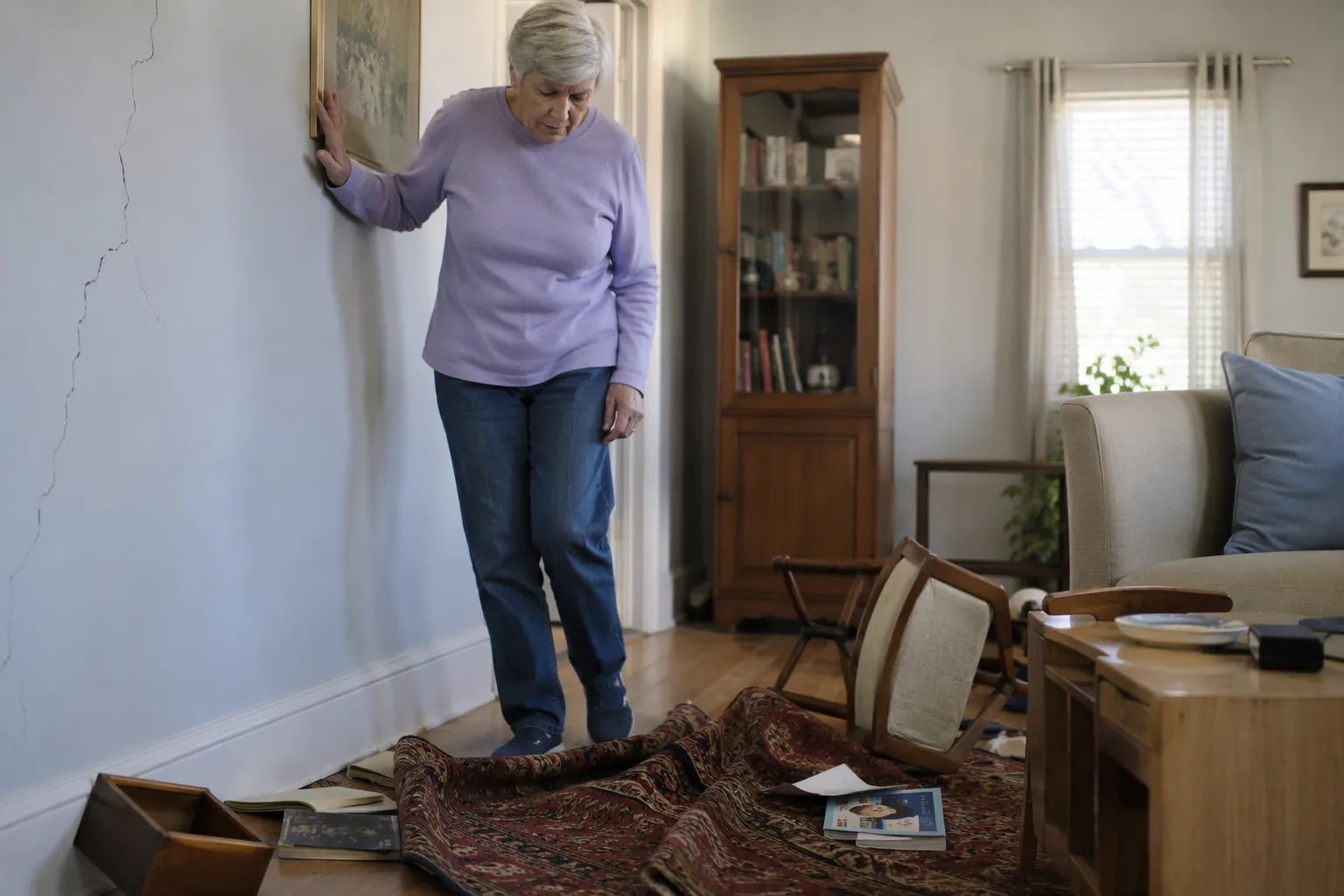
An earthquake changes more than the building. It changes the way an older person moves through a day. The route from bed to bathroom may be different. The favorite chair may be gone. The walker may be in a car, a shelter, or under a pile of stored belongings. The parent who used to cross the kitchen without thinking now pauses at every doorway, listening for another tremor.
That hesitation is not stubbornness, and it is not automatically “just anxiety.” In the Kahramanmaras survivor study, PTSD symptom severity directly predicted fear of falling, independent of age and comorbidities.[1] For a caregiver, that matters because trauma symptoms can show up as a mobility problem: refusing to shower unless someone stands nearby, avoiding stairs, staying in bed longer, holding furniture instead of using a cane, or freezing when a truck passes and the floor vibrates.
Fear then changes activity. Older survivors in the same study had significantly higher fear-of-falling scores than younger survivors, with a median Falls Efficacy Scale score of 30 compared with 12.[1] They also had higher kinesiophobia, or fear of movement: the older group’s mean score was 45.9, above the high-fear cutoff of 37, compared with 39.6 in younger adults.[1] A parent may describe this as being careful. Sometimes it is careful. But when caution becomes near-total avoidance, strength and balance start to drain away.
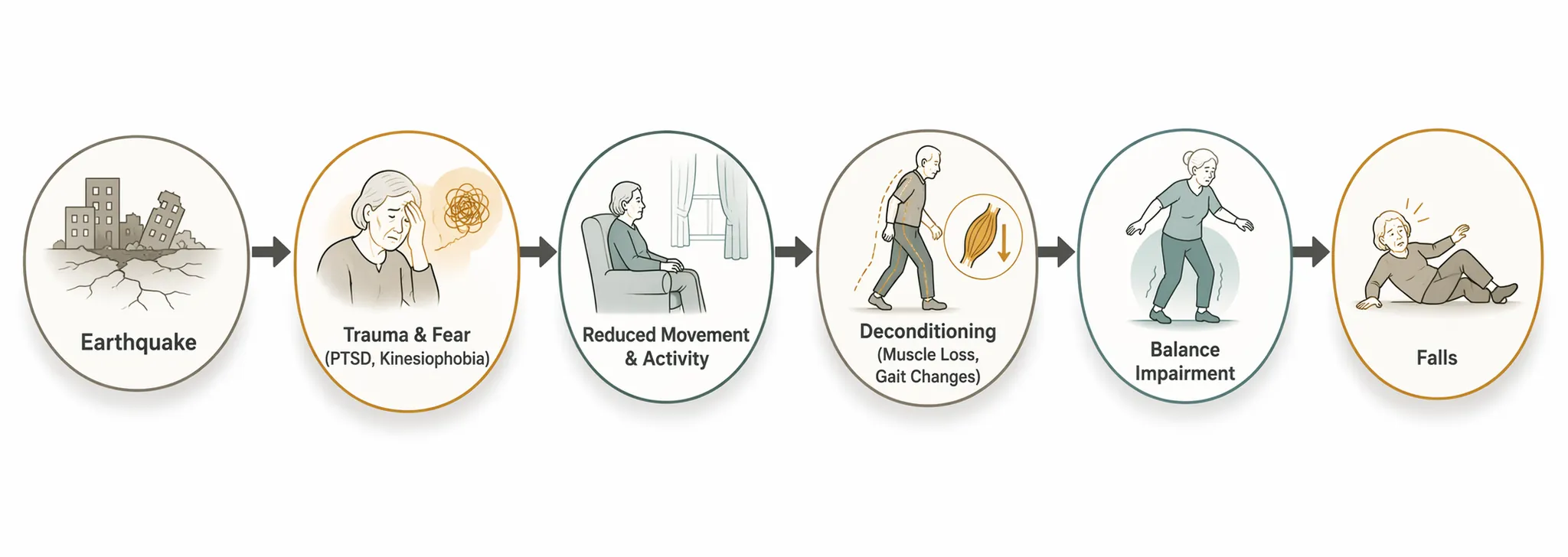
Displacement makes that chain worse. In the Kahramanmaras study, survivors had a median 14 days out of home after the earthquake.[1] Two weeks away from normal routines can mean fewer walks, fewer stairs, poorer sleep, less consistent meals, missed medications, and less confidence moving in unfamiliar rooms. Even after returning home, the home may not function as the old home. Furniture has been shifted. Repairs are half-finished. Boxes sit in hallways. A mattress may be on the floor. A bathroom grab bar may still be attached to a wall that no longer feels trustworthy.
Balance is where these changes become measurable. Older survivors in the same study scored worse on the Berg Balance Scale, with a median score of 46.5 compared with 56 among younger survivors.[1] That difference is not something a family can see by glancing at a parent across the room. It appears in small moments: taking extra steps to turn, sitting down hard, reaching for the back of a chair, slowing at thresholds, or needing more time to rise from a low seat.
Pain is the other piece families often normalize too quickly after a disaster. In the Kahramanmaras study, 69.6% of older survivors reported musculoskeletal pain after the earthquake, and 66.2% reported symptom aggravation.[1] Pain changes gait. A sore knee shortens a step. A painful back makes someone lean forward. A bruised hip makes them avoid putting full weight on one side. Those adjustments may be reasonable for a day or two, but if they continue, they can turn a hallway into a balance test.
A 6-point fall-prevention checklist for the recovery period
The goal is not to turn an adult child into a clinician. The goal is to notice the recoverable risks early, before a temporary disruption becomes a fall, a fracture, a hospitalization, or a permanent loss of confidence. Start at the doorway and work inward.
| Checkpoint | What you are looking for |
|---|---|
| 1. Reassess the current environment | New trip hazards, unstable furniture, poor lighting, unsafe bathroom access, blocked exits |
| 2. Restore mobility aids and walking paths | Cane, walker, glasses, hearing aids, shoes, clear routes from bed to bathroom and kitchen |
| 3. Watch for fear-of-falling behavior | Avoiding rooms, furniture-walking, refusing stairs, staying seated or in bed much more than usual |
| 4. Take PTSD symptoms seriously | Startle responses, sleep disruption, panic with aftershocks or noises, withdrawal, intrusive memories |
| 5. Reconnect medication and chronic-condition care | Missed doses, changed routines, unmanaged dizziness, blood pressure issues, pain, diabetes care gaps |
| 6. Rebuild strength gradually | Short safe walks, supervised transfers, gentle daily movement, and escalation if balance worsens |
1. Reassess the current environment as if it is a new home
Do not assume a familiar house is still familiar. Walk the route your parent actually uses: bed to bathroom, bathroom to chair, chair to kitchen, kitchen to exit. Look at the floor, not just the walls. A small rug that was harmless before may now be curled from cleanup. A lamp may have been moved away from an outlet. A stable path may now run between stacked boxes and a temporary space heater.
- Remove loose rugs, cords, broken thresholds, and low objects from walking routes.
- Put a light within reach of the bed, and test the route to the bathroom at night.
- Check whether chairs are high and firm enough for safe standing.
- Keep shoes, glasses, hearing aids, cane, walker, phone, and medications in predictable places.
- Do not let storage piles narrow hallways or force side-stepping.
Temporary housing needs the same inspection. A hotel bathroom, a relative’s guest room, a shelter cot, or a borrowed recliner may solve the sleeping problem while creating a transfer problem. If your parent has to push up from a rolling chair, step over bags, or walk to an unfamiliar bathroom in the dark, the living arrangement is not yet safe enough.
2. Restore mobility aids before you restore normal routines
After an earthquake, people often prioritize documents, phones, chargers, water, and repairs. Those matter. For an older adult, the cane, walker, eyeglasses, hearing aids, supportive shoes, and bedside light belong on that same priority list. A parent who walks “just this once” without the usual aid may be doing it for days because everyone is busy.
Place the mobility aid where the movement starts, not where someone last dropped it. If your parent rises from bed at night, the walker should be reachable from the bed. If they sit in one chair most of the day, the cane should not be across the room. If they are embarrassed, keep the language practical: “This is how we keep you moving while the house is disrupted,” not “You can’t walk without it anymore.”
Also watch for furniture-walking. Holding walls, counters, chair backs, and doorframes can look like independence, but it is often a sign that the real aid is missing, inconvenient, or emotionally hard to accept. A wall does not move with the person. A walker does.
3. Watch for fear-of-falling behavior, not just actual falls
Do not wait for a fall to decide fall risk is present. Fear itself can shrink activity, and reduced activity can weaken the very systems that prevent falls. In the post-earthquake study, older survivors showed both higher fear of falling and worse balance than younger survivors.[1] Those two findings belong together in a caregiver’s mind.
- Your parent stops going into a room they used before.
- They ask someone else to bring water, food, or medications more often than before.
- They say they are “just tired” but avoid standing or walking most of the day.
- They refuse bathing, stairs, porch steps, or outdoor walking after the earthquake.
- They walk only when another person is in the room, even for short distances.
The answer is not to pressure them into proving they are fine. Start with safer, smaller movement: standing up from a firm chair, walking a short clear path, practicing the bed-to-bathroom route in daylight, or taking a few supervised steps outside if the surface is safe. If fear keeps increasing, or if your parent becomes mostly chair-bound or bed-bound, bring in medical help rather than treating it as a family negotiation.
4. Treat trauma symptoms as part of fall prevention
PTSD is often discussed as emotional suffering, which it is. In this setting, it is also a movement issue. If sleep is broken, attention is poor, startle responses are frequent, and the body stays tense, walking becomes less automatic. A parent may move stiffly, rush when frightened, or avoid movement altogether. The finding that PTSD symptom severity predicted fear of falling after the earthquake makes this connection hard to ignore.[1]
Caregivers do not need to diagnose PTSD. They can document what they see: nightmares, panic during aftershocks, distress when sirens pass, refusal to sleep alone, withdrawal, irritability, or repeated replaying of the earthquake. Write down when symptoms happen and what they prevent your parent from doing. That record is useful for a primary care clinician, geriatric mental health professional, or trauma-informed therapist.
The tone matters. If a parent is refusing the walker because using it makes the earthquake feel real, scolding is unlikely to help. A steadier approach is to separate the tool from the identity: “This is temporary support while your body and the house recover.” Some supports may become long-term, but that decision does not have to be forced in the first exhausted days.
5. Reconnect medication, pain, and chronic-condition care quickly
A medication bag left in the car can matter as much as a cracked step. Missed blood pressure medication, changed diabetes routines, dehydration, poor sleep, pain, and dizziness all change fall risk. After a disaster, these problems may be dismissed because they sound ordinary compared with structural damage. They are not ordinary if they are changing how your parent stands, turns, or thinks.
Make a same-day medication and condition check. Confirm what was taken, what was missed, what was lost, and what needs refill approval. If pharmacies, clinics, or transportation routes are disrupted, contact the prescribing office and ask about emergency refills or alternatives. Keep an updated medication list with your parent, not only in your phone.
Pain deserves specific questions. “Are you okay?” often gets a yes. Ask where it hurts, whether it changes walking, whether it wakes them at night, and whether they are avoiding weight on one side. Because musculoskeletal pain and symptom aggravation were common among older earthquake survivors in the study, persistent pain should not be treated as background noise.[1]
6. Rebuild strength gradually, with company when possible
The safest recovery plan is usually not bed rest unless a clinician has prescribed it. It is controlled, repeatable movement. Short walks on a clear surface, sit-to-stand practice from a stable chair, gentle range-of-motion, and supervised stair practice may be more useful than one ambitious outing that leaves your parent sore and frightened.
Company helps, but it should not turn into hovering. Walk beside or slightly behind, not pulling from the front. Let your parent use the rail or walker. Keep the path short enough that they can finish successfully. The point is to rebuild confidence and capacity together, not to test endurance.
Social connection may also be protective. In the Japanese longitudinal study, social cohesion was linked with lower odds of fear of falling and fewer falls among older adults after disaster damage.[2] That finding comes from a specific community context, so it should not be stretched into a promise. Still, in practical caregiving, isolation rarely makes movement safer. A neighbor who checks the porch, a relative who walks the hallway route, or a community volunteer who helps restore routines can reduce the load on one exhausted caregiver.
When the checklist is not enough
Some problems need more than household fixes. Ask for professional help if your parent has a fall, near-fall, new confusion, worsening dizziness, severe pain, new weakness, repeated refusal to walk, unsafe transfers, or major changes in sleep and fear. The right next step may be a primary care visit, physical therapy, occupational therapy, geriatric mental health support, or a home safety assessment.
Physical therapy can evaluate strength, balance, gait, and safe progression. Occupational therapy can look at bathing, toileting, dressing, transfers, and how the temporary or repaired home is actually being used. A home modification assessment can help when the bathroom, entrance, lighting, or sleeping arrangement remains unsafe. Geriatric mental health support is especially important when fear, panic, or traumatic reminders are narrowing daily life.
Older adults with dementia, significant hearing or vision loss, or complex medical conditions need extra caution. The available studies do not fully answer every subgroup question, and a parent who cannot reliably describe pain, dizziness, fear, or medication changes may need earlier professional assessment. Veterans and others with prior trauma histories may also need more tailored mental health support after a disaster.
Earthquake recovery is not finished when the building is standing and the emergency crews have left. For an older survivor, recovery also means making movement safe again: the first step out of bed, the turn into the bathroom, the walk to the kitchen, the decision to use the cane, the confidence to move without rushing or freezing. That is where many preventable falls begin, and it is also where careful caregiving can interrupt them.
References
Related reading
Noticed something outdated or inaccurate on this page? Flag a correction. We review every report against CDC, NIA, and AARP HomeFit guidance before updating a page.
Part of the Fall Prevention section.