
How to Keep Your Elderly Parent Safe Around a Fire Pit
A 10-point checklist to help caregivers assess and adapt an older adult's fire pit area, addressing fall risks, seating stability, lighting, and fire type to prevent burns while preserving enjoyment.
The real question is usually not whether an elderly parent should ever sit near a fire pit. It is whether the setup is safe enough that no one has to hold their breath every time they stand up, turn around, reach for a drink, or walk back to the house in the dark.
That worry is not overprotective. A 2026 study of fire pit and fireplace burn injuries found that 40% of fire pit burn injuries involved the patient falling into the fire. The same data set was not limited to older adults, so it should not be read as an older-adult-specific statistic. Still, it makes the central point plainly: for many fire pit injuries, the burn starts as a fall problem.[1]
For older adults, that chain can be less forgiving. Federal fire death data from 2014 to 2023 show that adults 65 and older had 2.5 times the fire death risk of the general population, and adults 85 and older had 3.4 times the risk.[2] Clothing adds another layer: the National Council on Aging reports that the clothing-fire death rate for older adults is 14 times higher than for people under 65.[3]
The useful safety plan for an elderly parent is not a lecture about being careful. It is a walk-around assessment: where the feet go, how the chair behaves, how quickly the fire can be shut off, and whether an older body has enough time and support to recover from a misstep.
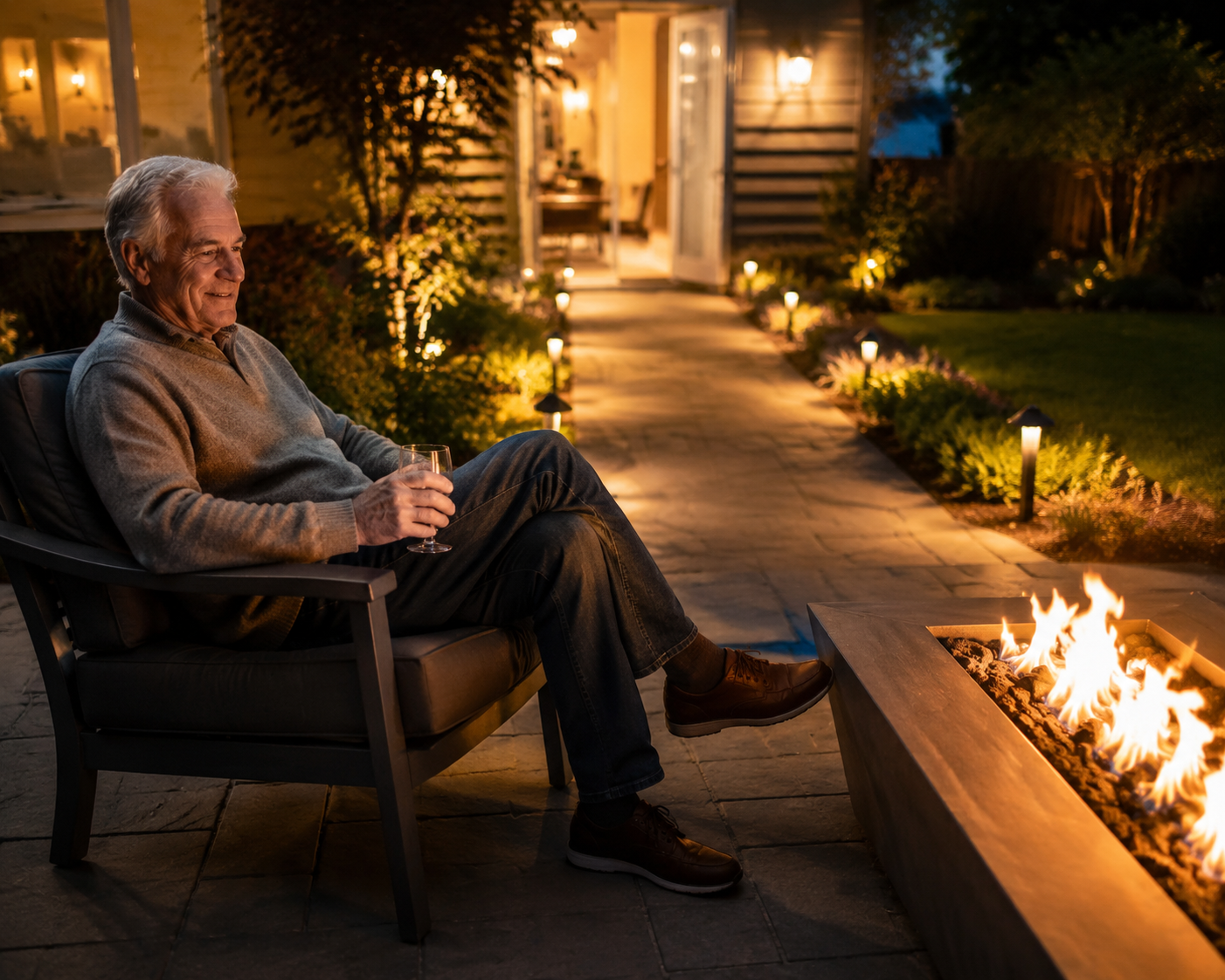
The 10-Point Fire Pit Safety Checklist
Use this first as a practical walk-through. You can always come back for the explanations, but the first pass should be simple: stand where your parent stands, sit where they sit, and walk the route they use after dusk.
| Check | What to Look For | Caregiver Judgment |
|---|---|---|
| 1. Surface | Firm, stable, non-slip, and as level as possible; avoid shifting gravel or uneven pavers. | Must fix before regular use if the walker, cane, or chair catches. |
| 2. Slope | Aim for a slope no steeper than 2% where people stand, turn, and sit. | Use as a design target, not a legal requirement for a private patio. |
| 3. Pathway clearance | Keep at least 4 feet of clear route for walkers, rollators, and side-by-side assistance. | Must fix if furniture, planters, hoses, or firewood narrow the route. |
| 4. Seating | Use stable chairs with armrests and a seat height around 17–19 inches. | Must fix if the chair rocks, sinks, swivels unexpectedly, or is hard to rise from. |
| 5. Distance from flame | Place seating at least 30 inches from the fire, with room to stand without stepping toward the flame. | Must fix if knees, clothing, blankets, or walker handles drift close to heat. |
| 6. Lighting | Use fixed path and task lighting from the door to the seating area. | Must fix if safe movement depends on carrying a flashlight. |
| 7. Fire type | Prefer gas or propane with a clear, quick shutoff; avoid alcohol or liquid-burning fire pits. | Must fix if the fire cannot be controlled quickly by the older adult or caregiver. |
| 8. Baseline fire placement | Keep the fire pit away from structures and on a stable, fire-resistant base. | Must fix before use. |
| 9. Emergency readiness | Keep water or an extinguisher nearby, a phone accessible, and a clear burn-response plan. | Must fix if no one knows what to do when something goes wrong. |
| 10. Health and clothing risks | Account for smoke sensitivity, neuropathy, reduced heat sensation, medications, loose clothing, and tetanus status. | Discuss individual medical questions with a clinician. |
Start With the Ground, Not the Flame
The fire may be the obvious hazard, but the ground is often where the accident begins. A patio that was fine ten years ago may now be full of small traps: a paver lifted by a root, pea gravel that shifts under a cane tip, an outdoor rug with a curled edge, or a slight slope that makes a rollator drift.
For a private backyard, there is no need to pretend that public-accessibility rules apply word for word. But the U.S. Forest Service guidance for accessible fire rings is useful as a design target because it focuses on the same physical realities: a firm surface, a slope of 2% or less, and 48 inches of clear space around usable sides.[4]
That 48-inch idea translates well at home. Four feet gives a walker or rollator room to approach, turn, and back away without forcing the person toward the flame. It also gives a caregiver room to step in without bumping the chair, the fire pit, or the person they are trying to help.
The route matters as much as the seating circle. Walk from the usual door to the fire pit and look for every place a foot, cane, walker wheel, oxygen tubing, or slipper could catch. The safest fire pit area still fails if the trip back to the bathroom crosses a dark threshold, a loose hose, or a patch of lawn that turns soft after watering.
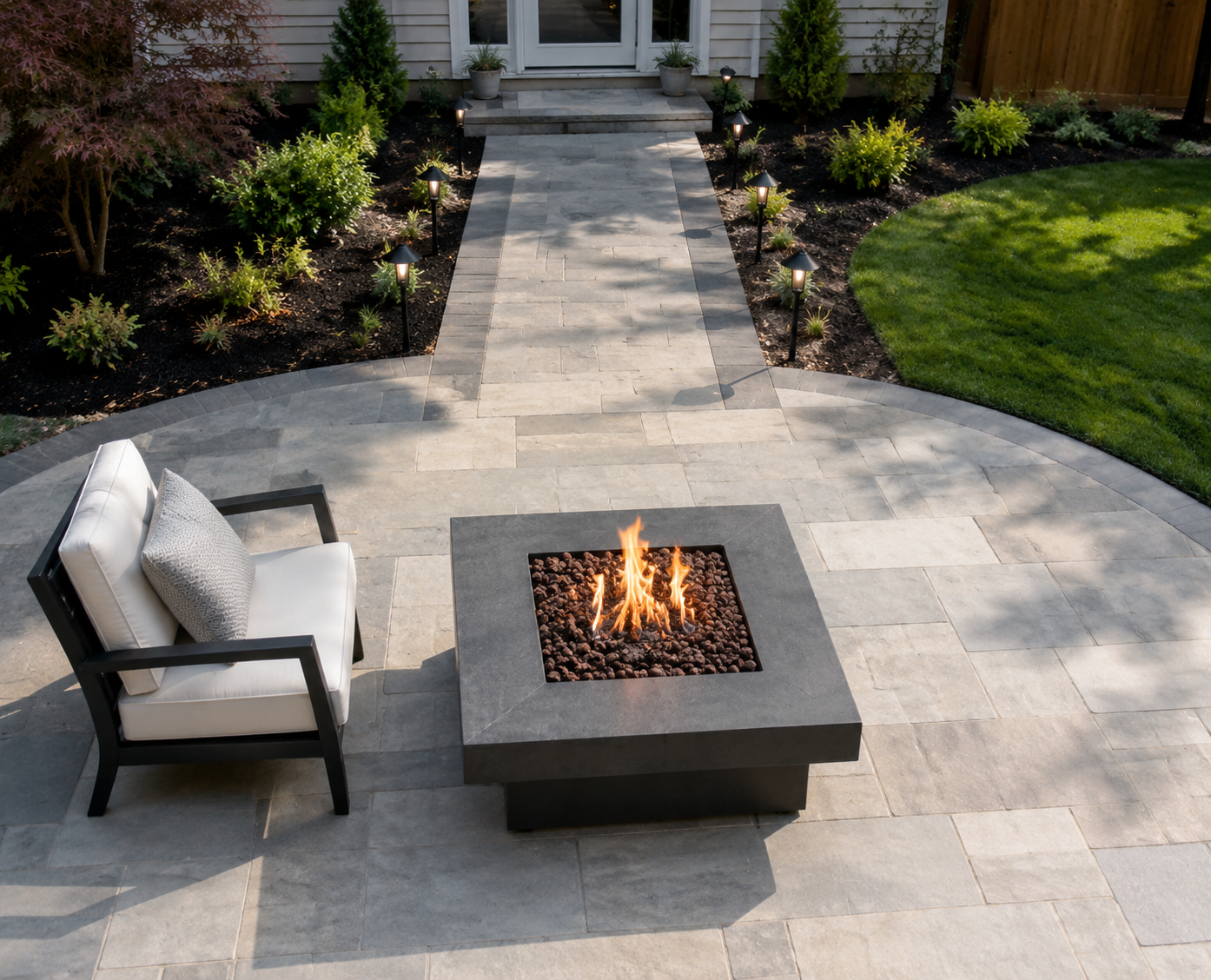
Must Fix Before Use
- Uneven pavers, cracked concrete, curled rugs, loose boards, or shifting gravel in the walking or seating area.
- A route narrower than 4 feet where a walker, rollator, or helping person needs to pass.
- A chair that sits partly on lawn, gravel, mulch, or a sloped edge.
- Any setup where standing up naturally sends the person closer to the flame.
Improve Next
- Replace loose decorative stone with a firmer patio surface in the seating and turning zones.
- Move planters, side tables, log holders, and extension cords out of the travel path.
- Mark step edges or patio transitions with contrast if vision is changing.
- If structural work is needed, treat it as a home modification project rather than a fire pit accessory.
Choose Chairs for Standing Up, Not Just Sitting Down
Outdoor chairs are often bought for looks, folding convenience, or cushion color. Around a fire pit for an older adult, the main test is whether the chair helps the person stand up without rocking, sliding, sinking, or pushing them forward.
A good fire pit chair for an elderly parent has armrests they can actually press on, a stable frame, and a seat height around 17 to 19 inches. Very low lounge chairs, deep Adirondack-style seats, lightweight folding chairs, and swivel chairs can turn a normal sit-to-stand movement into a balance test.
Place the chair so the person can stand by pushing up, pausing, and turning away from the fire. If the safest exit path requires stepping sideways between a chair leg and the fire pit, the layout is asking too much of reaction time and balance.
Keep at least 30 inches between the seated person and the flame. That distance is not only about comfort from heat. It is space for knees, blankets, sleeves, walker handles, and the small forward sway that can happen when someone stands.
Lighting Should Be Built Into the Route
A flashlight is useful in an emergency kit. It is not a lighting plan for an older adult carrying a mug, using a cane, managing a walker, or trying to step over a patio threshold.
The better setup is boring in the best way: low-voltage path lights from the door to the fire pit, enough light around each chair to see feet and walker brakes, and a switch or smart control that does not require walking across the yard in the dark. Glare matters too. A bright fixture pointed into older eyes can make the ground harder, not easier, to read.
Watch the route at the time your parent actually uses it. A path that looks fine at 5 p.m. can become a different place after sunset, especially if the back door creates a sharp light-to-dark transition.
The Fire Type Changes the Caregiver Math
Wood fires have atmosphere, but they also bring smoke, sparks, uneven flame behavior, and hot embers that remain after the gathering ends. Travelers’ fire pit guidance includes baseline rules such as keeping the fire pit at least 10 feet from structures, using a stable fire-resistant base, and never leaving the fire unattended.[5] Those rules still apply. They are just the floor, not the whole plan.
For many older adults, a gas or propane fire pit is the easier safety choice because the flame can be turned off quickly. The shutoff should be obvious, reachable, and easy to operate with stiff hands or reduced grip strength. If only one family member knows how to shut it off, the system is not ready.
Alcohol and other liquid-burning fire pits deserve a much firmer answer: avoid them for an older adult’s regular use. The U.S. Consumer Product Safety Commission warned that alcohol or other liquid-burning fire pits had been linked to two deaths and more than 60 serious burn injuries since 2019.[6] The problem is not just the flame; it is the way liquid fuel can spill, flash, or be mishandled during refilling.
Wood, Gas, or Liquid Fuel
| Fire Type | Why It Matters for an Older Adult | Practical Judgment |
|---|---|---|
| Gas or propane | Quick shutoff, less smoke than wood, no wood handling during use. | Often the safest fit if the shutoff is accessible and the unit is stable. |
| Wood-burning | Smoke, sparks, fire tending, ash, and lingering embers increase the number of tasks. | Possible, but needs more supervision, spark control, and cleanup discipline. |
| Alcohol or liquid-burning | Liquid fuel can create severe refueling and spill hazards. | Avoid for older adults. |
Emergency Readiness Is Part of the Setup
The emergency plan should be visible in the space, not stored in the adult child’s head. Keep water or an appropriate fire extinguisher within reach, make sure a phone is accessible from the seating area, and decide ahead of time who is responsible for turning off the fire, helping the older adult away from heat, and calling for help.
A parent who lives alone needs a stricter standard than a parent who only uses the fire pit during family gatherings. Nighttime use, mobility impairment, memory changes, oxygen use, or a history of falls all lower the margin for “I’ll just sit out for a little while.” If outdoor evening use is common, fall detection or monitoring technology may be worth considering as part of the broader safety plan, not as a substitute for fixing the patio.
Burn response is also worth discussing before anyone is upset or in pain. Know when to cool a burn, when to call emergency services, where the nearest urgent care or emergency department is, and whether the older adult’s tetanus vaccination is current. In one emergency department study of older adult burn patients, only 59.1% received tetanus vaccination, which is a reminder that preventive details can be missed once the injury has already happened.[7]
Health Details That Change the Answer
Two older adults can sit beside the same fire pit and face different risks. The difference may be in lungs, nerves, skin, medications, clothing, or how quickly someone can recognize and react to heat.
Smoke matters for a parent with COPD, asthma, heart disease, or smoke sensitivity. A wood fire that feels pleasant to one person may trigger coughing, shortness of breath, or fatigue in another. If smoke is the issue, the safer adaptation may be a gas fire pit, shorter use, better seating position relative to wind, or skipping fire pit use on poor air-quality days.
Skin and sensation matter too. A geriatric burn study from a major burn center notes that aging skin has a thinner dermis, which can allow burns to go deeper with shorter contact, and that reduced heat sensitivity may delay awareness of injury in some older adults.[7] Diabetic neuropathy is one reason a person may not feel heat or pain normally, especially in the feet and lower legs.
Medication concerns should be handled carefully. Anticoagulants, diuretics, sedating medications, and drugs that affect blood pressure or alertness are not fire pit hazards by themselves, and the research here is broader geriatric safety rather than fire pit-specific injury data. But they are reasonable caregiver prompts. If a parent gets dizzy when standing, bruises or bleeds easily, becomes dehydrated quickly, or has delayed reaction time, the fire pit setup should be more conservative and medical questions should go to a clinician.
Clothing deserves a plain rule: no loose sleeves, dangling scarves, open robes, trailing blankets, or synthetic fabrics that hang toward the flame. If a blanket is needed, keep it tucked, short, and away from the fire side of the body. This is one of those small changes that can feel fussy until it prevents exactly the wrong edge from catching.
What to Pause, What to Preserve
Some hazards are not “watch it next time” issues. Pause fire pit use until they are corrected if the chair is unstable, the path is dark, the walking surface shifts, the fire cannot be shut off quickly, the parent must step toward the flame to stand, or smoke worsens breathing symptoms.
Other improvements can be staged. Better lighting, firmer patio materials, a more supportive chair, a clearer emergency plan, and a switch from wood to gas can happen in order of risk and budget. If the walkway or patio needs real work, it may belong in the same category as other aging-in-place modifications rather than weekend decor.
The point is not to take away the evening fire by default. If the surface is firm, the route is wide and lit, the seating supports standing, the flame is far enough away, the fire can be shut off quickly, and health-specific risks are accounted for, a fire pit can remain part of an older parent’s life. If those conditions are not there yet, pausing use is not a verdict on independence. It is a design problem waiting to be fixed.
References
- Incidence of Firepit and Fireplace Related Burn Injuries in the United States, Nationwide Children's Hospital, 2026
- Older adults fire death and injury statistics, USFA FEMA
- Hidden Home Hazards: Older Adults More Likely to Die from Falls and Fires, NCOA
- Accessible Fire Rings, Grills, Fireplaces, and Wood Stoves at US Forest Service Facilities, ADA Inspections
- Fire Pit Safety Tips, Travelers Insurance
- Consumer Alert: Stop Using Alcohol or Other Liquid-Burning Fire Pits, CPSC
- Geriatric Burn Injuries Presenting to the Emergency Department of a Major Burn Center, Weill Cornell
Related reading
Noticed something outdated or inaccurate on this page? Flag a correction. We review every report against CDC, NIA, and AARP HomeFit guidance before updating a page.
Part of the Fall Prevention section.