
How to Evacuate an Elderly Parent During an Earthquake
Learn how to create a three-phase earthquake plan for an elderly parent with mobility concerns: pre-quake preparation, safe positioning during shaking, and the critical stay-or-go decision after. This guide covers the support network, go-bag contents, and adaptations needed so you don't have to improvise during a crisis.
If the floor starts moving, the first question is not “How fast can I get my parent outside?” It is “Are they safer moving right now, or safer protected where they are?” For an older adult with poor balance, a walker across the room, hearing aids on the nightstand, or stairs between them and the exit, evacuation during the shaking can create the injury you are trying to prevent.
Use three time windows. Before the earthquake, set up the people, keys, documents, medication backup, and mobility supplies so help is not improvised. During the shaking, keep the older adult as protected and stable as possible. After the shaking stops, decide whether evacuation is necessary because of immediate danger, not because “outside” automatically sounds safer.
| Time window | Caregiver priority | Plain rule |
|---|---|---|
| Before the earthquake | Build the support network and prepare supplies | Make sure someone nearby can enter, help, and understand the medical situation. |
| During the shaking | Protect the head, neck, and body without forcing risky movement | Adapt Drop, Cover, and Hold On to the person’s actual mobility. |
| After the shaking stops | Choose stay or go based on danger and exit conditions | Evacuate for fire, gas smell, structural damage, collapse risk, or official instruction; otherwise, staying put may be safer. |
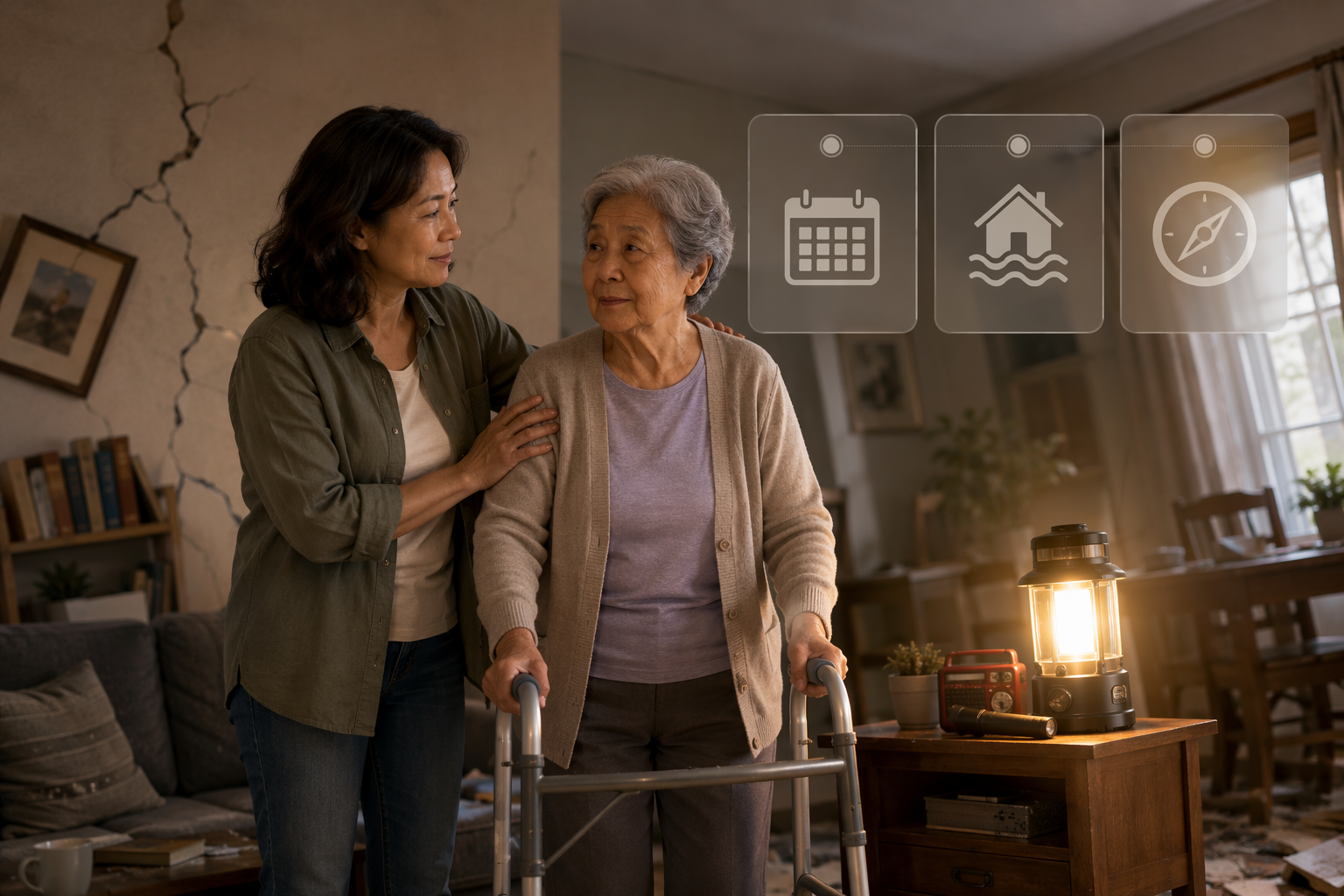
Before the Earthquake: Make Help Usable
The most important evacuation work happens on an ordinary day, before anyone is scared. Ready.gov and the American Red Cross both advise older adults to build a support network of at least three local contacts who know the plan, can check in, and can help during an emergency.[1][2] For a caregiver, “three contacts” should not mean three people in a phone. It should mean three people who can actually get through the door.
Choose contacts close enough to respond without crossing the whole city. Give them keys or another reliable way to enter. Tell them where the older adult sleeps, where mobility aids are kept, where the go-bag is stored, and whether the person may resist help when frightened. If your parent has medical directives, the Red Cross and Family Caregiver Alliance include copies of medical and legal documents in emergency planning for older adults and caregivers.[2][3]
For a long-distance caregiver, this network is not optional decoration. It is the difference between coordinating and guessing. If three relatives call at once after a quake, only one person should be responsible for checking on your parent first, one should handle information and calls, and one should be backup if the first person cannot get there. Decide that now, while everyone is calm enough to accept being second.
Put the Plan Where Other People Can Find It
A plan that lives in one daughter’s head fails the moment her phone battery dies. Keep a short emergency sheet in the go-bag, on the refrigerator, and with each local contact. It should say:
- The older adult’s full name, address, date of birth, and primary language if relevant.
- Emergency contacts in order, including who has keys.
- Medication list, allergies, diagnoses that affect emergency care, and physician or pharmacy contact information.
- Mobility needs: wheelchair, walker, cane, transfer help, stair limits, fall history, or whether they can stand briefly with support.
- Location of hearing aids, glasses, dentures, oxygen equipment, chargers, and mobility-aid parts.
- A simple stay-or-go instruction: evacuate for fire, gas smell, visible structural danger, collapse risk, or official order; otherwise assess exits before moving.
This is also the time to look at the home as a fall-prevention problem. Heavy furniture, blocked walkways, loose rugs, and poor night lighting are already hazards; an earthquake makes them worse. If you already use room-by-room fall-prevention checklists, add earthquake thinking to the same walkthrough: can a walker move through this hall if a lamp falls, can someone reach the bed without stepping over cords, and can a caregiver find the shoes in the dark?
Build a Go-Bag for the Person You Actually Care For
A standard emergency kit is not enough when the person depends on medications, hearing aids, eyeglasses, or a walker that needs intact glides. The Red Cross recommends that older adults prepare emergency supplies that include a 30-day medication supply when possible, extra eyeglasses, hearing aid batteries, copies of insurance and medical documents, and spare parts for mobility aids such as cane tips or walker glides.[2] Family Caregiver Alliance emergency planning guidance also emphasizes medication lists, legal documents, and caregiving instructions.[3]
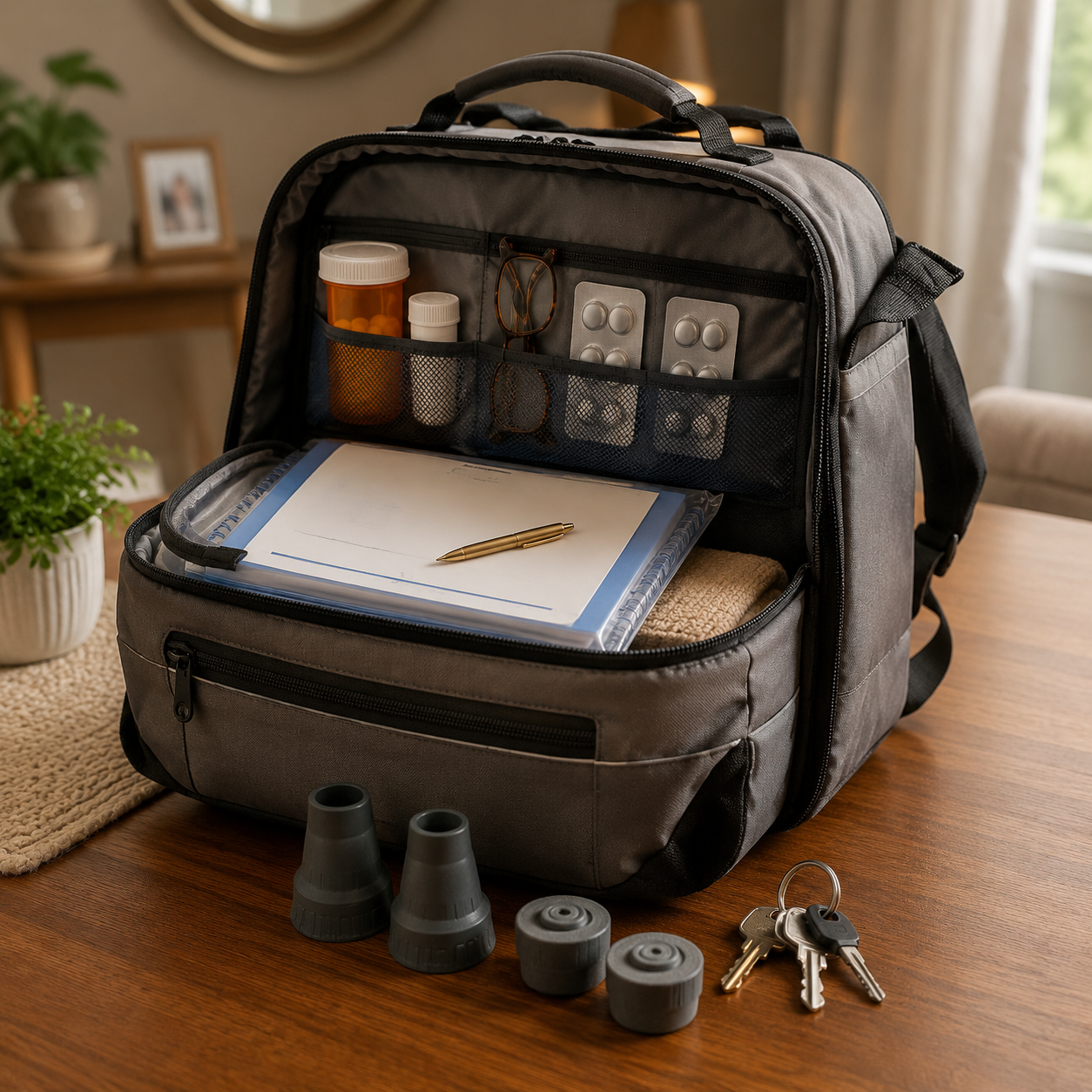
Pack the bag so another person can use it without a tour. Label the medication list. Put copies of documents in a sealed plastic bag. Keep spare hearing aid batteries where they can be found by touch. If your parent uses a walker, add replacement glides or tennis-ball covers if those are part of the usual setup. If they use a cane, add cane tips. If they use a wheelchair, include repair information, charger details for a power chair if relevant, and any instructions a neighbor would need to move it safely.
Do not store the bag in the garage if your parent cannot reach the garage. Do not put it behind holiday bins. The better location is boring: near the main sleeping area or the most likely exit, visible enough that a helper can grab it, but not in the path where it becomes a trip hazard.
Practice the Parts That Feel Awkward
Do a quiet walk-through, not a theatrical drill. Ask your parent to show where they would put their hands, how they would lock the wheelchair or walker, where they would sit if they could not get to the floor, and what they would do if the hallway light went out. A plan that only works when a strong adult child is standing nearby is not finished.
Practice communication too. If your parent has hearing loss, decide whether a text, flashing light, written card, or visual cue is more reliable than shouted instructions. If memory problems are part of the picture, keep the instruction short enough to repeat: “Lock. Cover your head. Stay there.”
During the Shaking: Do Not Drag Them Toward the Door
During the shaking, the job is protection, not evacuation. Earthquake Country Alliance’s core guidance is Drop, Cover, and Hold On, with adaptations for people who use mobility devices.[4] The doorway advice many adults remember is not the useful rule for a parent with balance problems. Moving across a room while the floor is moving is a fall risk before it is an escape plan.
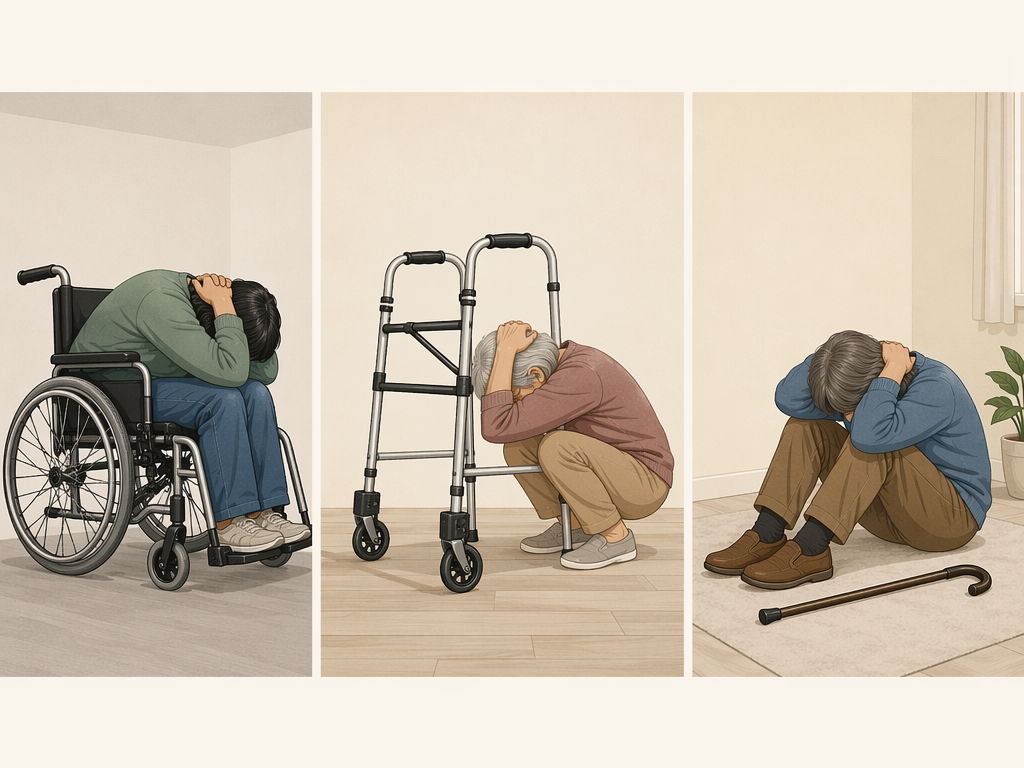
For a wheelchair user, lock the wheels if possible, bend forward if they can, and cover the head and neck with arms, a pillow, a book, or whatever is within reach. ShakeOut disability guidance and related mobility-disability resources describe this kind of adapted protect-in-place response for wheelchair users.[5]
For a walker user, lock the walker wheels if the walker has them, get as low as safely possible, and protect the head and neck. If getting to the floor would trap the person or create a second emergency, a sturdy chair may be safer than a forced crouch. For a cane user, sitting on the floor or on a sturdy chair may be safer than trying to stand through the shaking; the cane should stay within reach, not kicked away in the scramble.[5]
If you are beside your parent, give one instruction at a time. “Lock the chair.” “Cover your head.” “Stay there.” Do not try to gather pills, shoes, documents, pets, and blankets while the shaking is active. That is what the preparation window was for.
After the Shaking Stops: Evacuation Is a Decision, Not a Reflex
Once the shaking stops, pause long enough to assess danger. This pause may feel wrong. It is not delay for the sake of delay; it is triage. Earthquake Country Alliance guidance emphasizes checking for hazards after shaking, and caregiver-focused earthquake guidance for seniors commonly warns against unnecessary movement for mobility-impaired older adults unless there is immediate danger.[4][6]
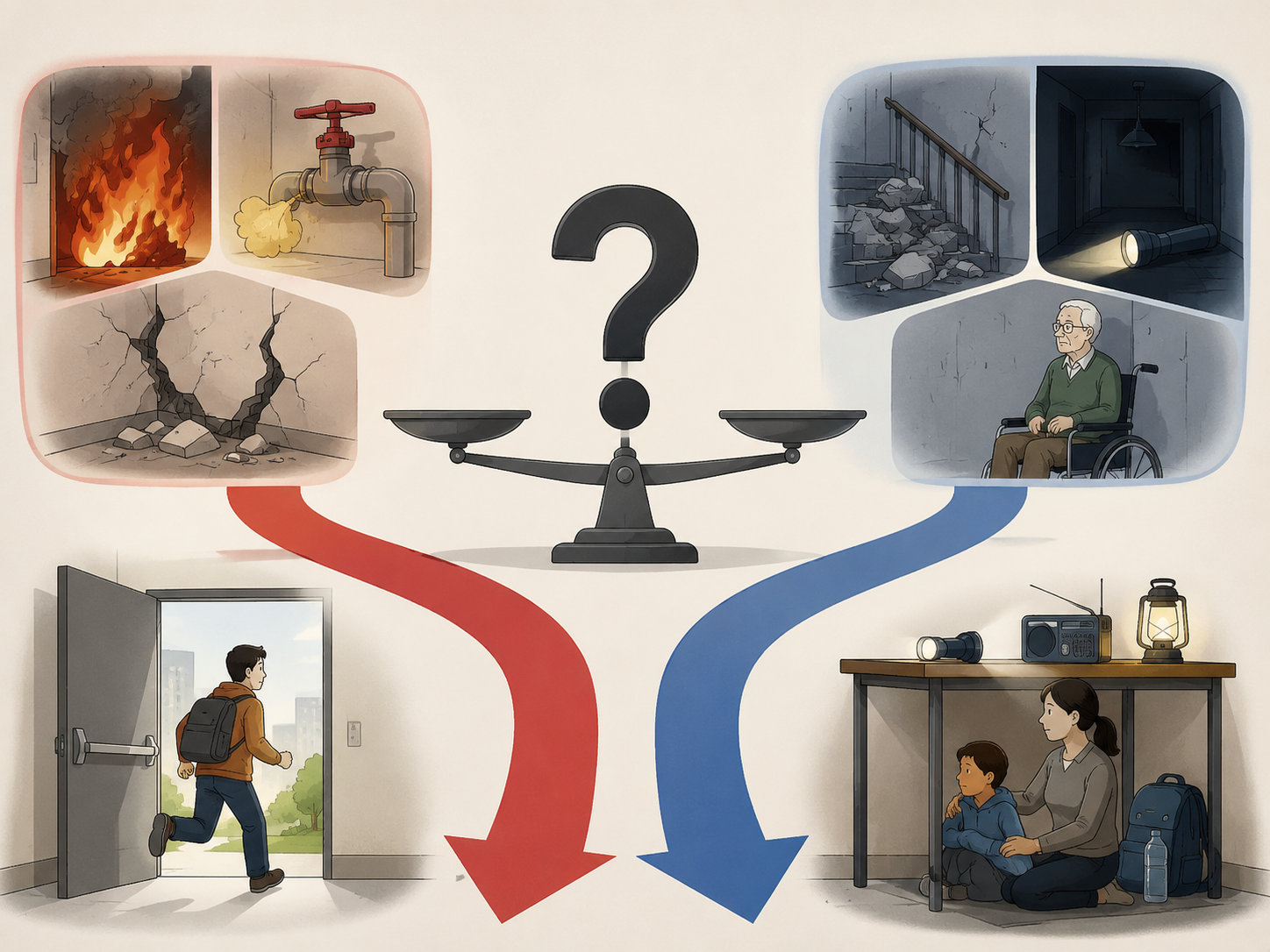
Evacuate when staying is clearly dangerous: fire, smoke, gas smell, visible structural damage, an obvious collapse risk, flooding, hazardous spill, or official instruction to leave. The fire part deserves special weight. U.S. Fire Administration and FEMA data show that older adults have a 2.5 times greater risk of dying in a fire than the population as a whole, so a post-earthquake fire or gas-related fire risk is not a situation to wait out casually.[7]
Staying put may be safer when there is no immediate danger, exits are unstable or blocked, stairs are damaged, elevators are out, and your parent cannot move without major assistance. That does not mean doing nothing. It means keeping the older adult protected, checking for injuries, keeping mobility aids close, contacting the support network, listening for local instructions, and preparing to move if the danger changes.
Floor level changes the answer. A ground-floor apartment with a clear exterior door is different from a fifth-floor unit with damaged stairs. Visible cracks, tilting, broken glass, the smell of gas, water coming through the ceiling, fire alarms, blocked hallways, and instructions from emergency officials all matter. No article can turn those conditions into a single automatic command.
If You Do Evacuate, Move the Person and Their Function
An older adult is not safely evacuated if the walker, glasses, hearing aids, medication list, or wheelchair charger is left behind and cannot be recovered. Those items are not conveniences after an earthquake. They are how the person stands, hears instructions, identifies medication, answers medical questions, and avoids a second fall outside.
If there is time and it does not put anyone in greater danger, take the go-bag, mobility aid, shoes, phone, keys, hearing aids, glasses, and medical information. If smoke, fire, gas, or collapse risk is present, people come first. But the support network should know the location of the bag and equipment so a later helper is not searching every closet.
For wheelchair users, caregiver earthquake guidance describes two-person carrying as one possible evacuation method when a wheelchair cannot be used, while also stressing that the mobility aid should accompany the person whenever possible.[6] Do not make a single caregiver lift beyond their ability because panic says “now.” A bad lift can injure both people and leave no one able to help.
There is also a counterintuitive point: some disability-focused earthquake guidance advises that people with disabilities may be evacuated later rather than first when immediate danger is not present, because reduced crowd pressure and clearer pathways can lower rush-related injury risk.[4][6] This is not a statement that their safety matters less. It is a recognition that crowded stairs, panicked neighbors, narrow halls, and a mobility device can be a dangerous combination.
A Short Stay-or-Go Rule for the Refrigerator
Write the decision rule where a helper can read it. Keep it blunt:
- Leave if there is fire, smoke, gas smell, major structural damage, collapse risk, flooding, hazardous spill, or an official evacuation order.
- Stay temporarily if there is no immediate danger and the exit route is more dangerous than the room.
- Do not use elevators after an earthquake unless emergency officials specifically say it is safe.
- Keep the older adult with their mobility aid, glasses, hearing aids, medication information, and go-bag whenever possible.
- Call the local support network in the agreed order; do not let everyone give instructions at once.
The plan is not to be fearless. The plan is to leave fewer decisions for the worst minute: prepare before, protect during, decide after, and never separate an older adult from the mobility aids and medical information they will need once outside.
References
- Older Adults, Ready.gov.
- Older Adults Emergency Preparedness, American Red Cross.
- Emergency Preparedness Checklist, Family Caregiver Alliance.
- Step 1: Secure Your Space, Earthquake Country Alliance.
- ShakeOut Tips for People with Disabilities, UC San Diego.
- Earthquake Preparedness for Seniors, Midnight Sun Home Care.
- Fire Risk to Older Adults, U.S. Fire Administration / FEMA.
Related reading
Noticed something outdated or inaccurate on this page? Flag a correction. We review every report against CDC, NIA, and AARP HomeFit guidance before updating a page.
Part of the Fall Prevention section.