
STEADI: Intervene
Keep Elderly Safe During a Dangerous Heat Wave
A practical two-part checklist for caregivers to protect aging parents from both heat illness and falls during a dangerous heat wave, with pre-wave preparation steps and daily action items.
When the forecast starts stacking hot days in a row, the question is not only how to keep an elderly parent safe during a dangerous heat wave. It is how to keep them cool, hydrated, steady on their feet, and reachable before the house starts working against them.
A dangerous heat wave turns ordinary rooms into small safety tests. The hallway to the bathroom feels longer. A warm kitchen becomes a place to avoid. A parent who says “I’m fine” may not feel thirst, overheating, or weakness early enough to act. The CDC advises checking on older adults at least twice daily during a heat wave, especially when they live alone or have chronic conditions, but a useful check-in has to be more specific than a friendly call.[1]
Treat the heat wave as a fall-prevention event. Injury Matters names the connection plainly: hot weather can contribute to dehydration, tiredness, dizziness, and reduced concentration, all of which can make falls more likely in older adults.[2] That does not mean every fall in hot weather is caused by heat. It means heat adds pressure to the same weak points caregivers already watch: balance, reaction time, nighttime bathroom trips, medication side effects, and cluttered walking paths.
Use this as a two-part checklist: first, what to set up before temperatures peak; second, what to repeat every day until the heat breaks.
Before the Heat Peaks: Set Up the House, Not Just the Reminder
The work that matters most happens before the worst afternoon. Once the house is hot and your parent is tired, every extra decision becomes harder. Do the fussy things early: test the cooling, place the water, clear the path, check the pill list, and decide what counts as “call for help.”
1. Check the cooling plan room by room
Start with the rooms your parent actually uses: bedroom, bathroom, favorite chair, kitchen, and the route between them. Do not assume “has air conditioning” means “is cool enough where Dad sits.” Turn the AC on before the heat wave, confirm it works, replace or clean the filter if needed, and make sure the remote or thermostat is readable and reachable.
- Put an easy-to-read thermometer in the main living area or bedroom.
- Move the most-used chair away from direct afternoon sun.
- Check that cords from fans or portable cooling devices do not cross walking paths.
- Confirm the bathroom is not becoming the hottest room they must enter several times a day.
- Write down who can bring them to a cooler place if the house cannot stay cool.
If there is no reliable AC, set up the least-hot room as the daytime base. The American Red Cross recommends spending time in air-conditioned places during extreme heat when home cooling is not adequate.[6] If leaving home is not practical, use layers of smaller steps: close blinds or curtains against strong sun, run fans only when they are helping comfort, use cool showers or baths if safe, and keep cooking heat out of the house.
Age UK advises keeping curtains closed during the hottest part of the day, roughly 10 a.m. to 3 p.m., avoiding oven or stove use when possible, and using cool showers or cool cloths to lower body temperature.[7] For a caregiver, that turns into setup: close the sunny-side curtains before you leave, stock no-cook meals, and make sure towels, washcloths, and a safe shower setup are ready before anyone is overheated.
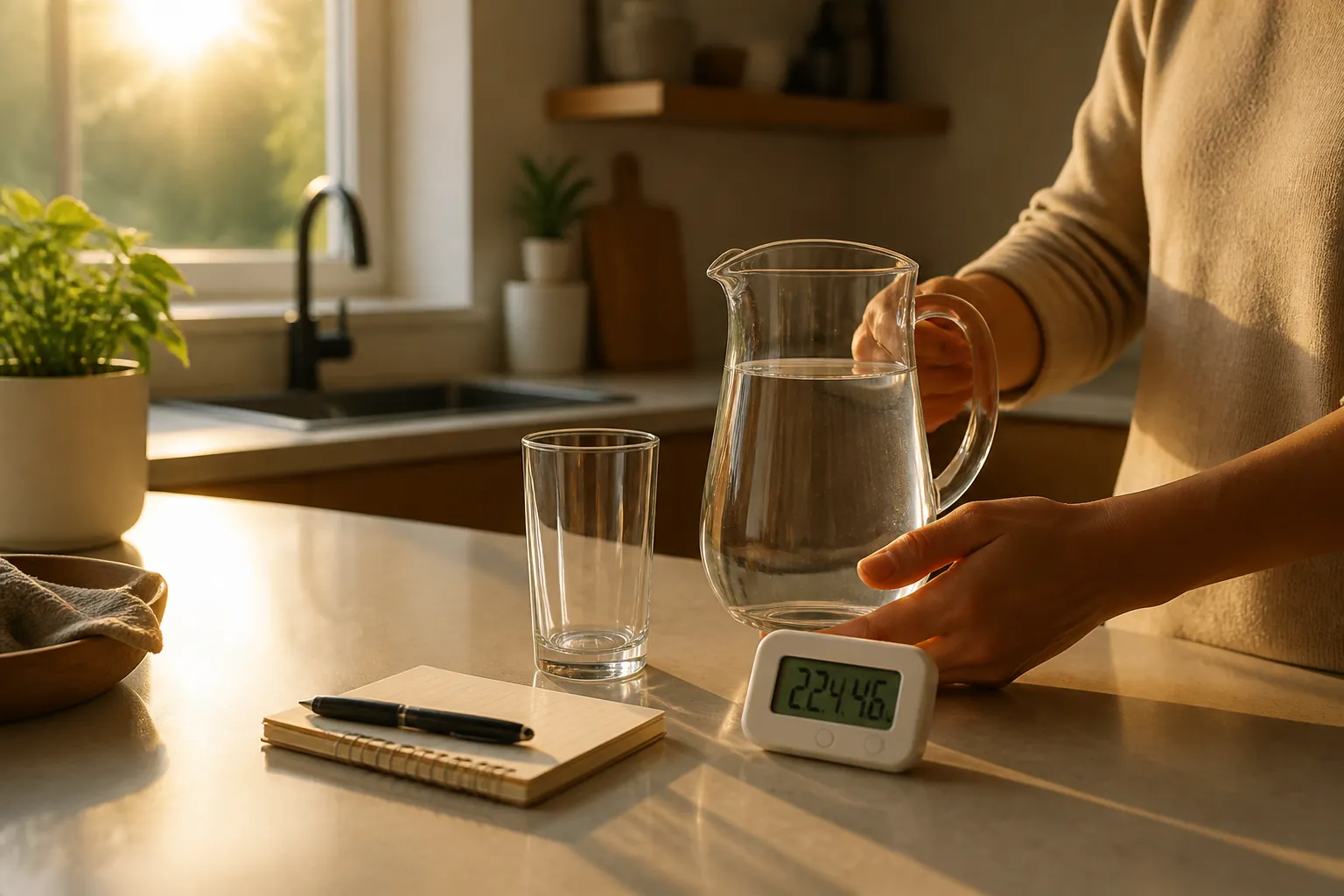
2. Build hydration into the room layout
Do not make water something your parent has to remember, stand up for, and carry across the room. Put it where the day already happens: bedside, favorite chair, medication area, and kitchen counter. Use cups that are easy to grip. If a walker or cane is used, leave one hand free; carrying a full glass while moving is a small wobble waiting to happen.
This is the part where self-report gets unreliable, through no fault of anyone’s character. Harvard Medicine explains that older adults may have reduced thirst, sweat less effectively, and have a diminished ability to sense temperature changes.[3] So “I’m not thirsty” is useful information, but it is not enough information.
- Place a filled water bottle or pitcher and cup within reach of the main chair.
- Set a visible morning and afternoon fluid cue, such as a marked bottle or a note by the phone.
- Stock easy fluids and water-rich foods your parent will actually accept.
- Ask the clinician whether any fluid limits apply, especially for heart, kidney, or other chronic conditions.
Health in Aging, from the American Geriatrics Society, advises older adults to drink plenty of water in hot weather and to talk with a healthcare professional if they have been told to limit fluids.[5] That second half matters. A caregiver’s job is not to turn hydration into a contest; it is to make safe fluids visible, reachable, and medically appropriate.
3. Review medications before the hot days, not during a scare
Make a current medication list before the heat wave. Include prescriptions, over-the-counter medicines, sleep aids, bladder medicines, allergy medicines, supplements, and any “only when needed” pills. Then ask the prescribing clinician or pharmacist what to watch for in hot weather.

The CDC’s clinician guidance on heat and medications identifies several medication classes that can affect thermoregulation, hydration, sweating, blood pressure, alertness, or balance, including diuretics, beta blockers, antipsychotics, selective serotonin reuptake inhibitors, and anticholinergics.[4] Those categories do not automatically mean a medicine is unsafe. They mean heat can change the margin for dizziness, dehydration, confusion, or unsteady walking.
Do not stop, skip, or adjust medications on your own because hot weather is coming. Ask what symptoms should trigger a call, whether blood pressure or weight should be monitored, whether fluid advice changes, and whether any medicine raises concern if your parent is eating or drinking less than usual.
| Medication question to ask | Why it matters during heat | Fall-prevention angle |
|---|---|---|
| Could any medicine increase dehydration or reduce sweating? | The body may have a harder time cooling itself. | Dehydration and overheating can contribute to weakness or dizziness. |
| Could any medicine lower blood pressure or slow heart-rate response? | Standing up may feel harder in hot conditions. | Lightheadedness can turn a normal bathroom trip into a fall risk. |
| Could any medicine cause sleepiness, confusion, or blurred thinking? | Heat fatigue can stack on top of medication effects. | Slower reactions make clutter, rugs, and stairs more dangerous. |
| What should we monitor, and when should we call? | The caregiver needs thresholds before symptoms escalate. | Clear instructions reduce guessing during the hottest part of the day. |
4. Clear the routes that heat will make harder
Heat does not create every fall hazard, but it makes old ones less forgiving. A throw rug that was annoying in May can become a real problem when your parent is tired, warm, and walking to the bathroom at night after drinking more fluids.
- Remove loose rugs or tape down edges on the bedroom-to-bathroom route.
- Move boxes, shoes, pet bowls, cords, and low stools out of walking paths.
- Check night-lights from bed to bathroom.
- Put the cane or walker where it can be reached before standing, not across the room.
- Place a stable chair near the bathroom or dressing area if your parent needs to sit while changing clothes.
If you want the deeper explanation of the heat-to-balance chain, use Three Ways Heat Waves Increase Fall Risk in Seniors as the side reading. For the checklist in front of you, the practical rule is simpler: assume fatigue will arrive before your parent announces it.
5. Make the bathroom and kitchen less demanding
The bathroom is where heat planning and fall planning meet. More fluids may mean more trips. Weakness may show up when standing from the toilet, stepping into the shower, or bending to pick up a towel. Before the heat arrives, check grab bars, non-slip mats, shower chair placement, towel reach, and lighting.
In the kitchen, reduce heat and standing time. Stock foods that do not require the oven. Move frequently used cups, plates, medications, and snacks to waist-to-shoulder height. If your parent likes a kettle, coffee maker, or microwave meal, check that the path is clear and the counter is not cluttered with objects they have to reach over while tired.
6. Assign the twice-daily check-ins before siblings start freelancing
The CDC recommends that family, friends, or neighbors check on older adults at least twice a day during a heat wave.[1] Put names and times on that job. “Someone should call Dad” is not a plan. “I call at 9 a.m.; Mark stops by at 5 p.m.; neighbor has the spare key” is a plan.
| Check-in item | What to confirm | Why it reduces fall risk |
|---|---|---|
| Cooling | Main room feels cool enough; AC or cooling plan is working. | Less heat fatigue means better attention and steadier walking. |
| Fluids | Water is within reach and some has been taken. | Dehydration can contribute to dizziness and weakness. |
| Symptoms | No new confusion, faintness, nausea, heavy sweating, or unusual tiredness. | Early symptoms can precede unsafe walking or collapse. |
| Walking | Parent can stand and move without new wobbling. | A change in gait may be the first visible warning. |
| Phone access | Phone is charged and within reach. | Help has to be reachable before a small problem becomes an emergency. |
7. Decide the emergency threshold while everyone is calm
Write down what means “call the doctor,” what means “go to urgent care,” and what means “call 911.” The Red Cross advises calling 911 for signs of heat stroke, including high body temperature, hot, red skin, confusion, loss of consciousness, or seizures.[6] Do not wait for a parent to agree that it is serious if they are confused, fainting, or not acting like themselves.
Also decide the non-emergency evacuation point. If the power fails or the AC stops working, where will your parent go: your house, a sibling’s house, a cooling center, a library, or a neighbor’s cooled room? Write the address and ride plan down. Heat is a poor time to discover that the only person with a car is out of town.
During the Heat Wave: The Twice-Daily Routine
Once the heat wave is underway, do not redesign the whole plan every day. Repeat the same short routine morning and late afternoon or evening, because those are the checks that catch small changes: the house is warmer than yesterday, the water bottle is still full, the walk to the bathroom is slower, the pill organizer looks off, or the phone is dead.

- Confirm cooling first. Ask what room they are in, check the indoor temperature if possible, and make sure curtains, AC, fans, or the backup cooling plan are being used.
- Prompt fluids in a way that can be verified. “Take a few drinks while we’re on the phone” is better than “remember to drink water.”
- Ask symptom questions that do not depend on the word “hot.” Try: Are you dizzy? weaker than usual? nauseated? confused? sweating more or less than normal? having a headache?
- Check walking before they make the next trip. Ask them to stand slowly, pause, and notice lightheadedness before heading to the bathroom or kitchen.
- Reduce unnecessary trips to hot or risky rooms. Bring food, water, phone, glasses, medications, and the walking aid within reach of the cooler room.
- Look for new fall hazards created by the heat plan itself: fan cords, extra water cups, towels from cool showers, or curtains pulled in ways that darken the hallway.
If you are checking by phone, make the call active. Have your parent put a hand on the water bottle, read the room thermometer if one is available, and confirm the phone charger is nearby. If you are visiting, do the unglamorous walk-through: bathroom floor dry, path clear, walking aid reachable, AC running, water visible, medications taken as prescribed.
What to watch more closely as the days add up
The first hot day may go smoothly. The third or fourth can look different because sleep is worse, appetite drops, errands pile up, and the house never fully cools. Watch for smaller changes than a medical textbook would emphasize: sitting longer before standing, skipping meals, leaving dishes undone, wearing the same damp clothes, forgetting the walker, or sounding unusually flat on the phone.
Health in Aging advises older adults to avoid strenuous activity in hot weather, stay in air-conditioned places when possible, and pay attention to warning signs of heat-related illness.[5] For a caregiver, that means canceling nonessential errands, moving appointments if the trip is unsafe, and refusing to let pride turn a pharmacy run or trash-bin trip into the day’s riskiest event.
When to Call for Help
Call the prescribing clinician, pharmacist, nurse line, or primary care office if your parent has new dizziness, repeated lightheadedness when standing, reduced urination, poor fluid intake, unusual sleepiness, worsening confusion, vomiting, or a medication question you cannot safely answer. If a clinician has already given specific heat instructions, follow those instructions.
Call 911 for emergency signs such as loss of consciousness, seizure, severe confusion, signs of heat stroke, chest pain, trouble breathing, or a fall with injury. The Red Cross identifies heat stroke as life-threatening and says to call 911 right away while cooling the person with whatever methods are available until help arrives.[6]
If the house loses power or cooling and your parent cannot get to a cooler place safely, treat that as an urgent logistics problem, not a comfort complaint. Use the ride plan. Call the backup person. If no safe cooling option is available, contact local emergency resources.
Keep the Plan Narrow Enough to Use
A heat-wave plan does not need to solve every aging-at-home problem. It needs to keep the main risks visible until the weather breaks: cooling, fluids, medication awareness, symptoms, walking steadiness, bathroom safety, and reachable help.
For broader emergency planning with the same fall-prevention lens, keep Help an Older Adult Stay Safe and Steady During Severe Weather nearby. If your family is also planning for other seasonal hazards, Fall-Proof Tornado Safety Tips for Elderly Loved Ones and Protect Seniors from Falls During Heavy Rain Warnings can sit with the same household papers.
The safest heat-wave routine is not a casual “drink water” reminder. It is a structured check that makes the water glass, the room temperature, the medication watch-outs, the walking path, and the emergency threshold impossible to overlook.
References
- Heat and Older Adults (Aged 65+), CDC.
- Supporting older adults to beat the heat, Injury Matters.
- The Effects of Heat on Older Adults, Harvard Medicine Magazine.
- Heat and Medications – Guidance for Clinicians, CDC, September 2025.
- Hot Weather Safety Tips, Health in Aging / American Geriatrics Society.
- Extreme Heat Safety, American Red Cross.
- How to keep cool in hot weather, Age UK.
Related reading
Noticed something outdated or inaccurate on this page? Flag a correction. We review every report against CDC, NIA, and AARP HomeFit guidance before updating a page.
Part of the Fall Prevention section.