
STEADI: assess
5 Fall Warning Signs During a Dangerous Heat Wave Peak
When extreme heat pushes past 95°F, older adults show distinct signs that a fall is imminent. This guide lists the five specific warnings — from gait changes to confusion — with a decision tree for cooling, balance checks, or 911, plus a peak-crisis checklist for California caregivers.
It is the part of the heat wave when the room is already warm before breakfast, the outside temperature is heading past 95°F, and the older adult you are checking on moves differently than they did yesterday. Maybe she reaches for the counter halfway across the kitchen. Maybe he stands up, stops, and says he is “just a little lightheaded.” During a dangerous heat wave peak, the risks for elderly California residents are not limited to heat exhaustion or heat stroke. Heat can make a fall the next emergency.
California has already had a hard 2026 heat season: a March heat dome pushed inland temperatures above 100°F and 20–30°F above normal, while July extreme heat warnings brought forecasts up to 110°F in parts of Southern California and overnight lows in the 70s that left less time for the body to recover.[1][2][3] In that setting, five warning signs deserve fast attention: changed walking, dizziness when standing, new confusion, dehydration markers, and abruptly seeking a cool surface or sitting down mid-task.
Use this rule: any one of those signs during dangerous heat should trigger cooling, hydration when safe, and a balance-safety check before the person walks again. New confusion, fainting, heat-stroke signs, a head injury, or a fall with possible fracture moves the decision to 911.
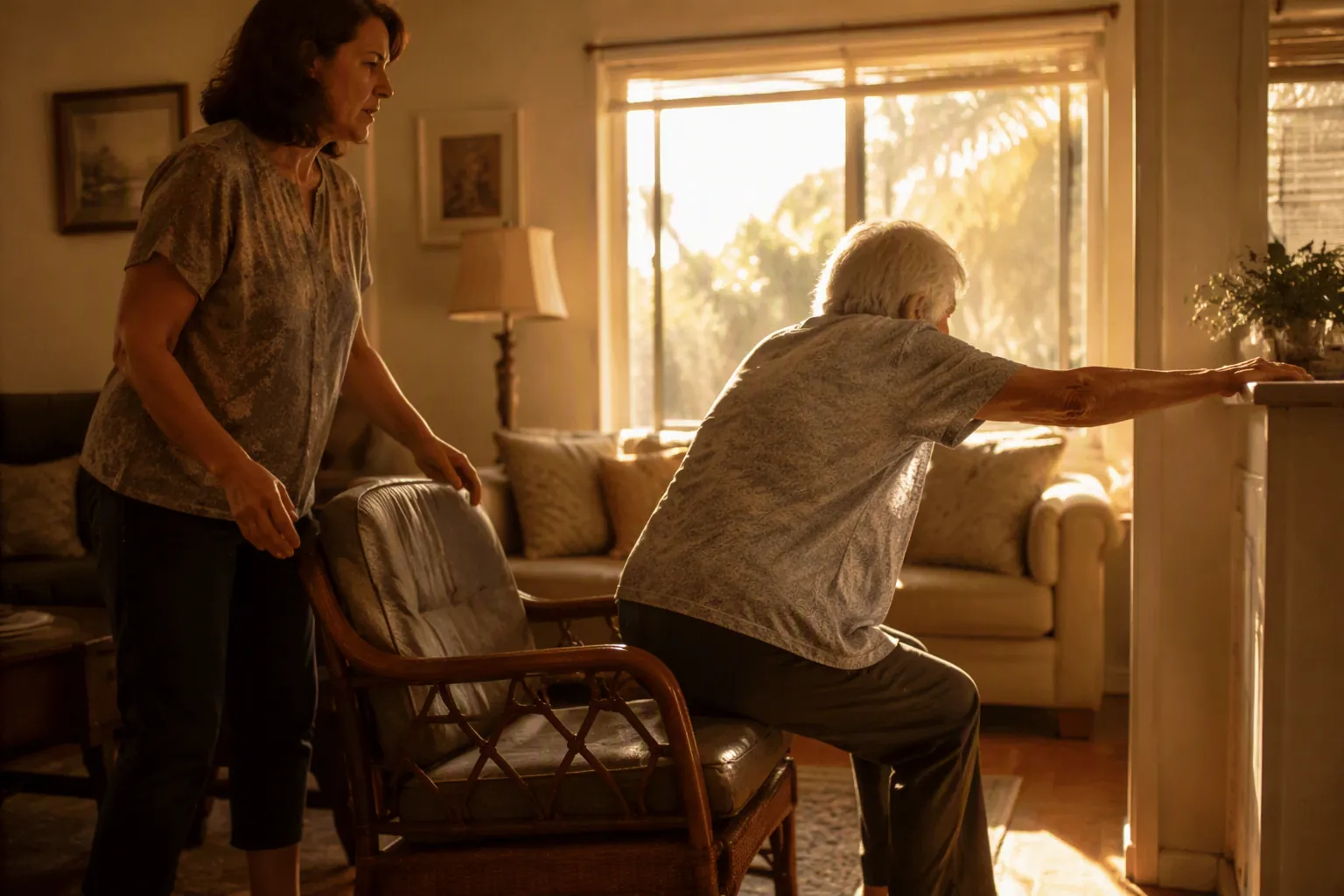
The five fall warning signs to watch during peak heat
Heat and falls belong in the same conversation because the body does not separate them. High heat strains thermoregulation. Older adults may feel thirst later. Dehydration can lower blood volume. Standing up can then produce dizziness. Medications may amplify the problem. Protective reflexes slow, and a trip that would have been corrected on a mild day becomes a fall.
A 2025 study in npj Climate and Atmospheric Science found that fall-related mortality risk increased 1.48% per 1°C above the minimum-mortality temperature, with risk rising more sharply at older ages. A separate Harvard Chan summary of nationwide Medicare research reported about 9 extra deaths per heat wave per 10,000 older adults. Neither finding is a California-specific forecast, but both support the practical point caregivers already see at home: heat can turn ordinary movement into unsafe movement.[4][5]
| Warning sign | What you may see | First action |
|---|---|---|
| Changed walking | Slower steps, wider stance, shuffling, reaching for furniture, pausing mid-room | Stop the walk; seat the person in a cooler place; do not let them continue unsupported |
| Dizziness when standing | Lightheadedness after getting up from bed, a chair, or the toilet | Have them sit or lie down; cool the room; recheck steadiness before any walking |
| New confusion | Repeating questions, not knowing where they are, unusual disorientation, trouble following a simple direction | Call 911 if confusion is new or above baseline during dangerous heat |
| Dehydration markers | Very dark urine, dry mouth, much less urination than usual, dry skin | Offer fluids if they are awake and can swallow; cool them; monitor closely |
| Abrupt rest-seeking | Sitting on the floor, lying on cool tile, stopping a task suddenly to rest | Treat it as a warning, not laziness; bring support to them rather than making them walk |
1. Their walking pattern changes
This is often the first sign a caregiver notices and the easiest one to talk yourself out of. The older adult is still upright. They may insist they are fine. But the movement has changed: smaller steps, a wider base, a hand sliding along the wall, a pause before crossing open space, or a sudden need to lean on the counter.
During extreme heat, that change can mean the body is spending more effort staying cool and less effort maintaining balance. Dehydration and fatigue make it harder to correct a stumble. Blood pressure medications, psychoactive medications, antihistamines, anticholinergic effects, and muscle relaxants can also add dizziness, sedation, or slower reaction time on top of the heat stress. CDC clinical guidance lists several medication classes that can raise risk on hot days, including diuretics, beta blockers, ACE inhibitors, ARBs, antipsychotics, SSRIs, TCAs, antihistamines, and NSAIDs; NCOA also flags psychoactives, antihistamines, muscle relaxants, blood pressure medications, and anticholinergics as fall-risk concerns in older adults.[6][7]
The immediate action is not to ask them to “walk it off.” Put a chair where they are, or guide them with close support only if you can do so safely. Move them toward cooler air after they are seated and steady. If they need the bathroom, do not send them alone; bathrooms are high-risk fall zones even before heat is added.
2. They get dizzy when standing up
Dizziness on standing is more specific than “feeling bad in the heat.” Listen for phrases like “I got woozy when I stood up,” “the room shifted,” “I need a second,” or “my legs feel weak.” Watch for the person rising from a recliner, bed, toilet, dining chair, or car seat and immediately grabbing for support.
Heat-related fluid loss can contribute to a drop in blood pressure when the person stands. Diuretics can worsen volume depletion. Blood pressure medications may make the standing transition harder to tolerate. Some medications can also affect sweating, thirst, sedation, or electrolyte balance, which is why a normal morning pill schedule can feel different during a 100°F-plus afternoon.[6]
Have the person sit back down or lie down in a cooler area. Do not let them stand again immediately to “test it.” Offer water if they are fully awake, not vomiting, and able to swallow safely. When they do stand again, the check is slow: sit at the edge, feet on the floor, pause, stand with support, pause again, then take only a few steps with someone beside them. If dizziness returns, the walking stops.
3. They seem newly confused or disoriented
Confusion is the sign to take least lightly. Heat can make an older adult tired or irritable, but new disorientation is different. They may ask where they are, repeat the same location question, seem unable to follow one-step instructions, call you by the wrong name when that is not normal for them, or make an unsafe choice that does not fit their baseline.
CDC guidance for older adults treats confusion, fainting, and heat-stroke concerns as emergency-level warning signs. Heat stroke can include very high body temperature, hot or flushed skin, confusion, and rapid pulse; a caregiver does not need to prove every sign before calling for help.[8]
Call 911 for new confusion during dangerous heat, especially if it appears with fainting, collapse, hot skin, vomiting, severe weakness, or a fall. While waiting, move the person out of direct heat if you can do so safely, loosen excess clothing, and begin cooling with cool cloths or cooler air. Do not make them walk to prove they are okay.
4. Dehydration signs are visible
The practical signs are not subtle once you look for them: very dark urine, a dry mouth, much less urination than usual, dry skin, unusual weakness, or a headache paired with heat exposure. The older adult may not complain of thirst even when fluids are needed. That matters because thirst sensation can be reduced in older age, and waiting for the person to ask for water may miss the window when balance is already becoming unsafe.[8]
If they are alert and able to swallow, start fluids and cooling together. Water is usually the first move. If their clinician has given fluid restrictions for heart, kidney, or other conditions, follow that plan and seek medical advice sooner. Heat does not cancel those restrictions; it makes the check-in more urgent.
Do not pair dehydration with unnecessary walking. Bring the drink to them. Clear the path to the bathroom. Turn on lights even during the day if glare and shadows are making the floor hard to read. If they have to stand, use the same slow stand-and-pause sequence used for dizziness.
5. They abruptly sit, lie down, or seek a cool surface
A person who normally finishes making lunch but suddenly sits on the kitchen floor is sending useful information. So is the neighbor who lies down on cool tile, stops halfway through taking out the trash, or says, “I just need to sit here,” in a place they would not normally rest.
Do not turn this into a debate about stubbornness or effort. Abrupt rest-seeking during dangerous heat can be the body choosing the ground before the ground chooses them. Bring a stable chair, water if safe, and cooler air to the person. If they are on the floor but did not fall, keep them there until you know whether they are dizzy, confused, injured, or too weak to rise safely.
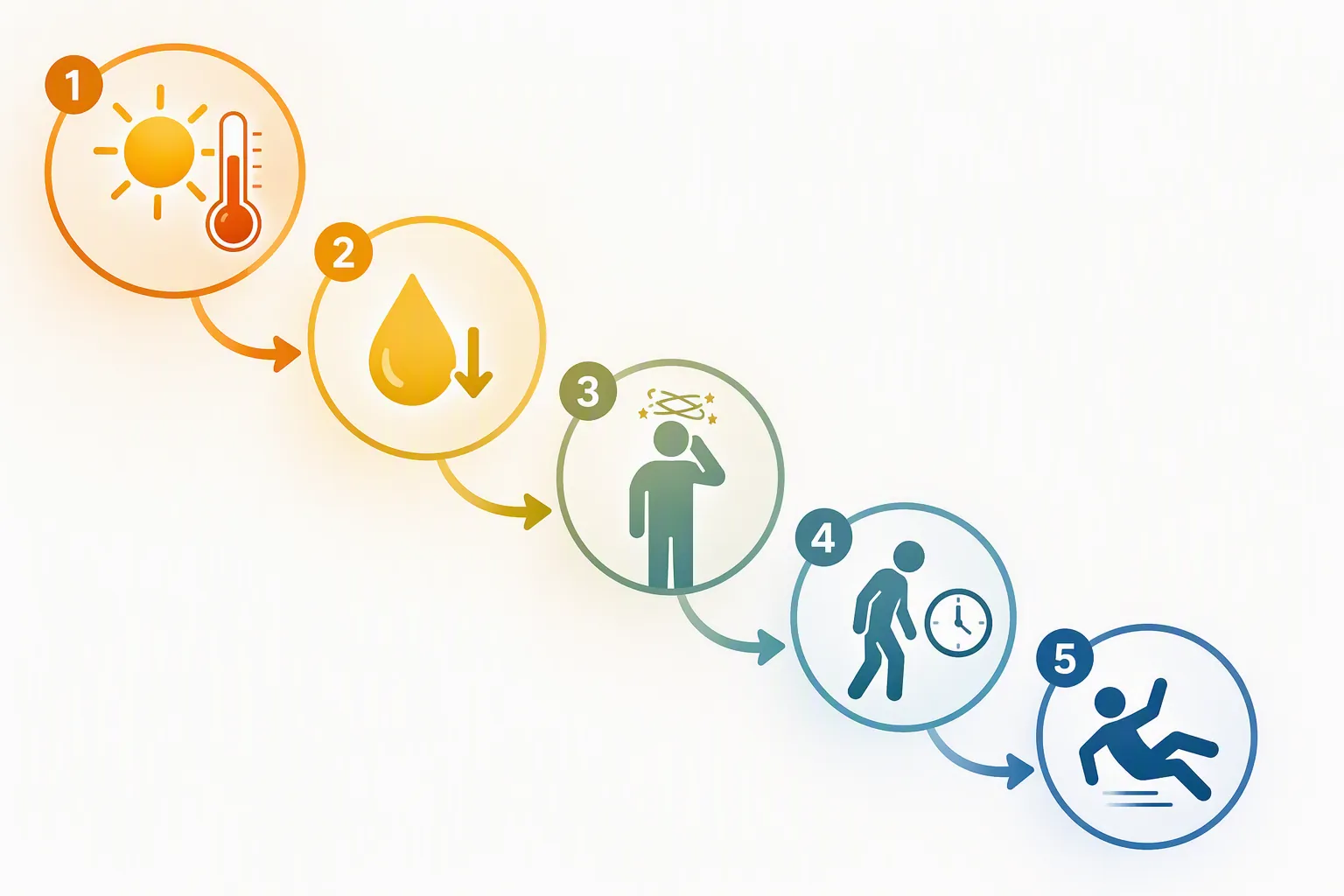
The decision tree: cool, stabilize, observe — or call 911
In the peak-crisis moment, the first question is not whether this is “really” heat illness or “really” fall risk. The first question is whether the person can be cooled and stabilized safely without delaying emergency care.
| What you see | What to do now | Do not do this |
|---|---|---|
| One warning sign, but the person is alert, speaking normally, and did not faint or fall | Seat them; move to cooler air; offer fluids if safe; reassess balance before any walking | Do not let them continue chores, stairs, showering, or walking alone |
| Dizziness on standing | Sit or lie them down; cool the room; recheck slowly before standing again | Do not ask for a quick walk across the room as a test |
| New confusion, fainting, collapse, hot/flushed skin, rapid pulse, vomiting, or severe weakness | Call 911; begin safe cooling while waiting | Do not drive them yourself if emergency signs are present and EMS is available |
| A fall occurred | Check for head injury, hip pain, inability to bear weight, bleeding, confusion, or heat-stroke signs; call 911 if any are present | Do not pull them up quickly just to get them off the floor |
| The home is not cooling | Move to a cooler location or cooling center if it can be done safely; ask a neighbor, family member, or local service for help | Do not assume an AC unit is protective until the room is actually cool |
That last line matters. Air conditioning is only protective when it is on, functioning, and cooling the space the person is actually using. Harvard Medicine described Arizona data showing that 91% of older adults who died indoors had AC units, but the units were off, improperly set, or broken.[9] For a caregiver, the room temperature and the person’s behavior matter more than the reassurance of seeing a unit in the window.
Peak-crisis checklist for a California caregiver
This is the short version for the hours when the warning is active and the older adult is already showing strain. For planning before the next heat event, use a fuller room-by-room heat safety checklist or a broader senior heat-wave preparedness plan.
- Start with contact, not instructions from across the room. Go to the person, look at their face, listen to their speech, and watch how they move before asking them to stand.
- Move them toward cooler air. Use air conditioning when it is working; if the home cannot cool, arrange a safer cooler location. If the household lacks reliable AC, use a specific no-AC heat plan for fall prevention before the next peak.
- Hydrate when appropriate. LA County advised drinking 2–4 glasses of water per hour during extreme heat; for an older adult with fluid restrictions or swallowing problems, follow the medical plan and seek advice sooner rather than forcing fluids.[3]
- Keep the indoor temperature below 78°F if possible. If the person’s usual room is hotter than the rest of the home, move the person, not just the thermometer.
- Do not rely on a fan as the main cooling method when the air temperature is above 95°F. CDC cautions that fans may not prevent heat-related illness at those temperatures.[8]
- Check balance before walking resumes. Have them sit upright, pause, stand with support, pause again, then take a few steps with someone close enough to help. Stop if dizziness, weakness, confusion, or an unsteady gait returns.
- Set twice-daily check-ins during the warning period. LA County advised checking on older neighbors at least twice daily during extreme heat, and that advice is just as relevant for adult children, building managers, and nearby friends.[3]
- Review medications before predicted hot days with the prescriber or pharmacist, especially if the person uses diuretics, blood pressure medications, psychoactives, antihistamines, anticholinergic medications, or NSAIDs. Do not stop prescribed medication on your own during the heat event.[6][7]
If you need the full explanation of how heat affects balance, use this heat-and-fall-risk guide. If you are deciding whether today’s heat index has crossed a senior-safety threshold, use the heat index thresholds for seniors. This page is for the narrower moment when the older adult is already moving differently and you need to decide what happens next.
If a fall already happened
Do not rush to lift the person. A heat-related fall can hide the same injuries as any other fall, with heat illness layered on top. Ask what hurts. Look for head impact, hip or wrist pain, bleeding, new weakness, confusion, vomiting, or inability to bear weight. Check whether the skin is hot or flushed and whether the person seems disoriented or faint.
Call 911 if there is confusion, fainting, suspected heat stroke, head injury, severe pain, possible fracture, chest pain, trouble breathing, or if you cannot get them up safely. If none of those are present, keep cooling and watching them, and do not let the rest of the day return to normal movement too quickly. A person who became unsteady once during peak heat can become unsteady again when they stand for the bathroom, the doorway, or the kitchen sink.
References
- Epic Southern California heat wave poses deadly health threat, Los Angeles Times, 2026-03-16.
- SoCal extreme heat warning risks, Los Angeles Times, 2026-07-14.
- Residents Advised of Extreme Heat Risks, LA County, 2026-07-14.
- npj Climate and Atmospheric Science study on temperature and fall-related mortality risk, Nature, 2025.
- Heat waves and annual death rates in older adults in the United States, Harvard T.H. Chan School of Public Health, March 2026.
- Heat and Medications – Guidance for Clinicians, CDC.
- What Medications Increase the Risk of Falling Among Older Adults?, NCOA.
- Heat and Older Adults Aged 65+, CDC.
- The Effects of Heat on Older Adults, Harvard Medicine.
Related reading
Noticed something outdated or inaccurate on this page? Flag a correction. We review every report against CDC, NIA, and AARP HomeFit guidance before updating a page.
Part of the Fall Prevention section.