
Fall-Proof the Shelter Path During a Tornado Watch
The greatest fall risk for seniors during a tornado isn't the storm itself—it's the panicked dash to shelter when a warning drops. This guide covers what to do during the tornado watch window: clear paths, pre-position mobility aids and flashlights, and rehearse the route so it becomes automatic before adrenaline takes over.
A tornado watch is the time to make the shelter path boring. Not heroic, not fast, not dependent on someone suddenly remembering where the flashlight went. A watch means conditions are favorable for tornadoes; a warning means a tornado has been sighted or indicated by radar and it is time to take shelter. The National Weather Service describes tornado warnings as averaging about 22 minutes of lead time, while also noting that tornadoes can form and strike within seconds.[1] For an older adult who needs a walker, oxygen tubing, a wheelchair transfer, or just a few extra minutes to stand without dizziness, that warning window is not as generous as it sounds.
That is the practical heart of senior safety during tornado watch conditions: do the fall-prevention work before the warning. The dangerous moment is often the rushed trip from the recliner, bed, kitchen chair, or bathroom toward the safest interior space. Shoes catch. Rugs buckle. A walker is on the wrong side of the chair. A hallway is darker than anyone expected. The older adult hears urgency in everyone else’s voice and tries to move faster than their body can safely move.
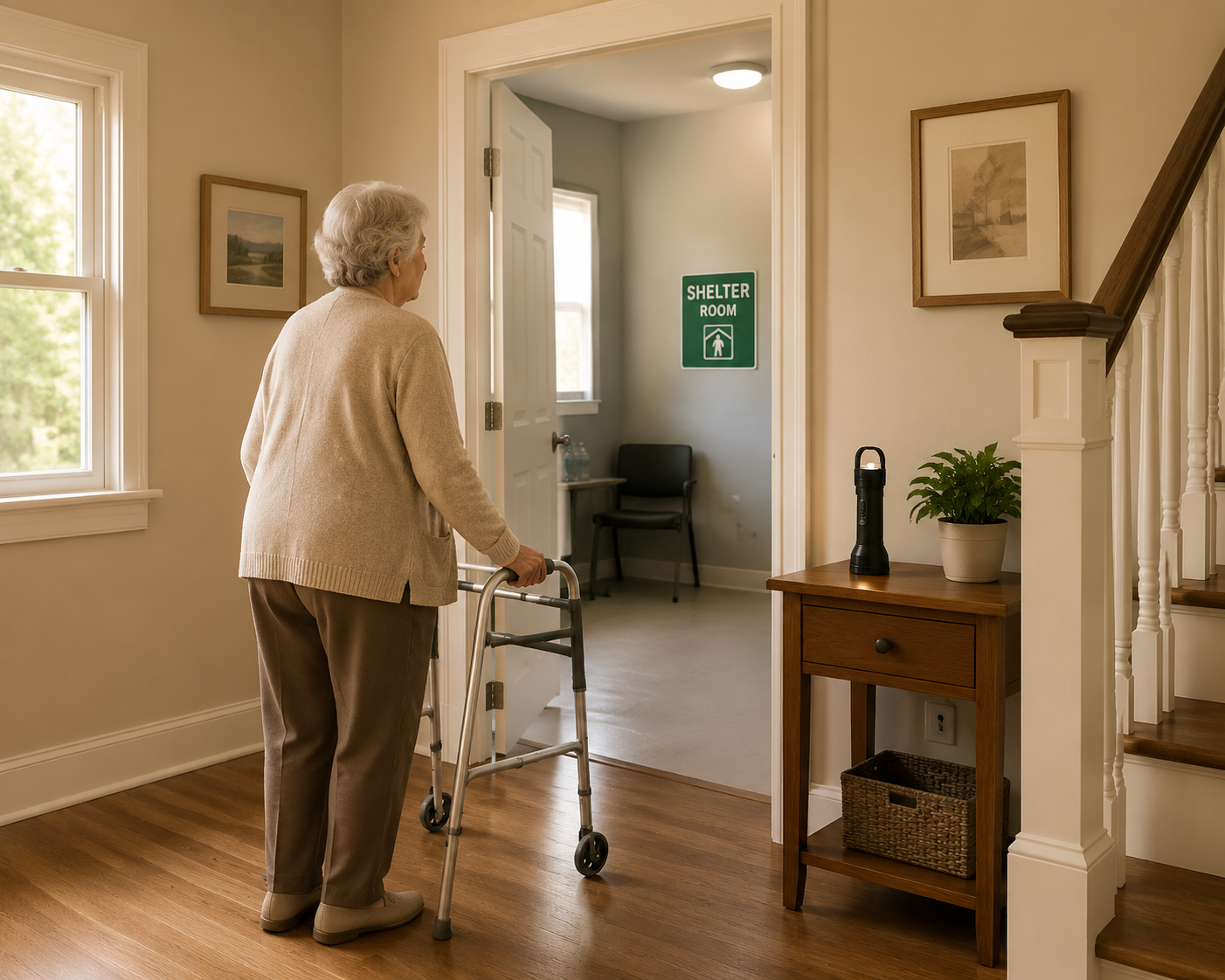
Tornado research does not give us a neat count of how many older adults fall while trying to get to shelter. The evidence is narrower, and it should be treated that way. In the CDC’s report on the April 25–28, 2011 tornado outbreak, adults 65 and older accounted for 32.5% of 338 fatalities across five states, and falls during escape were listed among established indirect causes of death.[2] Those percentages come from one extreme outbreak, not every tornado event. Still, the pattern is sobering enough to change what caregivers do during a watch: treat the route to shelter as part of the shelter.
Use the watch as the preparation window
During a watch, the senior does not need to sit in fear for hours. But the house should quietly shift into a safer state. The goal is to remove decisions and obstacles while everyone still has time, light, and a normal voice.
| When | Main Job | Fall-Prevention Meaning |
|---|---|---|
| Tornado watch | Prepare the route and equipment | Clear the path, stage mobility aids, check lighting, confirm medical equipment, and rehearse calmly |
| Tornado warning | Move to shelter | Use the already-cleared route without searching, lifting, arguing, or improvising |
| After the warning | Return slowly and check conditions | Watch for debris, power loss, wet floors, stress, dizziness, and furniture that shifted |
The safest shelter area is usually a basement, storm shelter, safe room, or a small interior room on the lowest level, away from windows. That standard advice matters, but for an older adult it is incomplete until someone has walked the actual route. “Interior bathroom” sounds simple until there is a raised threshold, a hamper behind the door, a bath mat that slides, and a walker that will not turn easily once inside.
If the safest available place is not perfect, choose the best reachable place. A basement that requires stairs may be unsafe for a senior with poor balance if no one can assist. A small interior room on the main floor may be the more realistic shelter if it can be reached quickly and safely. The watch is when that judgment should be made, not when a phone alert is sounding.
Start where the senior actually is
A shelter plan that begins at the front door or on a neat floor plan misses the daily reality of the home. Start with the places the older adult is most likely to be during storm hours: recliner, bed, kitchen table, bathroom, porch chair, laundry area, or favorite window. Then trace the route from each place to the shelter area.
The first route to check is not the prettiest one. It is the one the senior will use without thinking. If Mom always pushes up from the left arm of the recliner, the walker belongs where her left hand naturally reaches, not across the room where it looks tidy. If Dad always turns on the hallway lamp before walking to the bathroom at night, that lamp needs to work during storm conditions, and a backup flashlight needs to sit where his hand already goes.
- From the favorite chair: remove footstools, magazines, cords, pet toys, and small tables from the first few steps.
- From the bedroom: clear the floor beside the bed, move slippers where they can be put on without reaching, and make sure the path is not narrowed by laundry baskets or oxygen tubing.
- From the bathroom: check bath mats, thresholds, wet floors, and whether the door blocks the walker or wheelchair turn.
- From the kitchen: move lightweight stools, trash cans, throw rugs, and rolling carts out of the travel line.
- From outside or a porch: decide early when the senior comes indoors, because waiting until a warning may leave too little time.
This is not about making the house look staged. It is about making the first ten feet safer, because the first ten feet are where the body is still standing up, turning, reaching, and responding to alarm.
Clear the shelter path like a fall inspector, not a housekeeper
During the watch, walk the full route at the older adult’s pace and look low. Most fall hazards are not dramatic. They are ordinary objects that become dangerous when the room gets loud, dark, crowded, or rushed.
Loose rugs and edges
Pick up loose throw rugs along the route. Do not just flatten the corner and hope it stays flat. If a rug is needed for traction on a slick floor, it should be secured well before storm season, not negotiated during a watch. A curled hallway rug is exactly the kind of small hazard that becomes invisible when someone is trying to move quickly.
Thresholds, stairs, and tight turns
Check every threshold between the starting point and shelter. A walker can catch on a raised strip. A wheelchair may need a better angle. A cane user may need one hand free for a rail. If stairs are part of the plan, decide whether the senior can use them today, in today’s shoes, with today’s medication effects and stiffness. A plan based on last year’s mobility is not a plan.
Furniture that narrows the route
Move small tables, plant stands, ottomans, baskets, decorative ladders, and dining chairs away from the shelter path. Pay special attention to objects that are easy to move in calm weather but hard to manage while assisting another person. If two people will walk side by side, the route needs room for both bodies and the mobility aid.
Doors that need to stay open
Open the doors that should be open, and make sure they will not swing back into the path. A bathroom or closet door may be fine for a person walking alone but awkward when a caregiver is guiding a walker through it. If a doorstop is used, place it where it cannot become the next trip hazard.
Pets and pet supplies
Put pet bowls, leashes, beds, and toys away from the route. If a pet will be brought into the shelter space, decide who handles the pet before the warning. An older adult should not be bending for a carrier, reaching under furniture, or trying to step around an excited animal while moving to shelter.
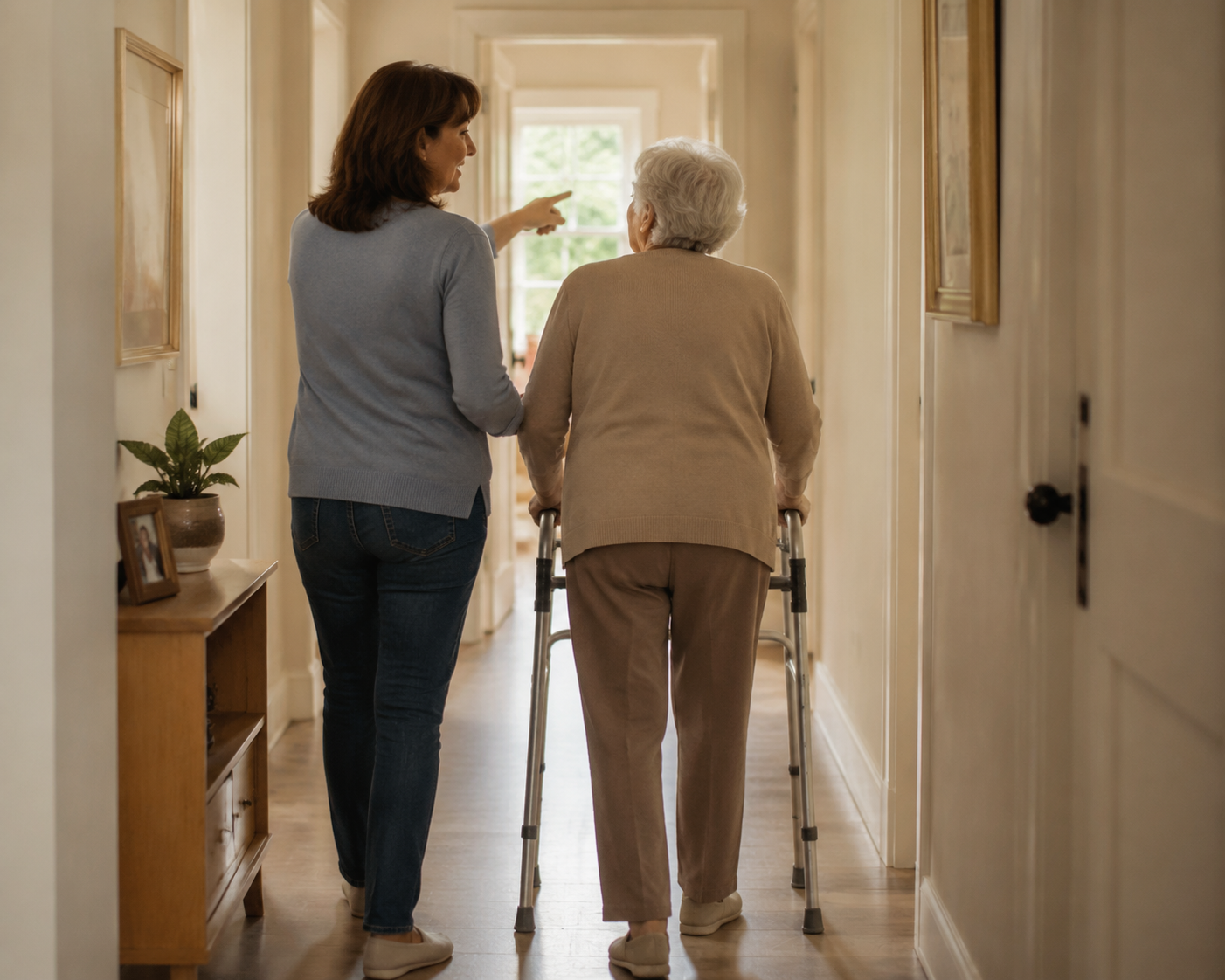
Stage mobility aids where hands will reach
The right place for a walker, cane, rollator, wheelchair, or transfer chair is not where it looks least intrusive. It is where the senior will reach first when the warning comes. If the walker is usually parked on the far side of the recliner, move it before the storm. If the cane leans by the back door but the shelter route starts from the bedroom, move the cane.
Check the aid itself. Walker glides should not be loose. Rollator brakes should hold. Wheelchair footrests should not be blocking the first transfer. Cane tips should not be worn smooth. These are small checks, but they keep the warning from becoming a scavenger hunt for safe movement.
- Put the walker on the side the senior normally stands toward.
- Lock rollator brakes before the senior uses it to rise.
- Place a wheelchair so the transfer direction is familiar.
- Keep the cane upright in a stable holder, not sliding along a wall.
- Remove baskets or bags hanging from mobility aids if they make the aid tip or snag.
If the older adult lives alone, the same rule still applies. Stage the aid for the most likely starting point, then use the watch to relocate it if the day’s routine changes. A walker next to the bed is not helpful if the senior spends the next two hours in the living room watching the weather.
Light the route before the power fails
A flashlight with dead batteries is not emergency equipment. During the watch, turn it on. Then put it where it will be used, not where supplies are stored. One flashlight in a hall drawer may be enough for a younger adult who can move quickly and search in the dark. It is not enough for someone balancing with both hands.
Place lights along the route: beside the chair, near the bed, at the shelter entrance, and inside the shelter area. Battery lanterns are often easier than handheld flashlights because they leave hands free. If the senior uses a walker, avoid asking them to carry a light unless it can be clipped on securely or placed in a stable basket that does not affect balance.
This is also the time to reduce glare and shadows. A bright beam pointed at the floor can hide a raised threshold behind glare. A lantern set on a low table may cast confusing shadows across a rug edge. Walk the route with the lights the senior will actually use and adjust them while there is still calm time to notice what does not work.
If power outages are a repeated problem in the home, connect this watch routine with a broader power outage fall prevention checklist for seniors. Tornado watches and power failures often overlap in the same practical problem: an older adult has to move through a familiar home that has suddenly become visually unfamiliar.
Check medical and power-dependent equipment
Medical equipment changes the shelter route. Oxygen tubing can snag under a door. A portable concentrator may need a charged battery. A wheelchair may need enough power to reach the shelter and return. A CPAP machine may not matter during the ten-minute move to shelter, but oxygen, suction equipment, powered mobility, hearing aids, and communication devices may matter immediately.
During the watch, confirm what has to move with the senior and what can stay in the shelter area. If oxygen is used, check whether the route allows tubing to travel without crossing underfoot. If a portable tank is needed, place it where the caregiver can handle it without also steadying the senior and holding a flashlight. If the senior uses a wheelchair or scooter, check the battery before the weather becomes urgent.
Families who need the larger medical-continuity picture can build from this route check into severe weather safety tips for elderly adults with medical needs. But during the watch itself, keep the question narrow: what equipment must be ready so the older adult can reach shelter without tripping, rushing, or being separated from something essential?
Do one calm rehearsal
Rehearsing the route can feel childish until the warning comes. Then it becomes the difference between moving and deciding. A calm rehearsal lets the senior’s body learn the sequence before fear narrows attention: stand, reach for walker, turn left, pass the table, enter the hallway, pause at the threshold, sit in the shelter chair.
Do not race the rehearsal. Speed is not the point. The point is to find friction. If the walker clips the bathroom doorframe, widen the turn. If the caregiver has to move ahead to open a door, decide that now. If the senior becomes short of breath halfway through, place a stable chair at the right pause point if there is time and if it does not block the route. If the shelter area is too cramped for the walker and another person, rearrange it before the warning.
One or two slow passes are usually more useful than repeated drills that exhaust or irritate the older adult. The rehearsal should lower stress, not turn the watch into a performance test. Speak in the same words you will use during a warning. “We’re going to the bathroom now. Walker first. I’ve got the light.” Familiar words reduce the need to interpret new instructions under pressure.
The rehearsal also protects the caregiver. In a real warning, adult children and spouses often try to do too much at once: lift a bag, guide a parent, watch the radar, grab medications, corral a pet, and keep talking. Walking the route once exposes which tasks need to be dropped, moved earlier, or assigned to someone else.
Keep supplies reachable without making the senior carry the house
Emergency kits are useful only if they do not create the next fall. Oklahoma State University Extension recommends separating supplies into two kits for older adults: a larger home-shelter tub and a lighter go-bag, recognizing that a standard emergency kit may be too heavy for an older adult to carry safely.[3]
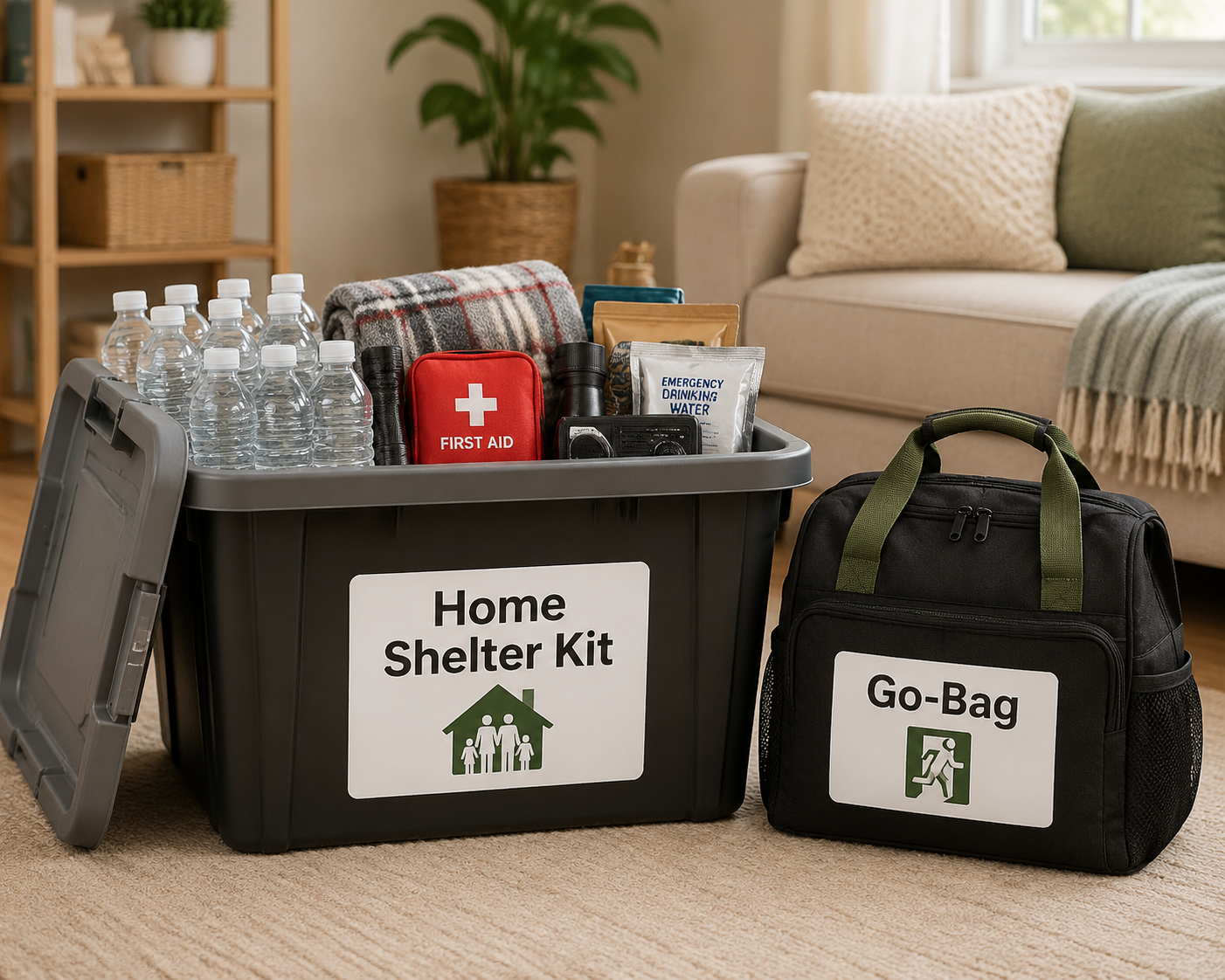
That distinction is worth taking seriously. The heavier tub belongs in or near the shelter area before it is needed. The light bag should contain only what the senior can carry without changing posture, grip, or balance. For many older adults, even that may mean the caregiver carries it. Preparedness should not depend on a frail person rushing down a hall with a loaded bag swinging from one hand.
| Supply Type | Where It Belongs During A Watch | Fall-Risk Test |
|---|---|---|
| Home-shelter tub | In or next to the shelter space | No one has to carry it during the warning |
| Light go-bag | Beside the staged mobility aid or with the caregiver | It does not pull the senior off balance |
| Medications needed soon | In a small pouch or already placed in shelter if appropriate | No searching through cabinets during the warning |
| Flashlight or lantern | On the route and inside shelter | Hands remain free for balance whenever possible |
| Phone and charger | With the senior or caregiver | No last-minute trip back across the house |
Water, medications, identification, hearing aid batteries, glasses, phone chargers, and comfort items may all matter. But the watch-phase question is not “What could we possibly need?” It is “What can be placed now so nobody has to carry too much later?”
Decide when to move early
Some older adults should not wait for a warning to begin moving. If the shelter is across a large home, down stairs, through a senior community hallway, or in another part of a building, the watch may be the right time to relocate closer to shelter. This is especially true when the senior uses oxygen, has Parkinsonian freezing, becomes confused under stress, needs transfer help, or lives with another older caregiver who cannot safely hurry.
Moving early does not have to mean sitting in the bathtub for hours. It may mean spending the watch in a main-floor room closer to the shelter. It may mean putting on sturdy shoes now. It may mean using the bathroom before the warning. It may mean bringing the walker, phone, and light to the same side of the room. These small changes reduce the number of things that must happen after the alert.
For seniors in independent living or assisted living, the watch is also the time to ask staff how movement will work. Which hallway is used? Is the elevator avoided? Who assists residents using walkers or wheelchairs? Where should oxygen users go? A posted tornado plan is not enough if the resident cannot physically follow it without help.
When the warning comes, shrink the job
Once the warning is issued, the job is no longer to improve the house. The job is to move along the prepared route. Do not stop to gather the heavy kit. Do not send the senior back for glasses if a spare pair is already in the shelter tub. Do not move furniture unless it is blocking the path. Do not argue about the perfect shelter if the safe, reachable shelter has already been chosen.
Use short, concrete instructions. Give the older adult time to stand before stepping. Let the walker come fully into position. Keep pets and extra people out of the path. If the senior freezes or tries to rush, return to the rehearsed words and the next physical action. The route should feel familiar because it has already been walked.
If a caregiver is not in the home, the watch preparation matters even more. Phone calls during a warning should not become complicated coaching sessions. The senior should already know where the walker is, where the light is, which room to enter, and where to sit. For a broader look at how storms increase fall risk beyond tornadoes, see why storms create a dangerous fall risk for seniors.
A repeatable watch-phase routine
The routine does not need to be elaborate. It needs to be repeatable every time a tornado watch includes the senior’s area.
- Choose the safest reachable shelter area for today’s mobility, not last year’s.
- Start from the senior’s likely location and walk the actual route.
- Remove rugs, cords, clutter, pet items, and furniture from the path.
- Stage the walker, cane, wheelchair, oxygen, phone, shoes, and lights where hands will naturally reach.
- Check batteries for flashlights, phones, wheelchairs, hearing aids, and portable medical equipment.
- Place the heavy shelter supplies in the shelter area and keep any go-bag light enough not to affect balance.
- Rehearse the route once or twice at a calm pace, then stop before anyone is tired.
- If the route is long or difficult, move the senior closer to shelter before the warning.
The point is not to make every weather alert feel like an emergency. It is to use the quiet part of the weather cycle for the work that cannot be done safely in a rush. The safest dash to shelter is the one that has already been slowed down, cleared, lit, equipped, and practiced.
References
- Tornado Safety, National Weather Service.
- Tornado-Related Fatalities — Five States, Southeastern United States, April 25–28, 2011, CDC MMWR, July 20, 2012.
- Older Adults and Planning Ahead for Severe Weather, Oklahoma State University Extension.
Related reading
Noticed something outdated or inaccurate on this page? Flag a correction. We review every report against CDC, NIA, and AARP HomeFit guidance before updating a page.
Part of the Fall Prevention section.