
STEADI: Intervene
What to Do After an Elderly Parent Falls and Fractures a Bone
A step-by-step guide for family caregivers responding to an elderly parent's fall with a suspected fracture. This article explains the critical first actions, when to call 911, and what common mistakes to avoid to prevent worsening the injury.
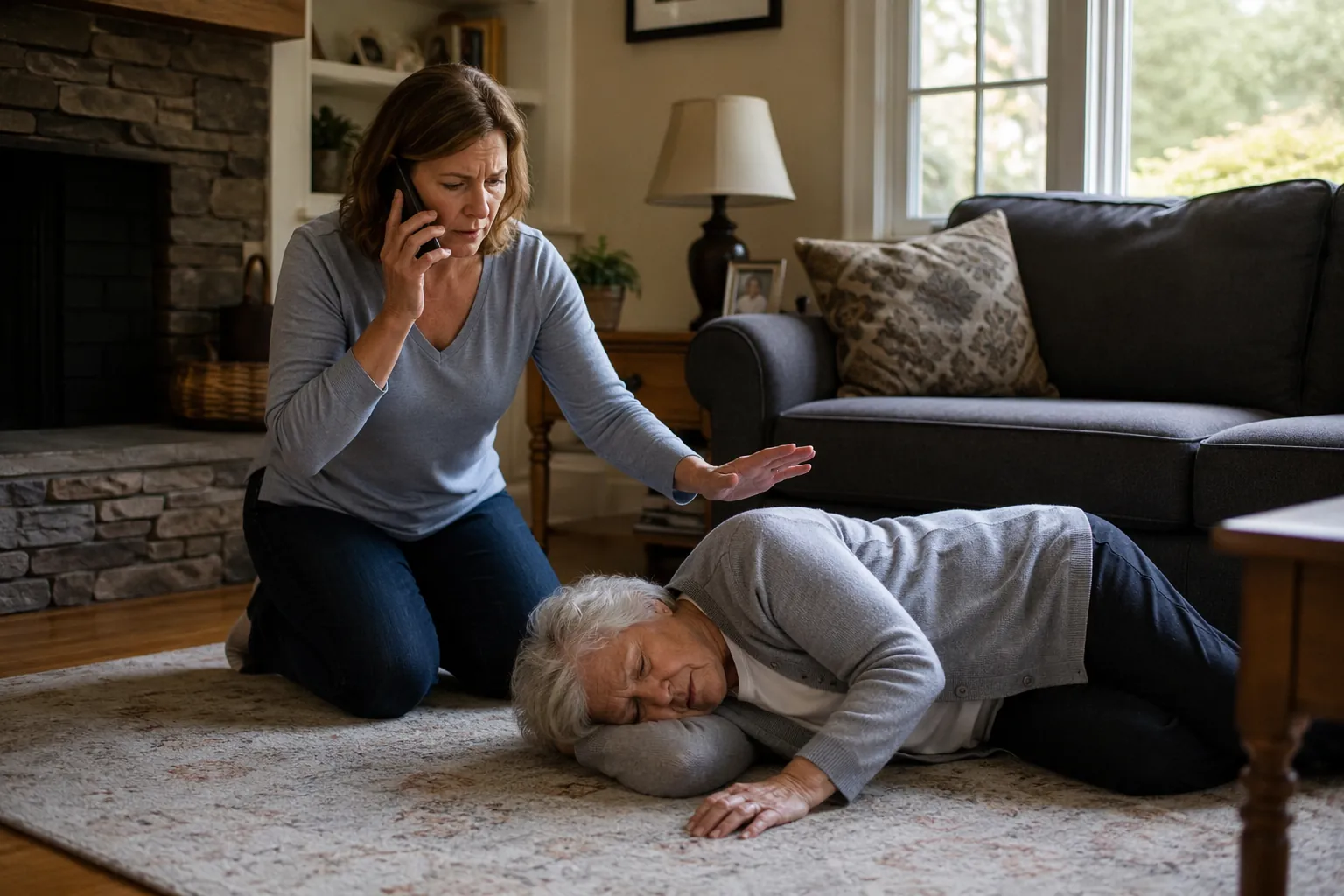
If your elderly parent has fallen and may have fractured a bone, do not lift them, drag them to a chair, straighten a twisted limb, give them food or drink, or drive them yourself. Check whether they respond and are breathing. If they are unresponsive, not breathing normally, bleeding heavily, visibly deformed, unable to bear weight, numb, or reporting head, neck, back, hip, or groin pain, call 911 and keep them still until responders arrive.[1]
The first 60 minutes: what to do in order
| Moment | What you do | What you do not do |
|---|---|---|
| First minute | Make sure the scene is safe. Speak to your parent. Check responsiveness and breathing. | Do not pull them up or roll them over unless they are in immediate danger. |
| If there are fracture or head/spine red flags | Call 911. Say there may be a fracture and possible head, neck, back, hip, or limb injury. | Do not drive them to the ER yourself. |
| During the call | Report blood thinner use clearly. Describe how the fall happened, any loss of consciousness, pain location, deformity, numbness, and bleeding. | Do not assume the medication list can wait until later. |
| While waiting | Keep them still and warm. Control bleeding with sterile gauze if needed. Use wrapped ice for swelling. | Do not realign a limb, apply heat, give food or drink, or keep checking whether they can stand. |
| When responders arrive | Repeat the blood thinner information and hand over the medication list if you have it. | Do not minimize symptoms because your parent is embarrassed or wants to avoid the hospital. |
| Only if it is clearly minor | If they are conscious, have no deformity, no head/neck/back symptoms, and can bear weight after a minor slip, arrange urgent care or same-day primary care evaluation. | Do not use this exception when you are unsure. |
Step 1: check responsiveness, breathing, and immediate danger
Start where you are, on the floor beside them. Say their name. Ask what hurts. Look at their breathing. If they do not respond, are not breathing normally, have heavy bleeding, or you suspect a head, neck, back, or major bone injury, call 911 immediately.[1]
The exception to “do not move them” is immediate danger: fire, flooding, traffic, or another threat that will hurt them if they stay where they are. If you must move them out of danger, move only as much as necessary. Once they are safe, stop moving them and wait for emergency responders.
If they are breathing and responsive, that does not clear the fall. Older adults can stay surprisingly composed with a serious fracture, especially when they are frightened, embarrassed, or trying not to alarm you. The next decision is not whether they can “try to get up.” It is whether any red flag is present.
Step 2: look for the seven fracture red flags
Call 911 and keep your parent still if you see or hear any of these signs:
- A limb, hip, shoulder, wrist, or ankle looks deformed or out of normal position.
- Bone is visible through the skin.
- They have severe hip or groin pain.
- One leg is turned outward after the fall.
- They cannot bear weight or cannot take steps normally.
- They report numbness, tingling, or loss of feeling.
- They have head, neck, or back pain after the fall.
These signs matter because suspected fractures should be immobilized before the person is moved. First-aid guidance warns not to move a person with a suspected fracture unless necessary to avoid further injury, and not to try to realign the bone.[1]
The hip fracture scenario is the one that makes families make the worst split-second choice. A parent is on the floor, the car is in the driveway, and it feels faster to get them into the back seat. But a suspected hip fracture is exactly when lifting under the arms, pivoting the body, or sliding them across the floor can make the injury worse. CarePatrol advises calling 911 for a suspected hip fracture rather than transporting the person yourself, because emergency personnel can stabilize and move the person more safely.[2]
Step 3: call 911 and say the blood thinner information early
When the dispatcher answers, start with the plain facts: “My elderly parent fell. I think there may be a fracture. They are on the floor. I have not moved them.” Then answer the dispatcher’s questions.
If your parent takes a blood thinner, say it before the call ends. Say the medication name if you know it. If you are not sure, say, “They may be on a blood thinner, and I am checking the medication list.” Henry Ford Health specifically warns that anticoagulants can dramatically increase the risk of internal bleeding after a fall and tells caregivers to report blood thinner use to emergency staff.[3]
This is the detail people forget because the room is loud, the parent is talking, and someone else is asking where the insurance card is. Force it to the front. Blood thinner use belongs in the 911 call, in the paramedic handoff, and again at ER triage.
What to tell the dispatcher
- Where your parent is and whether the scene is safe.
- Whether they are awake, breathing normally, confused, faint, or less responsive than usual.
- How the fall happened: slipped, tripped, fell from stairs, collapsed, or was found on the floor.
- Whether they lost consciousness or hit their head.
- Where the pain is and whether you see deformity, bleeding, numbness, or a leg turned outward.
- Medication list, with blood thinners stated first.
Why 911 is usually safer than driving them yourself
Self-transport feels efficient until you picture the steps it requires: getting your parent off the floor, into a seated position, through a doorway, into a car, out of the car, into a wheelchair, and through ER intake. Each transfer asks the injured bone, hip, pelvis, neck, or back to tolerate movement before anyone has stabilized it.
Paramedics can assess the injury, immobilize the suspected fracture, protect the spine when needed, manage bleeding, and move the person with equipment. Families cannot recreate that in a hallway with a bath towel and a sedan. For suspected hip fracture, CarePatrol’s guidance is direct: call emergency services and do not attempt to move the person, because movement can worsen the fracture and complicate recovery.[2]
There is also the trip itself. A car ride turns every bump, turn, and braking motion into movement through the injured area. If your parent faints, vomits, becomes confused, bleeds more, or develops worse pain on the way, you are now both driver and caregiver. That is not a safer plan.
What not to do while waiting
The waiting part is hard because doing nothing feels neglectful. It is not nothing. Keeping a suspected fracture still is an active job.
- Do not lift them under the arms. That can twist the torso, shoulder, spine, hip, or pelvis.
- Do not move them to a chair or bed to make them more comfortable.
- Do not straighten a crooked wrist, ankle, leg, or arm.
- Do not test whether they can stand “just for a second.”
- Do not give food, water, coffee, alcohol, or pain pills unless emergency services or a clinician instructs you to.
- Do not apply heat to the painful area.
Food and drink matter because surgery may be needed, and anesthesia planning can be affected by what is in the stomach. Mayo Clinic first-aid guidance for fractures says not to give food or drink to someone with a suspected fracture because anesthesia may be needed.[1]
Pain matters too, but pain is not permission to improvise. If they are in severe pain, tell the dispatcher. If responders are already on the way, the safest help is often stillness, warmth, calm communication, and accurate information.
What you can do safely
If there is bleeding, apply pressure with sterile gauze or a clean bandage if you can reach the wound without moving the injured area. If blood soaks through, add more material on top rather than pulling the first layer away.[1]
If swelling is visible and you can do it without shifting the limb, apply an ice pack wrapped in a cloth. Do not put ice directly on the skin. Do not use heat. Mayo Clinic includes wrapped ice packs among first-aid measures for suspected fractures.[1]
If they seem pale, clammy, weak, or faint, keep them warm. Mayo Clinic advises treating for shock by laying the person flat with the head slightly lower than the trunk and, if possible, elevating the legs, but this should not be done when you suspect a head, neck, back, hip, or leg injury that could be worsened by movement.[1]
If the injured limb is already resting in a stable position, leave it there. If you know how to pad around it without changing its angle, you may support it gently, but do not splint aggressively or try to make it look normal. A good-looking limb position is not the goal. An unmoved injury is the goal.
The narrow case where 911 may not be necessary
There are falls that do not need an ambulance. A narrow example would be a parent who is fully conscious after a minor slip, did not hit their head, has no neck or back pain, has no visible deformity, has no numbness, has only mild soreness, and can bear weight normally.
Even then, arrange urgent care or a same-day primary care visit. Older adults can underreport pain, and swelling or bruising may become clearer after the adrenaline fades. Same-day evaluation is especially important if they take blood thinners, have osteoporosis, have a history of fractures, or the fall was unexplained.
If you are debating whether a red flag is present, treat that as uncertainty and call 911. This article is first-aid guidance, not a diagnosis. The safer mistake is getting professional assessment too early, not discovering too late that the trip to the car displaced an injury.
Handoff: what to repeat when help arrives
When responders arrive, let them take over the lifting. Give short, factual answers. This is not the time to explain the whole week unless they ask. Start with the details that change emergency decisions.
- Blood thinners first: name the medication if you know it, or say you are not sure.
- How the fall happened and whether anyone saw it.
- Whether your parent hit their head or lost consciousness.
- Where the worst pain is and whether it changed while waiting.
- Any numbness, confusion, weakness, dizziness, or trouble breathing.
- Known medical conditions, allergies, and the rest of the medication list.
At ER triage, repeat the blood thinner information again. Do not assume it traveled perfectly from the living room to the ambulance to the intake desk. Good handoffs repeat the dangerous details.
After the immediate crisis
Once your parent is in emergency care, the job changes. The first hour was about not worsening the injury. The next phase is about discharge planning, home safety, mobility support, medication review, and follow-up care.
For that next phase, use the Aging in Place Checklist After a Parent Falls after the emergency decisions are handled. Medicare-covered fall-prevention services may also matter later, but not while your parent is still on the floor; save the Medicare fall-prevention coverage guide for follow-up planning.
In a suspected fracture, the safest caregiver is not the strongest lifter or the fastest driver. It is the person who keeps the injury still, calls 911, and makes sure blood thinner information reaches every handoff.
References
- Fractures (broken bones): First aid, Mayo Clinic
- Hip Fracture In Elderly Parents: Tips And Recovery Steps, CarePatrol
- Emergency Care after a Fall, Henry Ford Health
Related reading
Noticed something outdated or inaccurate on this page? Flag a correction. We review every report against CDC, NIA, and AARP HomeFit guidance before updating a page.
Part of the Fall Prevention section.