
STEADI: Intervene
Build an Emergency Evacuation Plan for Elderly Parents
Most evacuation checklists break down when they meet a parent's real mobility: doorways too narrow for a walker, alarms a hearing loss can't catch. Learn how to map exits that actually fit, name who will physically help, and rehearse a six-month drill — with a printable one-page worksheet and a senior-specific go-bag list.
Start the emergency evacuation plan for elderly parents in the room where the night would actually begin: the bedroom, recliner, or main sleeping area. If the smoke alarm sounds tonight, can your parent get from bed to outside on the route the family has been assuming will work? Not “can they probably manage.” Can they sit up, find glasses, reach the walker, open the door, turn through the hall, and get to the meeting place without stopping to solve a problem nobody wrote down?
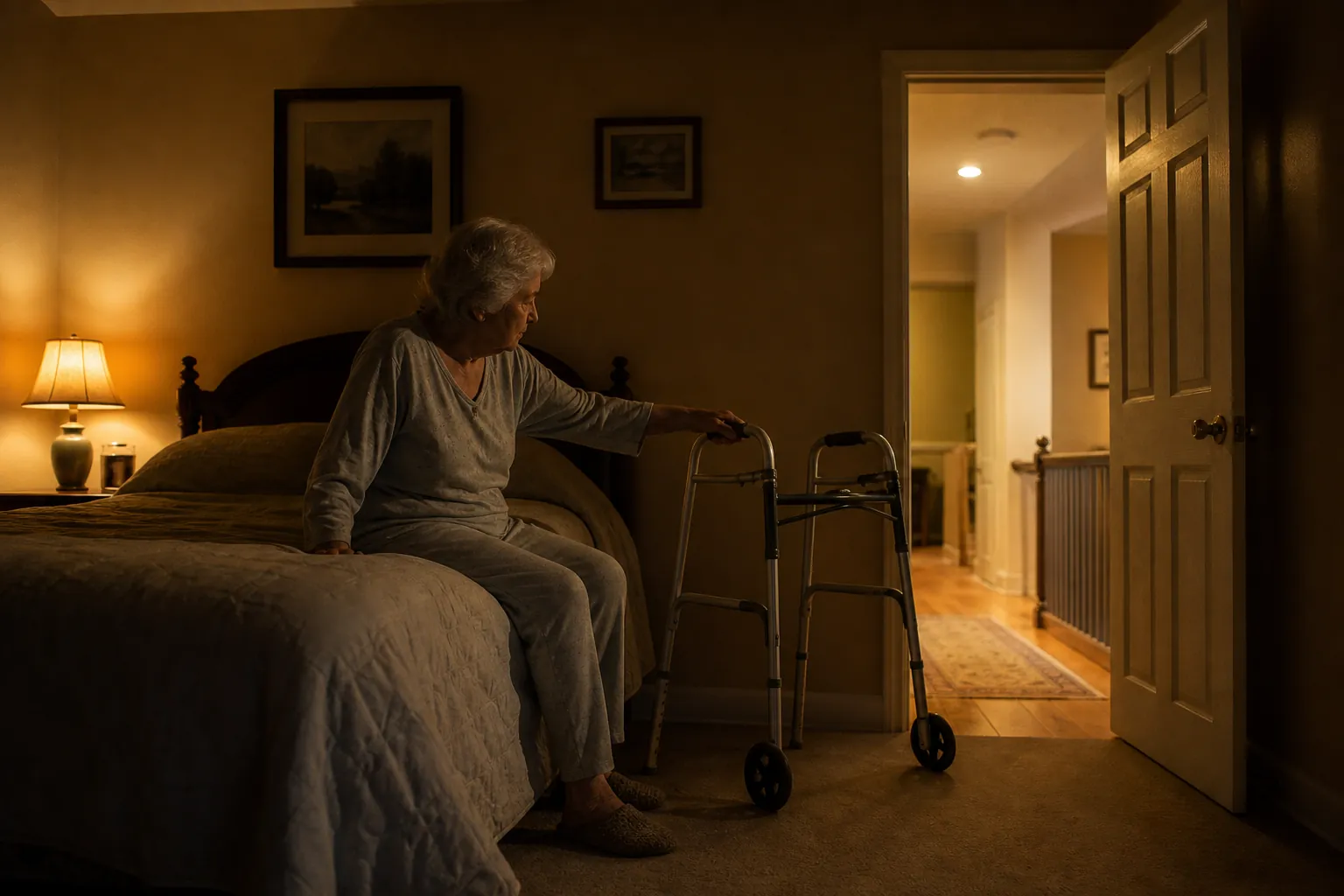
That first test matters because home fire escape planning is measured in minutes, not in good intentions. The U.S. Fire Administration says residents may have less than two minutes to escape once the smoke alarm sounds, and its home fire escape plan starts with drawing a floor map, marking two ways out of every room, keeping exits unblocked, choosing an outside meeting place in front of the home, and practicing the drill with everyone in the home [1].
For an older parent, “two ways out” is not a drawing exercise. It is a physical trial. A doorway that works for a steady adult at noon may not work for someone with a walker at 2 a.m. A window that looks like an exit may be painted shut, too high, or impossible to unlock with arthritic fingers. A hallway that seems clear in daylight may hold the laundry basket, oxygen tubing, a rug edge, and the walker your parent parks too far from the bed because it is “in the way.”
Walk the home from the sleeping area outward
Do not begin at the front door. Begin where your parent sleeps, because that is where confusion, darkness, hearing loss, stiffness, and urgency are most likely to meet at the same time. Bring paper, a tape measure if you have one, the walker or wheelchair your parent actually uses, and the person who usually helps with the home—not just the relative who is best at filling out forms.
The first pass is simple: draw the rooms and doors. The second pass is the one that makes the plan useful: stand in each room and mark the exits your parent can actually use. USFA specifically advises people who use a walker or wheelchair to check all exits and make sure they can get through the doorways [2]. That means the walker goes through the route during planning, not after an alarm has made the choice for everyone.
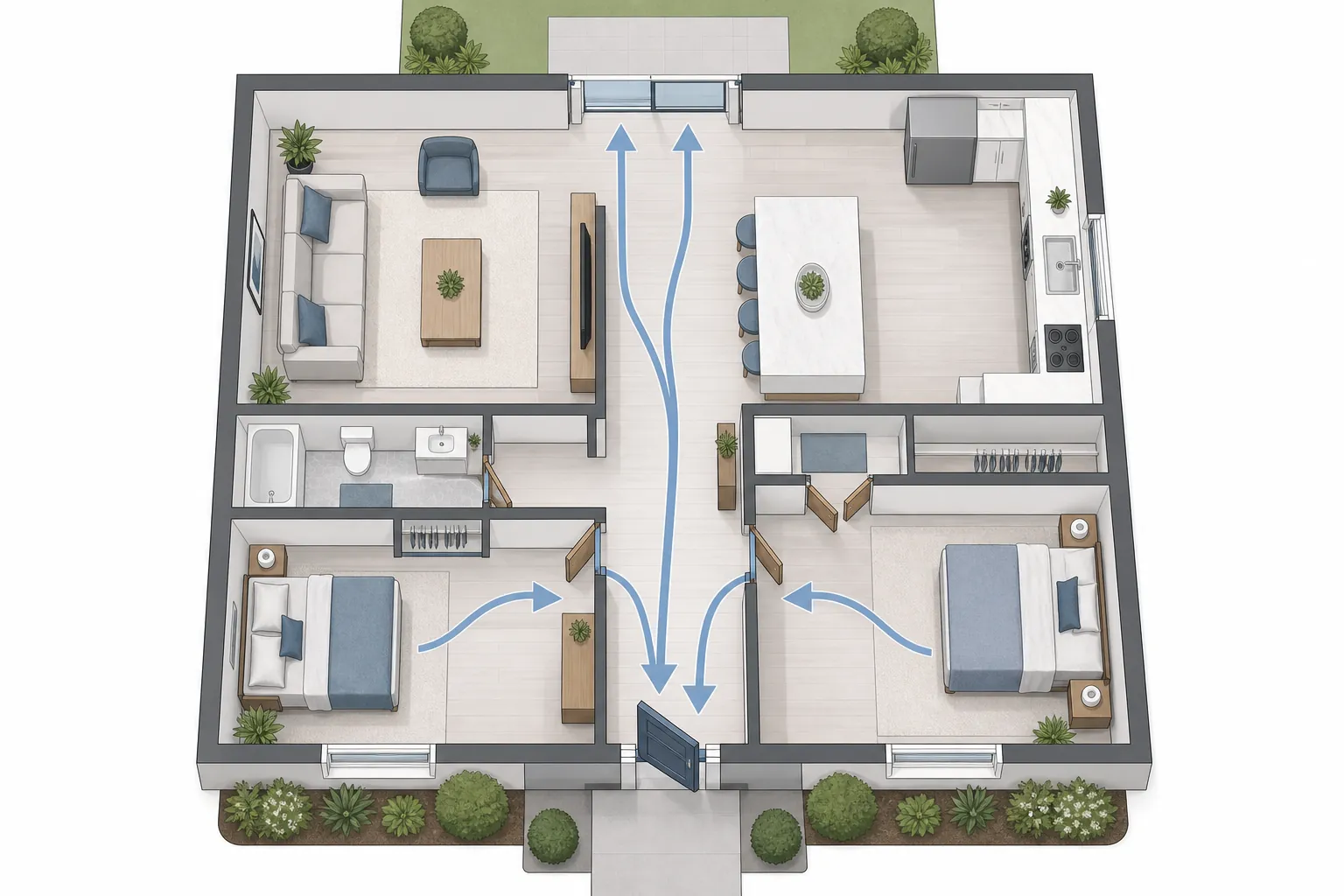
Use the first walkthrough to make a rough map, not a pretty one. A wobbly sketch is fine if it forces real decisions. For every room your parent uses, write down:
- Exit 1: the normal way out, usually a door into a hall, living room, garage entry, or exterior doorway.
- Exit 2: the backup, which may be another exterior door, a sliding door, or a window only if it is realistic for your parent and helpers.
- The mobility test: whether the walker, wheelchair, cane, or transfer path fits without lifting, folding, or turning sideways in a panic.
- The nighttime test: whether your parent can find glasses, hearing aids, shoes, phone, mobility aid, and the door without crossing the room blindly.
- The blockage test: what must be removed, relocated, unlocked, repaired, or labeled before the route counts.
The bedroom or main sleeping area
Stand beside the bed and look at the route from your parent’s eye level. If they sleep in a recliner, start there. The question is not whether the room is tidy. The question is whether a half-awake person can move through it in smoke, noise, and low light.
Put the walker, cane, wheelchair, or transfer pole where it is reachable from the sleeping position. If your parent uses glasses, keep them in the same bedside spot every night. If they need hearing aids to understand instructions, decide where the hearing aids and spare batteries sit overnight. If a small dose of medication must travel with them, do not leave the location vague; write the location down and confirm it with the person who manages medications. This article is not medical advice, and medication decisions should be confirmed with the clinician or pharmacist who knows your parent’s prescriptions.
Now test the door. Open it fully. Roll or walk through it using the same device your parent uses at night. Watch the turn into the hallway. Many plans fail at the turn, not at the doorway: the walker catches the dresser, the wheelchair cannot clear the laundry hamper, or the door swings into the exact space needed to pivot.
Then test the backup route. If the backup is a window, open it with the people and tools that would be present at night. If your parent cannot open it, cannot climb through it, or would need a helper who lives across town, it is not a usable independent exit. It may still matter as a rescue location—somewhere to close the door, call 911, and signal from a window—but it should not be written as if your parent can evacuate through it alone.
The hallway and bathroom
Hallways collect the small things families stop seeing: shoes, pet bowls, folded walkers, oxygen tubing, bags waiting to go to the car, and rugs that curl at the edge. Remove or relocate anything that narrows the route. If the bathroom is between the sleeping area and the exit, test the door swing and the turn outside it. A bathroom door left open at night can become a barricade if it blocks the hallway.
If your parent gets up frequently at night, do not build a plan that assumes they will be in bed. Walk the route from the bathroom back to the exit. If they use a bedside commode, make sure it does not block the mobility aid or the bedroom door.
The kitchen, living room, and usual daytime chair
Repeat the same test from the chair where your parent spends the most time. The daytime route may be different from the bedroom route. Recliners, side tables, charging cords, throw rugs, and pet gates often sit exactly where a walker needs to turn. If your parent naps in the living room, this is a second sleeping area for planning purposes.
Check every exterior door that appears on the map. Can your parent unlock the deadbolt? Is there a storm door that sticks? Does the sliding door require force they no longer have? Is there a step down to a patio that turns the walker sideways? If the family’s plan says “go out the back,” the back exit has to work with the actual body using it.
Stairs, elevators, and apartments
If your parent lives in a multi-story home or apartment building, mark the stair route clearly. USFA’s older-adult fire safety guidance says to use the stairs instead of an elevator during a fire [2]. If stairs are not realistic for your parent without help, the plan must say who helps, where your parent waits if the stair route is blocked, and how emergency responders or building staff will know where they are.
For an apartment, write down the unit number, stairwell location, building entrance code if appropriate, and the outside meeting place. The meeting place should be in front of the home or building, consistent with USFA’s home escape plan guidance, because “somewhere outside” is not specific enough when family and responders are trying to account for someone quickly [1].
Decide what counts as a usable exit
A usable exit is not merely visible on the floor plan. For an older parent, it should meet all of these conditions:
| Exit test | What to check in the home | Decision to write down |
|---|---|---|
| Clearance | Walker, wheelchair, cane, oxygen tubing, or caregiver standing beside the parent can move through the route. | Usable as-is, usable after moving items, or not usable. |
| Hands and strength | Locks, knobs, sliding doors, window latches, storm doors, and garage doors can be opened under stress. | Repair, replace, leave unlocked only if safe and intentional, or choose another route. |
| Night visibility | Parent can find glasses, mobility aid, shoes, phone, and the door from bed or recliner. | Bedside staging location and any night-light or tactile marker needed. |
| Sound and alerting | Parent can detect the smoke alarm or has an added alerting device such as a strobe or bed shaker if needed. | Who maintains batteries and tests devices. |
| Helper reality | The person assigned to help can arrive fast enough or is already in the home or nearby. | Name, phone number, key access, and backup helper. |
| Outside finish | Parent can get to the exact meeting place without crossing an unsafe path or waiting in the doorway. | Meeting place in front of the home or building. |
This is where a family may need to be blunt. If the second exit from a bedroom is a window your parent cannot open or use, do not pretend it is an evacuation route. Mark it as a rescue signal point or choose a different sleeping location if the home layout allows a safer route. Moving a bed to a room with a better exit is a family decision, not a checklist item, but it is often more honest than inventing strength or speed your parent does not have.
Build the support network before you need it
After the route is mapped, name the people. Not “the kids.” Not “a neighbor.” Names, phone numbers, distance, keys, and physical role. Ready.gov advises older adults to create a support network and says at least one person should have an extra key, know where emergency supplies are kept, and know how to use lifesaving equipment [3].

The extra-key point is small until it is not. A sibling 45 minutes away may be excellent at organizing appointments and useless for opening the door during the first few minutes of an emergency. A next-door neighbor with a key may matter more than the most devoted adult child across town. The plan should say who can enter, who can physically assist, and who calls 911 if the parent cannot.
Write the support network in roles:
- Primary nearby helper: the person most likely to reach the home quickly or already be nearby.
- Extra-key holder: the person who can enter without breaking a door or waiting for the parent to unlock it.
- Equipment helper: the person who knows how to handle oxygen equipment, a wheelchair, a stair chair if one exists, or other lifesaving equipment used in the home.
- Communication lead: the person who contacts family and tracks where the parent went after leaving the home.
- Backup helper: the person who takes over if the primary helper is at work, asleep, traveling, or unreachable.
If a helper has agreed only in a general way, have the real conversation. Can they lift? Should they lift? Are they comfortable opening the lockbox? Do they know where the go-bag is? Do they know whether your parent hears the smoke alarm? Can they manage the dog while helping your parent through the door? A support network that avoids these questions usually leaves the closest person to improvise under pressure.
AARP also recommends choosing an out-of-state contact as a communication hub because local lines can become congested during regional emergencies [5]. For a home-fire plan, that person may not help with the physical exit, but they can be the one family members call after the parent is outside, at a neighbor’s home, or transported elsewhere.
Make alarms and nighttime cues fit the parent, not the other way around
A smoke alarm only helps if your parent can notice it and act on it. If hearing loss is part of the household, ask whether the alarm is loud enough from the bedroom with the door closed, with hearing aids out, and with the television, fan, or oxygen equipment running. USFA’s older-adult fire safety guidance includes smoke alarms with strobe lights or bed shakers for people who are deaf or hard of hearing [2].
Do not leave sensory adaptations as a shopping note. Assign maintenance. Someone should know when batteries are changed, whether hearing-aid batteries are in the bedside or go-bag supply, and whether the parent actually wakes to the device. The six-month drill is a good time to check this, but the first check belongs in the initial walkthrough.
Pack the go-bag after the exit route is decided
The go-bag is important, but it should not swallow the plan. In a home fire, the first job is getting the person out. Pack the bag and keep it where it does not block the route. If the bag is so heavy that your parent cannot carry it and the helper cannot manage it while assisting, it belongs in a different format: a lighter grab bag near the exit and a larger supply bin elsewhere.
Medication guidance varies by source and situation. The Red Cross recommends at least a 30-day supply of medications for older adults, while AARP’s caregiver emergency guidance includes at least three days of medications in a portable kit [4][5]. Treat that as a planning range, not a universal prescription. Ask the prescriber or pharmacist what can be safely stored, how refills work, and which medications cannot sit in a hot car, garage, or long-term bag.
For many older adults, the useful emergency bag is not glamorous. It is practical and a little personal:
- Current medication list, pharmacy name, prescriber names, allergies, and key diagnoses.
- A medication supply plan that follows medical and insurance rules, with dates for rotation.
- Backup glasses, hearing-aid batteries, dentures or denture supplies if used, and chargers for essential devices.
- Durable medical equipment notes: wheelchair size, oxygen supplier, CPAP information, battery needs, or mobility-device instructions.
- Incontinence supplies, wipes, gloves, and a change of clothing.
- Copies of medical, legal, and insurance documents in a waterproof bag.
- Emergency contacts, the out-of-state contact, and support-network names.
- A small flashlight, spare batteries, and basic comfort items your parent will actually use.
Ready.gov, the Red Cross, AARP, and AgingCare all support including disability-specific supplies, documents, medications, batteries, backup glasses or hearing supplies, and personal-care items in older-adult emergency planning [3][4][5][6]. The legal-document portion is not legal advice. If your family is also sorting out powers of attorney, advance directives, or decision-making authority, use the emergency packet as a prompt to review the legal steps when an elderly parent loses capacity with a qualified professional.
Practice the drill, then fix what slowed it down
A plan is not finished when the worksheet is filled out. It is finished when your parent and the helpers have walked it. USFA includes practicing the home fire drill with everyone in the home as part of the escape plan [1]. The Red Cross recommends reviewing and refreshing the plan and supplies every six months, and AARP recommends practicing the evacuation drill every six months and reviewing kit contents every three to six months [4][5].
Do the first drill slowly and respectfully. This is not a race and not a test of whether your parent is “trying hard enough.” It is a test of the home, the route, and the family’s assumptions. Let your parent use the same shoes, walker, glasses, and hearing setup they would have at night. If they normally lock the bedroom door, keep that habit in the test. If they sleep with the television on, account for that sound. If the helper usually enters through the side door, make that the drill entry.
During the drill, one person should observe instead of coaching every move. Note where the plan slows down:
- Did your parent hear or see the alarm cue?
- Could they reach glasses, hearing aids, shoes, phone, and mobility aid?
- Did the walker or wheelchair catch on furniture, rugs, door frames, cords, or thresholds?
- Did a lock, latch, sliding door, or storm door take too long?
- Could the helper get in with the key or lockbox code?
- Did everyone know the exact outside meeting place?
- Was the go-bag reachable without blocking or delaying the parent’s exit?
Afterward, fix the slow parts while everyone still remembers them. Move the hamper. Change the bedside setup. Replace the sticking lock. Put the walker on the correct side of the bed. Give the key to the person who can actually arrive. Add the next drill date to the calendar before the family leaves the house.
One-page evacuation worksheet for an older parent’s home
Print this as one page if you can, or copy it into a shared family document and keep a paper copy in the home. The point is not to create a perfect form. The point is to keep the decisions where helpers can find them.
| Plan item | Write the decision here |
|---|---|
| Parent’s name and home address | |
| Main sleeping location | Bedroom, recliner, or other location: |
| Bedroom Exit 1 | Route, door/lock notes, clearance problems: |
| Bedroom Exit 2 or rescue signal point | Route or window location, what is realistic, who helps: |
| Bathroom/nighttime route | Path from bathroom or bedside commode to exit: |
| Living room/daytime chair route | Route from usual chair or nap location: |
| Kitchen or dining route | Primary exit and backup exit: |
| Walker/wheelchair clearance problems | Doorways, turns, rugs, cords, thresholds, furniture: |
| Alarm and sensory supports | Smoke alarm, strobe, bed shaker, hearing-aid battery location, who tests: |
| Bedside staging | Glasses, shoes, phone, mobility aid, medication note: |
| Outside meeting place | Exact place in front of home or building: |
| Primary nearby helper | Name, phone, distance, physical role: |
| Extra-key holder | Name, phone, key or lockbox location: |
| Backup helper | Name, phone, when they are available: |
| Equipment helper | Name, phone, equipment they know how to use: |
| Out-of-state contact | Name, phone, relationship: |
| Go-bag location | Location that does not block the exit: |
| Medication plan | Supply range, rotation date, prescriber/pharmacy notes: |
| Medical/legal document location | Waterproof bag or folder location: |
| Pet plan, if any | Who handles the pet without delaying parent’s exit: |
| Last drill date | |
| Problems found during drill | |
| Fixes assigned | Task, person responsible, due date: |
| Next six-month drill date |
The worksheet should live in the home, with the support network, and with the out-of-state contact if that person coordinates family communication. If anything changes—a new walker, a hospital bed, a different bedroom, a new lock, a helper who moves away—the plan changes with it. The useful plan is the one that still matches the house on an ordinary night.
References
- Home Fire Escape Plans — U.S. Fire Administration
- Fire Safety for Older Adults — U.S. Fire Administration
- Older Adults — Ready.gov
- Older Adults — American Red Cross
- Emergency Preparedness for Caregivers — AARP
- Prepare Elders for Emergencies — AgingCare
Related reading
Noticed something outdated or inaccurate on this page? Flag a correction. We review every report against CDC, NIA, and AARP HomeFit guidance before updating a page.
Part of the Fall Prevention section.