
STEADI: Intervene
Set Your Elderly Parent's Wildfire Evacuation Trigger Now
Older adults are over-represented in wildfire deaths largely because they wait to leave. Set the warning — not the order — as your parent's pre-committed evacuation trigger, and know how to respond if they refuse to go plus what the first 72 hours after evacuation require.
If you are trying to figure out how to help elderly parents prepare for wildfire evacuation, start with the decision that usually gets postponed: when does your parent leave? Not what goes in the bag. Not which flashlight is best. The trigger.
In Paradise, California, AARP’s one-year account of the Camp Fire reported 84 known fatalities; 78 were over 50, and the average age was 72. The lesson AARP drew was blunt: plan, prepare, practice — and do not wait to leave.[1] A Los Angeles County Aging & Disabilities post later described a similar age-skewed pattern in the January 2025 Los Angeles fires, reporting 31 lives lost, with 26 people over 65 or living with a disability.[2]
Those numbers are not here to turn this into disaster history. They are here because they make one family rule easier to defend while everyone is still calm: an evacuation warning is the trigger for an older parent to leave. An evacuation order is too late to begin the family debate.
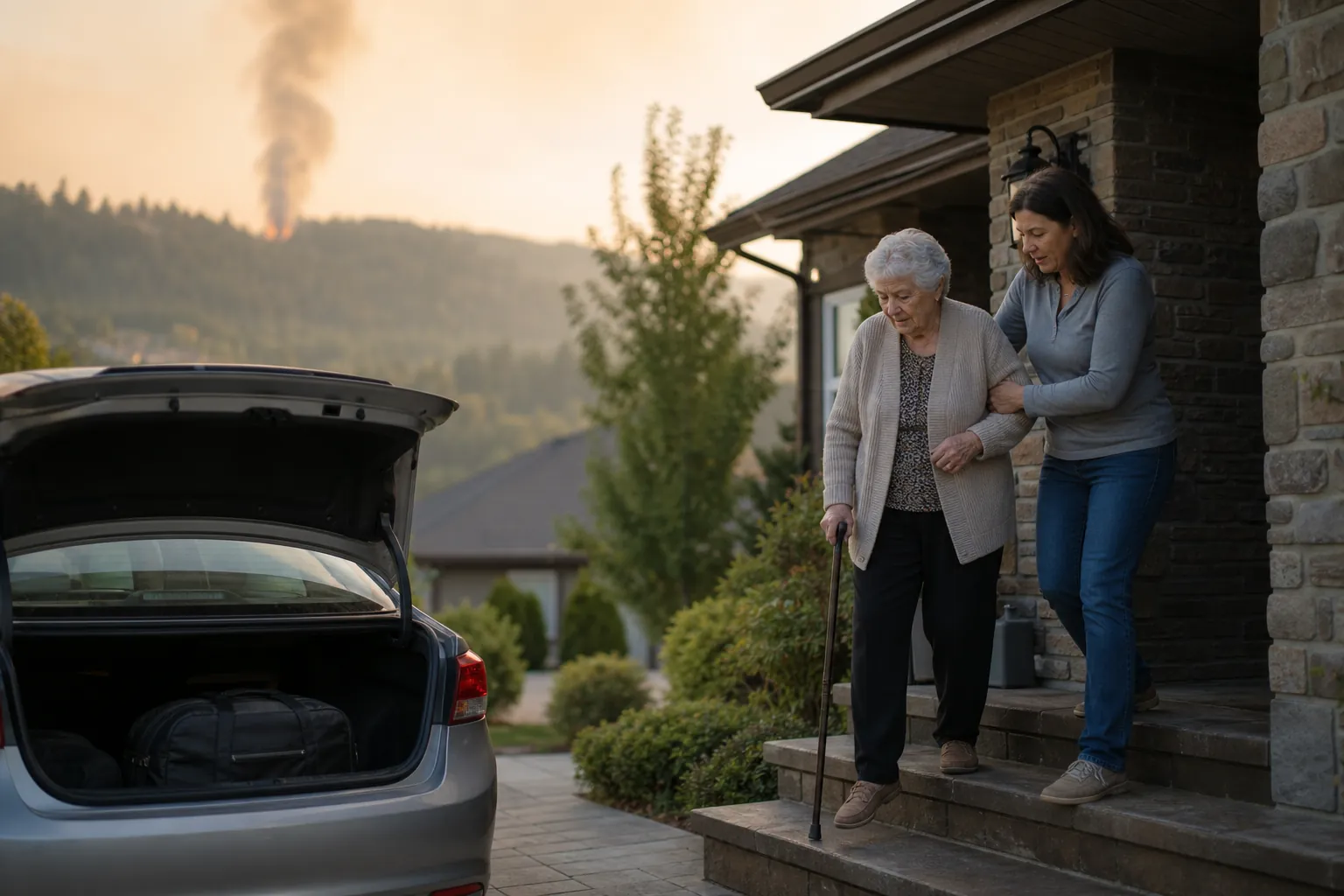
Agree now: “When the warning comes, we leave”
Alert language varies by county, so your family should read the exact wording used by your parent’s local emergency office. But for caregiving purposes, the difference is simple enough to act on:
| Local alert moment | What the caregiver should treat it as | What happens next |
|---|---|---|
| Evacuation warning | The leaving trigger for an older parent | Start transport, call the support person, move medications and essentials, and leave before roads, smoke, fatigue, and confusion narrow the choices. |
| Evacuation order | The point at which staying may no longer be safe | Follow official instructions immediately. Do not spend this moment renegotiating the plan. |
The sentence needs to be plain enough to survive bad reception and rising stress: “If your address is placed under an evacuation warning, we leave that day. We do not wait for the order.”
That does not mean your parent loses their say. It means the family moves the hard decision to a calmer day. Your parent can help choose where to go, who drives, what happens to pets, which neighbor gets called, and which comfort items matter. The part you stop reopening is whether a warning is serious enough.
Ready.gov’s older-adult preparedness framework starts with assessing needs, making a plan, and engaging a support network.[3] For wildfire evacuation, the support network has to be tied to a trigger. A neighbor who is “available if needed” is helpful. A neighbor who knows, “If the warning is issued and her daughter is still two hours away, I knock on the door and start the car plan,” is much more useful.
Why the warning matters more for older adults
For a healthy adult with a full gas tank, a packed car, and no mobility limits, “wait for more information” may feel like caution. For an older parent, waiting spends the very things evacuation requires: daylight, stamina, clear air, road access, medication timing, and the patience of whoever is coming to help.
A 2023 scoping review on wildfires and older adults found that studies consistently report significant numbers of older adults delaying evacuation. It also found that older adults lacking social support were more likely to die because they did not receive adequate warning or could not evacuate on their own.[4]
The Los Angeles County Aging & Disabilities post described the Eaton Fire as burning at one point at a rate equivalent to about seven football fields per minute, citing the California Commission on Aging, and said that made full evacuation of Altadena nearly impossible.[2] That is exactly why the family trigger cannot depend on one more update. A fire day can turn a normal errand — finding shoes, convincing someone to leave, loading a walker, locating the cat carrier — into the delay that decides whether the road is still usable.
Broader wildfire-risk work points in the same direction: older Californians are over-represented in wildfire risk, which matters because age often travels with slower mobility, chronic conditions, medical equipment, limited transportation, or living alone.[5] None of that makes an older parent helpless. It does mean the family should not use the same leaving threshold they would use for a thirty-year-old with no medications to manage.

Make the trigger usable before fire season
A trigger only works if everyone knows what it starts. Before fire season, write down the answer to these few questions and give the same version to your parent, the main caregiver, the backup driver, and one nearby person.
- Who tells your parent the warning has been issued?
- Who drives if the main caregiver is at work, asleep, out of town, or unreachable?
- Where does your parent go first: a specific relative’s home, a hotel zone outside the fire area, a designated shelter, or another pre-chosen location?
- What must leave with them in the first trip: medications, glasses, hearing aids, phone and charger, mobility aids, identification, insurance cards, key documents, pet supplies, and comfort items?
- Who is allowed to help with the pets, the door lock, the thermostat, the medical device, or the last look around the house so your parent is not trying to do it all?
- What exact sentence will the family use if your parent says, “Let’s wait”?
The full route map, equipment list, oxygen planning, and mobility-device transport details belong in a broader plan. If those pieces are not settled yet, use your family’s wildfire plan and review senior wildfire evacuation tips for family caregivers. This article is narrower on purpose: the bag is not useful if the family loses the warning period arguing about whether to go.
Medication deserves one extra note because evacuation often breaks routines. The Red Cross advises older adults to keep a 30-day supply of medications, when possible, and to account for medical supplies in emergency planning.[6] If a 30-day supply is not realistic because of insurance limits, prescribing rules, refrigeration needs, or controlled medications, ask the clinician or pharmacist before fire season what the emergency workaround should be. Write that answer down.
When the warning arrives, do not reopen the vote
The first call should not sound like a question. “Mom, your area is under an evacuation warning. This is the trigger we agreed on. I’m starting the plan now.”
Then move through actions in the order that reduces delay:
- Confirm the alert through the county emergency source your family chose in advance.
- Start transportation immediately: you, the backup driver, a neighbor, or the arranged service.
- Tell your parent the destination and the first small task: shoes on, medications into the bag, phone on the charger until the driver arrives.
- Call the support person who can help with the part your parent is most likely to use as a reason to stay, such as pets, locks, plants, mail, refrigerator contents, or a medical device.
- Send one message to the family group with the plan and destination so your parent is not fielding multiple emotional calls.
If you are coordinating from another town, your job is not to narrate the fire. Your job is to activate the person who can physically help. A warning can vanish into an hour of phone calls if every sibling asks the same questions and no one calls the neighbor with the spare key.
Keep the conversation small. Older adults who are already conserving energy do not need a lecture on fire behavior. They need a next action that does not feel like being managed by a committee.
If your parent says no
Refusal is not rare, and it is not always irrational. Home can mean memory, control, privacy, pets, medical routines, and the feeling of not being a burden. The caregiver’s mistake is to treat refusal as the moment to start a moral argument. The better response is to use the script you agreed on before pride, smoke, and fear are all in the room.
| What your parent says | A respectful response that still moves |
|---|---|
| “Let’s wait for the next update.” | “I know you want more information. The warning is the information we agreed to use. We are leaving now, and we can keep checking updates from the car.” |
| “The road is still open.” | “That is why this is the safest time to go. We leave while the road is open, not after everyone is trying to use it.” |
| “I don’t want to be a burden.” | “Leaving early is the least burdensome option. It lets us use the plan instead of needing a rescue.” |
| “I’m not leaving my pet.” | “The pet is part of the plan. I’m calling the person we chose for that job while you get your shoes and medications.” |
| “I’ll go later.” | “Later is the part we decided not to risk. You can choose the sweater and which bag comes, but the leaving starts now.” |
Bring in trusted support without turning it into a siege. A doctor, neighbor, clergy member, longtime friend, or building manager can reinforce the same trigger if your parent has agreed beforehand that this person may be called. The message should be calm and consistent: “The warning is active. Your family is following the plan you chose. It is time to go.”
Do not shame them with disaster stories. Do not threaten abandonment. Do not pretend you have legal authority you do not have. If an evacuation order is in effect, conditions are deteriorating, or you believe your parent is in immediate danger and still will not leave, contact local emergency services or the local emergency management number for guidance. That is different from trying to overpower them yourself.
The strongest refusal plan is made before refusal happens. Ask in advance: “If there is a warning and you are scared to leave, who do you want me to call to help you make the move?” That question preserves dignity. It also keeps the family from discovering, under smoke, that the only person your parent will listen to is not on anyone’s contact list.
The first 72 hours are still part of the evacuation
Reaching a shelter, hotel, or relative’s home is not the end of the risk for an older parent. It is the start of a strange environment with different floors, different lighting, different bathrooms, disrupted sleep, disrupted medication timing, smoky air, and a strong temptation to go home too soon.
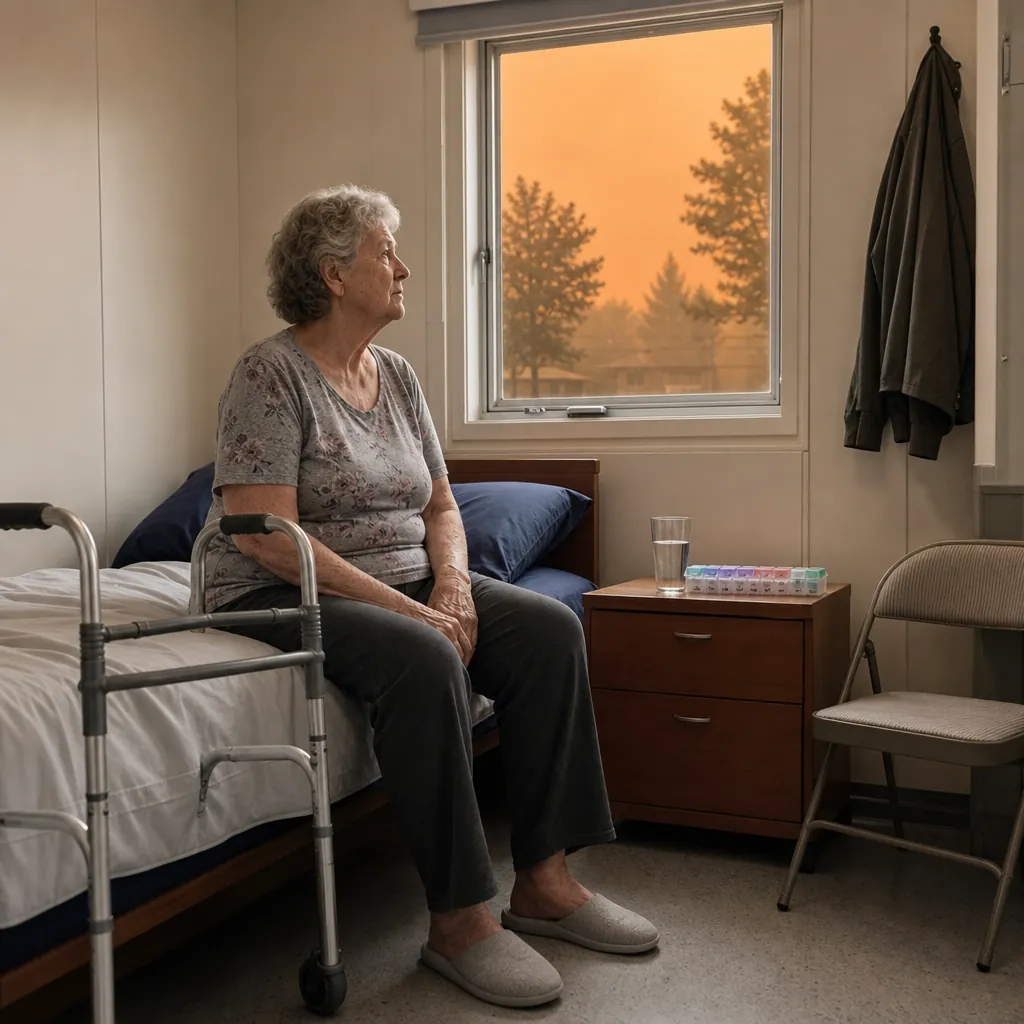
Medication continuity
Within the first hour after arrival, put medications somewhere visible but safe, not buried in the evacuation bag. Confirm what was taken that day, what is due next, and whether anything was left behind. If pills are normally sorted in a weekly organizer, take a photo of the organizer and the prescription labels in case another caregiver needs to step in.
For refrigerated medication, oxygen, dialysis, wound care, insulin supplies, or anything that cannot simply sit in a suitcase, make the first destination choice around care continuity, not convenience. If the chosen hotel or relative’s home cannot support the medical need, move again before your parent is exhausted rather than trying to improvise at midnight. For power-related medical-device planning, the same logic applies as in a power grid emergency for older adults or a heat wave power outage: the backup has to be usable where the person actually is.
Fall risk in a room your parent does not know
Most caregivers notice the obvious hazards at home. Fewer notice how much an older adult relies on memory: the number of steps to the bathroom, where the bed edge is, how far the nightstand sits from the mattress, which doorway has a threshold. In a shelter or guest room, that memory is gone.
- Create a clear path from bed to bathroom before your parent lies down.
- Put the walker, cane, glasses, hearing aids, phone, water, and medications in the same reachable zone.
- Use a nightlight, bathroom light, or hallway light if the space is unfamiliar.
- Move cords, loose bags, pet items, shoes, and low furniture out of the walking path.
- Check the shower or tub before it is used. A slick hotel bathroom can become the most dangerous part of a successful evacuation.
- If your parent is more tired than usual, treat that as a fall-risk warning, not just a mood problem.
The same practical thinking used in a post-earthquake fall prevention checklist applies here: the building may be standing, but the person is moving through an environment their body has not mapped yet. If you have time before fire season, also look at the home bedroom with the same lens by clearing the exit path from bed; a bedroom safety checklist for older adults can make the first minutes of leaving less chaotic.
Smoke symptoms and fatigue
After evacuation, watch for coughing, wheezing, shortness of breath, chest discomfort, unusual confusion, dizziness, severe headache, or unusual sleepiness. Some symptoms may come from smoke exposure; some may come from stress, dehydration, missed meals, missed medication, or poor sleep. The cause matters less in the moment than the response: call your parent’s clinician, nurse line, urgent care, or emergency services if symptoms are concerning or worsening.
Do not make your parent prove they are “fine” by managing stairs, long shelter lines, crowded bathrooms, or repeated trips to the car. Evacuation takes more out of people than it appears to from the outside. A parent who was steady at breakfast may be unsteady after hours of alerts, packing, smoke, traffic, and unfamiliar noise.
Safe return
The urge to go back can be intense. Pets, photographs, medications, freezers, doors, neighbors, and the simple need to see the house can pull hard. Still, return should wait for official clearance and a realistic look at conditions: power, water, smoke, ash, road access, downed lines, unstable trees, spoiled food, and whether your parent can safely sleep, bathe, use the bathroom, and take medications there.
If the home was damaged, or if a tree, utility problem, or access issue creates a new hazard, treat the return as another emergency decision rather than a sentimental errand. A senior-specific response plan, like what to do when a tree falls on an elderly parent’s home, can help keep the next steps from becoming another improvised family argument.
The decision you can make before the fire makes it for you
A caregiver cannot control the wind, the alert timing, the road conditions, or a parent’s fear of leaving home. What the family can control is whether the first serious alert starts action or starts bargaining.
Decide now that the evacuation warning is the leaving trigger. Choose the driver, the backup, the destination, the pet plan, the medication plan, and the person your parent trusts if they hesitate. Then, when the warning comes, you are not asking an older parent to make a new decision under smoke and pressure. You are helping them follow the decision they already made.
References
- Paradise Camp Fire A Year On, AARP.
- Lessons from the January Wildfires, Los Angeles County Aging & Disabilities, February 2026.
- Older Adults, Ready.gov.
- Wildfires and Older Adults: A Scoping Review, 2023.
- How we analyzed the risk wildfires pose to older people, CalMatters.
- Emergency Preparedness for Older Adults, American Red Cross.
Related reading
Noticed something outdated or inaccurate on this page? Flag a correction. We review every report against CDC, NIA, and AARP HomeFit guidance before updating a page.
Part of the Fall Prevention section.