
STEADI: screen
Heat Dome Fall Prevention for Elderly Parents
Learn how a heat dome specifically increases fall risk in older adults through a dehydration-to-dizziness cascade, and get a numbered warning-sign guide with a crisis decision tree for knowing when to call 911.
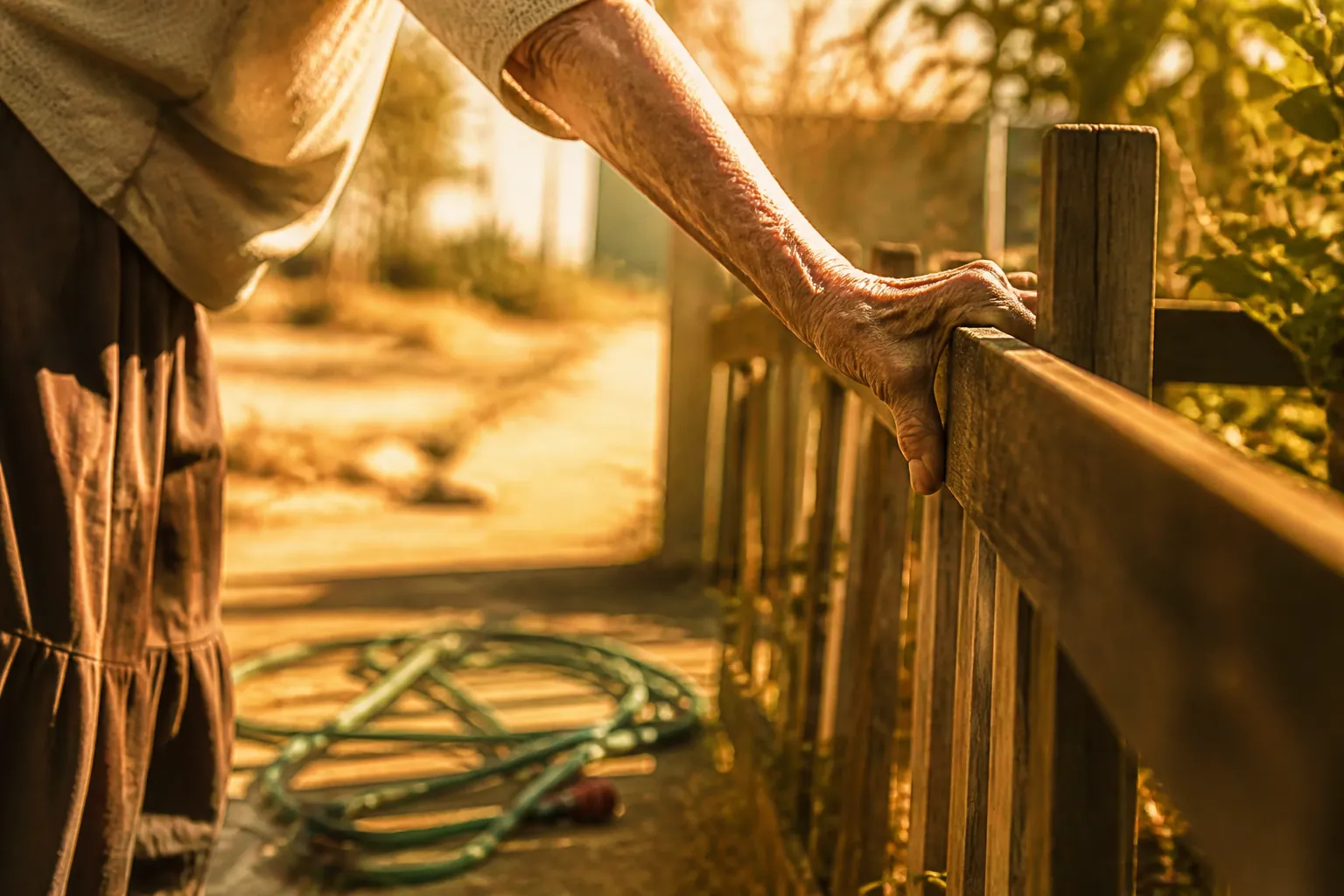
The heat dome story that stays with me is not an abstract warning about high temperatures. It is the report of an 83-year-old woman who fell in her garden and could not get up, in a month when The Washington Post counted at least 70 deaths linked to July heat domes in the United States; the paper also noted that the true toll may not be known for some time.[1]
That is the ordinary danger adult children worry about: not a dramatic collapse on a sidewalk, but a parent stepping outside to water plants, crossing a hot garage, getting up too fast from a chair, or walking to the bathroom after a poor night’s sleep. During a heat dome, those routine moments can become fall events because the body is already working harder than usual.
The most useful heat dome safety tips for elderly parents are not just “drink water” and “stay cool.” Those are fine words, but they are too soft for the moment when your parent says, “I’m fine,” while sounding slower than usual on the phone. The better question is: what is heat doing to balance, thinking, blood pressure, strength, and reaction time right now?
Why A Heat Dome Raises Fall Risk
A heat dome is especially hard on older adults because the heat can last day after day, with little relief at night. Harvard Medicine describes this prolonged exposure, especially in homes without air conditioning, as one reason older adults are at such high risk during extreme heat; it also reports that adults over 65 account for more than 80% of roughly 12,000 annual heat-related deaths in the United States, citing Climate Central.[2]
The CDC says older adults do not adjust as well as younger people to sudden temperature changes, are more likely to have chronic medical conditions that change normal body responses to heat, and are more likely to take medicines that affect the body’s ability to control temperature or sweat.[3] That matters for fall prevention because sweating, thirst, blood pressure control, alertness, and leg strength are not separate issues when someone is overheated.
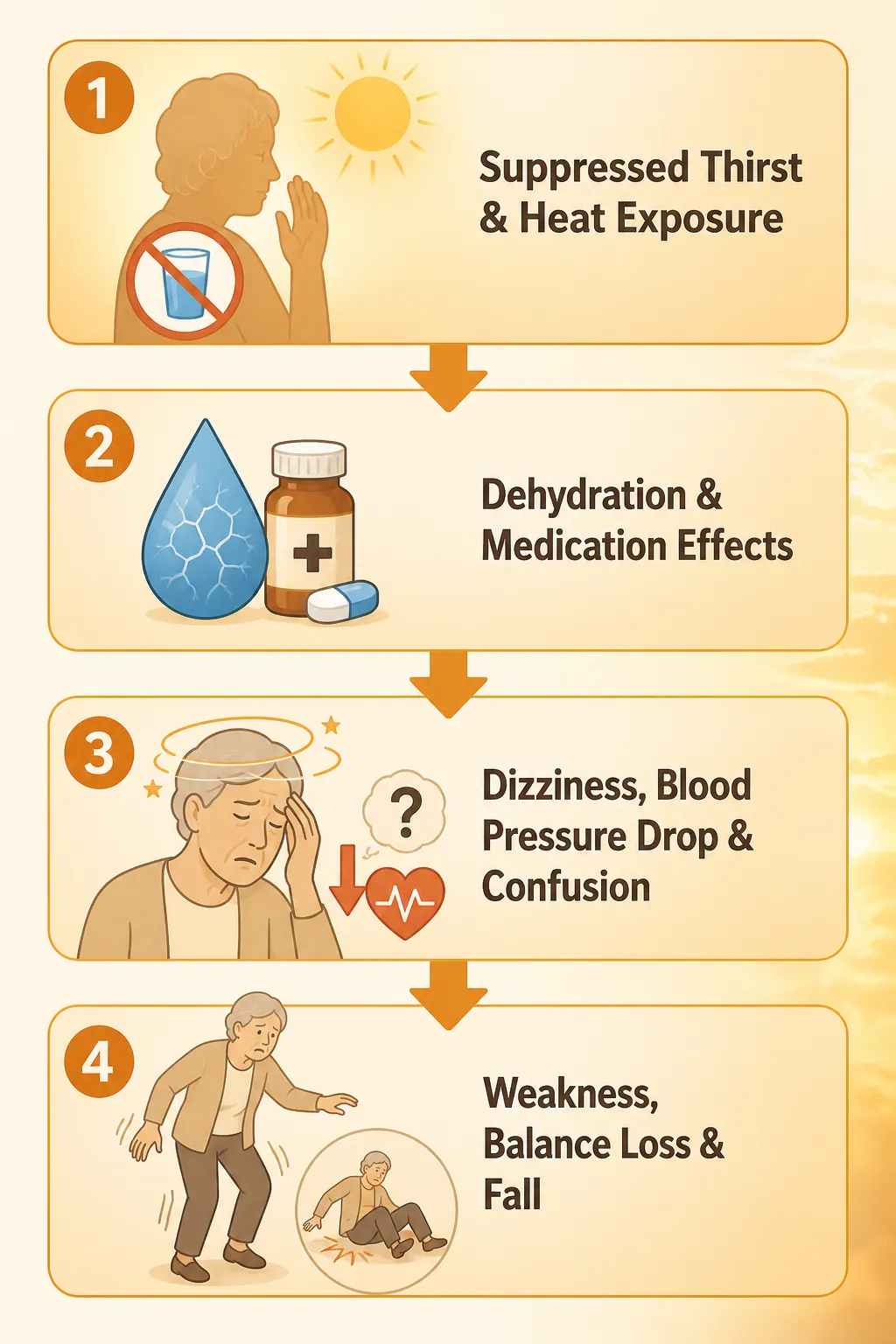
The fall chain often starts before anyone looks sick. Rush University notes that older adults may not feel thirsty until they are already dehydrated, and that the body holds less water with age.[5] So the parent who is not asking for water may still be drying out. The parent who says they “just don’t feel hungry” may also be drinking less. The parent who avoids the bathroom because it feels like too much effort may be cutting fluids on purpose.
Dehydration then pulls on several fall-risk levers at once. Injury Matters describes heat-related fall risk through hydration and cognition, reduced energy and reaction time, balance and blood pressure, and medication effects.[4] That framework is from Australia, so its local service guidance does not transfer neatly to a U.S. household, but the body mechanics do.
First comes thinking. A dehydrated older adult may become slower to answer, less organized, or unusually stubborn about a simple task. That does not mean every cranky conversation is a medical emergency. It does mean a change in clarity during extreme heat deserves attention, especially if the person is alone and still moving around the house.
Then comes blood pressure and balance. Heat and low fluid levels can contribute to dizziness or lightheadedness, especially when someone stands up. If your parent already uses a cane, walker, blood pressure medicine, diuretic, sedating medication, or medication that affects sweating or alertness, the margin gets thinner. The CDC specifically warns that some medicines can affect hydration and the body’s heat response, and it advises older adults to ask a doctor how heat may interact with their medications.[3]
Then come weakness and delayed reactions. Brown University Health connects dehydration with dizziness, weakness, confusion, and increased fall risk in older adults.[7] Oakley Home Access also notes that heat-related fatigue can slow reaction time during ordinary household activities, while humidity can make bathroom surfaces more slippery.[6] That is exactly how a small wobble becomes a hard landing: the foot catches, the hand reaches too late, the towel bar is not a grab bar, and the person is already overheated.
None of this means an older parent is fragile by default. It means the heat is adding load. A person who usually manages the garden, laundry, stairs, and shower may be safe on a normal day and unsafe during a run of hot days with poor sleep, reduced fluids, and medication side effects.
The Phone Check That Actually Helps
If you are checking from a distance, do not start with “Are you drinking enough water?” The answer will almost always be yes, or close enough to yes that the conversation dies. Ask questions that reveal function.
- Ask where they are sitting right now. If they are outside, in a garage, in a closed upstairs room, or near a sunny window, have them move before you continue the conversation.
- Ask what they drank since waking up. Listen for specifics, not confidence. “Coffee this morning” is not the same as steady fluid intake.
- Ask them to describe the room. Confusion, odd answers, or trouble following the conversation can be a heat warning sign, not just irritation.
- Ask whether they feel dizzy when standing. If they are already standing, tell them to sit before answering. Do not turn the check-in into a balance test.
- Ask about the last bathroom trip. Very dark urine, not urinating as usual, or avoiding fluids to avoid the bathroom can point toward dehydration.
- Ask what they are about to do next. Watering plants, taking out trash, showering, cooking over a hot stove, or going downstairs can wait until they are cooler and steadier.
On video, watch the little things. Are they pushing off the chair with more effort than usual? Are they leaning on furniture? Are they searching for words? Are they flushed, very sweaty, or oddly not sweating despite heat? The CDC lists warning signs of heat-related illness that include heavy sweating, cold or clammy skin, dizziness, headache, nausea, weakness, confusion, passing out, and very high body temperature, depending on the heat illness involved.[3]
In person, take over the environment before you lecture. Clear the walking path, get the hose off the ground, move the fan where it actually reaches them, put water within arm’s reach, and postpone the shower if they are already lightheaded. A shower can help cooling in some situations, but a hot, humid bathroom with slick flooring is a terrible place to discover that someone’s legs are weak.
Warning Signs That Fall Risk Is Rising
These signs matter because they show the heat is no longer just uncomfortable. It is affecting the systems that keep a person upright.
- New dizziness, faintness, or “woozy” feeling, especially after standing. Treat this as a fall warning, not a complaint to talk them out of.
- Confusion, unusual sleepiness, agitation, or trouble answering simple questions. The CDC includes confusion among serious heat-related warning signs.[3]
- Weak legs, shaky walking, furniture-walking, or needing more help than usual to get up from a chair.
- Heavy sweating, clammy skin, nausea, headache, or muscle cramps. These can appear before a fall, while the person is still insisting they can manage.[3]
- Very hot body, loss of consciousness, or passing out. These are emergency signs, not home-monitoring signs.[3]
- A recent stumble, slide, near-fall, or actual fall during the heat event. Even if nothing is broken, the next trip to the bathroom may be riskier.
- Medication or health changes that narrow the margin: diuretics, blood pressure medicines, sedating medicines, heart disease, diabetes, kidney disease, or any condition that makes heat regulation harder. The CDC advises older adults to review heat risks and medications with a clinician.[3]
Hackensack Meridian Health’s July 2026 guidance also emphasizes that older adults face higher danger in extreme heat because age, chronic conditions, and medications can interfere with the body’s ability to cool itself.[8] For a caregiver, that means a mild-looking symptom may deserve a faster response during a heat dome than it would on an ordinary warm afternoon.
Call 911 Or Cool At Home?
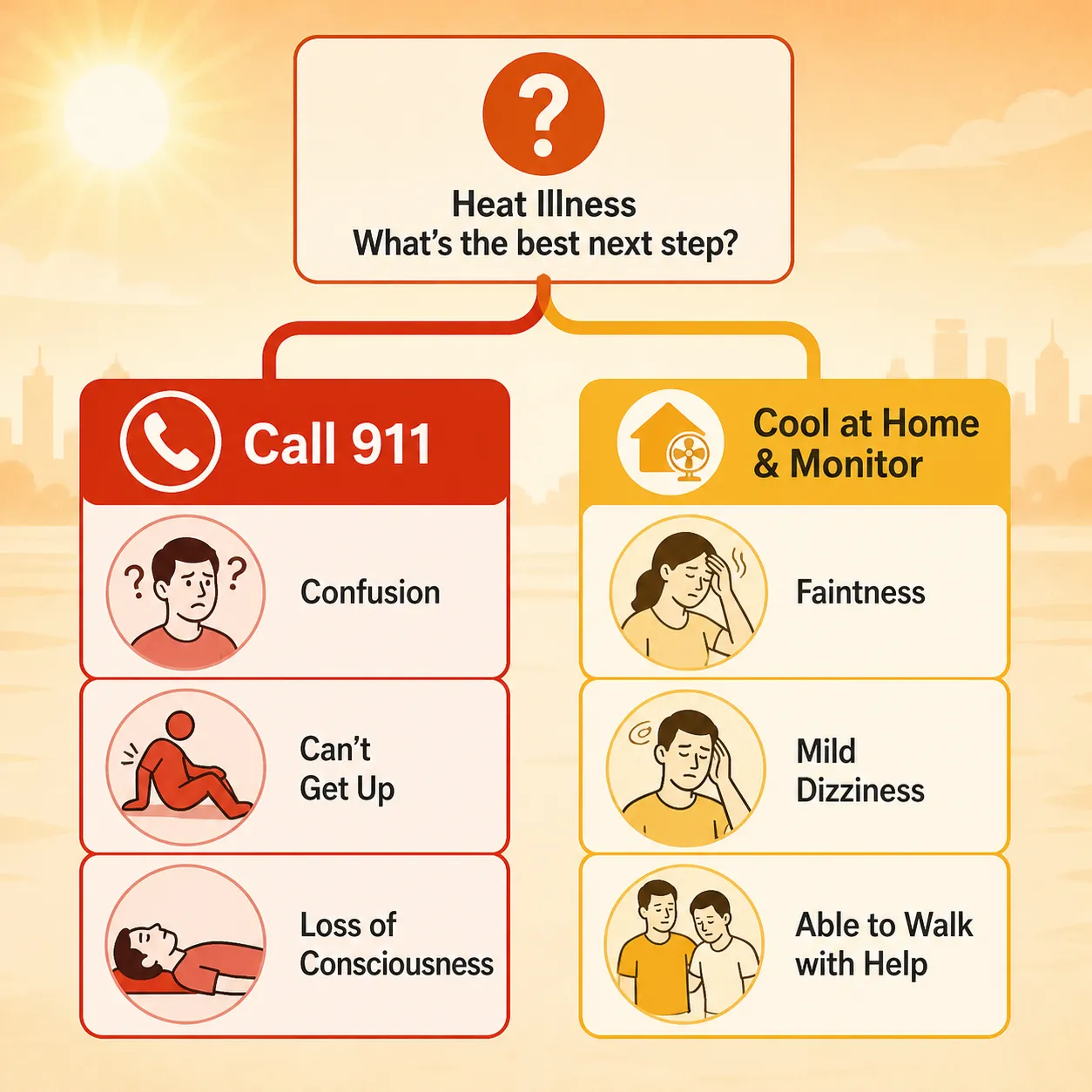
This is the part where politeness can get in the way. If your parent cannot get up, is confused, has passed out, or may have heat stroke, you are not “overreacting” by calling emergency services. You are responding to the situation you have.
| What You Notice | What To Do |
|---|---|
| They fell and cannot get up, may be injured, or are alone on the floor. | Call 911. Do not try to manage this by phone. |
| They are confused, fainted, lost consciousness, or are not responding normally. | Call 911. Move them toward cooling only if it is safe while help is on the way. |
| They have signs that may suggest heat stroke, such as very high body temperature, confusion, loss of consciousness, or hot skin. | Call 911. The CDC treats heat stroke as a medical emergency.[3] |
| They are dizzy, weak, nauseated, cramping, sweating heavily, or clammy, but alert, able to sit safely, and improving with cooling. | Move them to a cooler place, loosen clothing, encourage sips of water if they can drink safely, use cool cloths or a fan, and monitor closely. |
| They improve, but still need help walking or are not steady enough for the bathroom, stairs, shower, or outdoor tasks. | Keep them seated or lying down in a cooler area and arrange in-person help. Treat walking as the risk, not as proof that they are fine. |
| Symptoms worsen, do not improve, or you cannot tell what is happening. | Call 911 or local emergency services. Uncertainty during extreme heat is not a reason to wait. |
For cooling at home, keep it simple and supervised: move them to air conditioning if available, use fans only when they are helping rather than just blowing hot air, offer small sips of water if they are awake and able to swallow normally, apply cool cloths, and stop outdoor or bathroom tasks until they are steadier. If the home has no air conditioning, use a specific cooling plan rather than improvising; this guide to cooling seniors without AC while reducing fall risk is the next place to go.
If severe weather or a power outage is part of the heat dome, the fall problem changes again: dark rooms, dead phones, hot stairwells, spoiled routines, and nonworking medical equipment can all add risk. Use a severe weather safety checklist for seniors living alone and review power outage fall risks for senior caregivers before the outage becomes the emergency.
The hard line is this: during a heat dome, fall prevention is not only about rugs, grab bars, shoes, and night lights. It is also about catching heat illness early enough that dizziness, confusion, weakness, and a blood-pressure drop do not put your parent on the floor before anyone realizes the heat was already winning.
References
- The Post counted 70 deaths from July heat domes. The true toll may not be known. The Washington Post. July 26, 2026.
- The Effects of Heat on Older Adults. Harvard Medicine Magazine.
- Heat and Older Adults (Aged 65+). CDC.
- Supporting older adults to beat the heat: The impact of heat on falls risk. Injury Matters.
- Older Adults Face Extra Hazards in the Heat. Rush University.
- Senior Safety During Hot Weather. Oakley Home Access.
- How Seniors Can Stay Safe in Summer. Brown University Health.
- How Older Adults Can Stay Safe in Extreme Heat. Hackensack Meridian Health. July 23, 2026.
Related reading
Noticed something outdated or inaccurate on this page? Flag a correction. We review every report against CDC, NIA, and AARP HomeFit guidance before updating a page.
Part of the Fall Prevention section.