
STEADI: intervene
Evacuate or Shelter? How Fall Risk Shapes Your Storm Plan
When a tropical storm threatens, adult-child caregivers must decide whether to evacuate an aging parent or shelter in place. This guide helps you weigh fall risk against storm danger using a conditional four-factor decision framework.
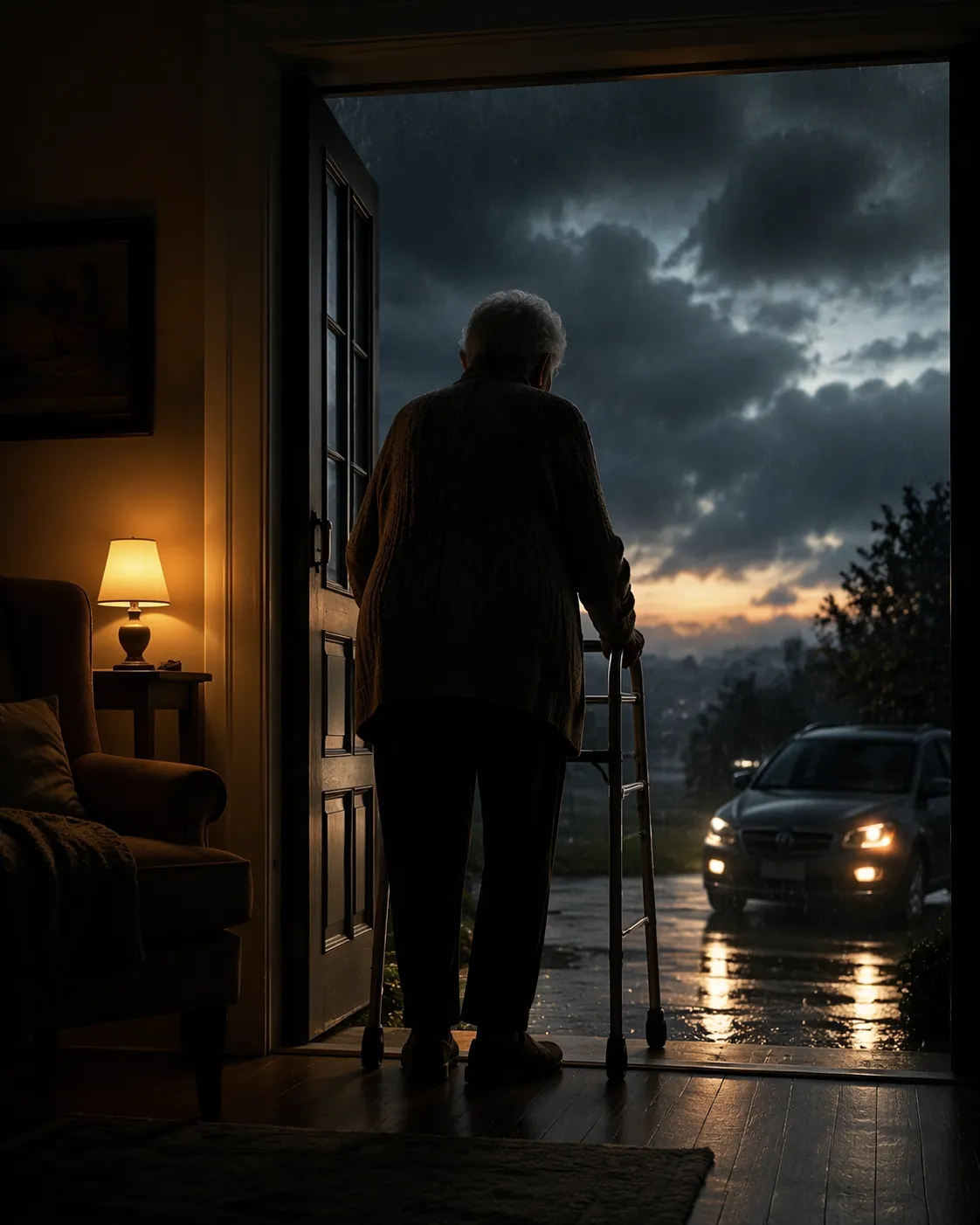
The hardest part of a tropical storm plan for an aging parent is not choosing between “safe” and “unsafe.” It is choosing which risk you can reduce fastest before conditions get worse. Evacuating can move your parent away from floodwater, storm surge, wind damage, and a house that may lose power. It can also put a person who already needs a walker, cane, or steady arm into a parking lot, a bus aisle, a shelter cot, an unfamiliar bathroom, and a nighttime route to the toilet with no usual handholds.
Staying home avoids the hazards of transit and strange buildings. It is not automatically the safer or more dignified choice. If the home is in a mandatory evacuation zone, has flood exposure, depends on electricity for medical equipment, or leaves the parent alone after dark during a power outage, “shelter in place” can become a polite name for being trapped.
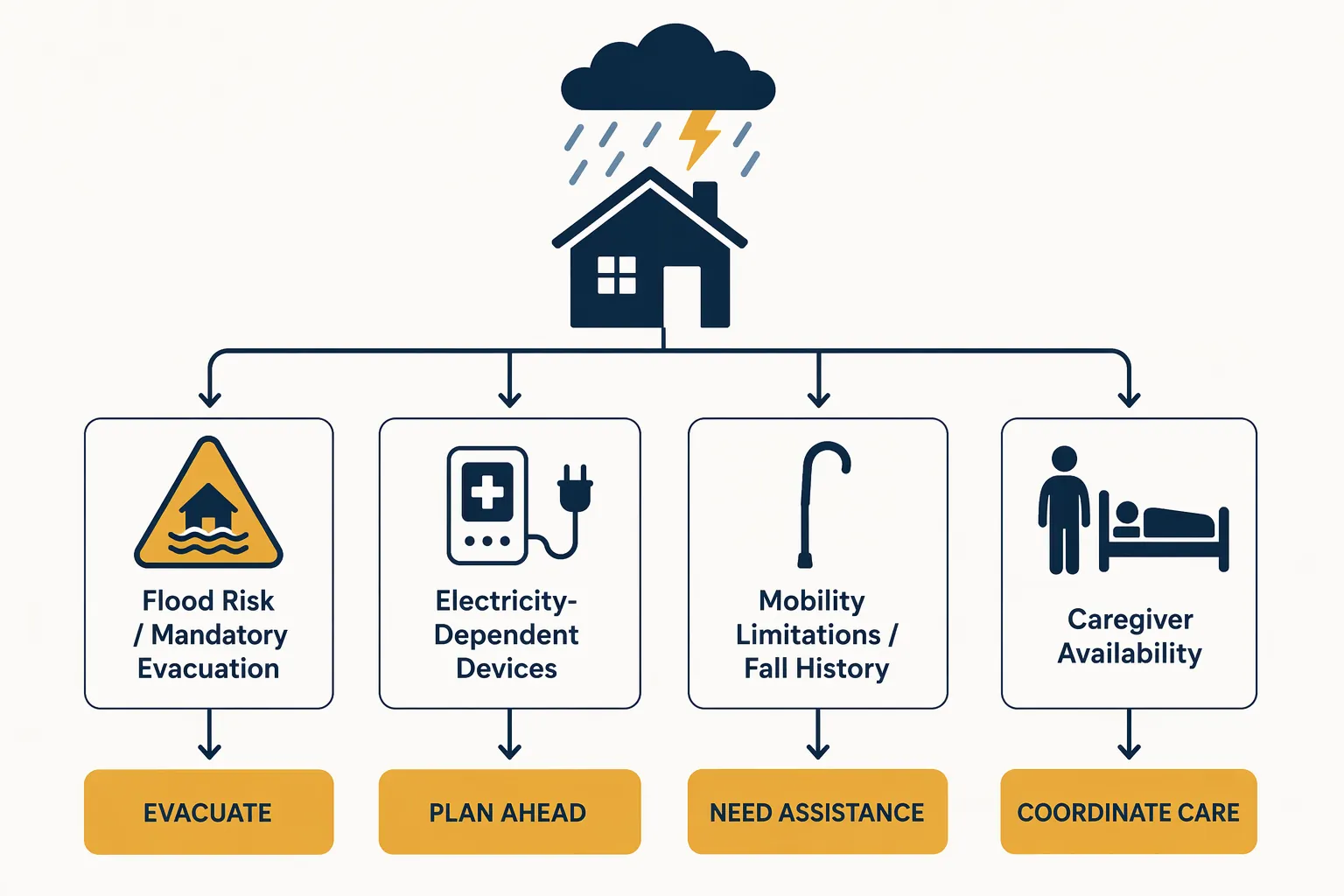
That is why the decision should start with four checks, in this order: mandatory evacuation zone or flood risk, electricity-dependent medical devices, mobility limitations or recent fall history, and whether a caregiver can physically stay with the parent. Fall risk matters at every point, but it should not be used as an excuse to ignore water. One senior-care article attributes to CDC that 71% of Hurricane Katrina victims were over age 60 and attributes to FEMA that nearly half of hurricane-related deaths involve drowning, often when evacuation is delayed; treat those figures as attributed unless you confirm them against the original agency sources. The warning is still the right one to hold in mind: waiting too long can make every later move more dangerous.[1]
Use the four checks before arguing about preference
Families often begin with the wrong question: “Does Mom want to leave?” or “Can Dad manage a shelter?” Those questions matter, but they belong after the non-negotiables. A parent’s preference cannot lower floodwater. A sibling’s confidence from three states away cannot keep a ventilator battery charged. A walker by the kitchen chair does not help if it gets packed last and ends up under luggage.
| Check | If the answer is yes | What fall risk changes |
|---|---|---|
| Mandatory evacuation zone or flood-prone location | Follow local emergency management instructions and leave early enough to move slowly. | Fall risk becomes a planning problem, not a reason to stay. |
| Electricity-dependent medical devices | Treat shelter choice and transportation as medical-continuity decisions. | A general shelter may not be the right destination. |
| Mobility limitations or recent fall history | Plan every transfer, bathroom route, and walking surface before leaving or staying. | The same storm plan may be unsafe for a parent who cannot rise without help. |
| No caregiver able to stay | Do not count on a shelter-in-place plan that depends on help no one can provide. | The biggest hazard may be the first nighttime trip after power fails. |
First override: evacuation orders and flood risk
If your parent is in a mandatory evacuation zone, the practical answer is not to debate whether a shelter bathroom is ideal. The answer is to leave early enough that your parent can move at their actual speed. Local emergency management, not a general article, controls evacuation zones, shelter openings, transportation options, and timing.
Flood risk deserves the same seriousness even before an order is issued. A one-story home, a low driveway, a neighborhood that floods at the entrance road, or a parent who cannot climb to a higher level changes the meaning of “we’ll wait and see.” Waiting may preserve routine for a few hours, but it can also turn a planned walk to the car into a carry, a rescue, or no exit at all.
For a parent with mobility or medical needs, check whether your county uses a special-needs or medical-needs shelter registration process. The American Red Cross advises older adults to plan for disasters around their specific support needs, including mobility, medical equipment, medications, and the help they may require; Ready.gov also directs older adults and caregivers to account for medical and assistive needs and to connect with local emergency management resources.[2][3] The details vary by county, and registration deadlines may close before a storm is at the door.
If flood risk is the main issue for your parent’s home, it may help to compare this decision with a more flood-specific framework in A Stay-or-Go Flood Evacuation Guide for Elderly Homeowners. The important point here is simpler: water outranks convenience. Once water is a credible threat, fall prevention shifts from “should we leave?” to “how do we leave without creating a fall on the way out?”
Second override: devices that need power
Electricity-dependent medical devices can turn a storm plan from a family preference into a medical continuity problem. Oxygen equipment, powered mobility devices, dialysis-related needs, refrigerated medications, CPAP machines, and other prescribed equipment each raise a different question: how long can the device or medication remain safe without grid power, and where can your parent reliably get support if the outage lasts?
This is where “we’ll go to a regular shelter if we have to” can be too vague. Some shelters are designed for the general public. Some communities designate special-needs shelters for people who need medical monitoring, electricity for medical equipment, or additional assistance. Red Cross and Ready.gov guidance both point older adults and caregivers back to local planning, because the right destination depends on local systems and individual needs.[2][3]
Before the storm is close, write down the device, power source, battery duration if known, prescribing clinician, supply vendor, and the phone number you would actually call at 9 p.m. If your parent uses equipment that changes the shelter choice, use a medical-needs plan rather than a regular storm checklist; How to Ensure Hurricane Preparedness for Seniors with Medical Needs covers backup power and special-needs shelter registration in more detail.
Mobility limits change the evacuation plan, not the evacuation order
A recent fall, a walker, poor balance, neuropathy, dizziness, low vision, or needing both hands to stand should not be treated as one combined label called “elderly.” These details decide who carries what, which entrance is usable, whether the parent can step into a vehicle, how many bathroom stops are realistic, and whether one adult helper is enough.
The mistake is letting mobility risk argue both sides without discipline. If leaving feels hard, the family says, “She might fall at the shelter.” If staying feels hard, the family says, “She might fall in the dark at home.” Both can be true. The job is to compare the real versions of each setting, not the imagined easy version.
- Can your parent stand from their usual chair without pulling on unstable furniture?
- Can they walk from bed to bathroom with the lights out if power fails?
- Can they step over the home threshold, garage lip, curb, or shelter entrance without two-person help?
- Has there been a fall, near fall, medication change, or new dizziness in the last few weeks?
- Will the walker, cane, glasses, hearing aids, and shoes stay with the person, not in a separate bag or car trunk?
There does not appear to be a single authoritative study that gives a clean fall-rate number for older adults during tropical storms. So do not invent one in your head. Use what you can see: fatigue, darkness, wet surfaces, crowding, unfamiliar bathrooms, disrupted medication timing, and separated mobility aids. Those are enough to justify planning every transfer before the weather turns.
Caregiver availability decides whether staying home is real
A shelter-in-place plan for a parent at fall risk is not real unless someone has named the person who will stay, the hours they will be there, and what they can physically do. Calling twice a day is support. It is not the same as helping someone transfer from bed after the hallway goes dark.
This is the point where families most often soften the facts. A neighbor “can check in” but may also be boarding windows, caring for children, or evacuating. A sibling “can drive down” but may not arrive before bridges close or roads flood. A paid aide may not be allowed or able to travel in tropical storm conditions. If the plan depends on one of those people, confirm it while there is still time to choose differently.
If no capable adult can stay with a parent who needs hands-on help, staying home requires a much higher bar: no evacuation order, low flood exposure, reliable power backup for medical needs, a fall-safer interior, and a communication plan that does not assume cell service will behave. If those pieces are missing, an earlier supported evacuation may be less risky than a lonely night in a familiar house.
If leaving is the lesser risk, leave like falls are predictable
Evacuation for a fall-risk parent should start earlier than evacuation for a younger adult who can move fast, stand in a long line, sleep on the floor, and improvise. Extra time is not a luxury. It is how you avoid rushing the exact moments when people fall: getting dressed, stepping outside, transferring into a vehicle, crossing wet pavement, finding a restroom, and getting up from an unfamiliar cot or chair.
- Put shoes on before the weather turns, not slippers, socks, or loose sandals.
- Keep the walker or cane in your parent’s hand or within reach during every transfer.
- Pack medications, glasses, hearing aids, chargers, incontinence supplies, and device instructions in a bag that stays with the caregiver.
- Use the most stable exit, even if it is not the usual one.
- Plan bathroom stops before urgency forces a rushed walk across a wet or crowded space.
- At the shelter or host home, identify the bathroom route before your parent sits down for the night.
A shelter can be the correct destination and still be a fall-risk environment. Look for the ordinary hazards first: cords near charging stations, cots too low to stand from, slick bathroom floors, long walks to toilets, poor nighttime lighting, crowded aisles, and mobility aids parked where someone else may move them. This is not an argument against shelters. It is an argument for arriving with the walker, the medication list, the charger, the right shoes, and a caregiver who checks the path before exhaustion sets in.
If your parent’s needs are medical as well as mobility-related, do not wait until arrival to discover that the shelter cannot support them. Call local emergency management or the designated shelter contact while communication is still working. For broader severe-weather planning around medical needs, Severe Weather Safety Tips for Elderly With Medical Needs is a useful companion.
If staying is defensible, prepare the house for darkness and fatigue
Sheltering at home is not simply keeping your parent in familiar surroundings. It means preparing that familiar space for the version of the house that exists after power fails, routines break, and everyone is tired.
The National Institute on Aging’s room-by-room fall prevention guidance emphasizes changes that matter during a storm: clearing walking paths, removing tripping hazards, using night-lights, securing rugs, keeping frequently used items within reach, and using grab bars where appropriate, especially in bathrooms.[4] For storm conditions, the same principles need to be applied before the first feeder band arrives, not after the hallway is dark.
- Clear the route from bed to bathroom, bathroom to chair, chair to kitchen, and chair to exit.
- Move throw rugs, loose cords, plant stands, pet bowls, and small tables out of those routes.
- Place battery lights or charged motion lights along the bedroom, hallway, bathroom, and kitchen paths.
- Keep the walker or cane parked in the same reachable location every time your parent sits or lies down.
- Put water, medications, glasses, hearing aids, phone, charger, flashlight, and sturdy shoes within reach of the main chair or bedside.
- Use existing grab bars and stable seating; do not count on towel racks, shower doors, or rolling chairs for support.
The bathroom deserves more attention than the pantry. A storm kit matters, but the first injury may come from a rushed trip to the toilet at 2 a.m. Put light on the route. Put non-slip footwear where feet actually land. Put supplies where your parent does not have to reach, twist, or carry items while using a walker. If continence supplies are part of daily life, stage them openly enough that no one has to dig through a closet in the dark.
For a fuller home-stay list, use Power Outage Fall Prevention Checklist for Seniors and Tropical Storm Preparedness Checklist for Seniors at Home. The short version is this: make the home safe for the body your parent has during a tired, dark, wet night, not for the best day they had last month.
Make the call, then switch checklists
Once the four checks point in one direction, stop re-litigating the decision unless the forecast, evacuation order, health status, or caregiver plan changes. If the parent must leave, move immediately to the evacuation checklist: destination, transportation, mobility aid, medication bag, medical equipment, bathroom plan, and arrival setup. If the parent can defensibly stay, move immediately to the shelter-in-place checklist: power, lighting, cleared paths, bathroom safety, caregiver coverage, communication, and supplies.
The goal is not to prove that evacuation is safe or that home is safe. For an older adult at fall risk, both choices carry hazards. Choose the lesser risk using the four criteria, then do the physical work that choice requires before rain, darkness, traffic, and fatigue make every step harder.
References
- Hurricane Safety Tips for Seniors, A Place at Home.
- Older Adults Emergency Preparedness, American Red Cross.
- Older Adults, Ready.gov.
- Preventing Falls at Home: Room by Room, National Institute on Aging.
Related reading
Noticed something outdated or inaccurate on this page? Flag a correction. We review every report against CDC, NIA, and AARP HomeFit guidance before updating a page.
Part of the Fall Prevention section.