
How to Explain Tornado Warnings to Elderly Parents
A practical guide for adult children to translate NOAA tornado alerts into clear, sensory-based action steps that work despite hearing loss, vision changes, or cognitive decline, plus a monthly rehearsal routine to make safe response automatic.
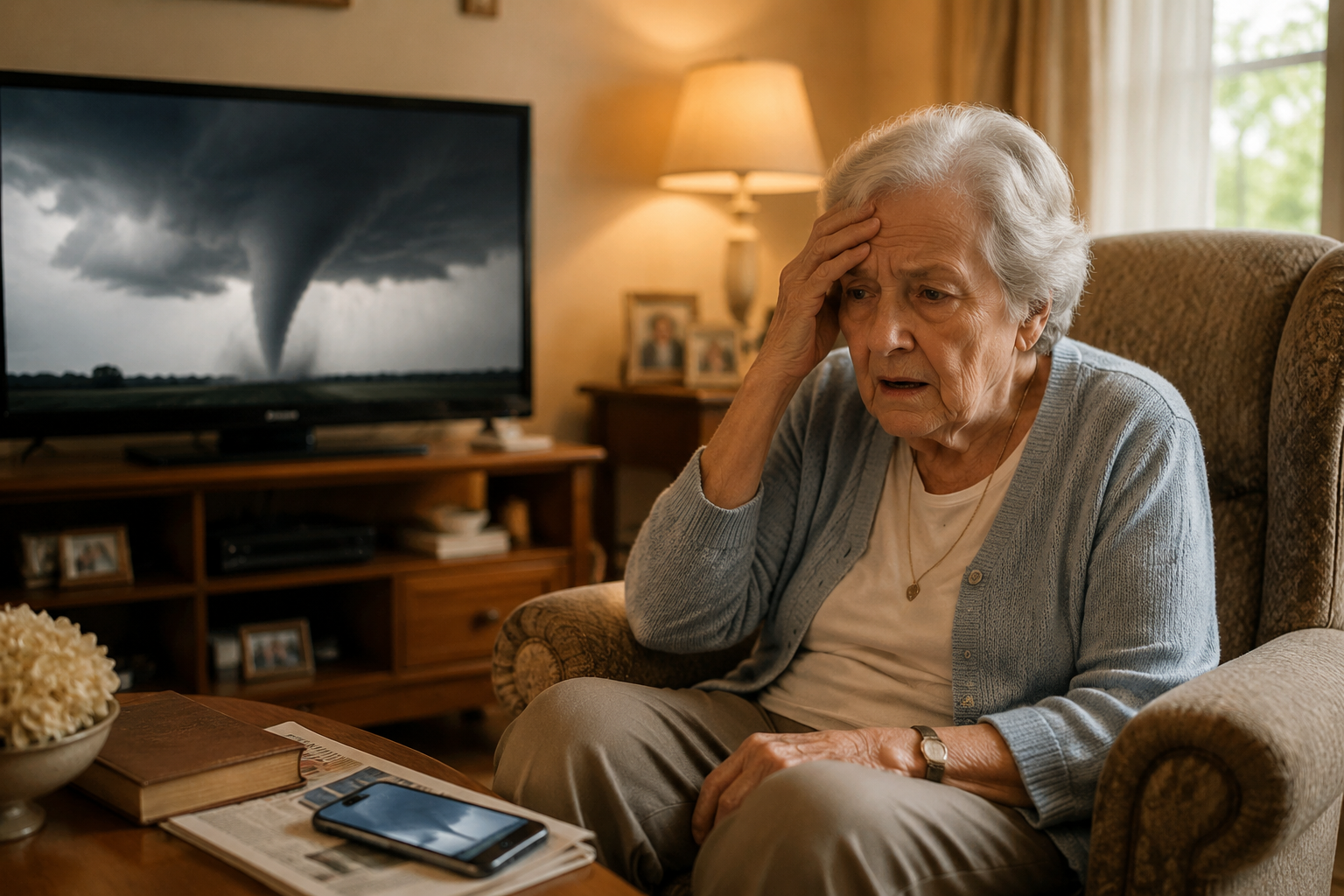
The hard part of explaining tornado warnings to elderly parents is not usually the word “tornado.” It is the translation that has to happen after the alert arrives. A phone shrieks. The TV crawl says Tornado Warning. A weather radio talks over itself. An adult child calls from across town and says, “Go now.” The parent hears part of it, sees part of it, remembers a different storm from years ago, and stays in the recliner because the next step is not obvious enough.
A warning can arrive and still fail as an instruction. That is the gap families have to close before storm season, especially when an older parent has hearing loss, poor contrast vision, mild cognitive decline, limited mobility, or the kind of weather anxiety that turns every forecast into a long phone call. The goal is not to make a parent recite NOAA language. The goal is to make each alert level mean one plain action their body can perform.
Start With Three Meanings, Then Remove the Guesswork
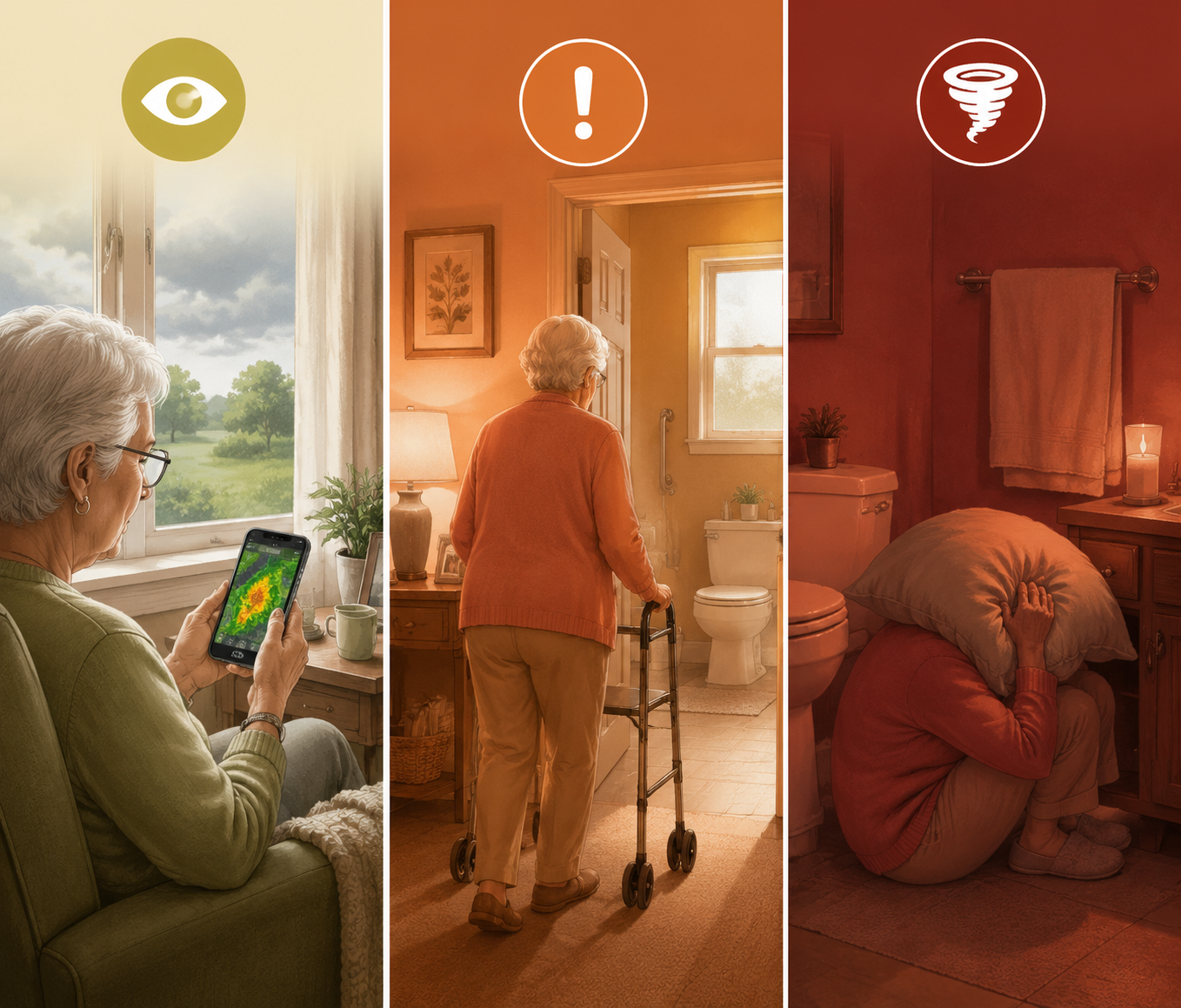
For many older adults, “watch,” “warning,” and “emergency” sound too similar when they are frightened, sleepy, hard of hearing, or already overstimulated. Do not leave those words as abstract categories. Put each one into a sentence that names the place, the movement, and the urgency.
| NOAA alert level | Parent-facing sentence | Action you want practiced |
|---|---|---|
| Tornado Watch | “A tornado could happen today. Stay dressed, keep your shoes nearby, and keep the radio or phone where you can hear or see it.” | Prepare without taking shelter yet: shoes on or nearby, walker close, phone charged, safe room path clear. |
| Tornado Warning | “A tornado has been seen or detected near you. Go to the bathroom now.” | Move immediately to the chosen interior room or lowest-level safe area. |
| Tornado Emergency | “This is the most dangerous warning. Get down, cover your head, and stay there until I or the weather radio says it is over.” | Take protective cover in the safe room and stop trying to check windows, doors, or outdoor conditions. |
That table looks almost too simple, which is the point. Under stress, extra interpretation becomes a burden. “Go to your safe place” may be too vague if your parent has several rooms in mind. “Go to the hallway” may be wrong if the hallway has glass nearby. “Take cover” may sound dramatic but not tell someone with a walker what to do first. The better version is specific: “Go to the downstairs bathroom now,” or “Go to the closet beside the laundry room now.”
Write the wording exactly as you want it used. If three siblings call with three different versions, the parent has to sort the language while the storm is moving. Pick one safe room, one phrase, and one first action.
Make the Alert Reach the Parent They Actually Are
A backup alert plan matters because many older adults cannot depend on the same channels their adult children use. Nearly 15% of adults age 50 and older have no internet access, and many do not have smartphones capable of receiving Wireless Emergency Alerts. AARP also notes that people age 75 and older were about 6% of New Orleans’ population in 2005 but accounted for 50% of Hurricane Katrina deaths, a reminder that disaster risk is not evenly shared once mobility, health, transportation, and communication barriers enter the picture.[1]
The alert system may be working exactly as designed, while one household still needs a different bridge from signal to action. Build that bridge around the parent’s actual limitation, not around the device that seems easiest to you.
If Hearing Loss Is the Main Barrier
Hearing loss affects about one in three adults over 65, so a phone alert, siren, or shouted instruction may not be enough.[1] A parent may hear that something is happening but miss the key word that separates “watch” from “warning.” They may also remove hearing aids at night, during naps, or while watching television with the volume already competing.
NOAA Weather Radio guidance for people who are deaf or hard of hearing points to adapted receivers that can connect with strobe lights, bed shakers, pillow vibrators, text displays, and other alerting devices.[2] For an older parent, this is not a gadget upgrade; it is the difference between an alert that exists somewhere in the room and an alert that reaches the body.
- Place the weather radio where the parent spends the most time, not where it looks tidy.
- Use a strobe or bed shaker if the parent may miss sound while sleeping or without hearing aids.
- Keep the spoken family command short: “Warning means bathroom now.”
- Do not rely on outdoor sirens as the only cue, especially inside a home with television, fans, or hearing loss.
When you test the setup, do it from the parent’s chair, bed, kitchen table, and bathroom. If they cannot perceive the alert from the places where they actually live, the plan still has a hole.
If Vision Changes Are the Main Barrier
Vision problems make many written emergency plans look better on a refrigerator than they work in a crisis. Small print, low contrast, decorative fonts, and crowded checklists ask too much from tired eyes. A tornado cue card should not look like a brochure.
Use large, dark lettering on a plain background. Put the card where the decision happens: by the TV, beside the bed, near the favorite chair, and on the safe-room door. The message can be as blunt as: “TORNADO WARNING = BATHROOM NOW.” If the parent reads better with symbols, add one simple tornado icon and one arrow toward the safe room. Avoid filling the card with every possible scenario.
Tactile cues can help when lighting is poor or vision is unreliable. A textured strip on the safe-room doorframe, a bright towel stored in the bathroom for head covering, or a walker parked in the same place before storms can reduce searching. None of these cues has to announce frailty to the whole house. They just have to make the right route easier than the wrong one.
If Mild Cognitive Decline Is the Main Barrier
Cognitive decline changes the job. The parent may understand the plan during a calm afternoon and lose it when the phone rings, the sky darkens, and two relatives call at once. The Alzheimer’s Association advises that people with dementia function best with familiar routines and may become agitated, cry, or refuse to move when they are frightened or rushed during an emergency.[3]
That means the caregiver’s voice should get simpler, not louder. Use one-step commands. Say the parent’s name. Name the room. Avoid explaining radar, counties, storm tracks, or why this time is different from the last alert. During a warning, “Mom, go to the bathroom now” is kinder and more useful than a full explanation delivered at high speed.
- Use one command at a time: “Stand up,” then “Take your walker,” then “Go to the bathroom.”
- Keep the safe-room setup familiar: same chair, same blanket, same flashlight, same radio location.
- Use place cards instead of memory tests: “Warning = bathroom now.”
- Assign one caller if possible, so the parent is not processing several urgent voices.
If the parent lives in assisted living, memory care, or a senior apartment, ask staff what phrase they use during tornado movement and mirror it. Mixed language can slow everyone down. The family phrase and the facility phrase should point to the same room and the same movement.
If Weather Anxiety Is the Main Barrier
Some parents do not ignore weather alerts; they live inside them. They call about forecasts days ahead, ask whether clouds look dangerous, or keep the television on until every storm feels personal. Treat that anxiety as a planning issue, not a character flaw. A frightened parent may seek reassurance so often that, by the time a real warning arrives, both sides are exhausted.
Give anxiety a script before the storm. For a watch, the script might be: “You do not need to go to the bathroom yet. Put on shoes, keep your walker beside you, and keep the radio on.” For a warning, the script changes without debate: “Now it is time. Bathroom now.” The difference between those two sentences should be practiced when nobody is scared.
It also helps to decide when you will call and when you will not. If every forecast produces a family emergency, the parent never learns which cue matters. You can still be compassionate while setting a firm pattern: watch equals prepare, warning equals move, emergency equals cover and stay.
Build the Monthly Rehearsal Around the Exact Route
A plan that only lives in conversation is fragile. Gray Matters Alliance recommends tornado preparedness steps for seniors, caregivers, and families that include identifying the safest location, preparing supplies, and practicing the plan regularly.[4] For this particular problem, monthly rehearsal is where the warning language becomes physical memory.
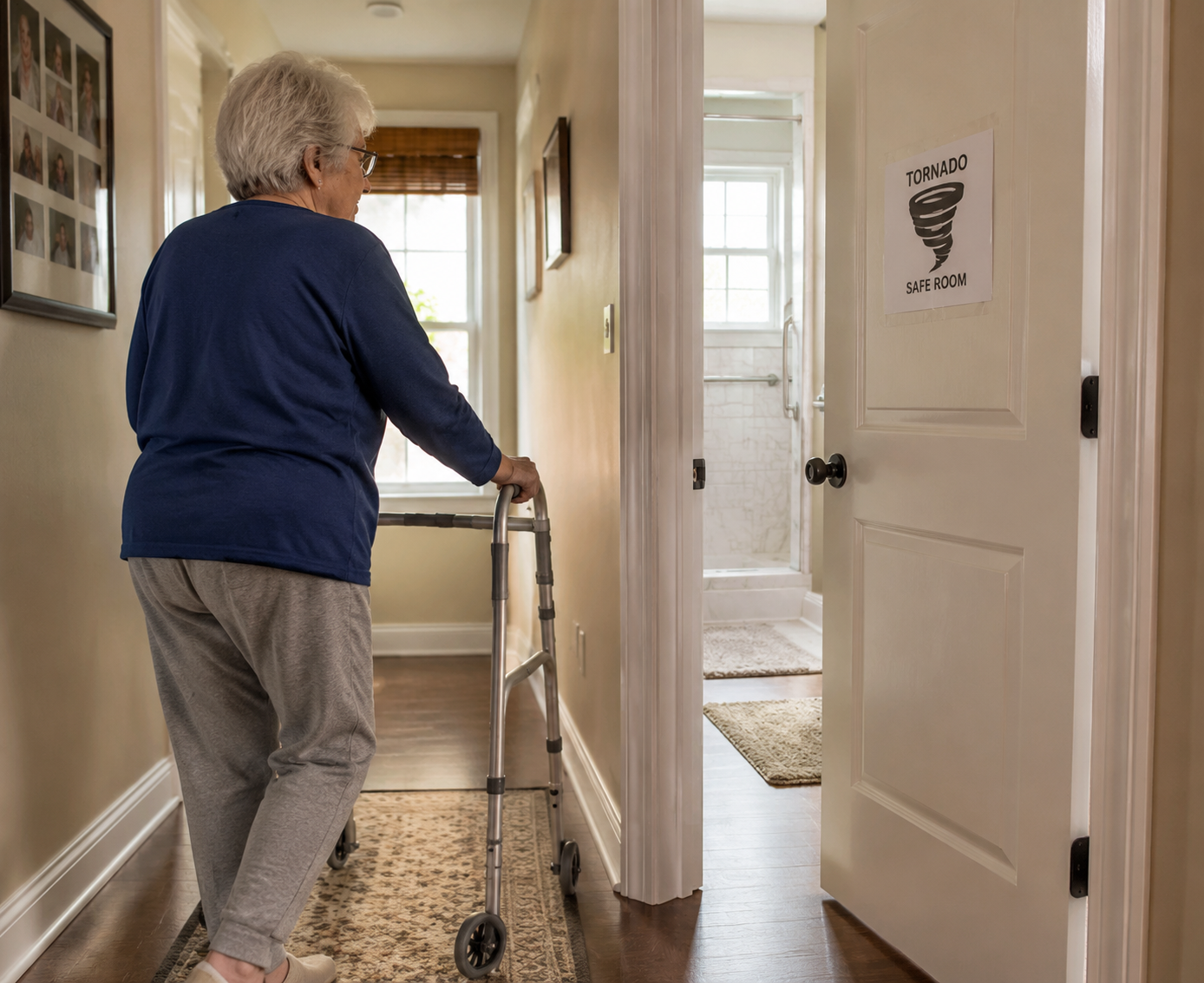
Do not make rehearsal a lecture. Make it a walk-through. Start from the places where your parent is most likely to be when an alert arrives: the recliner, bed, kitchen table, porch chair, laundry room. Then practice the route to the chosen shelter area with the same words you will use during a real warning.
- Choose one safe room: an interior room on the lowest level, away from windows, that the parent can reach with their normal mobility aid.
- Clear the route: remove throw rugs, boxes, pet bowls, cords, and anything that makes a rushed walker or cane trip more likely.
- Place the cues: large-print card at the decision point, cue card on the safe-room door, flashlight and shoes where they are actually reachable.
- Practice the words: “Watch means get ready,” “Warning means bathroom now,” and “Emergency means get down and cover your head.”
- Practice the movement: stand, take walker or cane, move to the room, sit or get low, cover head, wait for the all-clear.
- Check the alert chain: weather radio, phone alert, facility notification, neighbor contact, and family caller.
The rehearsal will show you what the conversation will not. Maybe the walker does not fit through the bathroom doorway when the laundry basket is there. Maybe the parent reaches for slippers instead of hard-soled shoes. Maybe the safest room is technically correct but too far away for the parent to reach quickly. Adjust the plan around what happens in the walk-through, not around what looked sensible on paper.
For parents with mobility limits, the safe place may need seating, a helmet or thick cushion for head protection, a whistle, and a charged phone already stored nearby. If oxygen, medications, dialysis supplies, refrigerated drugs, or powered medical equipment are part of the household, tornado communication is only the first layer. For that broader planning, see this guide to severe weather safety for elderly people with medical needs.
Use Family Calls as Commands, Not Weather Reports
Adult children often call with too much information because they are trying to be reassuring: “The cell is west of you, and it might pass north, but they just issued a warning, so maybe go ahead and move.” That sentence asks an anxious or impaired parent to interpret uncertainty. During a warning, the family call should confirm the action, not narrate the radar.
| Situation | Say this | Avoid this |
|---|---|---|
| Tornado Watch | “Put on shoes and keep your walker beside you. I will call if it becomes a warning.” | “It probably will not hit, but keep an eye on it.” |
| Tornado Warning | “Go to the bathroom now. I will stay on the phone while you move.” | “Are you watching Channel 6? What does it say for your county?” |
| Tornado Emergency | “Get down, cover your head, and stay there. Do not come out yet.” | “Can you look outside and tell me what you see?” |
| Parent freezes or argues | “Stand up now. Take your walker. Bathroom now.” | “We talked about this. Why are you not moving?” |
If your parent can stay on the phone while moving, keep the line open and narrate only the next step. If the phone distracts them from walking safely, hang up after the command and call back after the expected travel time to the safe room. The right choice depends on the parent’s balance, attention, and panic level.
For siblings, decide in advance who calls first. A parent who receives four urgent calls may hear care as chaos. One caller, one phrase, one room.
Do Not Let “They Were Warned” End the Investigation
After disasters, it is common to hear that people were warned. Sometimes that is true and still incomplete. An older adult may receive the warning but not hear it clearly, may hear it but not understand the difference between alert levels, may understand it but be unable to move fast enough, or may start moving and then stop because the route is blocked, dark, or frightening.
A useful tornado plan asks more specific questions: Can my parent perceive the alert at night? Can they read the cue card without glasses? Do they know which room “safe place” means? Can they get there with the walker? Do they have to unlock, lift, search, or decide anything on the way? Who calls, and what exact words do they use?
There is no single definitive study that answers every part of how to explain tornado warnings to elderly parents. The best guidance has to be assembled from weather alerting resources, older-adult disaster risk data, dementia safety guidance, and practical caregiver preparedness advice. That makes precision more important, not less. Do not pretend a conversation is enough when the barrier is sensory, cognitive, or physical.
The finished system is small: three translated alert levels, alerts your parent can actually receive, cue cards they can see, commands they can follow, and a monthly route they have walked before. The goal is not a parent who can explain NOAA terminology back to you. The goal is a parent who knows, before the sky changes, exactly where their feet go when the warning arrives.
References
- Disaster Resilience Tool Kit, AARP
- NOAA Weather Radio for the Deaf and Hard of Hearing, National Weather Service
- In a Disaster, Alzheimer’s Association
- Tornado Preparedness for Seniors, Caregivers and Families in Tornado Alley, Gray Matters Alliance
Related reading
Noticed something outdated or inaccurate on this page? Flag a correction. We review every report against CDC, NIA, and AARP HomeFit guidance before updating a page.
Part of the Fall Prevention section.