
How to Ensure Hurricane Preparedness for Seniors with Medical Needs
A medical-focused hurricane preparedness guide for family caregivers of older adults, covering medication refills, backup power for equipment, Special Needs Shelter registration, and chronic condition continuity before, during, and after a storm.
A standard hurricane checklist can make a family feel prepared while leaving the most fragile parts of an older adult’s care untouched. It may say to pack medications, but not whether there are enough pills to outlast closed pharmacies. It may say to charge devices, but not whether an oxygen concentrator can run through a long outage. It may say to evacuate early, but not whether the shelter can support a CPAP machine, refrigerated insulin, limited mobility, or a caregiver who needs to stay with the person.
That is why hurricane preparedness for seniors with medical needs has to start with continuity of care. Food, water, flashlights, and weather alerts still matter. But for an older adult with heart disease, diabetes, COPD, kidney disease, dementia, limited mobility, or oxygen dependence, the preventable danger after a storm is often the interruption: missed medications, dead batteries, spoiled refrigerated drugs, delayed dialysis, blocked home health visits, or a shelter plan that was never verified.
The scale is not small. CDC-published disaster preparedness research notes that about 80% of older adults have at least one chronic condition, and after Hurricane Katrina, as many as 200,000 people with chronic conditions may have lost access to their medications or other usual sources of care.[1] Older adults were also disproportionately represented among Katrina deaths; a widely cited federal lessons-learned figure reported that 71% of those who died were over age 65, though that number should be read as a historical disaster finding rather than a precise prediction for every storm.[1]
A quieter forecast does not remove this work. NOAA’s 2026 Atlantic hurricane outlook calls for a below-normal season, influenced by El Niño conditions.[2] That is useful planning context, not permission to wait. Team Rubicon’s 2026 forecast discussion makes the practical point plainly: even a below-normal season can still produce a devastating landfall.[3]
Start With The Medical Routine, Not The Supply Bin
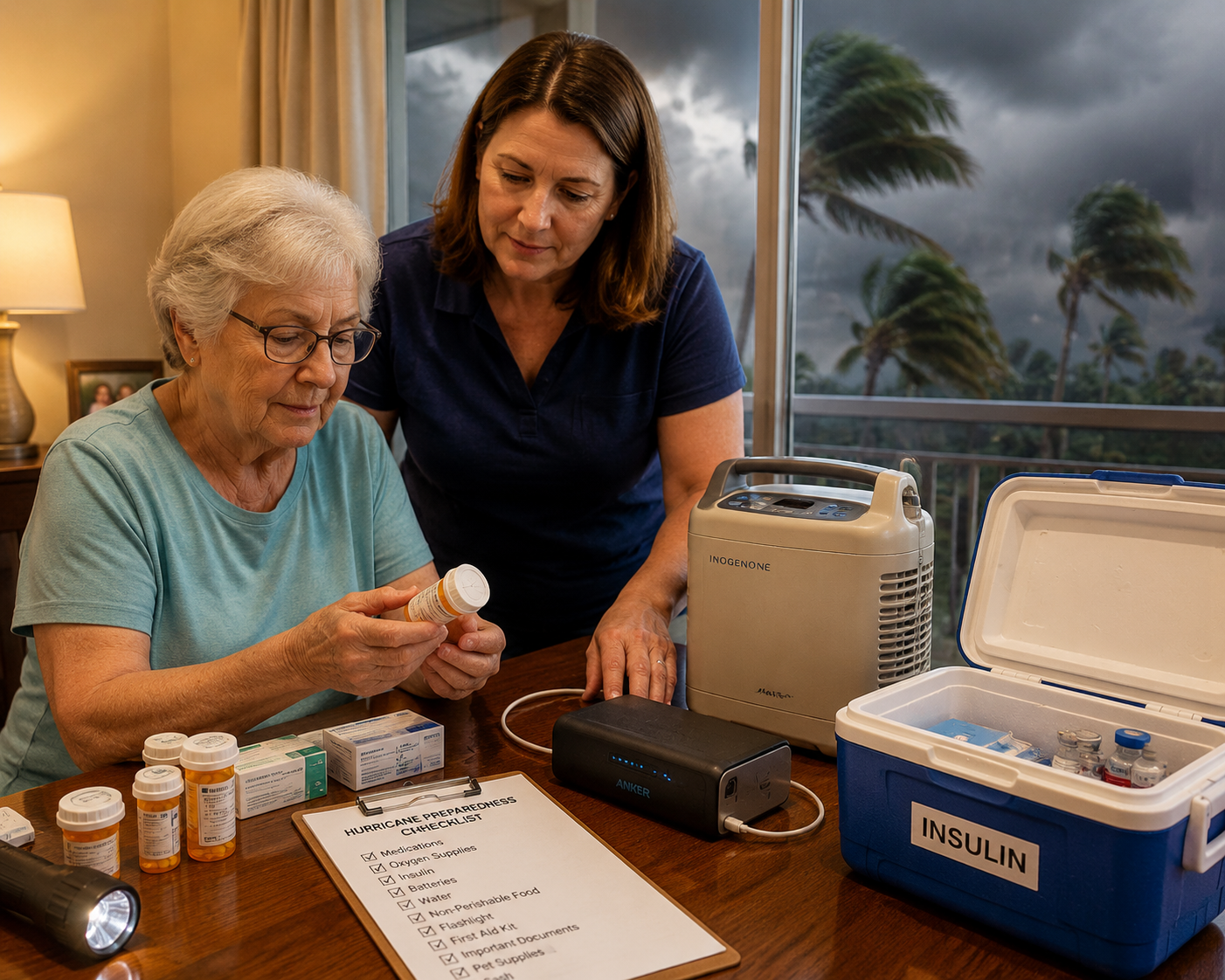
The first draft of the plan should look less like a shopping list and more like a day in the older adult’s life. What happens at 7 a.m.? Which pill is taken with food? Which inhaler is used before walking to the bathroom? Does the oxygen tubing reach the bed? Is the CPAP used every night? Who checks blood sugar? Which medication must stay cold? Which appointment cannot safely be skipped?
Write the routine down before hurricane season becomes urgent. A caregiver should be able to hand the document to an emergency clinician, shelter nurse, neighbor, adult sibling, or home health agency without having to reconstruct it from memory while cell service is poor.
- Current medication list with dose, timing, purpose, prescribing clinician, pharmacy, and known allergies.
- Diagnosis list, including chronic conditions that affect evacuation or shelter needs.
- Equipment list, including model numbers, power requirements, battery type, tubing size, supply vendor, and emergency phone numbers.
- Insurance cards, Medicare or Medicaid information, advance directives, health care proxy documents, and identification.
- A one-page care summary that says what cannot be interrupted, such as oxygen, dialysis schedule, seizure medication, insulin, anticoagulants, or heart medications.
Keep one printed copy in a waterproof folder, one copy in the evacuation bag, and one digital copy accessible to more than one family member. If the older adult has cognitive impairment, the printed version should be easy to find without requiring them to explain the system.
Medication Continuity Is The First Medical Emergency To Prevent
Medication planning needs more lead time than most families expect. A prescription bottle may look full until the pharmacy closes for three days, the refill is blocked by insurance timing, the doctor’s office phone line goes to voicemail, and the caregiver realizes the medication in question is not optional.
The American Red Cross advises older adults to keep at least a 30-day supply of medications, and the American Association for Geriatric Psychiatry advises having at least a two-week supply available for disasters.[4][5] Those recommendations are much larger than the old three-day emergency kit idea, and for good reason: hurricanes disrupt pharmacies, roads, refrigeration, delivery services, prescribers, and insurance processing at the same time.
Refill Before The Storm Is Named
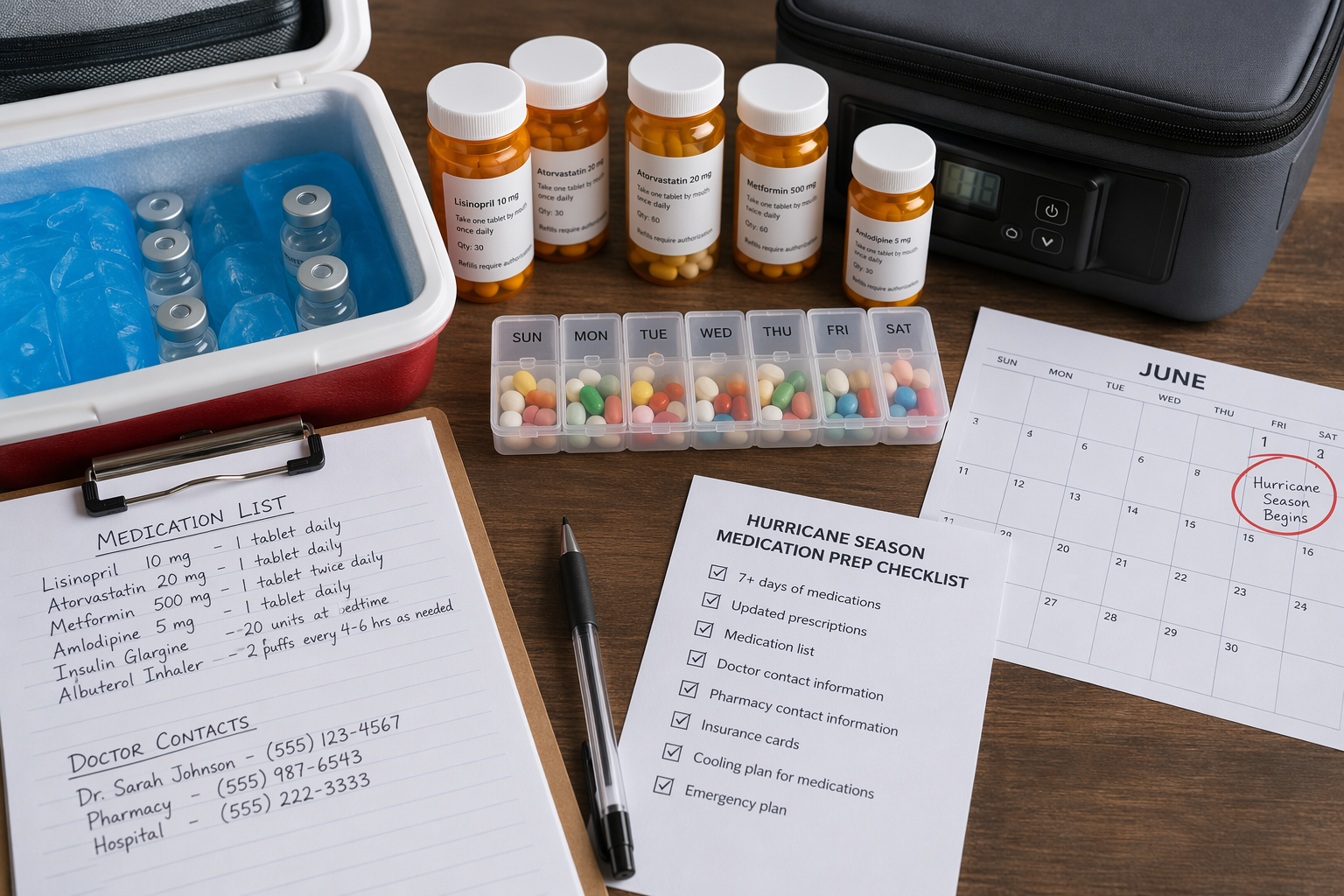
Do not wait for a hurricane warning to ask for refills. Once a storm is in the forecast cone, pharmacies are busy, phone trees are jammed, and prescribers may be closing offices or evacuating themselves. The caregiver’s job is to know, before the season gets active, which medications can be filled for 30 days, 60 days, or 90 days; which ones are controlled substances; which ones require a new prescription; and which ones insurance will not release early without an emergency override.
Early-refill rules are state-specific and can change during declared emergencies. Caregivers in Florida, Texas, Louisiana, South Carolina, North Carolina, and Georgia should check their state insurance department, board of pharmacy, Medicaid office, or emergency management site before peak season. The question to ask the pharmacy is concrete: “If a hurricane emergency is declared, what documentation do you need to fill this medication early, and how many extra days can we obtain?”
| Medication task | What the caregiver should confirm |
|---|---|
| Routine prescriptions | Days on hand, next refill date, prescriber contact, pharmacy disaster policy, and whether a 90-day fill is allowed |
| High-risk medications | Whether interruption could cause withdrawal, clotting risk, seizure risk, blood pressure instability, blood sugar instability, or breathing problems |
| Controlled substances | Whether state rules, prescriber availability, and pharmacy stock limit early refill options |
| Mail-order medications | Whether delivery can be moved earlier or redirected before storm-related shipping delays |
| Specialty medications | Whether the specialty pharmacy has a hurricane shipping plan and after-hours support |
Make The Medication List Useful In A Real Hand-Off
A medication list that only says “heart pill” or “water pill” is not enough. Use the drug name from the label, the dose, the time taken, and the reason if known. Add the prescribing clinician’s name and phone number, the pharmacy phone number, and the caregiver who usually manages the medication. If the older adult takes pills from a weekly organizer, keep the original labeled bottles available for evacuation, because shelters and clinicians may need to verify the prescription.
For older adults with memory loss, vision impairment, or complicated dosing, photograph each bottle label and the pill organizer layout. That does not replace the written list, but it gives a second way to check what was packed and what may have been missed.
Plan For Refrigerated Medication Before The Refrigerator Fails
Insulin and other temperature-sensitive medications need their own storm plan. Ask the pharmacist or prescribing clinician what temperature range is required, how long the medication can be outside refrigeration, whether it can touch ice packs directly, and what signs mean it should not be used. Those answers depend on the specific medication, so a generic cooler instruction is not safe enough.
Before hurricane season, assemble a small medication-cooling kit: insulated container, thermometer, cold packs, waterproof bags, printed storage instructions, and a plan for recharging or replacing cooling supplies. If the older adult may evacuate, confirm whether the destination can refrigerate medication or whether a portable medical cooling device is needed. If a shelter is part of the plan, ask the shelter program how refrigerated medications are handled; do not assume the answer will be the same everywhere.
Power-Dependent Equipment Needs A Written Runtime Plan
The most actionable preparedness gap is power. A national University of Michigan survey of 2,256 older adults found that only 25% of older adults who used electricity-dependent medical equipment had an alternative power source.[6] That finding does not measure whether every backup plan was adequate; it shows that many families have not even cleared the first hurdle.
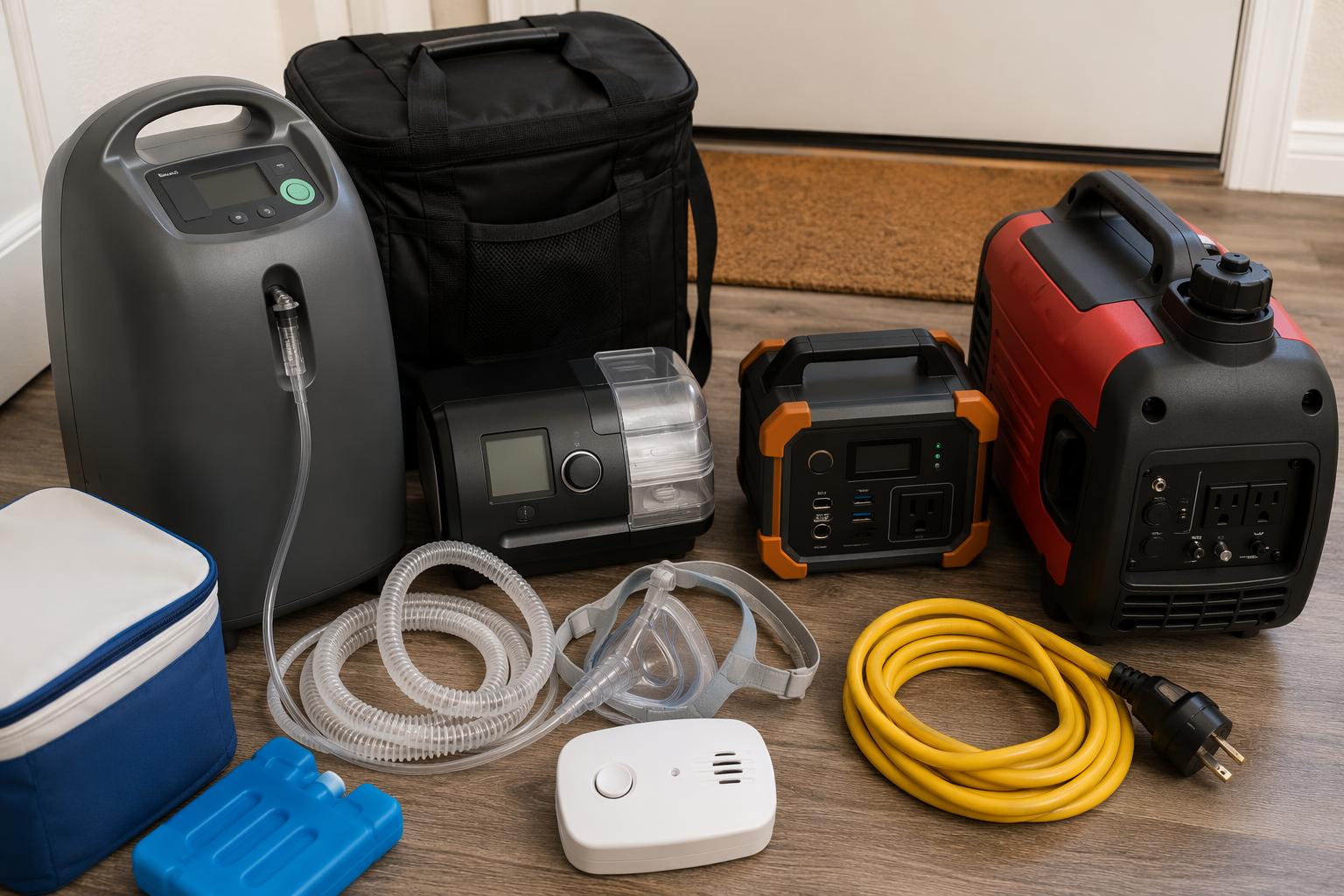
For a medically vulnerable senior, “we have a battery” is not a plan until someone knows what it powers, how long it lasts, how it is recharged, and what happens when the outage lasts longer than expected. Oxygen concentrators, CPAP and BiPAP machines, nebulizers, hospital beds, feeding pumps, suction devices, power wheelchairs, stair lifts, and dialysis-related equipment all create different failure points.
Build The Equipment Sheet
For each device, write down the exact model, supplier, power draw if available, battery type, expected battery duration, charging time, backup battery location, and whether the device can run safely from a battery pack, vehicle inverter, or generator. Call the equipment supplier before storm season and ask what they recommend during an outage. If oxygen is involved, ask specifically about portable tanks, concentrator backup, delivery limits before a storm, and whether the supplier provides emergency support after evacuations.
| Device or need | Questions to answer before hurricane season |
|---|---|
| Oxygen concentrator | How many hours will backup power last? Are portable tanks available? Who delivers replacements if roads are restricted? |
| CPAP or BiPAP | Can the machine run without humidification to conserve power if the clinician says it is acceptable? Which battery is compatible? |
| Nebulizer | Is there a battery-powered option or an inhaler backup plan prescribed by the clinician? |
| Dialysis-related needs | What is the dialysis center’s hurricane schedule, evacuation guidance, and emergency contact process? |
| Feeding pump | What battery runtime is available, and is there a clinician-approved gravity feeding backup plan? |
| Power wheelchair or lift | How will the person transfer, toilet, and evacuate if the chair or lift cannot be charged? |
Register With The Utility, But Do Not Depend On Priority Restoration
Many utilities allow customers with life-sustaining medical equipment to register for medical priority or critical-care status. That registration can help the utility identify households with urgent needs, but it should not be treated as a guarantee that power will return quickly after a hurricane. Restoration depends on damage, access, flooding, and grid conditions. The backup plan still has to carry the older adult through an outage.
Ask the utility what medical documentation is required, how often it must be renewed, whether the account holder must be the patient, and what alerts are sent before planned or storm-related outages. Keep the confirmation number or approval letter in the emergency folder.
Use Generators Without Creating A Second Emergency
Generators can keep medical equipment running, but they also create carbon monoxide risk. The American Association for Geriatric Psychiatry notes that generator-related carbon monoxide poisoning kills about 500 people each year and sends about 15,000 people to emergency rooms, with adults over 65 disproportionately vulnerable.[5]
A generator should never run inside a home, garage, porch, crawl space, shed, or near an open window or door. The home needs working battery-powered carbon monoxide detectors, fuel stored safely, outdoor-rated extension cords, and a clear assignment for who operates the generator. If no one in the household can safely lift, fuel, move, or maintain it, the plan needs another power source or a safer evacuation destination.
Special Needs Shelters Are Not A Last-Minute Discovery
A Special Needs Shelter can be the right option for some older adults who need more support than a general-population shelter but do not require hospital-level care. The important word is “some.” These programs are not identical across states or counties, and they usually require advance registration, medical information, and confirmation of what the shelter can and cannot provide.
Florida’s Special Needs Shelter program is a useful example because the state provides public instructions: residents are encouraged to pre-register, and local emergency management works with health departments to review needs; physician or medical provider information may be required as part of the process.[7] Florida’s documentation should not be read as the rule for Texas, Louisiana, South Carolina, North Carolina, or Georgia. In each county, caregivers need to check local emergency management instructions and repeat the check each season.
- Ask whether the older adult qualifies for the county’s medical or special needs shelter program.
- Confirm whether physician documentation, medication lists, equipment details, oxygen orders, or functional assessments are required.
- Ask whether a caregiver may or must stay with the older adult.
- Confirm whether the shelter supports oxygen concentrators, CPAP, refrigerated medication, mobility devices, incontinence supplies, and special diets.
- Ask what the family must bring, including medications, equipment, bedding, supplies, chargers, identification, and medical paperwork.
- Write down the registration confirmation, transportation process, activation procedure, and number to call when evacuation orders begin.
The mistake is assuming that an obvious medical need will automatically produce the right help at the door. In a hurricane, systems move through forms, eligibility screens, activation lists, transportation routes, and staffing limits. Pre-registration is not red tape for its own sake; it is how the county knows who needs what before the roads are unsafe.
Evacuation Planning Has To Account For Mobility, Cost, And Resistance
Evacuation advice often sounds simple from a distance. For a caregiver, it can mean moving an older adult who uses oxygen, has dementia, cannot sit comfortably for hours, needs toileting help, cannot afford a hotel, or refuses to leave because the last storm “turned out fine.” Those barriers are real planning constraints, not personality flaws.
AARP-cited research reported that at least 13 million older adults in the United States said they would need help evacuating, and about half of those would need help from someone outside their household.[1] The same University of Michigan survey cited by PBS NewsHour found that 24% of older adults said it would be difficult to afford staying somewhere else for a week.[6] Those numbers explain why families delay even when the medical risk is clear.
Normalcy bias can add another layer. Older adults who have lived through past hurricanes may judge a new storm by what happened last time, especially if previous warnings led to little damage. PBS NewsHour’s discussion of older-adult evacuation barriers describes this tendency as one reason people underestimate disaster risk.[6] A caregiver does not have to argue about character or bravery. It is usually more productive to make the decision concrete: “If power is out for two days, where will the oxygen run?” or “If the bridge closes, who can get you to dialysis?”
Decide Earlier Than The General Public
Medically vulnerable seniors often need an earlier trigger than neighbors who can pack quickly and sleep on a gym floor. The trigger might be a county evacuation order, but it might also be a forecast that threatens prolonged power loss, a dialysis center closure, a caregiver’s work obligation, or a mobility problem that makes nighttime evacuation unsafe.
Choose destinations by medical fit, not just distance from the coast. A relative’s inland house may be safer from storm surge but unsuitable if it has stairs, no backup power, no refrigeration, no accessible bathroom, and no nearby pharmacy. A hotel may work only if the caregiver confirms elevator risk, power backup, accessible rooms, pet policy, oxygen delivery, and cancellation terms. A shelter may be appropriate only after registration and eligibility are verified.
Make The Home Safer If Staying Put Is The Plan
Some older adults will shelter in place because evacuation is not ordered, the home is outside the surge zone, or the medical team and family judge that staying is safer than moving. That choice still needs a home setup that assumes darkness, noise, wet floors, disrupted sleep, and more frequent toileting or confusion.
- Clear walking paths from bed to bathroom, kitchen, exit door, and medical equipment.
- Tape down or reroute oxygen tubing and power cords so they do not cross main walkways.
- Set up a safe room on the lowest appropriate level, away from windows, with medications, water, charged lights, phone chargers, continence supplies, mobility aids, and shoes.
- Add nightlights, battery lanterns, and flashlights where the older adult actually walks.
- Reduce bathroom hazards with nonslip surfaces, grab bars if already installed or safely installable before the season, raised toilet support if needed, and towels ready for wet floors.
- Keep walkers, canes, wheelchairs, hearing aids, glasses, dentures, and backup batteries within reach, not in a closet across the house.
Fall prevention is not separate from hurricane planning. A power outage turns small home hazards into bigger ones: a loose rug becomes harder to see, a hallway cord becomes an oxygen trip line, and a bathroom trip can become an ambulance call when roads are flooded. If the home already needs larger modifications, such as ramps, safer bathroom access, or better entryway lighting, those upgrades belong in the pre-season plan rather than the week of landfall.
During The Storm, Protect The Routine You Built
Once the storm arrives, the caregiver’s job shifts from planning to preserving the medical routine with as little improvisation as possible. Keep the medication schedule visible. Use alarms if phones still work, and use a written log if sleep, stress, or multiple caregivers could cause missed or double doses. If a medication is skipped or vomited, follow the clinician’s prior instructions or call the appropriate medical line when service is available; do not guess with high-risk drugs.
Conserve power deliberately. If a device has a limited battery, record when it started running, estimate remaining time, and reserve backup power for the equipment that cannot be interrupted. Keep phones in low-power mode. Do not use medical batteries for comfort electronics unless the medical need is already secured.
If the older adult becomes short of breath, confused, weak, dehydrated, unable to take essential medications, unable to use oxygen or other critical equipment, or unsafe to transfer, treat that as a medical problem, not simply a storm inconvenience. Emergency services may be delayed, which is exactly why the threshold for calling should not be pushed too late.
After The Storm, Check For Care Gaps Before They Become Crises
The dangerous period does not end when the wind quiets. Pharmacies may be closed, roads may be blocked, home health visits may be canceled, refrigerated medication may be questionable, and equipment suppliers may be working through long call lists. This is when a caregiver needs to compare the written routine against what actually happened.
- Count remaining medications and request refills before the supply becomes urgent.
- Call the pharmacist about any medication that may have been exposed to unsafe heat, cold, floodwater, or uncertain refrigeration.
- Contact oxygen, CPAP, feeding pump, wheelchair, or other equipment suppliers if batteries, tubing, filters, tanks, or replacement parts are low.
- Confirm dialysis, wound care, infusion, therapy, primary care, and specialist appointments that were canceled or delayed.
- Watch for delayed symptoms: worsening breathing, swelling, chest pain, dizziness, confusion, blood sugar instability, dehydration, falls, or medication side effects.
- Update the plan while the problems are fresh: what ran out, what was hard to move, which phone numbers failed, and what paperwork was missing.
Post-storm cleanup can also pull attention away from the older adult’s care. A caregiver may be dealing with insurance calls, work, damaged property, and relatives asking for updates. The written care routine prevents the medical pieces from becoming invisible in that noise.
A Practical Medical Hurricane Plan
A complete plan does not need to be elegant. It needs to be findable, current, and specific enough that another responsible adult can follow it. The strongest version usually fits into one folder, one evacuation bag, and one shared digital file.
| Before hurricane season | When a storm is possible | During and after disruption |
|---|---|---|
| Create medication, diagnosis, clinician, pharmacy, equipment, and insurance records. | Refill medications early where allowed and confirm pharmacy, prescriber, and mail-order plans. | Track doses, count remaining supply, and resolve missed refills quickly. |
| Register for utility medical status if eligible and document backup power for each device. | Charge batteries, test equipment, stage oxygen or supplies, and confirm vendor contacts. | Protect battery runtime for essential equipment and call for help before power failure becomes medical danger. |
| Pre-register for Special Needs Shelter or accessible evacuation support if appropriate. | Confirm activation process, transportation, caregiver rules, and what the shelter provides. | Bring paperwork, medications, equipment, chargers, and supplies; report unmet medical needs early. |
| Prepare refrigerated medication instructions and cooling supplies. | Freeze cold packs, check thermometers, and verify destination refrigeration. | Ask the pharmacist about any medication exposed to unsafe temperatures. |
| Reduce fall hazards and set up a safe room with mobility and continence supplies. | Clear paths, secure cords and tubing, place lights, and move key items within reach. | Watch for falls, confusion, dehydration, and delayed worsening of chronic conditions. |
The pantry matters. So do water, weather alerts, batteries, cash, pet supplies, and important documents. But a hurricane plan for a medically vulnerable senior is not complete when the pantry is stocked. It is complete when the person’s treatment routine can survive the disruption: medications refilled and documented, equipment power accounted for, refrigerated drugs protected, shelter or evacuation options registered and verified, chronic-condition contacts ready, and post-storm care continuity checked.
References
- Disaster Preparedness and the Chronic Disease Needs of Vulnerable Older Adults — CDC Preventing Chronic Disease.
- NOAA predicts below-normal 2026 Atlantic hurricane season — NOAA.
- 2026 Hurricane Season Forecast Points to Fewer Storms, But — Team Rubicon.
- Older Adults Emergency Preparedness — American Red Cross.
- Older Adults and Disaster: Preparedness and Response — American Association for Geriatric Psychiatry.
- Why it can be more difficult to evacuate older adults in a disaster — PBS NewsHour / The Conversation / University of Michigan.
- Special Needs Shelters — Florida Department of Health.
Related reading
Noticed something outdated or inaccurate on this page? Flag a correction. We review every report against CDC, NIA, and AARP HomeFit guidance before updating a page.
Part of the Fall Prevention section.