
STEADI: intervene
Is Your Parent Safe in Extreme Heat? A Kansas City Fall Prevention Guide
Kansas City caregivers can use this three-tier triage guide to assess a senior's risk of heat-related falls, with phone-screening questions, medication warnings, and local cooling center resources.
It is dangerously hot in Kansas City today. The caregiver question is not whether heat is unpleasant. It is whether your parent can safely get from the chair to the bathroom, pour a drink, answer the door, or wait for help without becoming dizzy, confused, weak, or dehydrated enough to fall.
Kansas City’s first heat advisory of 2026 brought a heat index near 108°F, followed by extreme heat warnings across multiple consecutive days and little overnight relief.[1][2] That kind of heat does not need a dramatic emergency to become dangerous. It can work quietly through a warm apartment, a skipped lunch, a new medication, and one trip across the room.
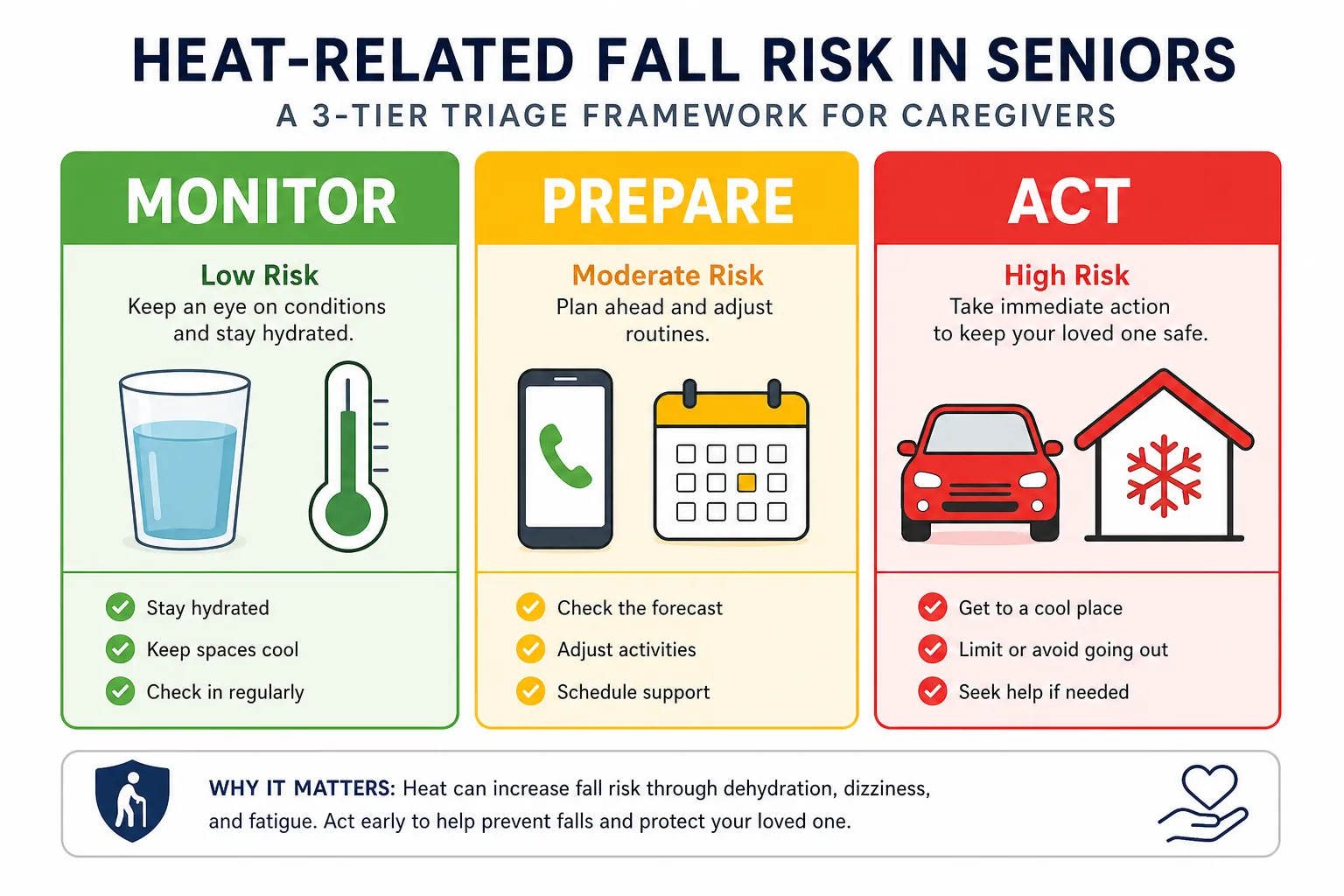
Start With the Three-Tier Heat and Fall Triage
Use this as a same-day decision tool. It is not a diagnosis, and it does not replace medical advice. It is a practical way to decide whether to monitor, prepare, or act before a heat-related fall happens.
| Tier | What It Usually Looks Like | Caregiver Action |
|---|---|---|
| Green — Monitor | Working air conditioning, lives with someone or has reliable daily contact, takes 0–1 heat-sensitive medications, no recent falls or major balance change. | Keep the home cool, schedule check-ins, confirm fluids and meals, and make a plan before the next heat warning. |
| Yellow — Prepare | No central AC, relies on a window unit or fan, lives alone, takes 2+ heat-sensitive medications, has mild balance concerns, or is reluctant to leave home. | Line up cooling options today, verify transportation, check medication heat risks with a pharmacist or prescriber, and increase check-ins during warnings. |
| Red — Act | No AC at all, hot indoor conditions, diuretic plus other heat-sensitive medications, history of falls, dizziness on standing, confusion, poor intake, dark urine, or cognitive concerns. | Arrange cooling or relocation now, send someone in person if needed, call 211 for current cooling resources, and seek urgent medical help for severe symptoms. |
If your parent fits two tiers, use the higher one. A parent with a window unit may sound “yellow” at first, but if they are also dizzy when standing and have fallen before, treat the situation as red. Heat risk stacks. It does not politely stay in one category.
How to Place Your Parent in the Right Tier
Do not begin with “Are you drinking enough water?” Most parents know the expected answer. Start with conditions and behavior: Is the apartment cool? Did they eat? Are they urinating normally? Are they steady when they stand? Has anything changed since the last heat wave?
Check the cooling situation first
Working central air is different from a single window unit. A fan in a hot room is different again. Ask where they are sitting, whether that room feels cool, whether the AC is keeping up in the afternoon, and whether they are sleeping in a cooler room at night.
If the AC is out, weak, or only cooling one room, move the parent at least into yellow. If there is no AC at all during an extreme heat warning, move to red unless someone is physically present and actively managing cooling. More than 10,000 Kansas City households lacked any air conditioning as of 2019, so this is not a rare edge case.[7]
Ask whether they are alone
Living alone changes the math. A spouse, roommate, neighbor, or adult grandchild in the home may notice confusion, weakness, or a stumble before it becomes a fall. A parent alone may wait until tomorrow because they do not want to bother anyone. Tomorrow is not a safe plan when the apartment is hot tonight.
If they live alone, ask who has seen them in person today. A phone call is useful, but it can miss the full picture: the thermostat reading, the unopened food, the full pillbox, the parent gripping furniture while walking.
Review medications as a heat-risk screen
Medication risk is often the piece families miss. A parent who did fine last summer may not be in the same risk category after a new prescription, dose change, or over-the-counter medication.
Put your parent in at least yellow if they take two or more medications that can affect heat tolerance, fluid balance, alertness, sweating, appetite, or dizziness. AARP lists several medication groups that may impair heat tolerance, including diuretics, antidepressants, antihistamines, antipsychotics, blood pressure medications, stimulants, sedatives, and some diabetes medications.[5] Houston Methodist also notes that GLP-1 weight-loss medications can suppress thirst, which matters during heat.[6]
Move toward red when heat-sensitive medications combine with no AC, poor intake, dizziness, a fall history, or confusion. Do not stop medications on your own. Call the prescriber or pharmacist and ask directly: “During this heat warning, does this medication increase dehydration, dizziness, overheating, or fall risk, and should we change monitoring or timing?”
Use three phone questions that are harder to fake
These questions are not perfect, but they beat a vague “Are you okay?”
- “What color was your urine the last time you went?” Dark yellow or amber suggests dehydration risk.
- “What have you eaten today?” Heat can suppress appetite, and too little food can worsen weakness or lightheadedness.
- “When you stand up, do you feel dizzy, woozy, or like you need to grab something?” Dizziness on standing is a fall warning, not a minor inconvenience.
In a study of older adults, Hamrick and colleagues discussed how aging can reduce thirst sensation and examined the relationship among dehydration, medications, falls, and mortality. The cohort was from Wisconsin, so it should not be treated as a Kansas City-specific forecast, but the dehydration-and-fall pathway is useful for caregiver screening.[4]
Do not ignore fall history or cognition
A parent with a recent fall, shuffling gait, neuropathy, poor vision, or a habit of furniture-walking belongs in a higher tier during extreme heat. So does a parent with dementia, mild cognitive impairment, medication confusion, or a pattern of insisting the house is “fine” when others have found it hot.
The issue is not whether they are independent in ordinary weather. The issue is whether heat has removed one or two supports they usually rely on: steady blood pressure, clear thinking, appetite, sleep, balance, or enough fluid.
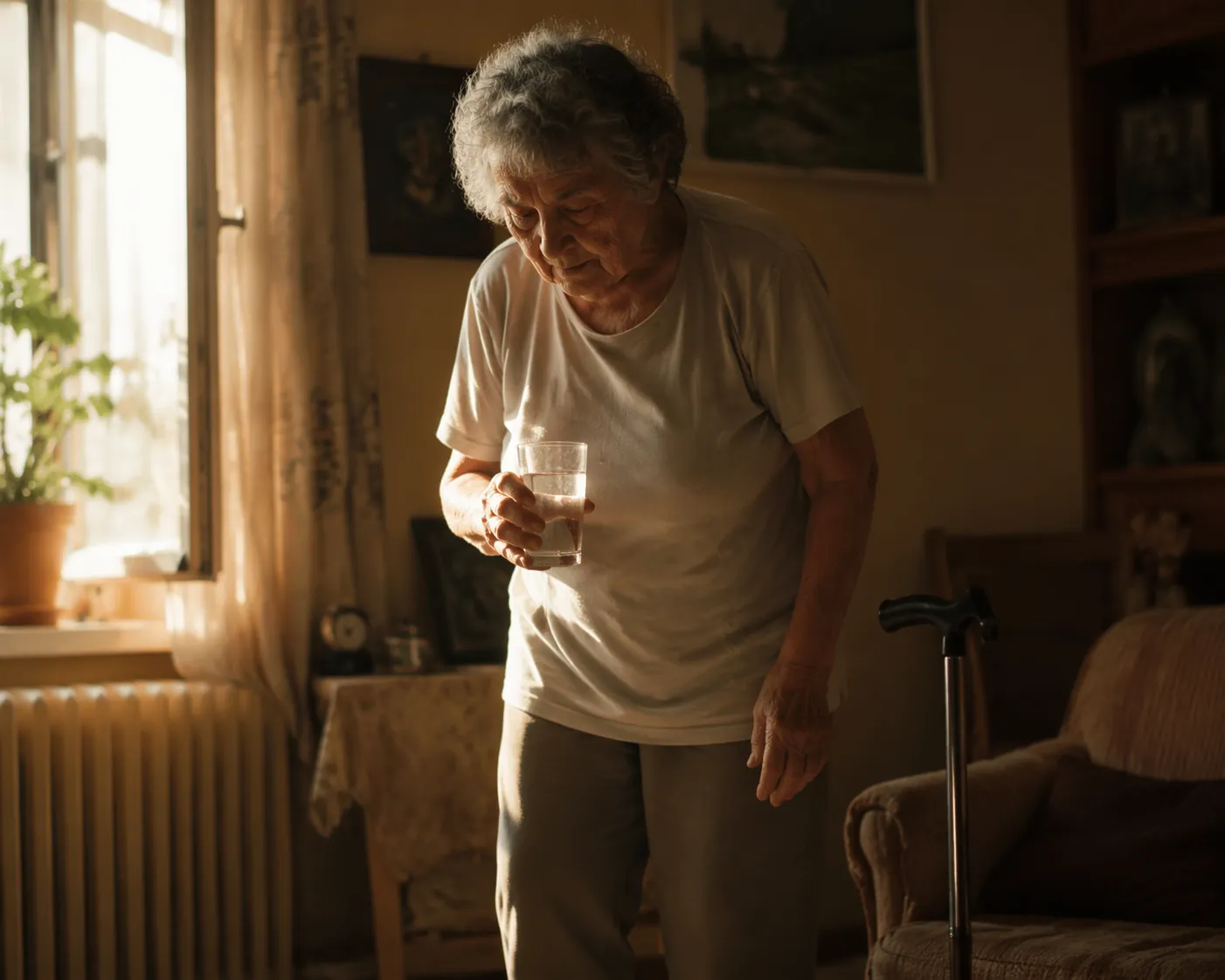
Why Heat Turns Into Fall Risk
Older adults are overrepresented in heat fatalities. Heat-related deaths among older adults increased 88% in 2018–2022 compared with 2000–2004, and adults over 60 account for more than 80% of U.S. heat fatalities annually, according to analysis cited by the Center for American Progress.[3] Those numbers establish seriousness, but for a caregiver, the more useful question is what heat changes inside the home before anyone calls 911.
Heat can lower the margin for ordinary movement. Less thirst means less fluid. Less fluid can mean darker urine, lower blood volume, and dizziness when standing. Heat can also reduce appetite, and a parent who has had coffee, pills, and half a piece of toast may not have enough reserve for repeated bathroom trips.
Medication can narrow that margin further. In Hamrick and colleagues’ analysis, loop diuretics were associated with 26% higher odds of fall or death, and antipsychotics with 52% higher odds, among older adults in the cohort.[4] That does not mean every person on those medications will fall, and it does not prove the medication alone caused the outcome. It does mean those drugs deserve attention when heat, dehydration, and balance concerns are already present.
The practical step is plain: collect the medication list, including over-the-counter sleep aids and allergy pills, and ask a pharmacist or prescriber about heat. Use the words “dehydration,” “dizziness,” “sweating,” “confusion,” and “fall risk.” A general “Is this medicine okay?” is too easy to answer with reassurance.
What to Do Today in Kansas City
Once your parent is in a tier, the next step should be specific enough that someone can do it before dinner.
Green: monitor, but put a time on it
For a green-tier parent, set a check-in time instead of saying “call me if you need anything.” Ask the three screening questions. Confirm that blinds are closed on sun-facing windows, errands are moved out of the hottest part of the day, loose clothing is reasonable, and the parent is spending time in the coolest room.
Also decide what would move them to yellow: AC struggling, missed meals, dark urine, new dizziness, a medication change, or another heat warning tomorrow. Green is not “forget about it.” Green is “watch with a plan.”
Yellow: prepare cooling and transportation before the choice disappears
For a yellow-tier parent, identify where they can cool down and how they will get there. Kansas City cooling center information is available through 211, and local lists are updated during heat events, but hours can change same day.[1][9] Call before sending an older adult across town.
Free, air-conditioned buses and streetcars can help some older adults reach cooling centers, libraries, community spaces, or family homes.[8] They are not automatically safe for every senior. Ask whether your parent can walk to the stop, wait in heat, manage transfers, carry a bag, and get from the stop to the cooling site without becoming dizzy or lost.
If the answer is no, do not call that a transportation plan. Ask a neighbor, relative, faith community member, rideshare, or local service to help. The riskiest part may be the exposed sidewalk, not the destination.
Red: act in person or arrange direct help
For a red-tier parent, do not manage the whole situation by phone. Arrange for someone to go in person, bring them to a cooled place, or stay until cooling is working. If they are confused, fainting, unable to keep fluids down, or too weak to stand safely, treat it as urgent and seek medical help.
Project ElderCool is one local option for the equipment side of the problem. Bishop Sullivan Center’s program provides free window air-conditioning units to eligible seniors age 63 and older and had installed more than 3,000 units since 2009, according to LISC Kansas City.[7] Verify current eligibility and availability by calling Bishop Sullivan Center at 816-231-0984 before promising it to a parent.
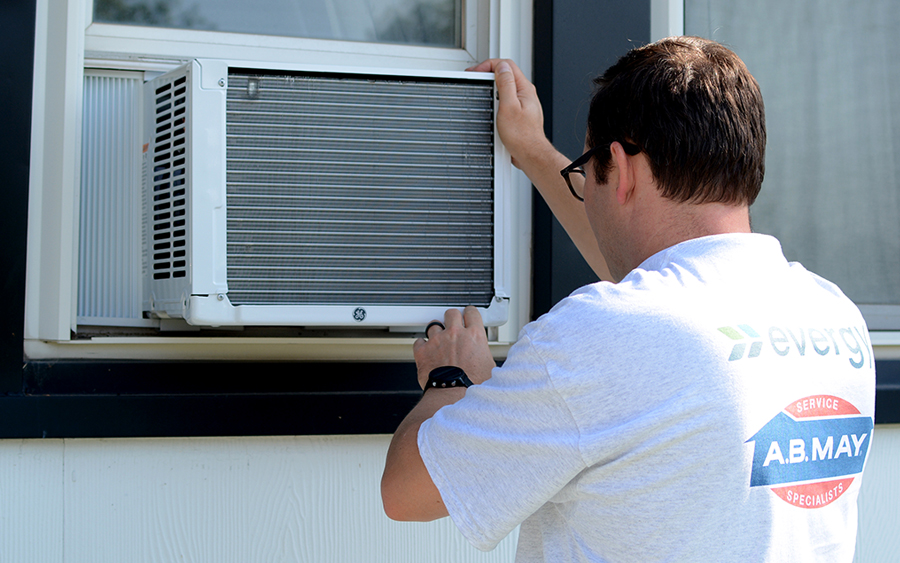
A cooling center, a bus route, or a future AC installation may be the right answer. None of them is a complete answer until you know whether your parent can safely use it today.
The Decision Point
If your parent is green, monitor with a scheduled check-in and clear triggers for escalation. If yellow, prepare cooling, medication questions, and transportation before the next heat warning tightens the timeline. If red, act now: send help, arrange cooling or relocation, call 211 for current local options, and involve medical care when symptoms suggest more than ordinary heat discomfort.
Heat-related falls are not random summer bad luck when the warning signs have been visible for two days. Use the tier, make the call, and decide who is physically helping your parent before the next trip across the room is theirs alone.
References
- Extreme Heat Resources, United Way of Greater Kansas City, June 9, 2026, link
- Kansas City extreme heat warning June 2026, KMBC, link
- Protecting Older Adults From the Growing Threats of Extreme Heat, Center for American Progress, link
- Association Between Dehydration and Falls, Mayo Clinic Proceedings / PMC, link
- Medications That Affect Heat Tolerance, AARP, link
- Medications That Don’t Mix Well With the Sun or Heat, Houston Methodist, June 2024, link
- When Summer Turns Deadly: Helping Kansas City Seniors Beat the Heat, LISC Kansas City, link
- Be Prepared for Extreme Heat, Prepare Metro KC, link
- List: Cooling centers across Kansas City area, KCTV5, June 29, 2026, link
Related reading
Noticed something outdated or inaccurate on this page? Flag a correction. We review every report against CDC, NIA, and AARP HomeFit guidance before updating a page.
Part of the Fall Prevention section.