
STEADI: assess
Summer Destinations Where Heat Puts Seniors at Highest Fall Risk
Extreme summer heat and humidity can accelerate dehydration in older adults, leading to dizziness and falls. This guide profiles seven popular destinations where weather conditions pose a hidden fall hazard and offers preparation tips to reduce risk.
Summer travel planning often starts with the cheerful parts: the hotel balcony, the museum passes, the dinner reservation, the family photo nobody has taken in years. The fall risk usually enters later, if it enters at all, when someone realizes the rental has stairs, the afternoon tour has no shade, or the person taking a blood pressure medication is standing up from a long lunch into 98-degree pavement heat.
That is why lists of summer travel destinations seniors should avoid due to weather need to be more specific than “hot places are risky.” The danger is not simply discomfort. It is the physical chain that can turn a normal sightseeing day into a fall: heat or humidity accelerates fluid loss, older adults may not feel thirsty soon enough, blood volume drops, blood pressure can dip when they stand, and dizziness arrives right when they are stepping off a curb, crossing polished hotel tile, or walking uneven stone.
A 2020 retrospective study of 30,634 patients age 65 and older found dehydration was associated with a 13% higher risk of falls, with an odds ratio of 1.13. The study came from one health system and its population was predominantly white non-Hispanic, so it should not be stretched into a universal prediction tool. Still, it gives a credible anchor to a pattern many families only recognize after the fall has already happened.[1]
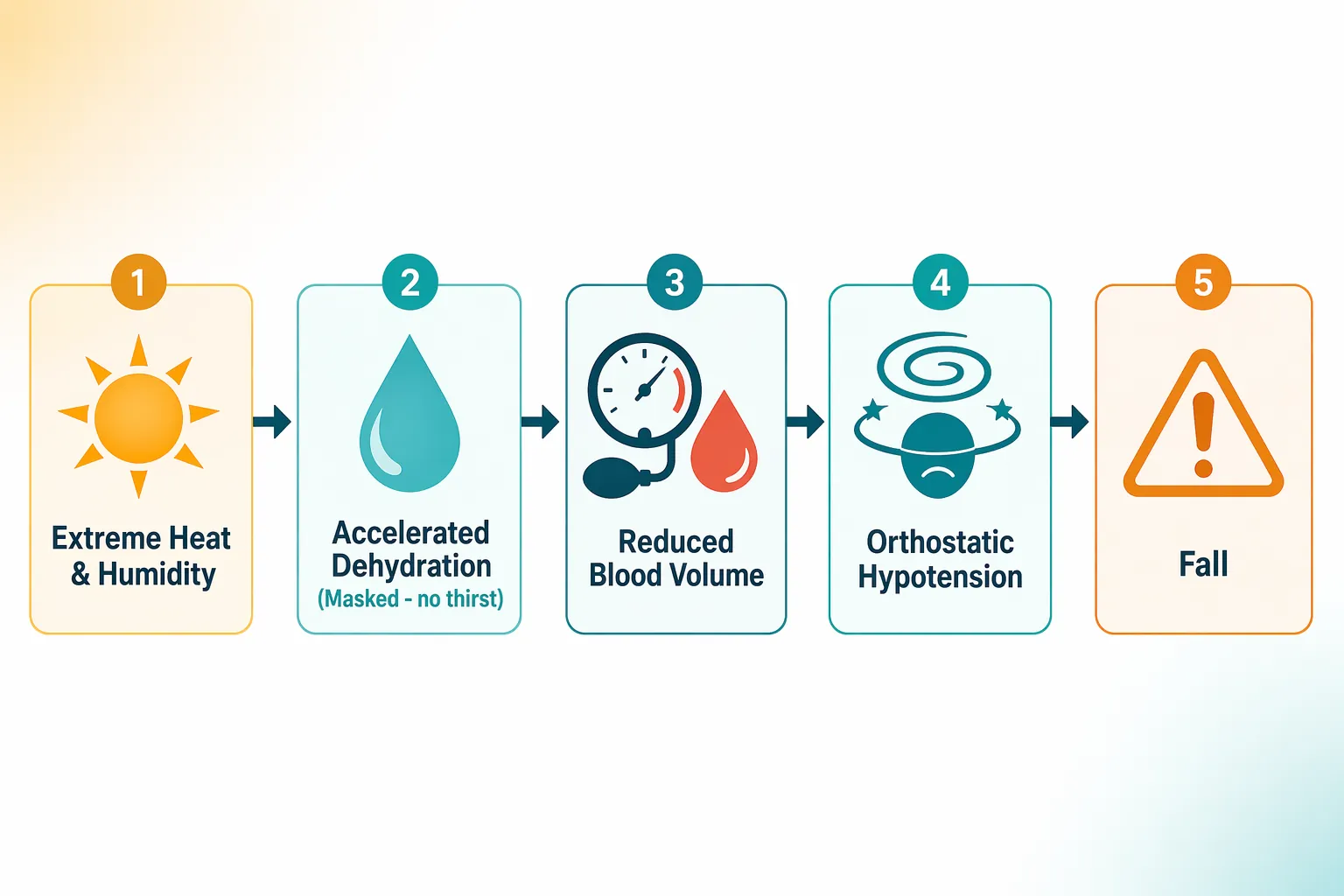
Why Heat-Related Falls Sneak Up on Older Travelers
Older adults begin summer travel with less margin. AARP notes that older adults have about 10% to 15% less total body water than younger adults, and that the brain’s thirst mechanism dulls with age. By the time an older traveler feels thirsty, dehydration may already be well underway.[2]
Medication can narrow that margin further. Diuretics, antihistamines, antidepressants, and blood pressure drugs can interfere with cooling or fluid balance, which matters when a travel day includes airport lines, a long restaurant meal, outdoor walking, and a warm bedroom at night.[2] The CDC also identifies adults 65 and older as a group at higher risk in heat, and says older adults account for 1 in 3 heat-related deaths.[3]
The fall often happens during a transition rather than at the hottest-looking moment. A parent sits through lunch, stands up quickly, walks into glare, and tries to keep pace. Or they leave an air-conditioned lobby and cross a parking lot before their body has adjusted. Sit-stand sightseeing, delayed thirst, and the wish not to slow everyone down can be a bad combination.
| Weather Setup | What It Can Do to Fall Risk |
|---|---|
| Dry desert heat | Fluid loss can happen without the traveler noticing much sweat. |
| Humid heat | Sweat evaporates poorly, so the body has a harder time cooling itself. |
| Historic streets and old buildings | Uneven walking surfaces and unreliable air conditioning reduce recovery time. |
| Stop-and-go sightseeing | Repeated standing after sitting can expose orthostatic hypotension. |
| Poor overnight cooling | Sleep loss, dehydration, and morning dizziness can carry into the next day. |
Phoenix: Dry Heat That Hides Fluid Loss
Phoenix is the destination I would pause over before almost any other summer booking for a fall-prone older adult, not because it lacks comfort indoors, but because the outdoor exposure can be underestimated. The summer heat is extreme, the pavement radiates it back, and dry air can make dehydration feel less obvious than it would in sticky humidity.
Maricopa County recorded 608 heat-related deaths in 2024, and later reporting said 2025 was tracking lower but still critical.[4] Local senior-care guidance for Phoenix warns that summer highs can exceed 110°F and emphasizes the need for hydration, shade, indoor cooling, and avoiding peak heat.[5]
The fall setup here is not complicated. A senior walks from a parking lot to a restaurant, from a resort building to a pool area, or through a desert garden because “it’s only ten minutes.” Sweat may evaporate quickly enough that nobody sees the warning. Then the person sits, cools slightly, stands, and gets lightheaded. The curb or stone path becomes the part everyone remembers, but the weather started the sequence.
Booking judgment: reschedule if the trip depends on outdoor daytime activity. If Phoenix is non-negotiable, build the itinerary around early morning only, verified air-conditioned transport, shaded drop-offs, and long indoor recovery periods. Do not treat “we’ll carry water” as the plan; water helps, but it does not fix radiating pavement, medication effects, or an overheated afternoon schedule.
Orlando: Humidity, Theme-Park Distances, and Hard Surfaces
Orlando’s risk is easy to misread because the trip is often framed as family fun rather than physical exertion. A grandparent may not be “hiking,” but they may still be walking long distances, standing in lines, stepping around strollers, and moving from indoor cold to outdoor humidity all day.
UCF Health warns that Florida’s high temperatures create special risk for seniors, and Orlando summer conditions can mean mid-90s heat with humidity above 55%.[6] Humid air interferes with sweat evaporation, the body’s primary cooling mechanism, so an older traveler may become overheated even when they are drinking more than usual.[6]
Theme parks add a very specific fall surface: hard, crowded pavement. If dizziness hits in a hotel hallway, a family may have space to react. If it hits while stepping off a curb near a shuttle stop or turning quickly in a crowd, the consequences can be harsher. The older adult who does not want to be the reason everyone leaves early may keep walking past the first warning signs.
Booking judgment: avoid peak-summer park days for seniors with recent falls, known dizziness, heart disease, or diuretic use unless the trip is redesigned. That means mobility rentals arranged before arrival, indoor meal reservations at predictable times, a planned midday exit, and permission to skip major outdoor queues without turning it into a family negotiation.
Las Vegas: Short Distances on a Map, Long Walks in Heat
Las Vegas can look safer than it is because so much of it is indoors. The problem is the space between those indoor zones. Casino-to-casino walking on the Strip can be longer, brighter, and more exposed than a visitor expects, especially when pedestrian bridges, crowds, and detours stretch a “next door” plan into a tiring route.
The dry-heat problem resembles Phoenix in one important way: dehydration may not announce itself with damp clothing. Add alcohol, late nights, and long indoor corridors, and an older traveler may be more depleted than they appear. A stumble on polished flooring or an escalator approach is not usually described as a heat-related incident afterward, but heat can still be part of the cause.
Booking judgment: prepare with strict limits rather than assuming indoor entertainment solves the weather problem. Choose one property as the main base, use rideshares for even modest outdoor transfers during the day, and treat alcohol as a fall-risk factor when the traveler is also managing heat, blood pressure medication, or poor sleep.
Washington, D.C.: Monument Routes and Repeated Sit-Stand Sightseeing
Washington, D.C., is not usually placed in the same mental category as desert cities, which is why it deserves a place on the booking checklist. The summer problem is humid heat plus a sightseeing style that asks older adults to stand, walk, wait, sit, and stand again all day.
The monuments and museums are meaningful, but the route between them can be unforgiving in July and August. There are long exposed stretches, security lines, stone steps, curbs, and crowded crossings. A senior can look fine while seated in a museum cafe and then become lightheaded when standing to continue the route.
Booking judgment: do not plan D.C. as a full-day walking itinerary for a fall-prone older adult in peak summer. Use timed entries, taxis between zones, one major outdoor site per day, and a hotel close enough for real rest. If the trip is built around “we’ll see how far we get,” the person at highest risk is often the one least likely to say when far enough has arrived.
New Orleans: Humidity, Uneven Sidewalks, and Air-Conditioning Assumptions
New Orleans is a good example of why “hot destination” is too blunt a category. The risk is humid heat layered onto old streets, uneven sidewalks, long meals, alcohol-centered evenings, and historic buildings where air conditioning should be verified rather than assumed.
A senior who is trying to enjoy the French Quarter may be managing several small hazards at once: wet-looking pavement, broken sidewalk edges, curb cuts, crowds, music spilling from doorways, and the need to step aside quickly. If heat-related dizziness arrives there, the walking surface gives very little forgiveness.
The air-conditioning question matters at night, too. A room that never cools properly can mean poor sleep, morning fatigue, and a weaker start the next day. For practical hotel-room preparation, CareWise’s guide to sleeping in a heat wave without air conditioning is useful even when the goal is not to go without AC, but to recognize when a room is not cooling safely.
Booking judgment: choose lodging with clearly confirmed air conditioning, elevator access, and short shaded routes to meals. If the main appeal is wandering outdoors for hours, move the trip to a cooler month or reduce the plan to a small number of nearby stops with seated recovery built in.
Houston: Heat Index Burden for Seniors With Heart Conditions or Diuretics
Houston’s summer risk is less about scenic walking and more about the body’s workload. Gulf humidity can push the heat index into dangerous territory, and Houston reporting has described heat index values of 115°F to 117°F during summer heat.[7]
That matters for seniors with heart conditions or those taking diuretics. The body is already trying to regulate blood pressure, fluid balance, and cooling. A short errand, a delayed rideshare, or a long walk across a medical center parking area can become more demanding than the itinerary suggests.
This is where medication review belongs in the travel plan, not as a vague reminder but as a specific pre-trip call. Ask the clinician or pharmacist how heat, sweating, reduced appetite, alcohol, and changed fluid intake could interact with the traveler’s prescriptions. CareWise’s extreme-heat fall prevention guide includes phone-screening questions that can be adapted for travel.
Booking judgment: avoid Houston in peak summer for older travelers with unstable heart symptoms, recent dehydration, recurrent dizziness, or medication changes unless the trip is essential and tightly controlled. Air-conditioned transport, minimal outdoor transfers, and flexible rest time are not luxuries here.
Athens, Rome, and Seville: Beautiful Streets, Exposed Heat, and Limited Cooling
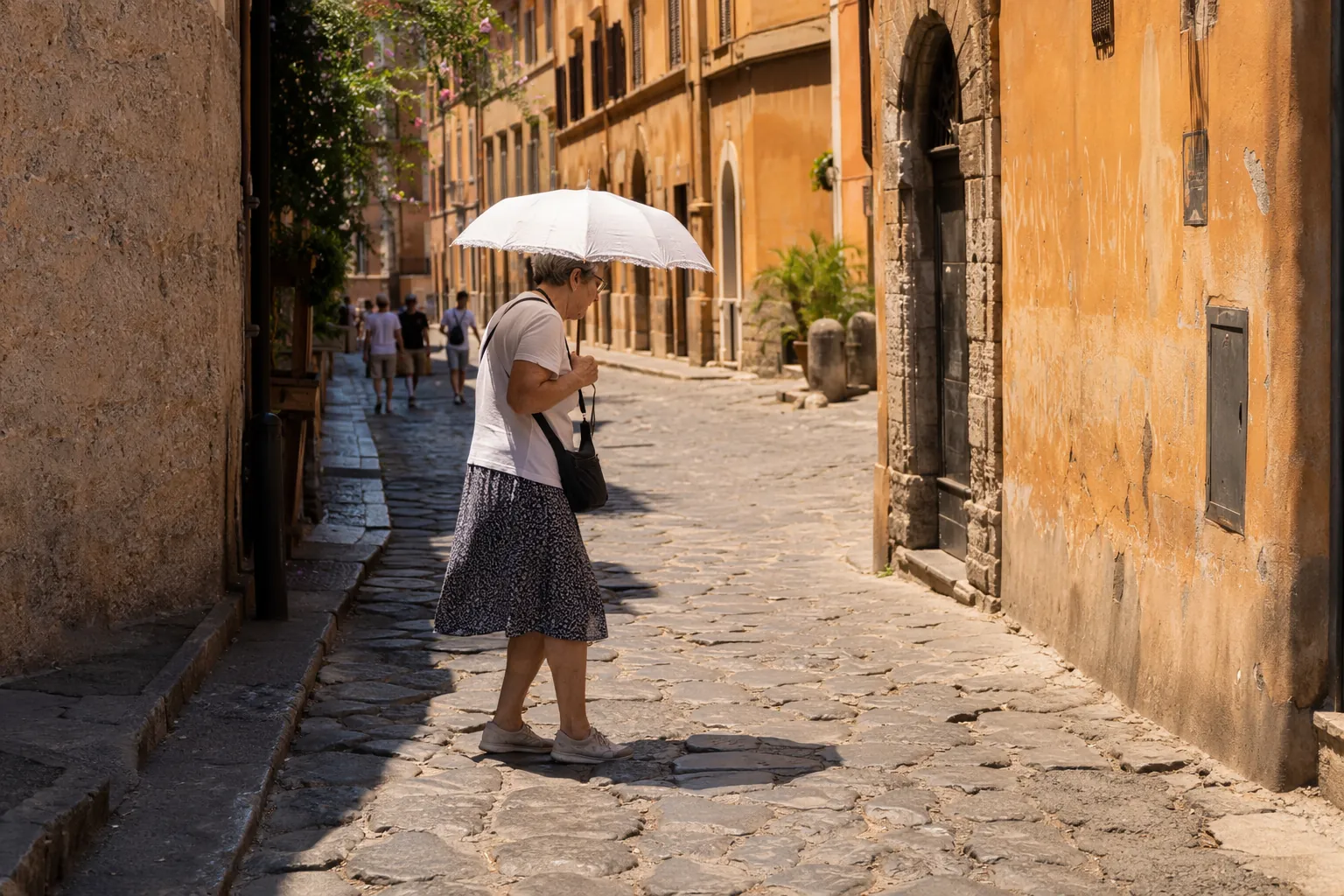
Athens, Rome, and Seville are the hardest places to discuss without sounding like the person ruining the dream. They are also exactly where a family needs to be honest before booking. The appeal often depends on long outdoor walking, old stone, stairs, plazas, archaeological sites, and rentals in historic centers. Those same features can turn heat-related dizziness into a serious fall hazard.
Current 2026 Europe heat-wave reporting describes sustained June-to-August heat in the 35°C to 42°C range in affected areas, and Travel + Leisure reported severe disruptions and safety concerns during the late-June heat wave.[8] Atlas & Awe’s 2026 analysis says only 30% of Airbnbs in historic European city centers have confirmed air conditioning, a detail families should treat as a booking filter rather than a comfort preference.[9]
CN Traveller has also covered the 2026 European heat wave and cooler alternatives for travelers trying to avoid the worst conditions.[10] The WHO Director-General reported more than 1,300 deaths since June 21, 2026, in connection with the European heat wave, though current-event figures can change as public-health reviews continue.[8]
The Acropolis problem is the clearest version of the mechanism: exposed stone, little shade, climbing or uneven footing, crowds, and the pressure to keep moving because this may be the only visit. Rome and Seville add their own versions through cobblestones, plazas, steps, and old buildings where cooling can be inconsistent. A senior may be able to manage one hot outdoor site; the risk rises when the trip repeats that demand over several sightseeing days without true recovery.
Booking judgment: for a fall-prone older adult, strongly consider a cooler European alternative in peak summer. Cooler options include the Basque coast at 22°C to 26°C, Norwegian fjords at 18°C to 22°C, the Scottish Highlands at 15°C to 20°C, Baltic capitals at 20°C to 24°C, and Alpine villages above 1,000 meters at 15°C to 25°C.[10]
The Booking Questions That Matter More Than the Brochure
A destination does not have to be crossed off forever because it is hot in summer. But if an older traveler has fallen before, gets dizzy on standing, takes medications that affect blood pressure or fluid balance, has heart disease, or tries hard not to complain, weather belongs in the fall-prevention checklist before money is spent.
- Confirm air conditioning in writing, including bedrooms, elevators if needed, and common areas where the traveler will wait.
- Map the actual walking surfaces: cobblestones, curbs, ramps, long parking lots, pedestrian bridges, museum steps, and exposed paths.
- Plan seated recovery after meals, tours, and transit; standing up after a long rest is a high-risk moment for dizziness.
- Avoid peak heat as a rule, not as a preference. Build the day around early activity, indoor midday rest, and flexible evenings.
- Review medications before travel, especially diuretics, blood pressure drugs, antihistamines, and antidepressants.
- Give the older traveler an easy exit plan that does not require admitting defeat in front of the group.
For families preparing a hotel room or vacation rental during extreme heat, CareWise’s guide on preparing an elderly parent for 108°F heat translates well to travel: check cooling before the crisis moment, plan backups, and do not wait until symptoms appear.
The safest summer destination is not always the most famous one. For seniors at fall risk, the better question is whether the weather, walking pattern, cooling reliability, medication profile, and recovery time make dizziness likely. If they do, the trip needs a different season, a cooler place, or a stricter plan before the itinerary is finalized.
References
- Dehydration and Falls in the Geriatric Population: A Retrospective Analysis of a Large Regional Health System, Mayo Clinic Proceedings, 2020.
- Heat Wave Dangers, AARP.
- Heat and Older Adults Aged 65+, CDC.
- Heat-related deaths in Phoenix on track to be lower this year despite extreme temps, NPR, August 2025.
- Beat the Heat: Summer Safety Tips for Phoenix Seniors, Comfort Keepers Phoenix.
- Seniors at Risk as Florida Temperatures Soar, UCF Health.
- Texas heat puts older adults at risk during summer, Houston Chronicle.
- Europe Heat Wave 2026 Travel Updates, Travel + Leisure, June 29, 2026.
- Europe Heatwave 2026 Survival, Atlas & Awe.
- Heatwave Europe 2026, CN Traveller.
Related reading
Noticed something outdated or inaccurate on this page? Flag a correction. We review every report against CDC, NIA, and AARP HomeFit guidance before updating a page.
Part of the Fall Prevention section.