
STEADI: intervene
Why Extreme Heat Raises Fall Risk in Older Adults
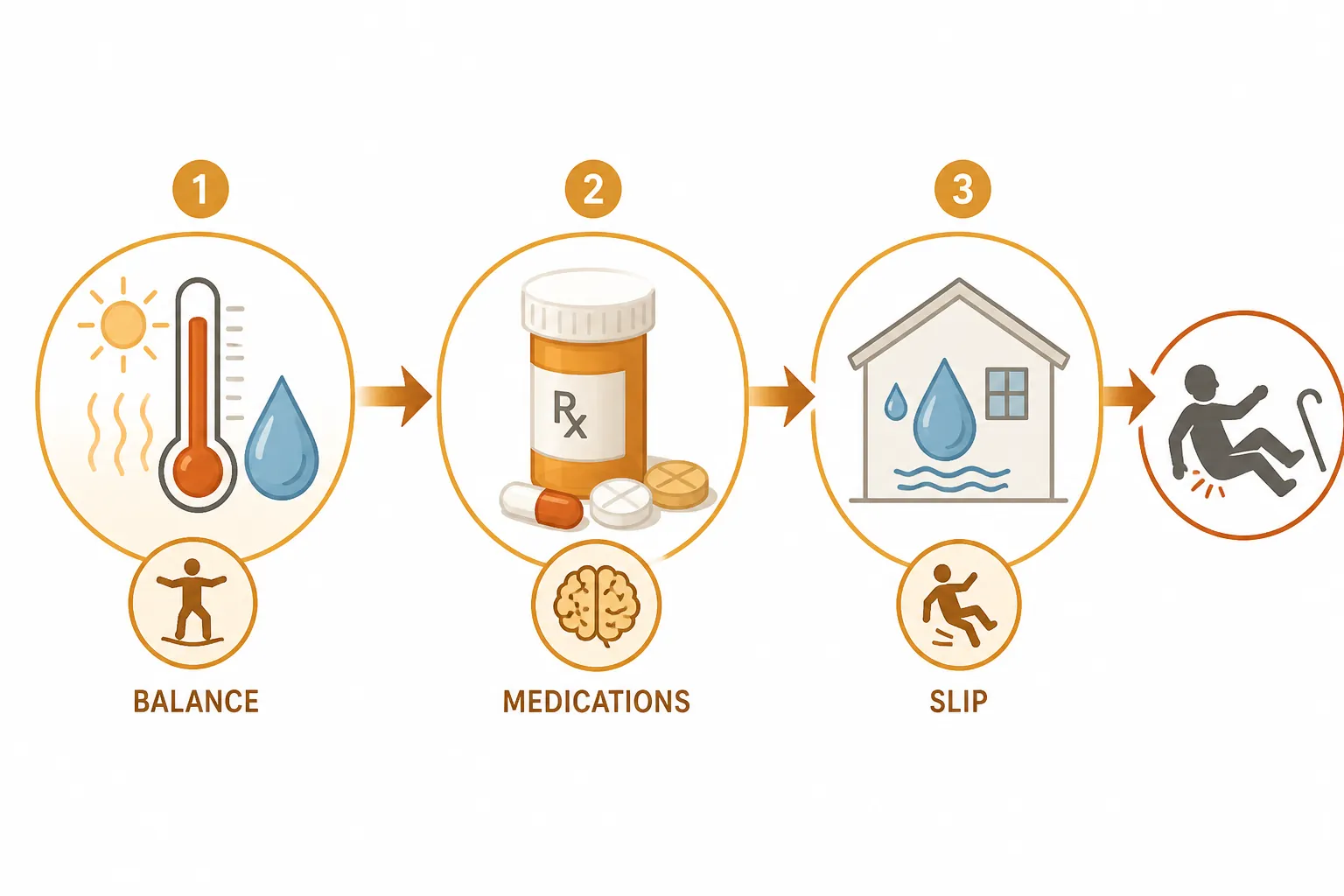
Extreme heat creates a preventable three-link fall-risk cascade in older adults: dehydration impairs balance and cognition, common medications block cooling and independently increase fall risk, and indoor humidity adds physical slip hazards. This article explains each link and the specific interventions that can break the chain before a fall occurs.
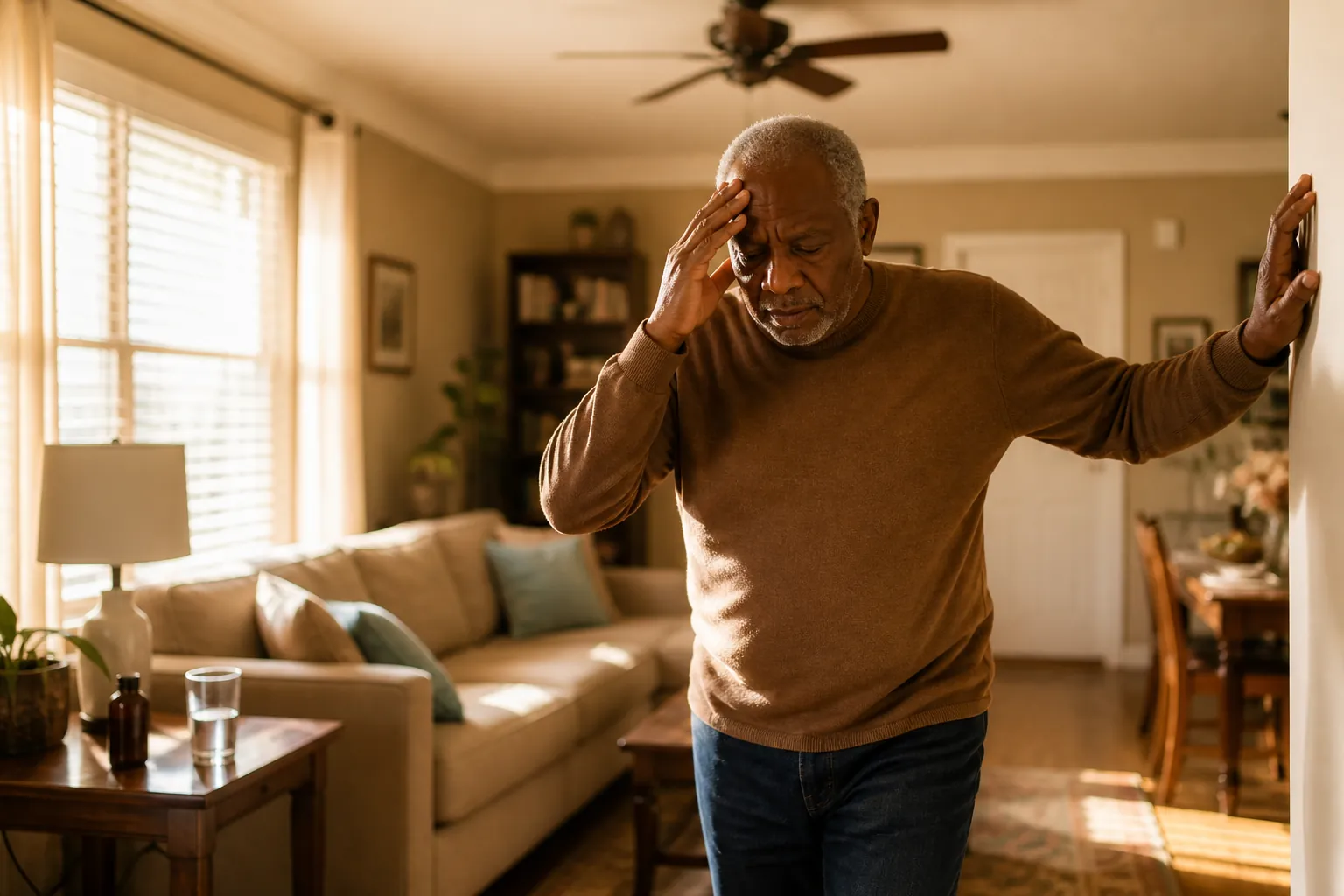
The first sign is often small. An older parent stands up from the chair and reaches for the wall. The house is not boiling, exactly, just heavy and still. The blinds are closed, the bathroom rug is damp, the pill organizer is on the kitchen table, and the answer to every question is, “I’m fine.”
That is where extreme heat becomes a fall-prevention issue. The danger is not only heatstroke, and it is not solved by telling someone to drink more water and hoping they remember. Heat can start a preventable chain: fluid loss makes balance and thinking less reliable, certain medications make cooling harder while also raising fall risk, and a humid home turns a slow step or weak reaction into a slip.
The practical answer is to watch the chain, not just the thermometer. Check hydration before dizziness appears. Review medications before a heat wave turns side effects into hazards. Cool and dry the places where the person actually walks.
Heat Raises Fall Risk Before It Looks Like an Emergency
Older bodies do not shed heat as efficiently as younger bodies. Aging is associated with less sweating and reduced blood flow to the skin, which weakens two of the body’s ordinary cooling routes.[1][2] That matters inside the home, not just outside in direct sun. A stuffy bedroom, a warm hallway, or a bathroom after a shower can be enough to make an already cautious walker slower, weaker, or less steady.
Heat also takes away some of the backup systems people rely on to avoid falling. A person may stand more slowly, turn less smoothly, or need an extra second to notice the edge of a rug. That extra second is not a minor detail when the floor is damp or the walker is parked just out of reach.
Big heat statistics have their place. Harvard Medicine notes that broad estimates attribute about 12,000 U.S. deaths each year to heat-related causes, while narrower counts produce lower annual figures.[1] But in a home visit, the useful question is smaller: what is making this person unsteady today, and which part of the chain can be interrupted before the fall?
The First Link: Dehydration Can Show Up as Wobbling, Not Thirst
One of the least helpful reassurances in hot weather is “she says she isn’t thirsty.” Older adults may have a reduced thirst sensation, so they may not feel thirsty even when their bodies already need fluid.[1] That does not mean every unsteady step is dehydration. It does mean thirst is a weak screening tool.
Heat-related dehydration can make older adults feel dizzy, weak, or confused, which are exactly the conditions that make a trip to the bathroom or kitchen more dangerous.[2] A parent who is mildly confused may forget the cane. A person who feels weak may push up from a rolling chair. Someone who is dizzy may reach for a towel bar that was never meant to hold body weight.
The useful shift is from asking only how someone feels to checking what has changed. Brown University Health gives caregivers one concrete marker: a weight loss of 2 or more pounds in 24 hours can be a sign of dehydration in older adults.[3] That is not a diagnosis by itself, but it is much better than guessing from mood, color, or a quick “Are you drinking enough?”
What to Check Before Dizziness Becomes a Fall
- Track daily weight during high-heat periods if the person can do so safely and consistently; a 2-pound drop in 24 hours deserves attention.[3]
- Notice new wobbling, slower walking, confusion, unusual fatigue, or needing the wall more than usual.
- Look at actual intake: cups left full, water bottles untouched, meals skipped, or coffee replacing fluids.
- Check the timing of symptoms. Dizziness after standing, after a hot shower, or after sitting in a warm room points to a different risk pattern than a one-time stumble over clutter.
- Call a clinician promptly if dehydration is possible and the person has heart, kidney, or fluid-restriction instructions; “drink more” is not safe advice for every medical situation.
For a broader seasonal overview, CareWise Guide’s companion article on how summer heat increases fall risk in older adults covers the larger pattern. Here, the key point is narrower: do not wait for thirst to prove heat is affecting balance.
The Second Link: Medication Risk Is Not Just “Being Frail”
Medication is where heat advice often gets too vague. It is not enough to say that older adults on medications should be careful. Some drugs can interfere with the body’s ability to cool itself, and some also increase fall risk through dizziness, sedation, low blood pressure, or changes in alertness. During extreme heat, those two problems can land on the same person at the same time.
CDC clinical guidance identifies several medication groups that can increase heat-related risk, including diuretics such as furosemide and hydrochlorothiazide, beta blockers such as atenolol and metoprolol, SSRIs and SNRIs, antipsychotics, and anticholinergic antihistamines such as diphenhydramine.[4] Banner Health also warns that common medications can affect hydration, sweating, and temperature regulation in older adults during hot weather.[2]
| Medication group | Why it matters during extreme heat | Fall-prevention action |
|---|---|---|
| Diuretics, including furosemide and hydrochlorothiazide | May contribute to fluid loss and dehydration risk in hot weather.[4] | Ask the prescriber or pharmacist what symptoms should trigger a call; do not change the dose on your own. |
| Beta blockers, including atenolol and metoprolol | Can affect cardiovascular responses that help the body manage heat.[4] | Watch for new weakness, dizziness, or reduced tolerance for warm rooms. |
| SSRIs and SNRIs | Can be part of heat-risk medication profiles identified by CDC guidance.[4] | Treat new confusion, unsteadiness, or unusual sleepiness during heat as worth reporting. |
| Antipsychotics | Can impair thermoregulation and may also affect alertness or movement.[4] | Make a heat plan before temperatures peak, especially for people who cannot reliably report symptoms. |
| Anticholinergic antihistamines, including diphenhydramine | Can interfere with sweating and cooling mechanisms.[4] | Avoid adding over-the-counter sleep or allergy products without checking with a clinician or pharmacist. |
This is where the pill organizer on the table matters. A caregiver does not need to memorize every drug interaction, but someone should know which medicines are taken in the morning, which are taken at night, which were added recently, and which over-the-counter products have quietly become routine. Diphenhydramine, for example, may be sitting in a sleep aid or allergy box rather than in a prescription bottle.
The safe move is review, not improvisation. Do not stop blood pressure medication, psychiatric medication, diuretics, or other regular prescriptions abruptly because the weather is hot. Bring the medication list to the prescriber or pharmacist and ask a heat-specific question: “During a heat wave, which of these could worsen dehydration, dizziness, low blood pressure, sleepiness, or confusion, and what should we do if that happens?”
Medication risk also changes the threshold for concern. A slight wobble in a cool room after a normal breakfast is one thing. A slight wobble at 5 p.m. in a stuffy apartment after a diuretic, little fluid, and a poor lunch is another. The movement may look the same from the doorway; the risk behind it is not the same.
Cognitive Changes Make Self-Reporting Less Reliable
Heat safety depends on noticing discomfort early, but some older adults cannot do that reliably. People with cognitive impairment may not recognize or report that they are hot or thirsty, so caregivers need to rely more on observation and routine checks than on verbal reassurance.[5][6]
That changes the caregiving job. Instead of asking once, accept the answer, and move on, look for departures from the person’s usual pattern. Is the person more irritable, quieter, sleepier, or more repetitive? Are they refusing food, walking less, or forgetting the walker? Are they wearing heavy clothing in a warm room? These signs do not prove heat illness, but they tell you not to treat “I’m fine” as the whole assessment.
For escalation signs during the hottest part of an event, use a focused warning-sign guide such as 5 Fall Warning Signs During a Dangerous Heat Wave Peak. This article stays with the earlier part of the problem: the point where a caregiver can still interrupt the fall-risk chain.
The Third Link: Humidity Turns Small Mistakes Into Slips
The home environment does not have to be dramatic to become dangerous. Humidity can make bathrooms, entryways, and other surfaces slippery, especially when moisture collects on floors or mats.[7] Add heat fatigue, slower reaction time, and a rushed trip to the toilet, and the fall no longer looks mysterious.
Bathrooms deserve special attention because they combine heat, steam, water, hard surfaces, and transitions from sitting to standing. Entryways matter because wet shoes, umbrellas, condensation, or a humid doormat can create the first hazard a person meets when coming inside. Kitchens matter because people often walk there when they are already thirsty, lightheaded, or trying to prepare something quickly.
- Cool the walking route, not just the room with the air conditioner; the bedroom-to-bathroom path may be the highest-use route.
- Dry bath mats, entry rugs, and floor edges quickly; damp fabric can slide or catch a foot.
- Run bathroom ventilation during and after bathing, and give the room time to clear before an unsteady person walks in.
- Keep canes, walkers, grab bars, and night lights available where the person actually reaches for support.
- Remove temporary summer clutter from paths: fans with cords, extra water bottles on the floor, laundry baskets, shoes, and rolled-up towels.
A fan cord stretched across the hallway is not a minor housekeeping issue when someone is dehydrated and taking a medication that can worsen dizziness. A damp bath mat is not just untidy when the person stepping onto it is weak from heat. The same object becomes more dangerous because the body’s recovery response is slower.
Use Temperature Guidance Without Waiting for a Perfect Cutoff
Caregivers often want a single number that says when danger begins. That would be convenient, but heat risk depends on humidity, indoor airflow, medications, hydration, cognition, and how long the person has been exposed. Brown University Health uses 103°F as a danger threshold for seniors when discussing heatstroke signs, while other clinical materials may use different thresholds for heatstroke definitions.[3] In fall prevention, waiting for a textbook number is the wrong habit.
The better question is whether the current conditions are changing how the person moves or thinks. If the hallway is hot, the bathroom is humid, the person has had little fluid, and the medication list includes heat-risk drugs, act before a collapse or a high fever settles the matter.
For temperature-specific planning, use heat index thresholds for senior heat safety. If the problem is a power outage, broken cooling, or a disaster setting, use the separate guide to heatstroke prevention for seniors after a disaster.
A Practical Heat-Visit Sequence for Caregivers
When you arrive after work and the house feels heavy, do not start with a lecture. Start with the chain.
- Watch the walk: standing up, turning, bathroom trips, and whether the person reaches for walls or furniture more than usual.
- Check fluid clues: weight change if tracked, cups left untouched, skipped meals, dry mouth, dizziness, weakness, or confusion.
- Look at the medication setup: prescriptions, over-the-counter sleep or allergy products, recent dose changes, and timing of dizziness.
- Cool the path: bedroom, hallway, bathroom, kitchen, and favorite chair area, not only the room that feels best to you.
- Dry the slip points: bath mat, shower floor edge, entry rug, kitchen sink area, and any floor near a fan, cooler, or condensation.
- Escalate if symptoms are changing: new confusion, fainting, severe weakness, repeated dizziness, or signs that the person cannot stay safely upright.
This sequence is not meant to replace medical care. It is meant to keep a caregiver from treating heat, hydration, medication, and flooring as separate chores. In real homes, they stack.
The same dehydration-to-dizziness pattern can also appear when fluid loss comes from illness rather than heat. CareWise Guide discusses that related mechanism in its article on dehydration-related fall risk during a cyclospora recall. The cause differs, but the caregiving lesson is similar: dizziness and weakness are not background noise in an older adult who is already at risk of falling.
Where to Break the Chain
Caregivers do not have to predict every heat emergency. They do need to notice when heat has begun changing the conditions for safe movement. A parent who is less thirsty than expected may still be dehydrated. A familiar medication may become more hazardous during a heat wave. A damp bathroom floor may matter more when balance and reaction time are already impaired.
The practical work is to check fluid status, medication risk, and indoor conditions together. That is how extreme heat stops being only a weather problem and becomes something a caregiver can interrupt before it becomes a fall.
References
- The Effects of Heat on Older Adults, Harvard Medicine Magazine
- Heat Warning: Summer Safety Tips for Seniors and More, Banner Health
- How Seniors Can Stay Safe in Summer, Brown University Health
- Heat and Medications – Guidance for Clinicians, CDC, September 2025
- Tips to Keep the Elderly Safe in Extreme Heat, Atrium Health Wake Forest Baptist
- How to Recognize the Signs of Heatstroke in Older Adults, Jefferson Health
- How Heat and Humidity Can Impact Senior Safety at Home, Oakley Home Access
Related reading
Noticed something outdated or inaccurate on this page? Flag a correction. We review every report against CDC, NIA, and AARP HomeFit guidance before updating a page.
Part of the Fall Prevention section.