
STEADI: intervene
How Summer Heat Increases Fall Risk in Older Adults
Learn how summer heat triggers a preventable fall-risk cascade in older adults—from dehydration and medication effects to orthostatic hypotension—and get specific steps to prevent falls during extreme weather.
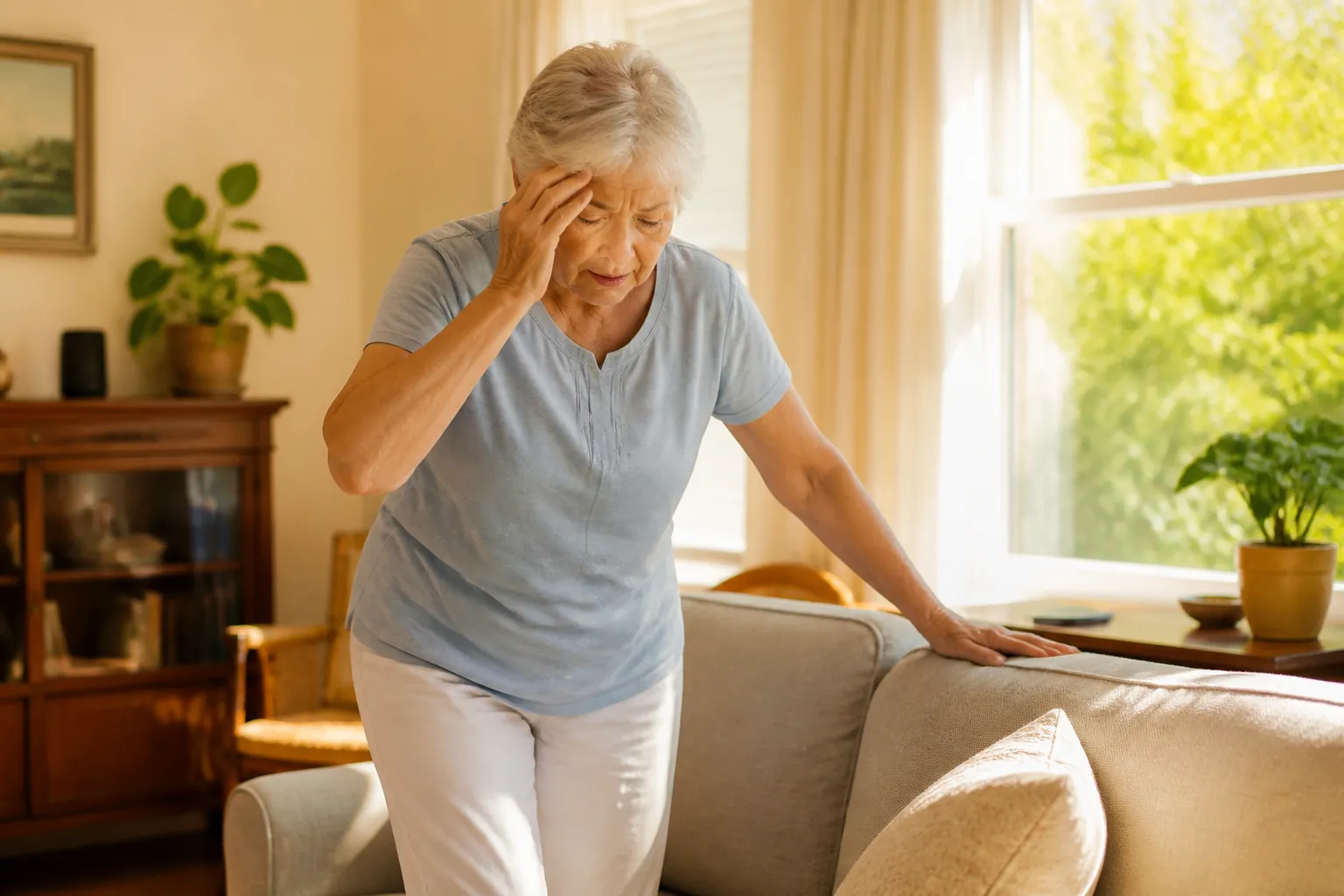
The fall often starts before anyone calls it a fall risk. An older parent stands up from the living-room chair on a hot afternoon, pauses, reaches for the sofa, and says they are “just a little lightheaded.” They may not feel thirsty. They may have taken their usual morning medications. The room may not seem dangerous, only warm.
That small moment is where summer preparedness for older adults needs to become more specific. Heat does not only threaten older adults through heat stroke after hours outdoors. It can quietly lower fluid reserve, interfere with the body’s normal cooling response, worsen dizziness after standing, and slow the reaction time needed to catch balance before the knees buckle.
The practical question is not simply whether an older adult has water nearby. It is whether the family can see the chain early enough: less thirst, less fluid, heat-sensitive medications, a blood pressure drop on standing, weakness, and then a fall.
The Hot-Afternoon Fall Cascade
Aging changes the margin of safety. The CDC notes that older adults do not adjust as well as younger people to sudden temperature changes, and they are more likely to have chronic conditions or take medications that affect the body’s normal response to heat. The same CDC guidance also warns that older adults may not feel thirsty even when they are dehydrated.[1]
That matters for falls because thirst is a late and unreliable alarm for many older adults. If a person waits until they feel thirsty, they may already have less circulating fluid than their body needs for a safe stand from a chair. When they rise, gravity pulls blood toward the legs. If the body cannot tighten blood vessels and maintain pressure quickly enough, the brain gets a brief shortfall. The person feels dizzy, dim, weak, or suddenly unsure where to put their feet.
That blood pressure drop after standing is orthostatic hypotension. In a cool, rested body, the person may compensate fast enough. In a hot room, after missed fluids, after lunch, or after a medication that changes fluid balance or heart response, the recovery can be slower. The older adult does not need to faint for the situation to become dangerous. A half-second delay can be enough to miss the counter, twist toward a chair, or step backward onto a rug edge.
Families often describe this as “weakness,” which is understandable but too vague to be useful. On hot days, new weakness after standing, slower walking after a warm afternoon, or a need to hold the wall on the way to the bathroom should be treated as information. It may be the body showing the fall pathway before the fall happens.
Medication Review Is a Heat-Safety Task, Not a Paperwork Task
The CDC’s clinician guidance on heat and medications is useful because it names the mechanisms instead of offering a vague warning that “some medications” are risky in summer. It identifies medication classes that can increase heat-related risk by affecting fluid volume, sweating, thermoregulation, sodium balance, sedation, dizziness, and blood pressure.[2]
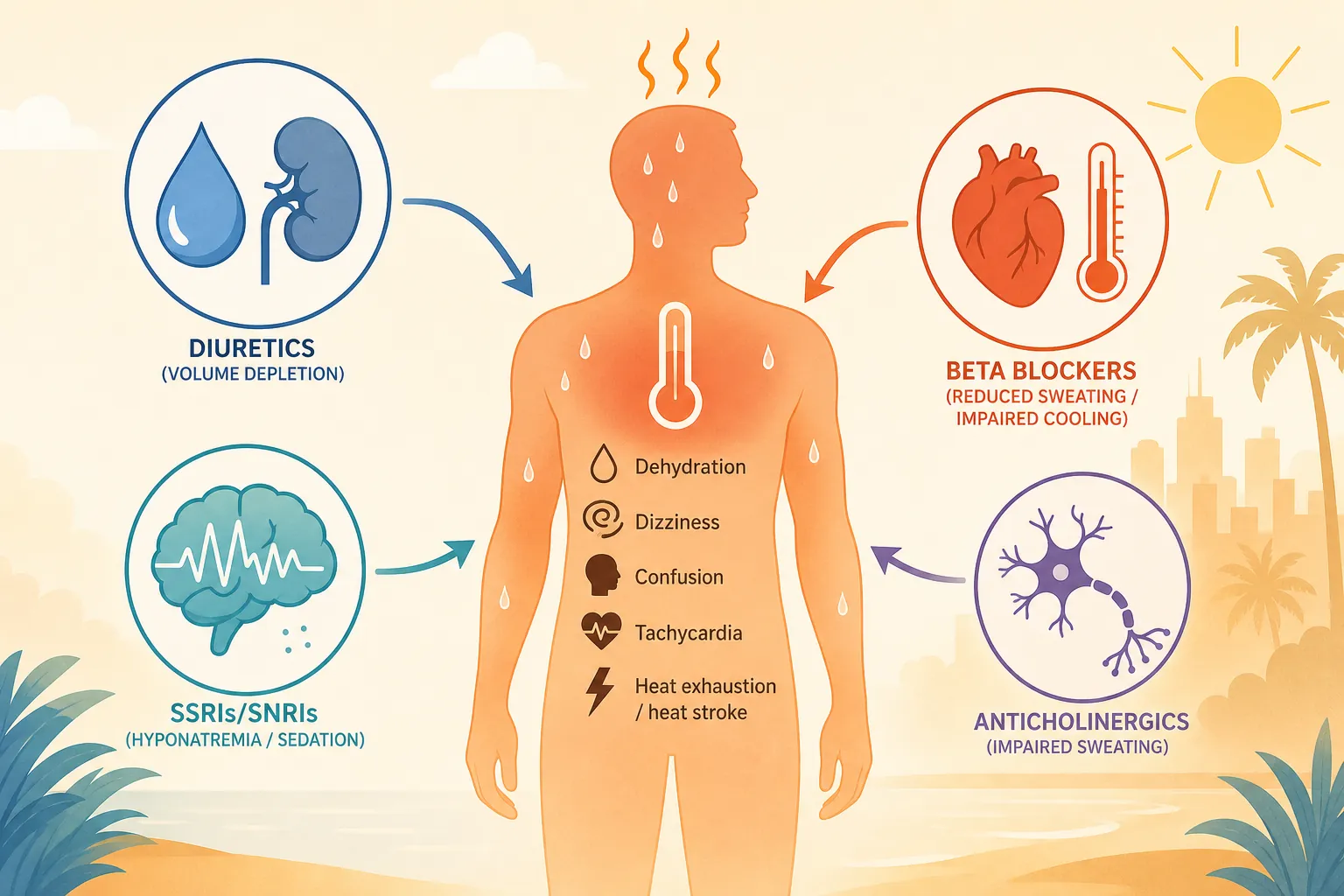
For fall prevention, the point is not to stop medications. It is to know which medicines may narrow the safety margin during heat waves, then ask a pharmacist or prescriber what monitoring or timing precautions make sense. Medication changes should only be made under a prescriber’s supervision.
| Medication class | Why it can matter in heat | Fall-prevention question to ask |
|---|---|---|
| Diuretics | Can contribute to volume depletion, which leaves less fluid reserve when standing. | “During very hot days, what signs of dehydration or low blood pressure should we watch for?” |
| Beta blockers | Can reduce sweating and impair thermoregulation, making it harder for the body to cool itself. | “Could this medication make heat tolerance or dizziness harder to judge?” |
| SSRIs/SNRIs | Can be associated with hyponatremia and sedation, both of which can affect steadiness. | “Should we watch for confusion, unusual sleepiness, or balance changes during heat?” |
| Anticholinergics | Can impair sweating, reducing one of the body’s main cooling tools. | “Is this medication adding heat risk, and are there safer alternatives or timing concerns?” |
| ACE inhibitors and related blood-pressure medicines | Can interact with heat stress and fluid changes in ways that affect blood pressure. | “If standing dizziness appears in hot weather, what should we check before changing anything?” |
| Antipsychotics | Can impair thermoregulation and may add sedation or balance concerns. | “What heat warning signs would require urgent medical advice for this person?” |
A useful medication review sounds concrete. Bring the full medication list, including over-the-counter sleep aids, allergy medicines, bladder medicines, and supplements. Ask which items can affect sweating, fluid balance, sodium, alertness, or blood pressure in hot weather. Ask what symptoms should trigger a call. Ask whether home blood pressure checks are appropriate, especially when dizziness appears after standing.
The review belongs before the first serious heat wave if possible. During a heat wave, the job changes: watch for new patterns. A father who is usually steady in the morning but wobbly after lunch, a mother who skips her usual walk because her legs feel heavy, or a spouse who becomes unusually sleepy in a warm room may be showing medication-plus-heat stress, not ordinary aging.
Heat Exhaustion Symptoms Are Also Fall Warning Signs
Heat exhaustion is usually discussed as a heat-illness problem. In an older adult at home, it is also a balance problem. Dizziness, nausea, weakness, and a rapid pulse can appear before a fall, especially when the person keeps trying to move around normally instead of sitting, cooling, and rehydrating safely.[3][4]
Caregivers should pay special attention to changes that happen in sequence. The older adult eats less because it is hot. They drink less because they are not thirsty. They stand and feel lightheaded. They sit down and say they are fine. An hour later they walk to the bathroom quickly because they do not want help. That is a common household pattern, and it gives several chances to interrupt the fall path.
Heat stroke signs are different. A body temperature of 103°F or higher, confusion, or unconsciousness requires emergency care, not home observation.[3][4]
What to Do Before the Weak-Knee Moment
Good hot-weather fall prevention is not a long disaster checklist. It is a short set of decisions made before judgment is foggy and legs are unsteady.
- Schedule fluids instead of waiting for thirst. Use routine anchors such as waking, breakfast, midmorning, lunch, midafternoon, dinner, and evening medication time, unless a clinician has given fluid restrictions.
- Build a slow stand into the day. Sit at the edge of the chair or bed first, place both feet flat, stand with support, pause, and only then walk.
- Treat post-lunch and late-afternoon movement as higher risk on hot days. Those are good times for check-in calls, bathroom planning, and clearing walkways.
- Move cooling from comfort to prevention. Air conditioning, a cooler public space, cool showers, and light clothing help reduce heat strain before dizziness starts.
- Keep assistive devices where the person actually stands up. A cane across the room does not help during the first dizzy seconds.
A hydration schedule should be individualized. People with heart failure, kidney disease, or fluid restrictions need clinician guidance. For everyone else, the key shift is behavioral: make drinking part of the day’s structure, not a response to thirst.
The fan rule needs to be clear
Fans can make a room feel more comfortable, but they are not reliable protection from heat illness when temperatures exceed 90°F. Ready.gov states that fans create air flow and a false sense of comfort but do not reduce body temperature or prevent heat-related illness in high heat; the Red Cross gives the same practical warning that electric fans should not be relied on as the primary cooling device during extreme heat.[3][4]
That matters because a fan may hide the seriousness of the situation. If an older adult is dizzy in a 90°F-plus room, the answer is not to aim the fan closer and ask them to be careful. The answer is to lower body heat: air conditioning, a cooler location, a cool shower or bath if safe, cool cloths, and rest. If power outages are part of the heat plan, families should also review a room-by-room power outage safety plan for seniors and a severe weather safety checklist for seniors living alone.
A Hot-Day Fall-Prevention Protocol
On the hottest days, the household routine should change before anyone looks ill. A simple protocol works better than repeated reminders to “be careful.”
- Check the indoor temperature and cooling plan in the morning.
- Start scheduled fluids early, following any clinician limits.
- Review the day’s higher-risk transitions: getting out of bed, standing after meals, showering, toileting, and walking to the kitchen.
- Use supported sit-to-stand pauses every time, not only when dizziness has already started.
- Move activities to cooler hours and avoid unnecessary errands during peak heat.
- Call a clinician or pharmacist for new dizziness, unusual sleepiness, confusion, repeated nausea, or suspected medication-related heat problems.
- Call emergency services for heat stroke signs such as 103°F or higher body temperature, confusion, or unconsciousness.
For an older adult who dislikes being watched, the language matters. “Sit for a minute so your blood pressure can catch up” is often easier to accept than “You might fall.” The action is the same, but it preserves dignity and explains the reason.
For an adult child checking in by phone, listen for functional changes instead of waiting for dramatic symptoms. Ask whether they stood up without dizziness, whether they finished usual meals, whether urine looked darker than usual, whether the house cooled down, and whether walking felt slower than yesterday. A parent who says “I’m fine, just tired” may still need a cooling plan and a safer next trip to the bathroom.
Earlier Intervention, Not Fear
Not every summer fall can be prevented, and not every dizzy spell has the same cause. This article is educational guidance, not medical advice. New dizziness, fainting, medication concerns, or changes in alertness should be discussed with a qualified clinician, and medications should not be changed without prescriber supervision.
Still, summer heat is not just uncomfortable background weather for older adults. It is a traceable fall-risk pathway. Once a family can see the links — low thirst, lower fluid reserve, heat-sensitive medications, standing blood pressure drops, fatigue, and delayed balance recovery — they have specific places to intervene before the weak-knee moment becomes an injury.
References
- Heat and Older Adults (Aged 65+) — CDC — https://www.cdc.gov/heat-health/risk-factors/heat-and-older-adults-aged-65.html
- Heat and Medications – Guidance for Clinicians — CDC — https://www.cdc.gov/heat-health/hcp/clinical-guidance/heat-and-medications-guidance-for-clinicians.html
- Extreme Heat — Ready.gov — https://www.ready.gov/heat
- Extreme Heat Safety — Red Cross — https://www.redcross.org/get-help/how-to-prepare-for-emergencies/types-of-emergencies/extreme-heat-safety.html
Related reading
Noticed something outdated or inaccurate on this page? Flag a correction. We review every report against CDC, NIA, and AARP HomeFit guidance before updating a page.
Part of the Fall Prevention section.