
STEADI: Screen
Is Your Parent's Fall an Early Dementia Warning Sign?
A parent's fall — or quieter changes like unsteadiness, new dents on the car, or trouble judging distance — can be an early dementia warning sign. Understand why falls and dementia are linked, which changes warrant memory screening, and how to tell a gradual warning from a sudden emergency after a fall.
A parent falls in the hallway, on the porch step, or beside the bed. The first questions are rightly ordinary ones: Are they hurt? Did they hit their head? Can they stand? But once the immediate injury is handled, the quieter question is often the one families are afraid to ask: was this just a fall, or part of something changing in how my parent moves through the world?
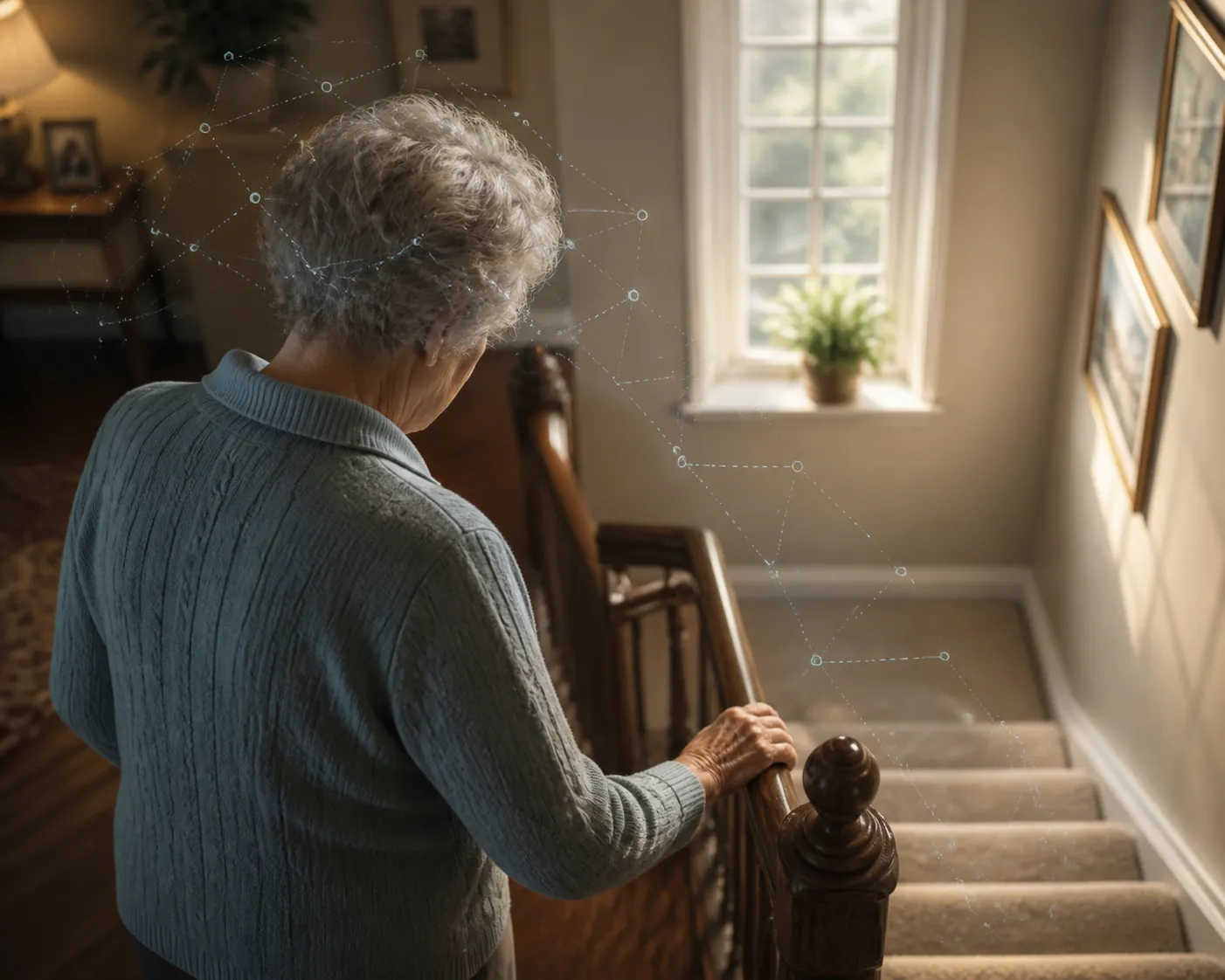
That is why recognizing early signs of dementia in an elderly parent can be less about a memory quiz and more about patterns. A single fall does not diagnose dementia. A cluster around the fall may deserve attention: new unsteadiness, fresh scrapes on the car, hesitation at stairs or curbs, trouble judging distance, getting lost on a familiar route, or repeated falls that are waved away as bad luck.
This article is educational and is not a diagnosis or a substitute for medical care. If your parent has fallen, especially with a head impact, pain, confusion, weakness, vomiting, or a sharp change in alertness, treat that as a medical issue first.
A fall is an event. The warning sign is often the pattern around it.
Families often get stuck between two unhelpful extremes. One extreme turns every stumble into a frightening dementia warning. The other treats every fall as a flooring problem, a weak-leg problem, or an “everyone falls sometimes” problem. Neither gives you much to act on.
Look instead for changes that show up in movement, judgment, and orientation. The Alzheimer’s Association includes trouble understanding visual images and spatial relationships among the early warning signs of Alzheimer’s and dementia; examples include difficulty judging distance, determining color or contrast, and problems that may affect driving [1]. The NHS also lists repeated falls as a possible symptom in dementia with Lewy bodies, while noting that dementia symptoms are typically gradual and worsen over time [2].
That matters because a fall may be the first incident serious enough for the family to notice what has been building. The missed curb, the hand hovering longer over the stair rail, the parent who no longer wants to drive at dusk, the bruises explained with a laugh — these details are more useful than trying to decide from one accident whether dementia is present.
- Your parent has begun hesitating at stairs, curbs, thresholds, or uneven sidewalks.
- They misjudge where a chair, doorway, table edge, or step is.
- There are new dents, scrapes, parking problems, or driving near-misses.
- They seem less steady even when they say they feel fine.
- They get turned around on familiar routes or avoid places they used to navigate easily.
- There has been more than one fall, especially without a clear explanation.
Why dementia can show up as a fall risk before it looks like “memory loss”
Memory changes still matter. Repeating questions, misplacing items, losing track of appointments, or struggling with familiar tasks can all belong in the conversation. But when a family arrives through a fall, the cognitive clues are often spatial and practical first.
Walking through a house is not just a leg-strength task. Your parent has to notice the rug edge, judge the height of the step, remember where the hallway turns, divide attention between carrying a laundry basket and seeing the pet underfoot, and react quickly if something is in the way. Changes in attention, depth perception, route-finding, hazard recognition, or judgment can make that chain less reliable.
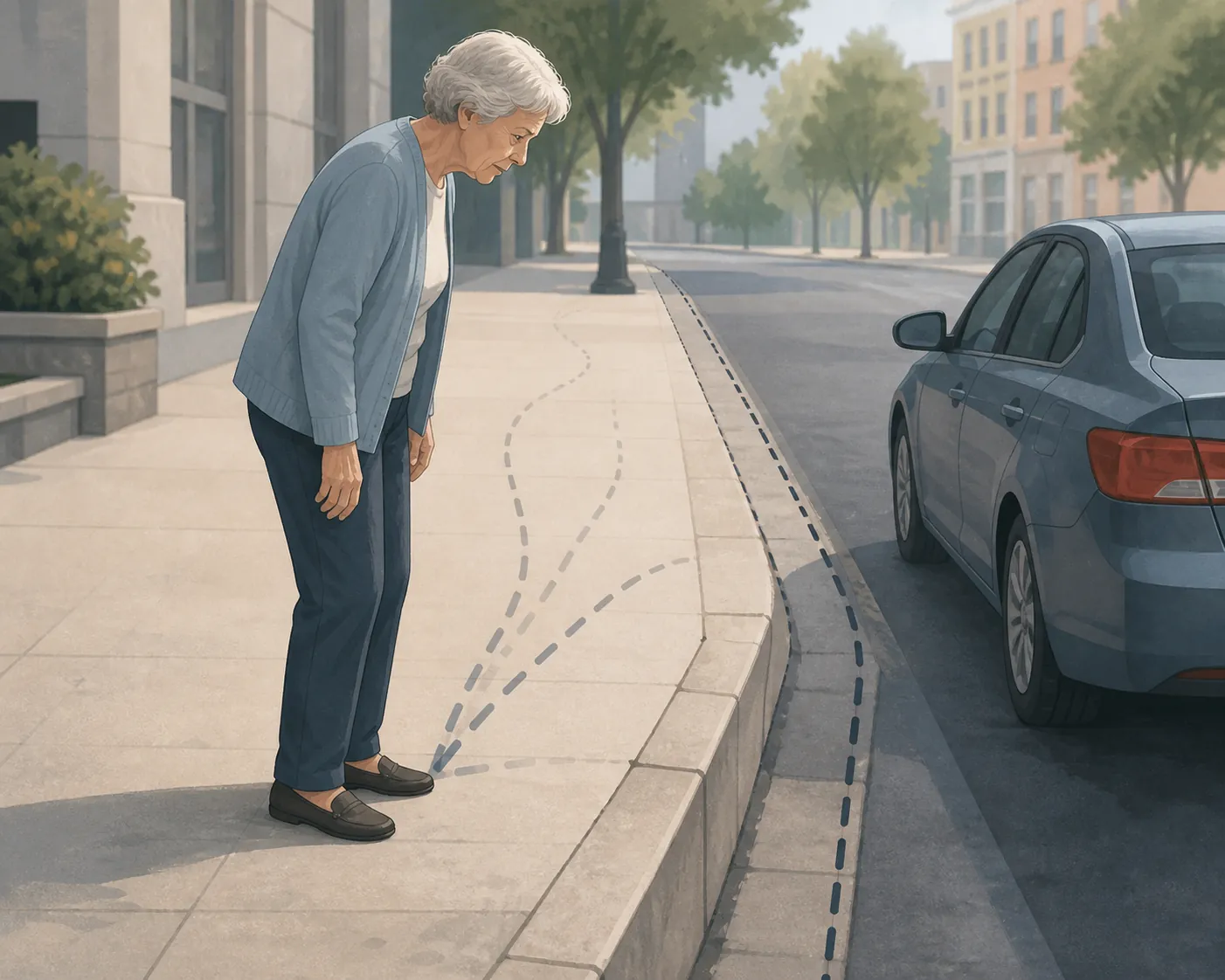
That is why the car can become part of the same story. A new scrape on the garage frame, trouble centering the car in a lane, or anxiety at intersections may reflect more than eyesight alone. It may be vision, medications, neuropathy, arthritis, sleep, alcohol, blood pressure, or a normal change in confidence. It may also be the kind of visual-spatial difficulty that belongs in a cognitive evaluation, especially if it appears alongside falls or getting lost.
The point is not to decide which disease, if any, is present from the doorway. It is to stop treating mobility and cognition as if they live in separate rooms.
What the fall-and-dementia study can — and cannot — tell you
The strongest reason to take a medically significant fall seriously comes from a large JAMA Network Open study published in 2024. Researchers studied more than 2 million older Medicare beneficiaries and found that 10.6% of those who had a fall requiring medical attention were diagnosed with Alzheimer’s disease or another dementia within the following year. Compared with other injury types, falls were associated with a 21% higher risk of a future dementia diagnosis [3].
Those numbers are important, and they need careful handling. “About 1 in 10” is not “most.” A 21% higher future diagnosis risk is not proof that your parent has dementia, and it does not mean the fall caused dementia. It means an injurious fall can be a documented precursor event — a moment when clinicians and families should ask whether thinking, judgment, vision, gait, and attention also need assessment.
The relationship also runs the other way. A Fisher Center summary reports that 70% of people with dementia experience at least one fall per year and that older adults with memory or thinking problems are about five times more likely to be admitted to long-term care after a fall [4]. Those figures describe a high-risk group; they should not be used to assume that every older adult who falls has dementia.
The useful conclusion is narrower and more practical: if a fall was serious enough to need medical attention, or if it is part of a cluster of spatial, gait, driving, or route-finding changes, ask for cognitive screening as part of the follow-up.
Sudden confusion after a fall is different
A gradual pattern belongs in a doctor’s visit and a cognitive screening conversation. A sudden change after a fall belongs in urgent medical care.
Do not wait for a routine dementia evaluation if your parent becomes newly confused, severely sleepy, unusually hard to wake, newly weak on one side, repeatedly vomits, develops a worsening headache, or has a sharp change in thinking within hours or days of a fall. Mayo Clinic lists bleeding between the brain surface and its covering — especially after a fall in older adults — among potentially reversible causes of dementia-like symptoms [5].
This is the safety line: sudden post-fall confusion may be delirium, bleeding, medication effect, infection, dehydration, or another acute problem. It should not be explained away as “probably dementia” while the family waits.
For a broader post-fall triage framework, use CareWise’s guide to senior health warning signs after a fall, especially if you are trying to track symptoms over the first few days.
What to do next after a serious fall or troubling cluster
The next step is not to accuse your parent of having dementia. It is to bring better information to the clinician who is already looking at the fall.
If the fall required medical attention, ask directly: “Can we include memory and thinking screening in the follow-up?” The CDC advises that people with possible dementia symptoms should talk with a healthcare provider, who can perform an assessment and help determine whether symptoms are due to dementia or another cause [6].
A screening request is easier for a parent to hear when it is tied to the fall and framed as routine safety follow-up: “The doctor is checking balance, vision, medications, and thinking because all of those affect fall risk.” That sentence keeps the parent from feeling as if one frightening moment has become a verdict on their independence.
Bring a short observation log, not a case against your parent
Write down concrete examples from the past few weeks or months. Keep the tone factual. Clinicians can do more with “three new dents on the passenger side since May” than with “she seems off.”
- Date and place of each fall or near-fall.
- Whether there was dizziness, tripping, weakness, pain, confusion, alcohol use, or a medication change.
- Any head impact, bruising, new pain, or change in sleepiness after the fall.
- Trouble judging curbs, stairs, chair height, doorways, or traffic distance.
- Driving scrapes, parking problems, near-misses, or getting lost.
- Changes in walking speed, shuffling, freezing, leaning, or needing to hold furniture.
- Memory or thinking changes that appear alongside the mobility changes, such as missed bills, repeated questions, or trouble following familiar instructions.
If your parent is eligible for Medicare, the annual wellness visit can be another place to raise the question because it includes cognitive assessment as part of preventive care. CareWise’s 2026 Medicare benefits checklist for seniors can help you plan that conversation.
Make the home safer while the question is being answered
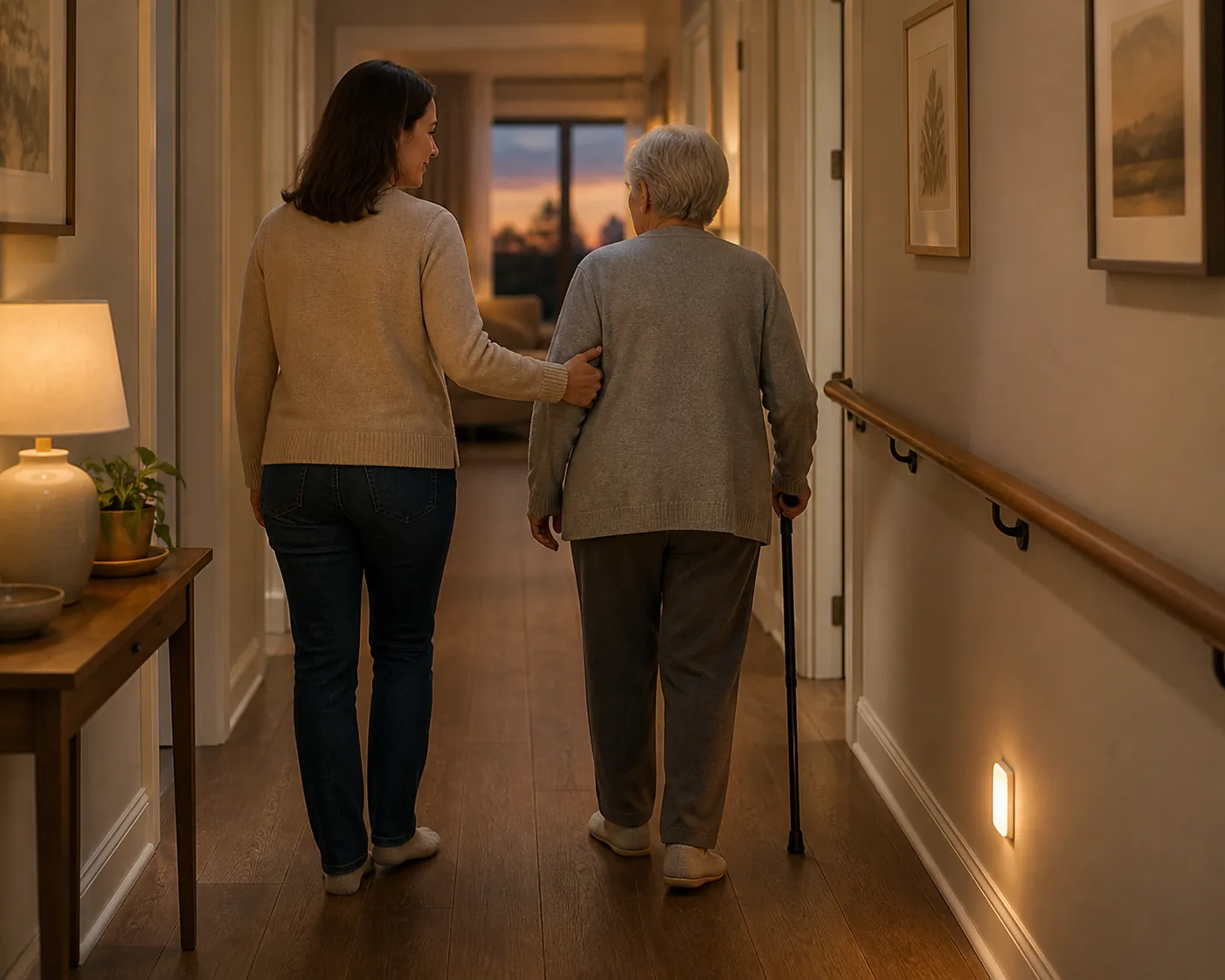
You do not have to wait for a diagnosis to reduce fall risk. In fact, waiting for certainty is one of the easiest ways to lose useful time. Lighting, trip hazards, medication review, vision correction, balance support, and safer routines help whether the cause is arthritis, neuropathy, low blood pressure, medication side effects, early dementia, or several of those at once.
- Remove throw rugs or secure them so edges cannot curl.
- Improve lighting at stairs, hallways, bathrooms, and the route from bed to bathroom.
- Add nightlights that do not create glare.
- Install or tighten handrails on both sides of stairs when possible.
- Clear cords, low furniture, shoes, pet bowls, and clutter from walking paths.
- Ask the clinician or pharmacist to review medications that may affect dizziness, sleepiness, blood pressure, or balance.
- Schedule vision and hearing checks if changes are suspected.
- Use footwear with secure backs and non-slip soles inside the home.
- Consider a physical therapy or balance evaluation if gait has changed.
If the pattern includes outdoor hesitation or seasonal hazards, expand the safety review beyond the house. Curbs, uneven sidewalks, dim parking lots, ice, and rushed transitions from car to doorway can be just as revealing as a hallway fall.
How to talk about screening without turning the fall into a verdict
A parent who has just fallen may already feel embarrassed, watched, or afraid of losing control. The words you choose can either help them participate or make them defend every ordinary lapse.
A useful script is calm and specific:
“I’m not saying this fall means dementia. I am saying there have been a few changes — the stair hesitation, the car scrape, and getting turned around last week — and I want the doctor to check everything that affects fall risk, including balance, vision, medications, and memory.”
That keeps the conversation anchored in observable safety, not blame. It also leaves room for other explanations. Many fall risks are treatable or improvable. Some dementia-like symptoms can come from reversible or partly reversible causes. And if a cognitive disorder is present, earlier recognition gives the family more time to adjust the home, review driving, organize medications, update legal documents, and include the parent in decisions while they can still speak for themselves.
Most older adults who have a medically attended fall are not diagnosed with dementia in the following year. Still, a serious fall — or a cluster of falls, distance-judging problems, gait changes, driving scrapes, and familiar-route confusion — is enough reason to ask for screening and tighten fall prevention now.
References
- 10 Early Signs and Symptoms of Alzheimer's and Dementia — Alzheimer's Association
- Symptoms of dementia — NHS
- Risk of Dementia Diagnosis After Injurious Falls in Older Adults — JAMA Network Open — September 30, 2024
- Falls in Older Adults May Presage Dementia Onset — ALZinfo.org
- Dementia — Symptoms and causes — Mayo Clinic
- Signs and Symptoms of Dementia — CDC
Related reading
Noticed something outdated or inaccurate on this page? Flag a correction. We review every report against CDC, NIA, and AARP HomeFit guidance before updating a page.
Part of the Fall Prevention section.