
STEADI: Assess
Watch for Senior Health Warning Signs After a Fall
Know which warning signs after an older adult's fall are emergencies, which need a doctor today, and what to watch over the next 72 hours. Includes a printable symptom log so vague concerns become concrete details for a medical visit.
First decision: call 911 now, call the doctor today, or watch at home
If an older adult has just fallen, do not start with reassurance. Start with sorting. The senior health warning signs caregivers should watch for fall into three buckets: emergency signs, same-day medical signs, and symptoms that can be monitored only if the person is otherwise stable.
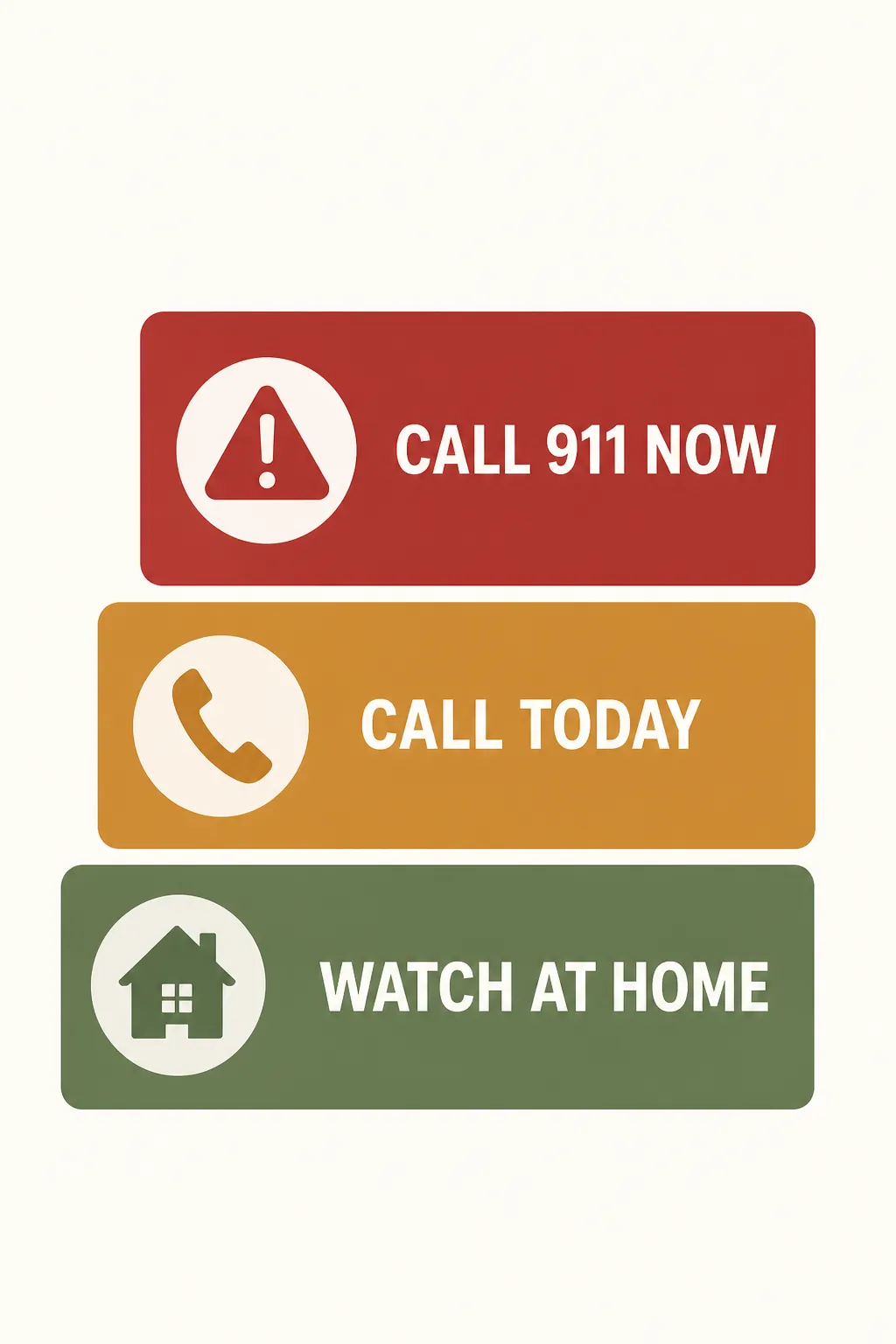
| What you see after the fall | What to do |
|---|---|
| Loss of consciousness, seizure, slurred speech, one pupil larger than the other, worsening confusion or agitation, weakness or inability to use a limb, serious bleeding from the head or face, fluid or blood from the nose or ears, or new loss of balance after the injury [1] | Call 911 now. |
| They hit their head and take blood thinners, even if they say they feel fine [2] | Call the doctor or seek medical care right away. Do not wait for symptoms to prove it. |
| No 911 signs, but pain, bruising, swelling, dizziness, headache, unusual sleepiness, or walking ability is worse than their normal | Call the doctor, nurse line, or urgent care today and describe exactly what changed. |
| No head injury concern, no blood-thinner concern, no new confusion, no new weakness, pain is mild and improving, and they can move and communicate at their usual baseline | Watch at home for now, but keep a written log for the next 72 hours and arrange follow-up. |
This guide is for caregiver decision support, not a diagnosis. If you are unsure which bucket applies, treat that uncertainty as a reason to call a clinician or emergency services. A fall can look small from across the room and still matter.
Call 911 now for these warning signs
After a fall involving possible head trauma, Mayo Clinic lists several signs that should trigger emergency help. Do not drive them yourself if they are declining, confused, weak, seizing, or hard to keep awake; call 911 and let emergency responders take over. [1]
- Loss of consciousness, even if brief
- Seizure
- Slurred speech
- One pupil larger than the other
- Worsening confusion, agitation, or behavior that is not their baseline
- Weakness or inability to use an arm or leg
- Loss of balance that appears after the fall or does not resolve
- Serious bleeding from the head or face
- Fluid or blood coming from the nose or ears
The blood-thinner rule deserves its own line because it is easy to miss in a quiet living room. The CDC says an older adult who hits their head and takes blood thinners should see a doctor right away, even if they feel fine. [2] That includes the parent who is insisting they are embarrassed, not injured. Embarrassment can wait.
Call the doctor today when things are not clearly back to baseline
Not every concerning sign is a 911 sign. Some are “do not sleep on this” signs. If your parent is stable but not normal, call the doctor’s office, nurse line, or urgent care the same day and ask where they should be seen.
- New or worsening headache, dizziness, nausea, or unusual sleepiness after the fall
- New pain in the hip, back, ribs, shoulder, wrist, or neck
- Limping, guarding one side, refusing to bear weight, or needing more help to stand than usual
- Bruising or swelling that is spreading or becoming more painful
- A new change in mood, alertness, appetite, or willingness to move
- Any fall where you cannot tell whether the head was hit, especially if no one saw the fall happen
The reason to call today is not that every bruise is dangerous. It is that pain and function matter. If walking, transferring, thinking, or using an arm changed after the fall, the doctor needs that information while the timeline is still fresh. Home-care guidance commonly treats pain, swelling, bruising, mobility changes, and behavior changes as symptoms to monitor after an older adult falls. [5]
Why “they seem okay” is not enough for the first 72 hours
A fall in someone 65 or older is common enough that families can start treating it like a normal inconvenience. That is the wrong lesson. CDC data says about 1 in 4 older adults falls each year, and about 37% of those who fall report an injury that requires medical treatment or restricts activity for at least 1 day. [3]
Head injuries are the part that make quiet monitoring so important. University Hospitals notes that after a mild head injury, people are often told to have someone observe them for the next 48 hours, and only about 4% to 6% of concussions show changes on CT or MRI. [4] A normal scan can be reassuring, but it does not turn the next two nights into a free pass.

The 72-hour window in this article is practical caregiver structure, not an official CDC rule. It gives you a defined period to compare symptoms instead of relying on memory. Home-care guidance describes brain swelling as a possible concern over 24 to 72 hours after a fall, while some bleeding around the brain can declare itself later than the first few days. [5][6]
That last point matters most for older adults on blood thinners, people who live alone, and anyone whose baseline is already complicated by dementia, Parkinson’s disease, stroke history, frailty, or balance problems. If the person is normally forgetful, write down what “normal” means tonight. “Confused” is too vague. “Asked where the bathroom was 6 times between 8 p.m. and 9 p.m.; usually asks once” is useful.
What to watch over the next 72 hours
The job is not to stare at them every second. The job is to create planned check-ins, compare each check with the last one, and escalate when the pattern moves in the wrong direction.
| Time after the fall | What to do |
|---|---|
| Right away | Decide whether any 911 warning sign is present. Ask what happened, where it hurts, whether the head was hit, and whether they take blood thinners. |
| First evening or first day | Set a baseline: speech, alertness, pupils if you can see them clearly, walking ability, pain location, bruising, swelling, and whether they can use both arms and legs as usual. |
| 24 to 48 hours | Compare against the baseline instead of asking, “Are you okay?” Watch for worsening headache, confusion, sleepiness, dizziness, nausea, pain, swelling, bruising, or walking changes. |
| 48 to 72 hours | Keep checking for delayed changes, especially after a head hit, a blood-thinner concern, or a fall that was not witnessed. |
| After 72 hours | Do not ignore new symptoms just because the first few days were quiet. Delayed bleeding symptoms can appear later in some subdural hematomas. [6] |
Use direct prompts. “Do you feel okay?” often gets a yes because the person wants the evening to be over. Better questions are: “Point to where it hurts,” “Is this headache better, worse, or the same as two hours ago?” “Stand up with me the way you usually do,” and “Tell me what room we are in.” If any answer is clearly worse than the last check, stop watching and call.
If a clinician gives different monitoring instructions, follow those. If they say to wake the person, wake them. If they say not to, do not invent a more aggressive plan because anxiety is driving. What you should not do is let everyone go to bed with no plan, no notes, and no agreement about what would trigger a call.
Turn vague worry into a symptom log
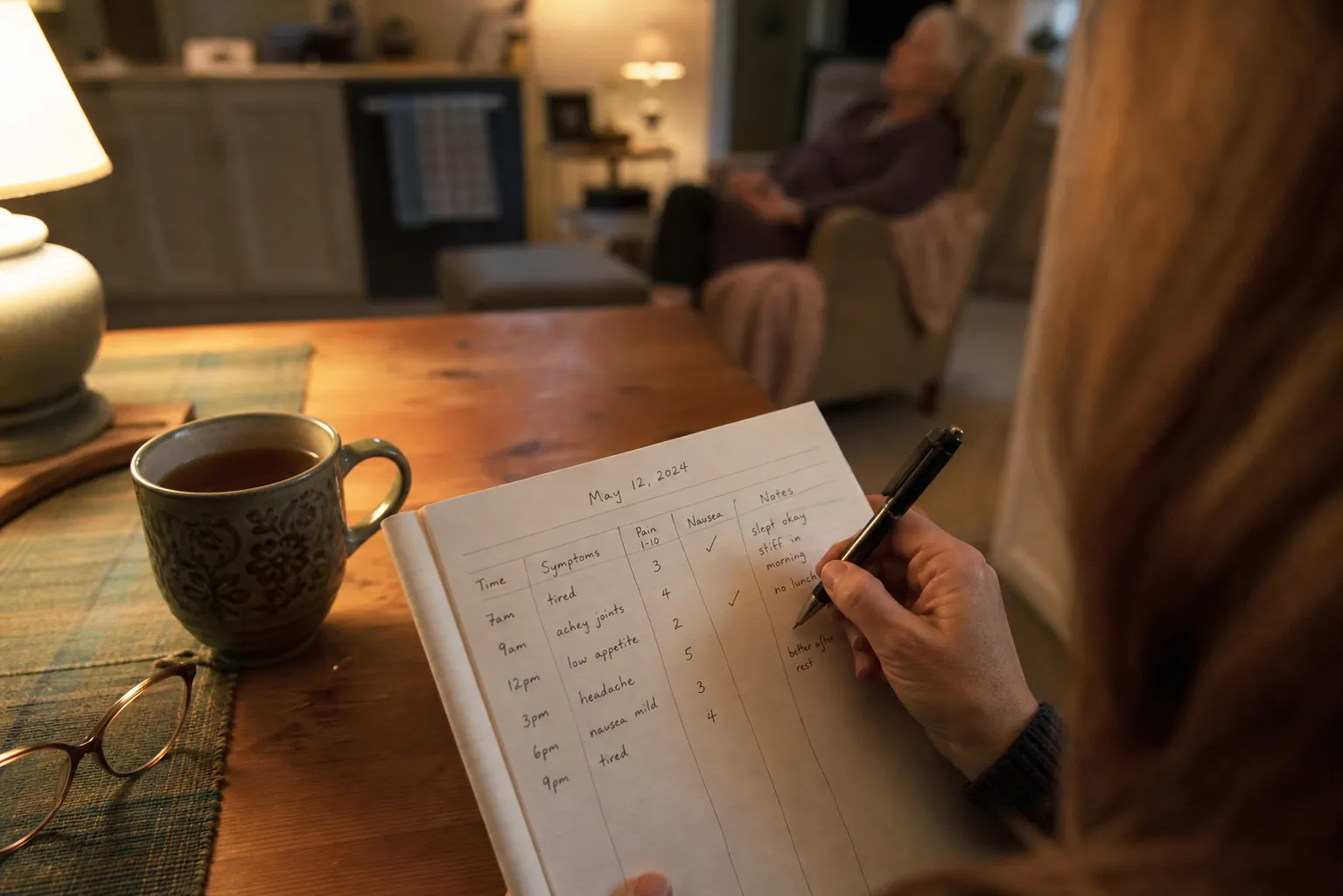
A symptom log is not busywork. It keeps one tired caregiver from trying to reconstruct the night at 7 a.m. It also gives the doctor something better than, “She seemed off.” Home-care guidance specifically recommends documenting symptoms after an older adult falls so changes over time are easier to see. [5]
| Time and date | What changed | Exact words or behavior | Pain and location | Movement | Medicine or relevant detail | Action taken |
|---|---|---|---|---|---|---|
| Example: 8:15 p.m. | More sleepy than at dinner | Answered slowly; knew name and home address | Right hip 4/10 | Stood with help; limping | Takes blood thinner; says head did not hit floor | Called nurse line |
Print this table or copy it into a notebook. If the situation is an emergency, do not pause to fill it out. Call 911 first. The log is for the gray zone: the sore hip that may be getting worse, the headache that was mild and now is not, the repeated question that might be baseline or might be new.
What belongs in the log
- The time of the fall, or the time they were found
- Whether the fall was witnessed
- Whether the head, face, hip, back, shoulder, wrist, or ribs may have hit something
- All medications that affect bleeding risk, especially blood thinners
- Pain location and whether pain is better, worse, or unchanged
- Walking, standing, transfers, grip, and ability to use each limb
- Speech, alertness, repeated questions, agitation, or unusual behavior
- Bruising, swelling, bleeding, vomiting, dizziness, or headache
- Who you called, what they told you, and when follow-up is scheduled
If several family members are rotating in and out, keep one shared log in one place. Do not let each person keep a separate version in their phone. The next caregiver needs the last check, not a group chat argument about whether Mom was “a little wobbly” before dinner.
Follow-up is part of the fall plan, even if no red flags appear
If the first 72 hours stay quiet, that is good news. It is not the end of the plan. The CDC says falling once doubles an older adult’s chance of falling again, and fewer than half of older adults who fall tell their doctor. [3] That combination is exactly how the next fall gets set up in silence.
Schedule a primary-care follow-up and bring the log. Ask about medication review, blood pressure changes, vision, footwear, home hazards, strength and balance, dizziness, dehydration, and whether physical or occupational therapy should be involved. For a broader prevention review, use the Fall Prevention FAQ and the Fall Prevention Handout after the urgent monitoring period has passed.
If the fall happened during heat, illness, poor fluid intake, or a dizzy spell, also look at the senior heat-safety checklist. If the monitoring period shows that someone cannot be left safely alone, the next practical question may be supervision; this 24-hour-care decision guide can help frame that discussion.
Keep the log. Watch for change, not just discomfort. Escalate when a threshold is crossed. A quiet first few hours is a relief, but it is not proof that the fall is finished.
References
- Head trauma: First aid, Mayo Clinic
- About Older Adult Fall Prevention, CDC
- Older Adult Falls Data and Facts About Falls, CDC
- Should You Go to the Emergency Room After a Mild Head Injury?, University Hospitals, March 2022
- 14 symptoms to look for after an elderly person falls, Alina Homecare
- Subdural Hematoma, Cleveland Clinic
Related reading
Noticed something outdated or inaccurate on this page? Flag a correction. We review every report against CDC, NIA, and AARP HomeFit guidance before updating a page.
Part of the Fall Prevention section.