
STEADI: Intervene
Keep Elderly Parents Safe During a Power Outage
A numbers-first, hour-by-hour plan for keeping an older parent safe during a power outage — the exact time and temperature limits for food, insulin, heat and cold exposure, generator placement, and when it is no longer safe to stay home.
The outage clock: what to do first, and when the rules change
| Time since power went out | Decision to make now |
|---|---|
| Hour 0 | Keep refrigerator and freezer doors closed. Switch to flashlights, not candles. Check medications, mobility path, phone battery, and any powered medical equipment. If using a generator, it must be outdoors and at least 20 feet from windows, doors, and vents. [1] |
| Hour 4 | The refrigerator becomes the main food-safety decision. Food is generally safe for about 4 hours if the door stayed closed; discard perishable food if it has been above 40°F for 2 hours or more. [2] |
| Hour 8+ | Treat the outage as more than an inconvenience for an older adult, especially with heat, cold, breathing problems, heart disease, poor lighting, or medical-device dependence. |
| Hour 24 | A half-full freezer may still hold safe temperatures if kept closed, but this is the outer limit. A freezer should be at 0°F or below; use the appliance thermometer, not a guess. [2] |
| Hour 48+ | A full freezer may hold safe temperatures for about 48 hours if the door stayed closed. After that, temperature records matter more than hope. Never taste food to decide whether it is safe. [2][3] |
| Leave now | Leave if the home cannot stay safely lit, the parent cannot avoid falls in the dark, indoor heat or cold is becoming dangerous, insulin or essential medication cannot be handled safely, a generator is being used incorrectly, carbon monoxide is suspected, or the caregiver cannot reliably check in. |
If you are trying to keep elderly parents safe during a power outage, start with the clock. Write down the time the power failed. Put one person in charge of the refrigerator and freezer. Put another person, if available, in charge of the parent: lighting, walking route, medications, temperature comfort, and phone contact.
That division matters because the first confused phone call usually blends everything together: “The lights are out, the milk is warm, Mom wants tea, Dad says the generator is fine, and nobody knows where the flashlight is.” The answer is not to argue each detail from scratch. The answer is to move through the cutoffs before they expire.
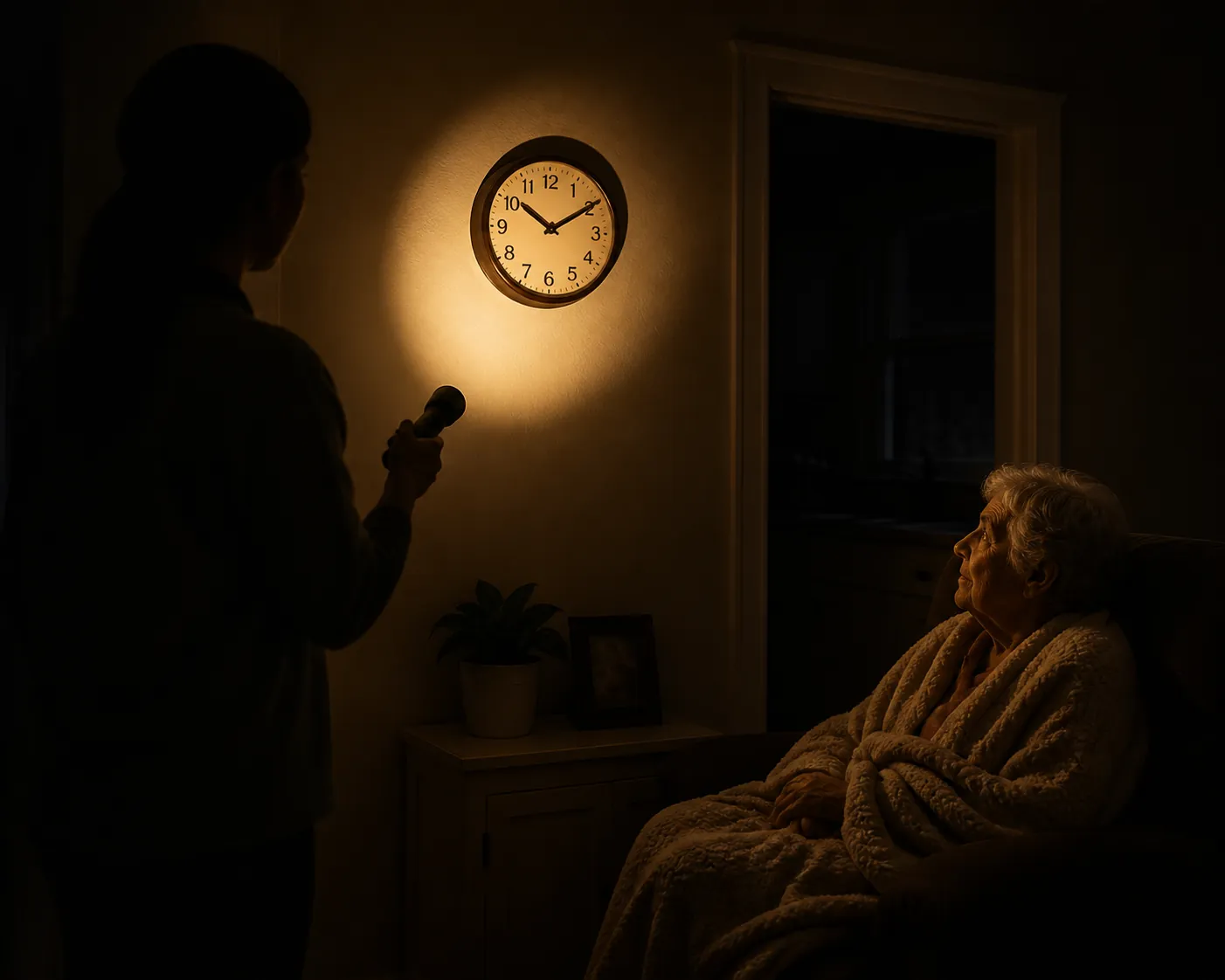
Hour 0: protect cold air, prevent falls, and stop unsafe improvising
At the moment the power goes out, close the refrigerator and freezer and leave them closed. Do not let everyone “just check” what is inside. The cold air is now a limited resource, and every open door spends some of it.
Then get light onto the floor. A parent who knows their house well can still trip when a familiar hallway becomes a black tunnel. Use flashlights or battery lanterns, not candles; the American Red Cross specifically advises using flashlights instead of candles during a power outage because of fire risk. [1]
- Put one flashlight beside the parent, not across the room.
- Light the route to the bathroom before it is needed.
- Move throw rugs, oxygen tubing, pet bowls, charging cords, and small stools out of the walking path.
- Have the parent sit before looking for supplies, changing clothes, or using the phone.
- Keep shoes or nonslip slippers on if broken branches, glass, or wet floors are possible.
If your parent uses oxygen, a ventilator, dialysis equipment, a powered bed, a lift, a CPAP machine, or another electricity-dependent device, that becomes its own urgent track. Use the companion power outage checklist for seniors on medical equipment rather than trying to solve device backup power from the pantry plan.
Do not heat the house with a gas stove or oven. Do not run a generator in a garage, on a porch, under an overhang, or near an open window. The Red Cross rule is blunt: portable generators belong outdoors, at least 20 feet away from windows, doors, and vents. [1]
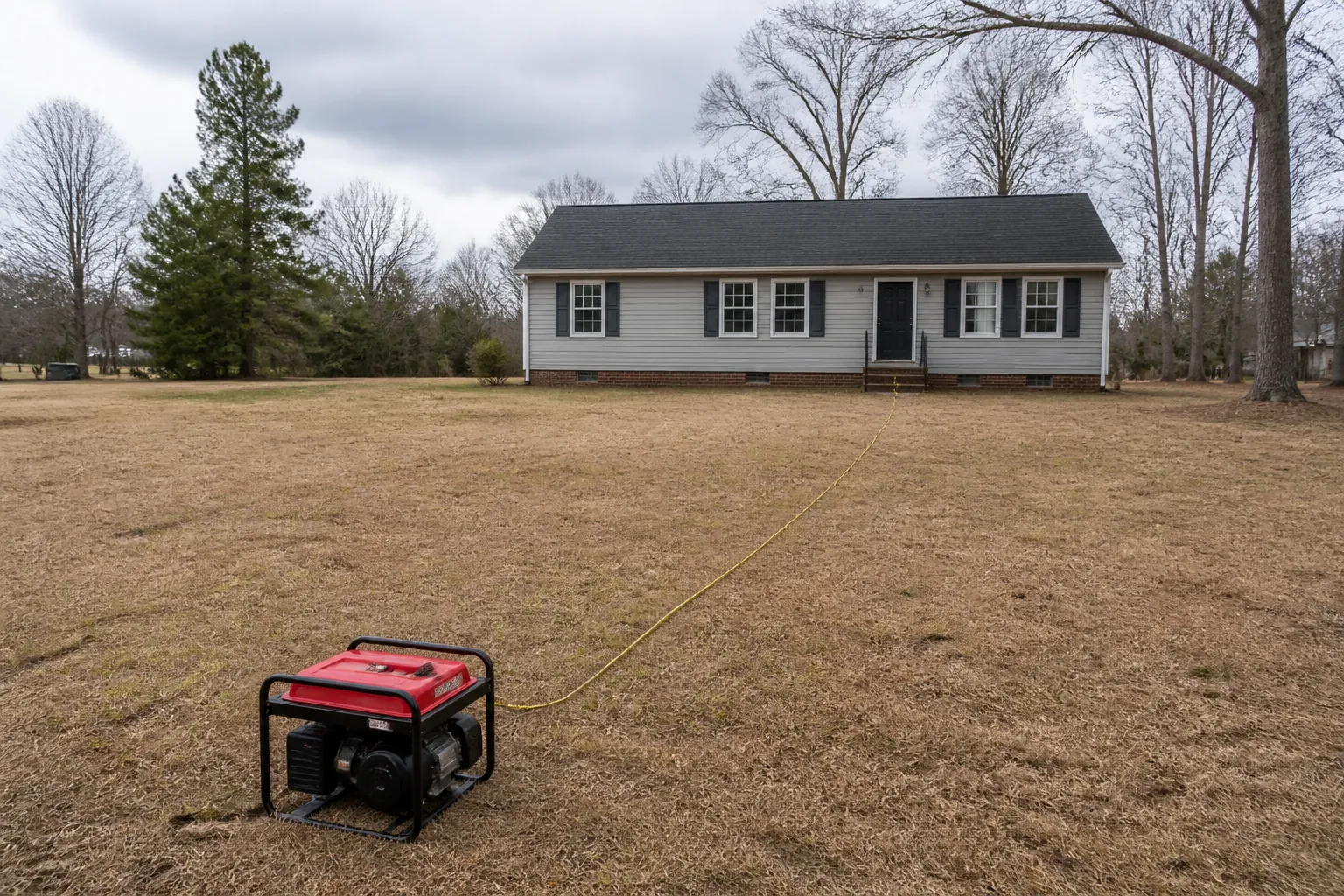
Hour 4: the refrigerator is no longer a maybe
Four hours is the refrigerator line caregivers need taped to the fridge before the storm. The FDA says a refrigerator will keep food safe for about 4 hours during a power outage if the door stays closed. The refrigerator should be at or below 40°F, and perishable food such as meat, poultry, fish, eggs, and leftovers should be discarded if it has been above 40°F for 2 hours or more. [2]
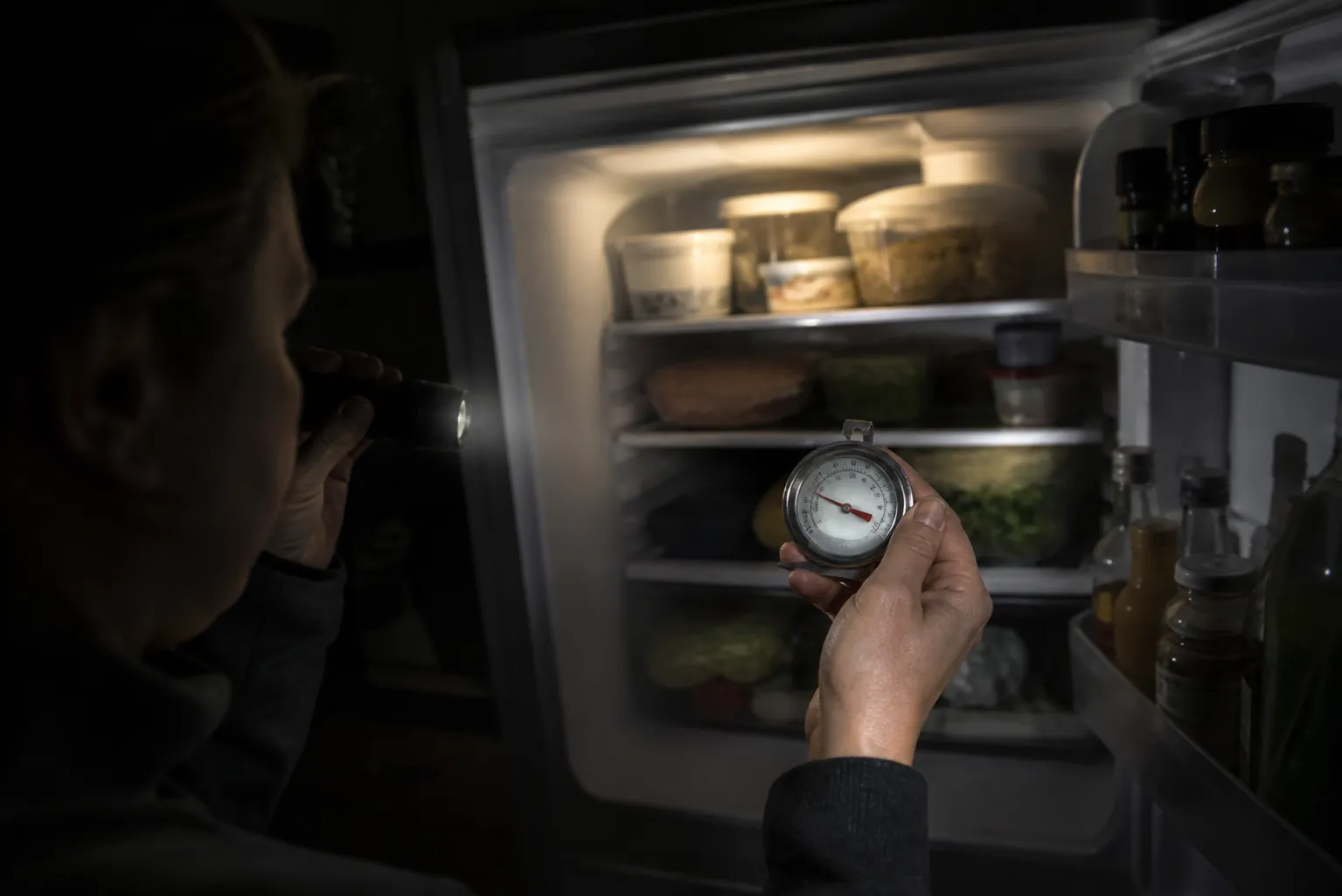
This is where an appliance thermometer earns its space. Without it, the family ends up making a food-safety decision by memory, smell, or optimism. The FDA recommends keeping appliance thermometers in both the refrigerator and freezer so you can know whether the refrigerator stayed at or below 40°F and the freezer stayed at or below 0°F. [2]
Do not taste food to see whether it is safe. Both FDA and CDC guidance reject tasting as a safety test; harmful bacteria may not change smell, look, or flavor in a way a caregiver can detect. [2][3]
| If the refrigerator has been without power | What to do |
|---|---|
| Less than 4 hours and door stayed closed | Keep it closed. Use refrigerated food only if it remained at or below 40°F. |
| Around 4 hours | Check the refrigerator thermometer. Plan meals around safe foods first, but do not repeatedly open the door. |
| Above 40°F for 2 hours or more | Discard perishable foods covered by FDA guidance, including meat, poultry, fish, eggs, and leftovers. [2] |
| No thermometer and the outage has passed the 4-hour mark | Be conservative with high-risk perishables. For an older parent, food poisoning is not a small inconvenience. |
Insulin: cool is good, frozen is not
Insulin needs its own note because “keep it cold” is too vague during an outage. CDC emergency guidance says insulin should be kept as cool as possible but should not be frozen. If insulin has been stored above 86°F, blood sugar should be monitored closely, and a doctor should be contacted after the emergency. [4]
Product labels vary, so do not turn one general temperature rule into a permanent rule for every insulin. During the outage, keep insulin out of direct heat, do not place it directly on ice where it can freeze, and keep the box or label available so a pharmacist or clinician can verify what applies to that exact product.
If your parent’s diabetes care depends on powered equipment, refrigeration, or frequent monitoring, treat that as a reason to leave earlier, not later. The safer choice may be a relative’s home, a cooling or warming center, an urgent clinic, or another location where medication and monitoring can be handled predictably.
Hour 8 and beyond: inconvenience can become a health event
After several hours, the question changes from “Can we get through dinner?” to “Can this house still protect this person?” That depends on the parent’s health, the season, the building, and whether someone can keep checking in.
One PLOS Medicine study of Medicare beneficiaries age 65 and older estimated that power outages lasting longer than 8 hours were associated with increased cardiovascular and respiratory emergency hospitalizations, with roughly 4,246 excess hospitalizations in 2018. That is one study’s estimate, not a prediction for every outage or household, but it is a useful warning against treating long outages as merely annoying for older adults. [5]
A review in Current Environmental Health Reports describes several outage-related injury and death pathways, including falls, fires, and carbon monoxide poisoning. [6] Those are exactly the hazards that appear when families improvise: a candle on a side table, a generator too close to the house, a dark bathroom trip, or a parent staying in a room that is becoming too hot or too cold.
Heat: fans have a limit
A fan can help in a warm room, but it is not a rescue plan for dangerous indoor heat. CDC guidance says fans should not be used as the primary cooling method when indoor air temperatures are higher than 90°F. [7]
For an older parent, especially one with heart disease, breathing problems, dementia, limited mobility, or medications that affect fluid balance, a hot house can become unsafe before the rest of the family feels alarmed. If the indoor temperature is climbing and there is no air conditioning, no cool room, and no reliable way to monitor the parent, arrange transportation before everyone is exhausted.
Cold: do not wait for shivering to settle the argument
Cold outages create a different kind of pressure because the parent may insist they are fine while the house slowly loses heat. Layer clothing, close off unused rooms, use blankets, and keep the parent dry. But do not use a gas oven, charcoal grill, camp stove, or generator indoors to warm the house; carbon monoxide and fire risk are not tradeoffs worth making. [1]
A parent who is confused, very drowsy, unusually clumsy, or unable to stay warm needs help, not another hour of debate. If a safe heated place is available, go while the route is still manageable.
Hour 24 and hour 48: freezer rules are useful only if the door stayed closed
The freezer gives you more time than the refrigerator, but only under specific conditions. The FDA says a full freezer will hold temperature for about 48 hours if the door remains closed; a half-full freezer will hold temperature for about 24 hours. The freezer should be at or below 0°F. [2]
| Freezer condition | Expected safe-temperature window if kept closed |
|---|---|
| Full freezer | About 48 hours. Confirm with the appliance thermometer when power returns or before using food. [2] |
| Half-full freezer | About 24 hours. After that, the thermometer and signs of thawing matter. [2] |
| Food still has ice crystals or is at 40°F or below | It may be safely refrozen or cooked, depending on the food and condition. [2] |
| Food has warmed above safe limits | Discard. Do not taste it to decide. [2][3] |
For a caregiver, this is not just about saving groceries. It is about stopping the chain that starts with “it looked fine,” turns into vomiting or diarrhea, and ends with dehydration, weakness, dizziness, or a fall. Older adults may have less margin for a mistake that a younger adult might ride out at home.
When staying home is no longer safe
Leaving can feel like overreacting, especially when a parent is proud, frightened, or determined not to be “a bother.” Use conditions instead of persuasion. If any of these are true, the plan should shift from coping at home to getting the parent somewhere safer.
- The parent cannot walk safely to the bathroom, bedroom, or exit in the available light.
- The caregiver cannot keep the floor clear, dry, and visible.
- Indoor heat is rising, and fans are the only cooling option above 90°F indoors. [7]
- The home is becoming too cold, and there is no safe heat source.
- A generator is being used anywhere except outdoors at least 20 feet from windows, doors, and vents. [1]
- Carbon monoxide is suspected, a CO alarm sounds, or anyone has symptoms that could suggest exposure.
- Insulin, refrigerated medication, oxygen, or other essential care cannot be managed safely.
- The parent is confused, unusually weak, short of breath, unable to stay warm or cool, or cannot be checked on reliably.
The sentence to give siblings is simple: “If we cannot keep the house lit, breathable, temperature-safe, and walkable, we are leaving.” That sentence prevents the family from treating evacuation as an opinion poll.
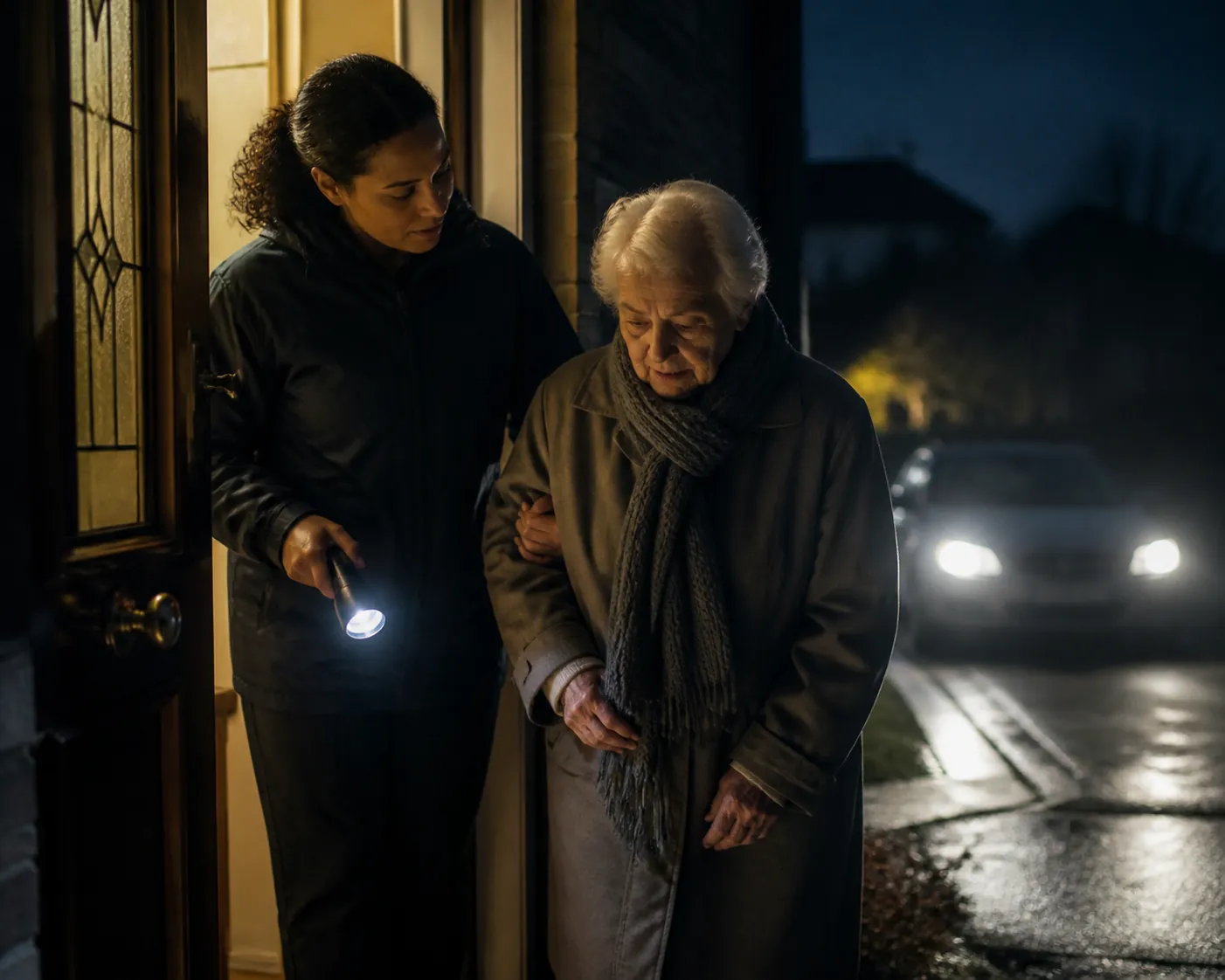
If a fall does happen during the outage, do not rush the parent upright just to get them off the floor. Check for pain, head injury, confusion, bleeding, weakness, and inability to bear weight. The post-fall steps in activating senior health services after a fall are especially relevant when emergency conditions are already stretching judgment.
Before the next outage, tape the cutoffs where the phone call starts
Preparation is only useful if the person in the dark can find it. Put the rules on the refrigerator, inside a kitchen cabinet, and in the caregiver group text. The note should be short enough to use while someone is tired.
- Refrigerator: keep closed; 4-hour limit; discard perishables above 40°F for 2 hours or more. [2]
- Freezer: 0°F target; full freezer about 48 hours; half-full freezer about 24 hours if kept closed. [2]
- Food: never taste to test safety. [2][3]
- Insulin: keep cool, never frozen; monitor blood sugar closely if stored above 86°F. [4]
- Heat: fans are not the primary cooling method above 90°F indoors. [7]
- Generator: outdoors only, at least 20 feet from windows, doors, and vents. [1]
- Leaving rule: if the home cannot stay safely lit, walkable, breathable, and temperature-safe, leave.
The Red Cross also recommends stocking a 2-week supply of non-perishable food and water and keeping the car’s gas tank at least half full. [1] That belongs in the storm-season plan, along with spare batteries, appliance thermometers, charged power banks, backup glasses, medication lists, and a written pickup plan.
For a broader household kit and contact plan, use a severe weather preparedness checklist for older adults. If storms are already forecast, a severe storm checklist for seniors can help remove the outdoor and entryway hazards that become fall risks once the lights go out.
If you live far away, decide before the outage how you will know your parent is safe. A monitoring plan may be as simple as scheduled calls with a neighbor, or it may involve a device and alert process. The question is not whether a gadget is impressive; it is whether someone will know when the house has crossed from inconvenient to unsafe. The elderly monitoring system decision framework can help sort that out before the next storm.
References
- Power Outage Safety, American Red Cross.
- Food and Water Safety During Power Outages and Floods, U.S. Food and Drug Administration.
- Keep Food Safe After a Disaster or Emergency, Centers for Disease Control and Prevention.
- Managing Insulin in an Emergency, Centers for Disease Control and Prevention.
- Power outages and community health: a narrative review, PLOS Medicine.
- Power Outages and Community Health: a Narrative Review, Current Environmental Health Reports.
- Heat and Older Adults, Centers for Disease Control and Prevention.
Related reading
Noticed something outdated or inaccurate on this page? Flag a correction. We review every report against CDC, NIA, and AARP HomeFit guidance before updating a page.
Part of the Fall Prevention section.