
STEADI: Intervene
Fall Prevention Tips for Caregivers Before a Tropical Storm
A room-by-room guide to preventing falls in an older adult's home before a tropical storm hits. It reveals the fall hazards that standard storm prep creates and how to eliminate them so your parent stays safe when the power goes out.
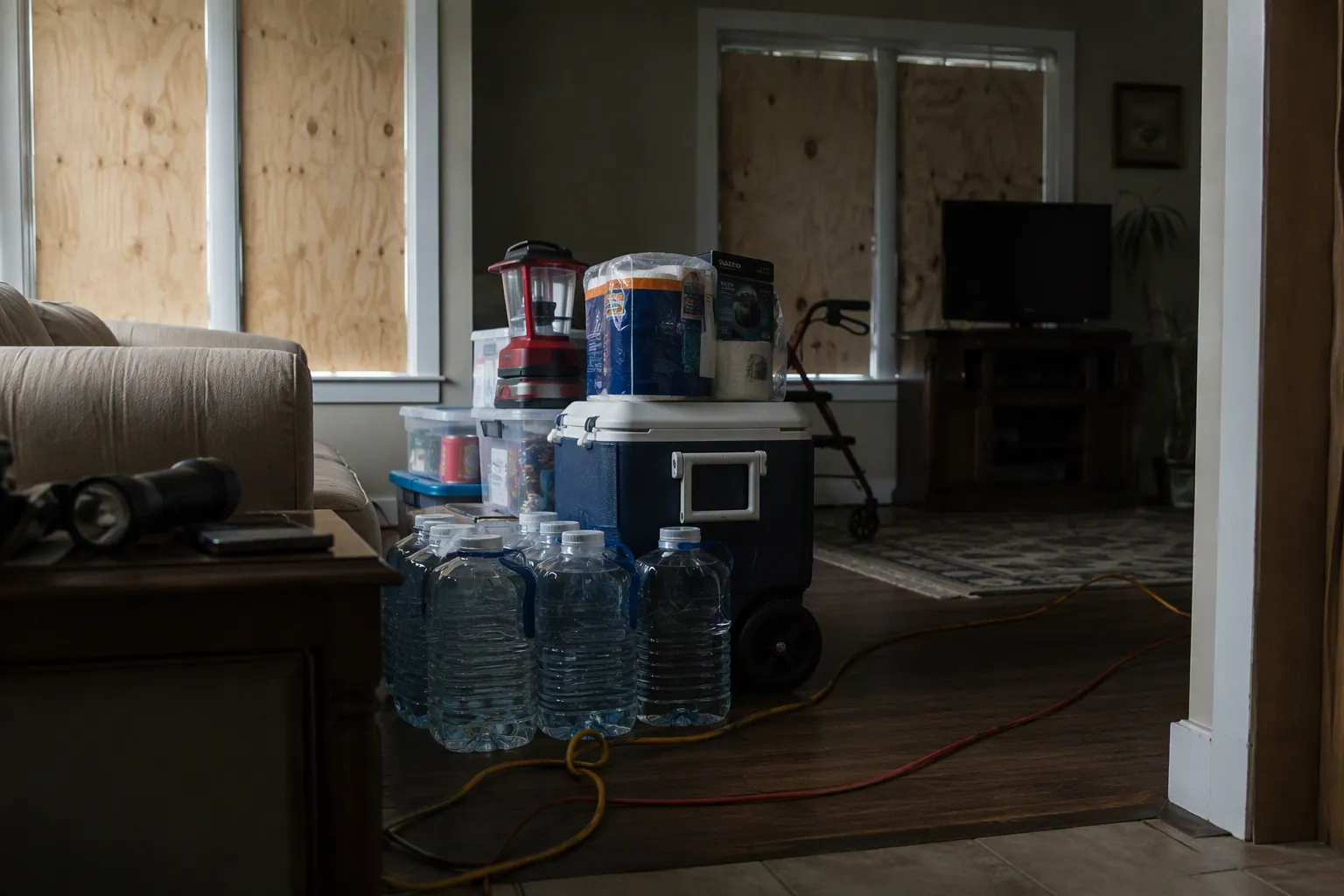
By the time the patio chairs are inside, the windows are covered, the phones are charging, and the extra water is lined up, the house can look ready for a tropical storm and be less safe to walk through than it was that morning. A cooler sits where the walker normally turns. Gallon jugs narrow the hallway. An extension cord runs from the wall to the recliner. A lamp was unplugged to make room for a charger. The window covering darkens a room that already needed better light.
That is the part most tropical storm safety tips for elderly caregivers miss. Official hurricane guidance is still the starting point: older adults should have supplies, communications plans, evacuation awareness, documents, medications, and support contacts in place before conditions deteriorate.[1][2] The CDC also tells households to clear yards of loose items such as furniture and propane tanks before hurricanes or tropical storms.[3] But once those sensible jobs are done, someone has to walk back through the inside of the home and ask a different question: can my parent still get from bed to bathroom, chair to kitchen, and door to phone if the power goes out?
If you need the broader storm plan, start with the Hurricane Preparedness Checklist for Seniors Living Alone. This guide is narrower on purpose. It is the last indoor fall-prevention pass before landfall.
Do the ordinary storm prep first, then do the fall-prevention pass
There is no point clearing a hallway at noon if it will be full of batteries, bottled water, and porch cushions by dinner. The fall-prevention walk-through should happen after the big disruptive jobs: bringing outdoor items inside, staging supplies, charging devices, moving lamps, covering windows, setting up coolers, and deciding where your parent will sleep if the weather gets loud.
PowerOutage.us warns that a sudden blackout “multiplies the risk of falling in every room of the house” for older adults because reduced light affects depth perception and peripheral vision.[4] That tracks with what caregivers see in real homes: the room does not have to be messy to become dangerous. It only has to be darker, tighter, and slightly rearranged.
Keystone.Health’s senior preparedness guidance is unusually direct about this point, telling families to “plan for fall prevention” by keeping flashlights within reach, taping down area rugs, and using nightlights during outages.[5] That advice belongs at the center of the pre-storm visit, not as an afterthought once the rain starts.
| After storm prep creates this | Check this before you leave |
|---|---|
| Water jugs, coolers, food bins, porch cushions, or pet supplies on the floor | A full-width walking path remains clear for a cane, walker, rollator, or two-handed balance |
| Windows covered and rooms darker than usual | Flashlights, nightlights, and battery lanterns are reachable without crossing the room |
| Charging cords, extension cords, oxygen tubing, or device cables | No cord crosses a walking route; any unavoidable cord is rerouted along a wall |
| Furniture moved to make room for supplies | The older adult can still turn, sit, stand, and reach support surfaces normally |
| Medications, documents, and devices gathered in one place | The staging area does not block the bathroom route, bedroom route, or exit path |
Start at the door, because that is where supplies pile up
The entryway often becomes the storm staging area because it is convenient for the caregiver, not because it is safe for the person who lives there. Bags land by the door. Shoes get kicked aside. A case of water waits to be moved “in a minute.” If your parent uses a walker, that minute is long enough to create the first bad obstacle.
- Move water, coolers, batteries, and outdoor items out of the entry path and away from the usual walker turn.
- Leave a clear route from the main chair or bedroom to the safest exit, even if you do not expect evacuation.
- Keep shoes, umbrellas, pet leashes, and doormats from bunching at the threshold.
- Place one flashlight where your parent can reach it before opening the door, not in a drawer across the room.
- If the porch light may fail, set a battery lantern inside the door for responders, neighbors, or a family member arriving later.
Do not judge the path by whether you can step over something. Judge it by whether your parent can pass through it at night, tired, holding a cane, and possibly distracted by wind noise or a weather alert.
Build the low-light route before the lights go out
The most useful flashlight is not the one in the emergency bin. It is the one on the nightstand, on the side table by the recliner, beside the bathroom door, or in the pocket of the walker basket. A storm kit in a closet is fine for you. It may be useless to an older adult who wakes up in a dark bedroom and has to find the bathroom.
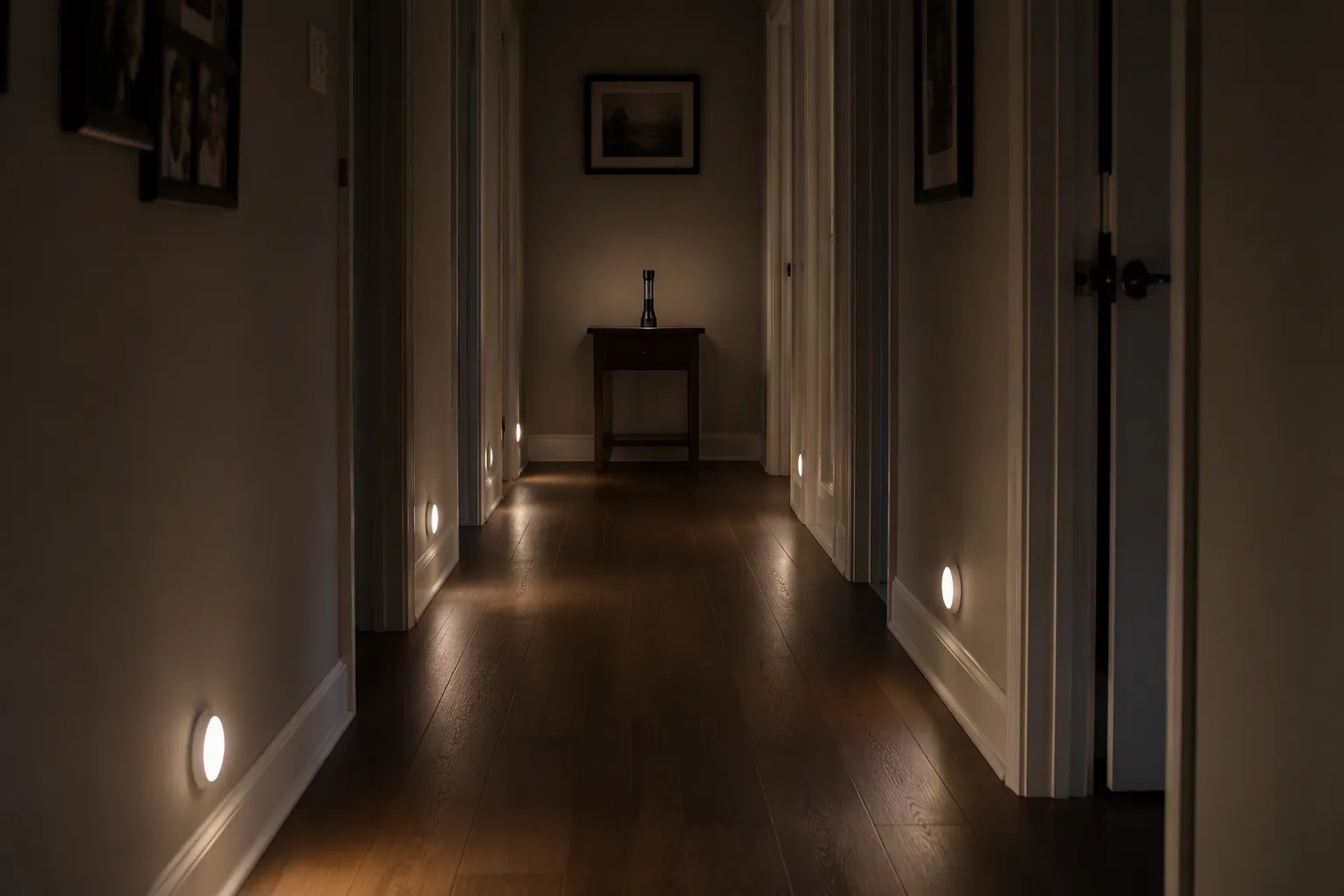
Place light in layers. A handheld flashlight helps with reaching and reading. A battery lantern gives room light. Battery-powered nightlights or low floor-level lights help define the path. If the home already has plug-in nightlights, assume they will be gone when power is gone unless they have battery backup.
- Put a flashlight within arm’s reach of the bed, favorite chair, toilet path, and medication area.
- Use wide, stable lanterns instead of candles; candles add fire risk and still leave shadows.
- Aim light at walking surfaces, doorways, and turns, not only at tabletops.
- Check that batteries are already installed and that your parent can turn each light on without reading tiny instructions.
- Avoid placing lanterns on the floor where they become obstacles.
For a parent with low vision, glaucoma, neuropathy, dizziness, or a history of nighttime falls, this is not a cosmetic detail. It is the route. The same low-light principles that matter during seasonal time changes also matter during storms; the practical goal is to make edges, turns, and obstacles easier to see before the house becomes unfamiliar. If you want a deeper look at visibility and fall risk, see What Permanent DST Means for Your Elderly Parent's Fall Risk.
Bedroom: set up the first five minutes after waking
A storm fall often starts with a very ordinary movement: sit up, find glasses, reach for the walker, stand, turn toward the bathroom. The bedroom should be arranged for that sequence, not for how tidy it looks after supplies are staged.
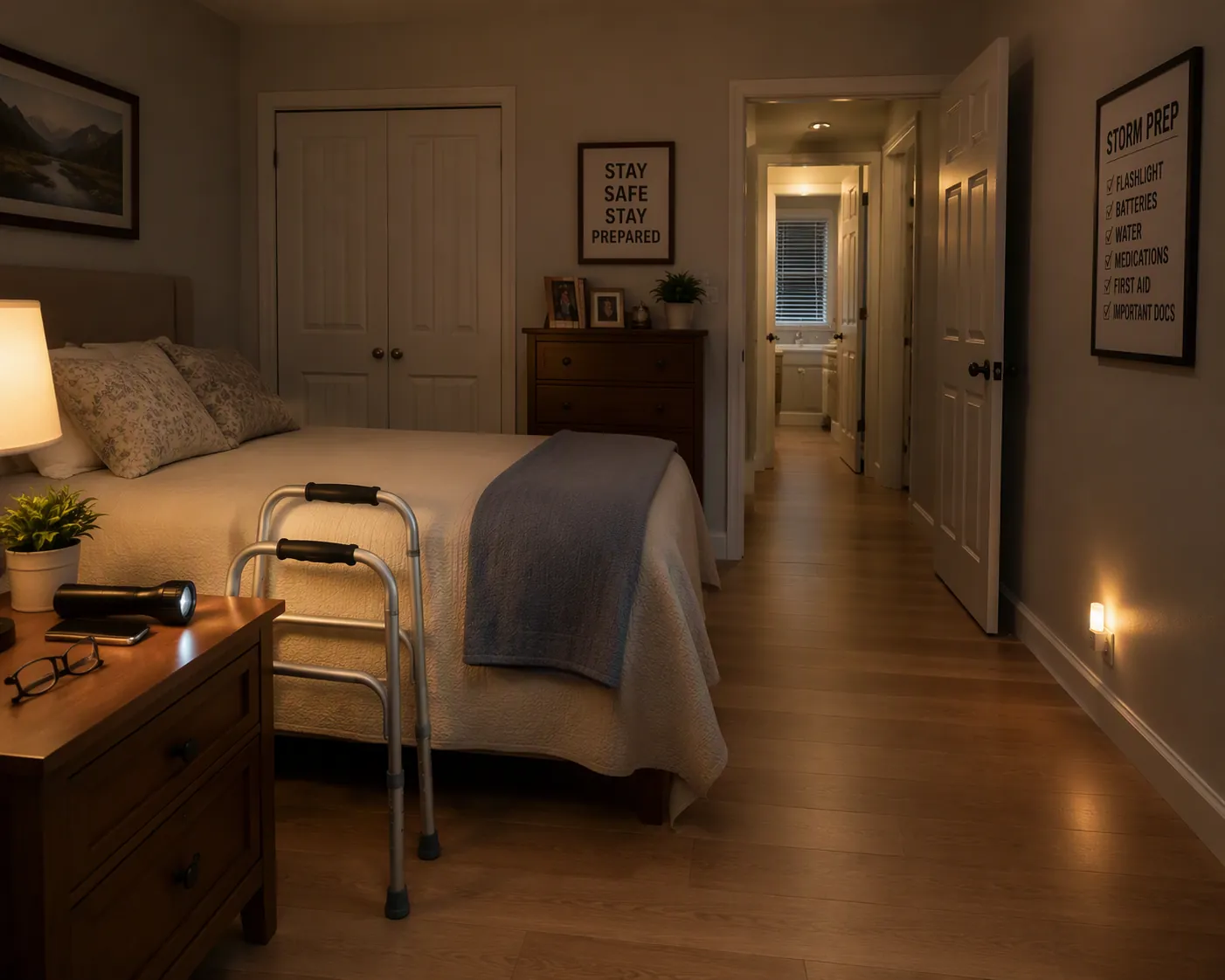
- Put the phone, flashlight, glasses, hearing aids, water, and any nighttime medication on the same side your parent normally uses to get out of bed.
- Park the walker, cane, or rollator in its normal reachable position; do not move it to make room for storm supplies.
- Clear the path from bed to door and bed to bathroom of slippers, laundry baskets, fans, chargers, and oxygen tubing loops.
- Remove or tape down loose rugs at the bedside, especially if your parent shuffles or wears socks at night.
- If your parent may sleep somewhere other than the usual bed, repeat the setup there instead of assuming the old nightstand plan still works.
The bed area is also where charging cords become a problem. A phone charging across the walking route is not a preparedness win. Charge devices where they can be reached from a seated position without stretching a cord across the floor.
Bathroom: protect the trip your parent is most likely to make in the dark
If you only have time to check one route carefully, check the bed-to-bathroom route. It is predictable, repeated, and often done half-awake. Storm prep can make it worse by moving a laundry hamper, storing extra water in the tub area, or leaving a bucket where feet normally land.
- Clear every object from the path between bed and toilet, including small bins, bath mats that slide, scales, and cleaning supplies.
- Place a flashlight or battery nightlight so the toilet, sink edge, and doorway are visible from the entrance.
- Make sure grab bars, raised toilet seats, shower chairs, and toilet safety frames are not blocked by stored water or supplies.
- Keep necessary incontinence supplies reachable without bending into a low cabinet in the dark.
- If water has been stored in the tub, confirm it does not interfere with toileting, handwashing, or safe turning space.
A filled bathtub may make sense for household water needs, but it should not turn the bathroom into a place where your parent cannot move safely. If the bathroom is small, put non-drinking water somewhere else or reduce what is stored there so the toilet path stays usable.
Kitchen: keep supplies reachable without turning the floor into storage
Storm food and water should be accessible, but “accessible” does not mean stacked on the floor in the middle of the kitchen. For an older adult, the safer place is often waist-height shelving, a cleared counter, or a stable table near where meals will actually happen.
- Move heavy water containers off the walking path and away from the refrigerator, sink, stove, and table route.
- Pre-open packaging that would require scissors, force, or awkward bending during the storm.
- Set out easy meals, utensils, and a manual can opener where your parent can reach them from a stable standing or seated position.
- Keep pet bowls, food bags, and litter supplies from spilling into the main walking path.
- If a cooler is needed, place it against a wall or under a table where it will not be used as an accidental step-over obstacle.
Do not leave your parent with a plan that requires carrying a full gallon jug across a dark kitchen. Pour smaller containers ahead of time, or stage water in cups or manageable bottles where it will be used.
Living room: fix the room that storm prep usually wrecks
The living room is where the house absorbs everything: porch cushions, extension cords, device chargers, extra blankets, batteries, weather radio, snacks, flashlights, and sometimes the safest chair. It is also where an older adult may spend hours waiting out the storm.
Start with the chair your parent actually uses. From that seated position, they should be able to reach a phone, flashlight, water, glasses, remote, hearing aids, and necessary medication without standing up and searching. Then look outward from the chair: can they stand, turn, reach the walker, and walk toward the bathroom without stepping around the emergency setup?
- Reroute charging cords along walls or behind furniture; do not run them from outlet to chair across open floor.
- Move porch cushions, folding chairs, and outdoor items into a corner or unused room, not beside the recliner.
- Keep the walker or cane on the side where your parent normally reaches for it.
- Remove throw rugs or tape them flat if they cannot be removed.
- Place one battery lantern high enough to light the floor without shining directly into your parent’s eyes.
If you have to choose between a perfect supply arrangement and a clean walking path, choose the path. Supplies can be inconvenient. A blocked walker path is dangerous.
Hallways and stairs: do not use them as overflow storage
Hallways look like storage space until someone has to move through them in the dark. Before a tropical storm, they often collect water cases, backup batteries, laundry baskets, tools, towels, and the cardboard boxes that carried supplies in from the car.
- Keep hallways clear from wall to wall wherever a walker, rollator, cane, or caregiver assistance may be needed.
- Put battery lighting at turns, thresholds, and stair landings, where shadows can hide changes in level.
- Remove loose runners and curled mats before the storm starts.
- Check that handrails are reachable and not blocked by hanging bags, cords, or stacked supplies.
- If stairs are not essential during the storm, move needed items to one level before landfall.
For a parent who uses a stairlift, the stair question belongs in the power plan, not just the mobility plan. If the lift may not work during an outage, food, medications, bathroom access, phone access, and sleeping arrangements need to be on the same level before conditions worsen. For more detailed power-dependent planning, use a 72-Hour Power Outage Plan for Medically Dependent Seniors.
Mobility aids, medical devices, and medications need their own walking test
A cane leaning in the corner is not available if your parent wakes up and reaches to the other side of the bed. A walker behind the cooler is not available. A rollator with its brakes unlocked beside a chair can become a moving hazard instead of support.
- Place canes, walkers, rollators, and transfer aids exactly where your parent naturally reaches for them.
- Lock rollator brakes when parked, and confirm the seat is not being used as a supply shelf.
- Keep oxygen tubing, CPAP cords, charging cables, and monitor cords out of walking paths.
- Move medications to a reachable, well-lit location without placing them somewhere a child, pet, or confused adult may disturb.
- Put written emergency contacts, medication lists, and device instructions where a responder or neighbor can find them without searching the house.
The National Council on Aging advises older adults to prepare to be self-sufficient for at least 72 hours during an emergency, including the possibility of managing falls without immediate emergency services.[6] That standard changes the meaning of “good enough.” If your parent cannot safely reach the bathroom, phone, medications, and mobility aid for those first days of disruption, the supply pile is not the main problem.
Power-dependent equipment deserves a separate check. CPAP machines, oxygen concentrators, refrigerated insulin, stairlifts, lift chairs, and communication devices can all change where your parent should sleep, sit, or store supplies during the storm. If batteries, backup power, or cooling are part of the plan, keep the equipment reachable without cords across the floor. A broader supply setup is covered in How to Build a 72-Hour Senior Power Outage Safety Kit.
Ask your parent to walk the route while you watch
A caregiver walk-through catches obvious clutter. It does not catch everything. The person who lives there has habits you may not know: touching the doorframe before turning, grabbing the dresser on the way to the bathroom, stepping around a pet bed without thinking, leaning on a counter that you just covered with supplies.
Ask your parent to do the normal route, slowly and with their usual mobility aid: chair to bathroom, bed to bathroom, bed to phone, chair to kitchen, bedroom to exit. Do not make it a test they can fail. Make it a rehearsal that lets you see where the storm setup has interfered with the house they know.
- Watch where their hand reaches for balance.
- Notice whether the walker turns cleanly or clips a box, rug, or cooler.
- Check whether they look down because the floor is hard to see.
- Ask what they would do if the lights went out while they were in that spot.
- Move anything that makes them change their normal gait, reach, or route.
This is also where independence and safety collide. If your parent does not want the house rearranged, avoid rearranging everything. Keep the familiar layout whenever possible. The goal is not to take over the home; it is to remove the few objects that will matter most in a blackout.
When the checklist is no longer enough
A fall-prevention checklist is for a home that can still be made safe enough. It is not a substitute for evacuation orders, reliable power for essential medical equipment, or the physical ability to move through the home. FirstContact.org’s disaster preparedness framework for older adults and caregivers uses an evacuation decision-tree approach, which is the right boundary here: if conditions or care needs make safe sheltering impossible, the indoor checklist should not be used to justify staying.[7]
- Local officials advise or order evacuation.
- Your parent cannot reach the bathroom, bed, phone, medications, or exit without unsafe effort.
- Essential power-dependent equipment lacks a workable backup plan.
- Flooding, structural risk, heat, or medical instability makes the home unsafe even if the floors are clear.
- The caregiver plan depends on someone driving over after conditions are already dangerous.
Evacuation brings its own fall risks, especially with mobility aids, steps, unfamiliar bathrooms, and hurried transfers. If that becomes the safer choice, use a disaster-specific fall-prevention approach such as How Seniors Can Avoid Falls During Brush Fire Evacuations for the same basic method applied outside the home.
The final pass before landfall
When the supplies are staged and the house is as ready as it will be, walk the main routes one more time. If it is safe, dim the lights or close the curtains enough to mimic a darker house. Do not create danger for the sake of practice; just make sure the hazards are visible before they become surprises.
- From the bed: light, phone, glasses, mobility aid, bathroom route.
- From the favorite chair: light, phone, walker or cane, water, bathroom route.
- From the bathroom: clear exit, visible floor, reachable support.
- From the kitchen: reachable food and water without lifting heavy containers or stepping around supplies.
- From the exit path: no boxes, rugs, cords, pet items, or outdoor furniture in the way.
Then stop rearranging unless something changes. Confirm how your parent will reach you, where the lights are, where the medications are, and what they should do if they feel dizzy or unsteady. After the storm, the fall hazards will change again: wet thresholds, debris, spoiled food, damaged flooring, and fatigue all matter. That is a different walk-through, closer to the one in Helping Elderly Parents Avoid Falls After a Tornado. Before landfall, the useful work is simpler: keep the route familiar, light the dark spots, and make sure the person who has to walk through the house can actually do it.
References
- Older Adults, Ready.gov
- Older Adults Emergency Preparedness, American Red Cross
- Preparing for Hurricanes or Other Tropical Storms, Centers for Disease Control and Prevention
- Power Outage Preparedness for Seniors, PowerOutage.us
- Emergency Preparedness for Seniors, Keystone.Health
- Emergency Preparedness 101, National Council on Aging
- Disaster Preparedness for Older Adults and Caregivers, FirstContact.org
Related reading
Noticed something outdated or inaccurate on this page? Flag a correction. We review every report against CDC, NIA, and AARP HomeFit guidance before updating a page.
Part of the Fall Prevention section.