
STEADI: intervene
Hurricane Evacuation Tips for Seniors to Prevent Falls
This guide explains how to help an older adult avoid falls at every stage of a hurricane evacuation — from pre-storm home preparation and packing to navigating a shelter and returning safely. It covers the specific fall risks that arise during the chaos of evacuation and the practical steps that can prevent them.
The risky part of a hurricane evacuation for an older adult often starts before the car ever moves. Someone is trying to carry a medication bag, reach for a cane, step around a suitcase, answer a weather alert, and get through a doorway that was easy yesterday but is now crowded. PBS NewsHour has reported on exactly this problem: storm preparation itself can raise fall risk for older adults with mobility limitations because carrying supplies while using a cane or walker creates a trip hazard, and repeated stair climbing, moving items, and other preparation tasks can trigger falls in people with balance concerns.[1]
That is the point of these hurricane evacuation tips for seniors: not another reminder to buy water, but a safer sequence for the moments when a parent has to stand, turn, carry, transfer, sleep somewhere unfamiliar, and come home through possible damage. If evacuation is needed, the goal is to keep hands free for balance, keep mobility aids within reach, avoid rushing, and treat every new surface as untested until someone checks it.
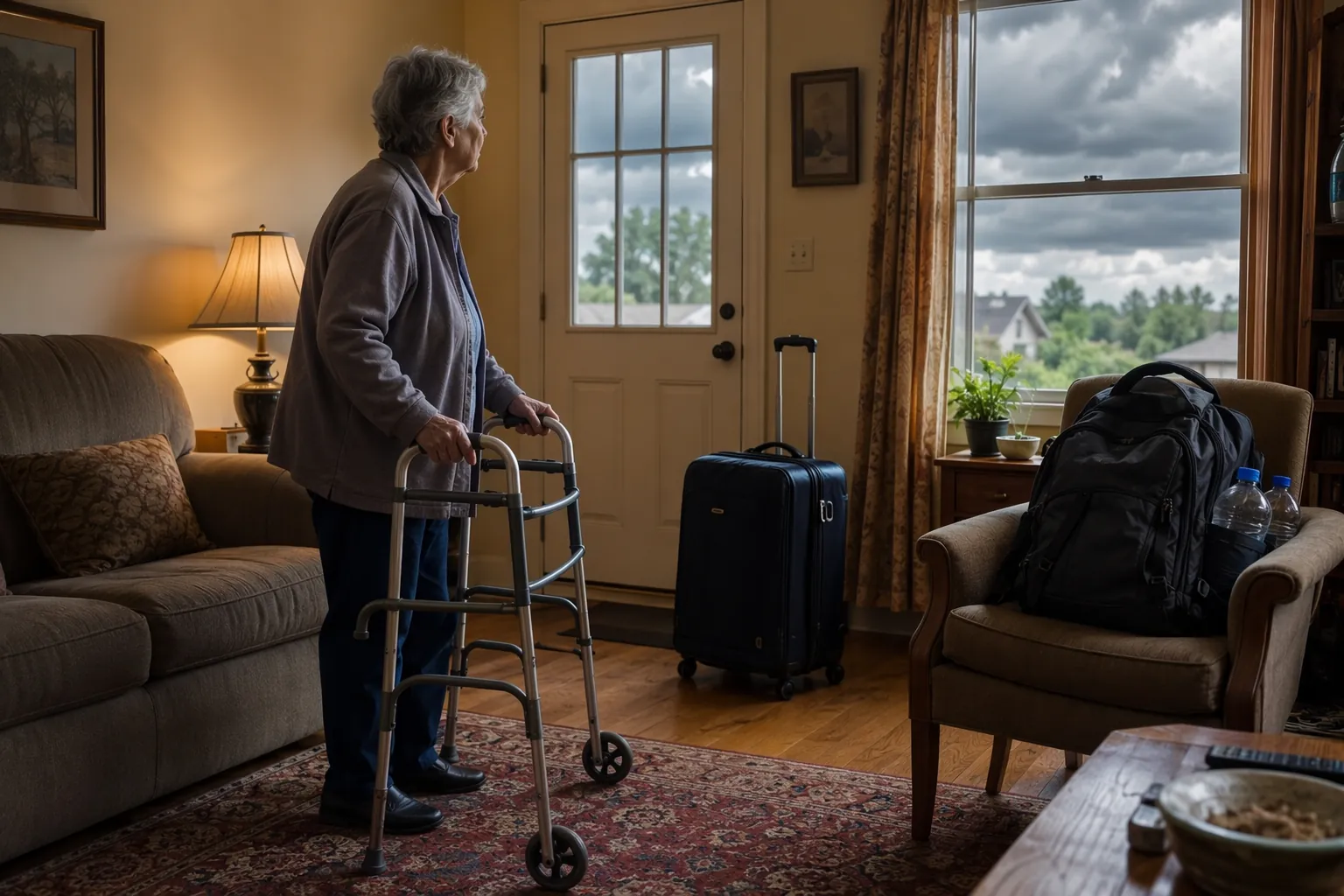
Decide Early Enough That No One Has to Hurry
Evacuation is not automatically safer for every older adult in every setting. One study cited by PBS found that evacuation among nursing home residents increased the probability of death at 90 days from 2.7% to 5.3%.[1] That finding does not mean an older adult aging at home should ignore an evacuation order. It does mean the decision has to be made with mobility, frailty, medications, cognition, transportation, and destination in view—not as a last-minute test of endurance.
The pre-storm work that matters most for fall prevention is the work that prevents rushed movement later. Check the evacuation zone, know which road you would actually take, confirm whether the destination can handle a walker, wheelchair, oxygen equipment, or other assistive device, and register in advance for local special-needs transportation or shelter programs when the older adult qualifies. A 2025 scoping review of 20 studies on evacuation and transportation barriers found that physical limitations—including dependence on mobility aids and inability to carry items while walking—are primary evacuation barriers, along with lack of accessible transportation that can accommodate mobility devices.[2]
A short pre-season phone session can save a dangerous hour later. Call the county emergency management office, ask how special-needs shelter registration works, ask whether transportation accepts walkers and wheelchairs, and write the answer in one place. Senior preparedness guidance from Miami Jewish Health also emphasizes zone-based risk assessment, local emergency management registration for special-needs shelters, and awareness of Medicare Part D emergency medication refill options.[3]
| Before Storm Season | Why It Reduces Fall Risk |
|---|---|
| Confirm evacuation zone and likely trigger for leaving | Removes the late argument that keeps everyone packing in a hurry |
| Register for special-needs shelter or transportation if eligible | Avoids improvising rides that cannot fit mobility devices |
| List medications, pharmacies, prescribers, and refill options | Prevents last-minute pharmacy trips on wet, crowded surfaces |
| Choose a destination with accessible bathroom and sleeping space | Reduces nighttime walking through unfamiliar layouts |
| Practice the route from bedroom to door with bags staged | Shows which furniture, cords, rugs, or thresholds are in the way |
Older adults have accounted for a disproportionate share of hurricane deaths: nearly half of Hurricane Katrina fatalities, about 75% of Hurricane Sandy deaths, and overrepresentation in Hurricane Ian and Florence mortality have been documented in disaster-risk reporting.[4][5] Those numbers are not useful as scare tactics. They are useful because they justify taking the slow parts seriously: the hallway, the bathroom, the car transfer, the shelter cot, the return through a dark house.
Pack So the Older Adult Is Not the Pack Mule
A go-bag can become a fall hazard when it is too heavy, worn on one shoulder, or carried by the person who also needs both hands for a walker. The Red Cross recommends that older adults keep at least 30 days of medications and extra assistive items such as a cane or eyeglasses in emergency supplies.[6] That is sensible, but it creates a practical problem: the more carefully you pack, the easier it is to overload the person least able to carry it.
Separate the medical essentials from the bulk. Medications, glasses, hearing-aid batteries or chargers, a written medication list, insurance cards, ID, phone charger, and a small flashlight belong in a small bag that stays with the caregiver or rolls beside the older adult. Water, clothing, incontinence supplies, shelf-stable food, bedding, and backup equipment can go in a wheeled suitcase, a bin, or the car before the older adult starts walking.
- Use wheeled bags whenever possible; do not ask someone using a cane or walker to carry a heavy shoulder bag.
- Load the car in two passes: supplies first, older adult second.
- Keep the walker, cane, wheelchair, eyeglasses, hearing aids, and medication organizer out of the trunk until the person is seated.
- Remove hallway rugs, cords, shoes, pet bowls, boxes, and stacked supplies before the older adult begins moving.
- Put a small flashlight or headlamp where it can be reached without bending into a bag.
The bag test is simple: if the older adult cannot stand, turn, and take several normal steps while using the same mobility aid they will use during evacuation, the bag is too heavy or in the wrong hands. It does not matter that the bag is technically organized. If it changes posture or occupies the hand needed for balance, it belongs on wheels or with someone else.
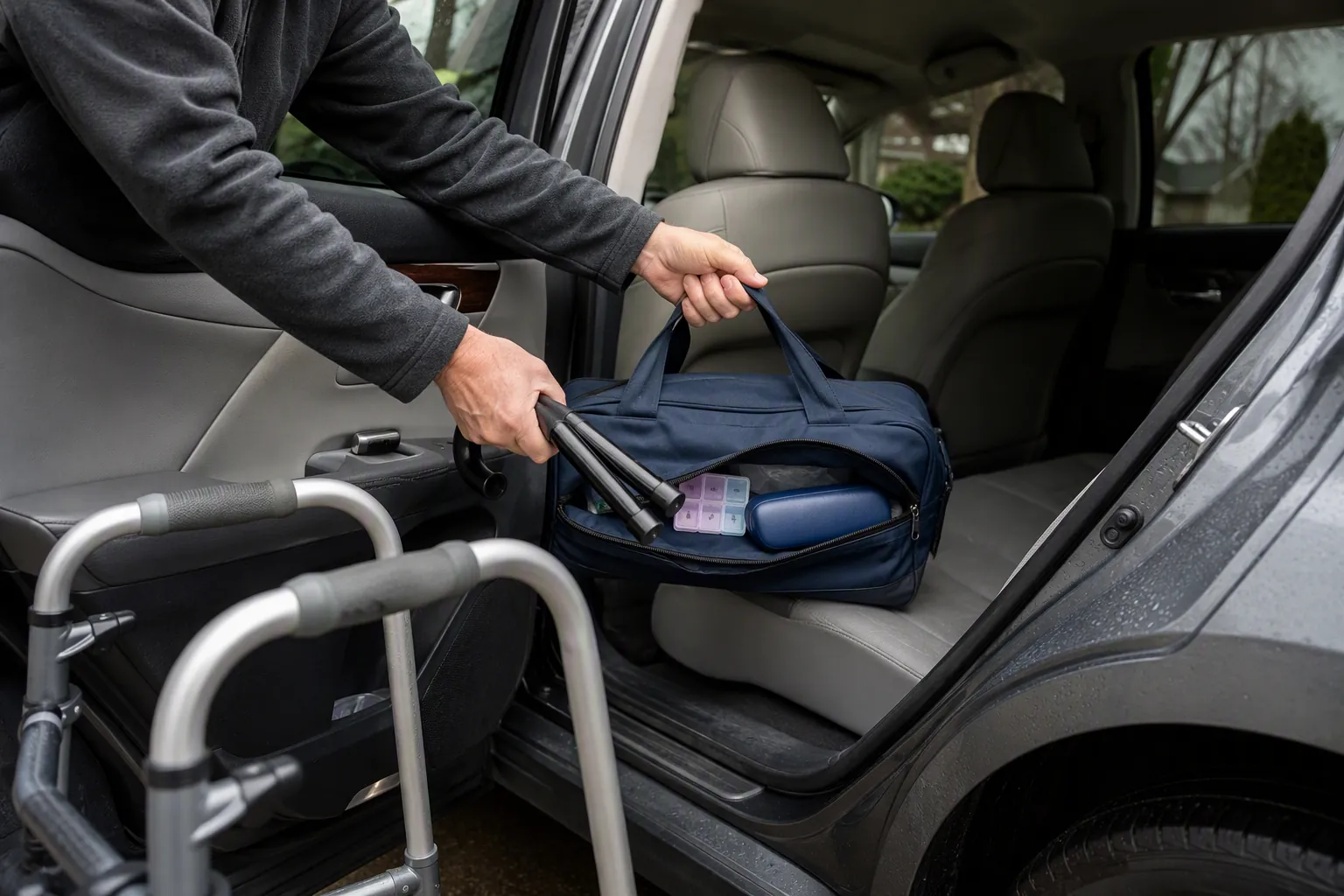
Clear the Route From Chair to Car
The last walk through the house should not be the first time anyone notices that the suitcase blocks the walker, the porch mat curls up, or the garage is slick. Before the older adult stands, one person should walk the route from the usual chair or bed to the vehicle and remove hazards. This is not fussing. It is the part of evacuation where a preventable fall most easily steals the remaining time.
Stage supplies near the door, but not in the walking path. Put heavier bags in the car first. If the older adult uses a walker, leave enough width for the walker to pass without turning sideways. If a wheelchair is involved, check thresholds and ramps before the person is seated and waiting. If rain has already started, put down a dry, flat, non-slip surface at the doorway only if it will not bunch underfoot.
Transfers need their own pause. The person should sit to put on shoes. Shoes should have backs and non-skid soles; slippers and loose sandals are not evacuation footwear. The cane or walker stays on the exit side of the chair, not across the room. Glasses and hearing aids should be on before movement starts, because misjudging a step or missing a warning is part of fall risk.
A Safer Exit Sequence
- Move supplies to the car while the older adult remains seated.
- Clear the walking route and check the porch, garage, ramp, and driveway for water or debris.
- Place mobility aids, glasses, hearing aids, and the small medical bag within reach.
- Have the older adult stand slowly, pause for dizziness, then begin walking without carrying bulky items.
- Keep one person slightly behind and to the side, close enough to steady but not pulling.
- Seat the older adult in the vehicle before loading the mobility aid, unless the aid is needed for a transfer at the destination.
If there is time pressure, shorten the supply list instead of speeding up the older adult. A rushed walker user is not faster in any useful sense; the risk simply moves from the forecast to the floor.
Plan the Ride Around Transfers, Not Just Miles
Transportation problems are often described as whether someone has a ride. For fall prevention, the better question is whether the ride allows safe transfers with the mobility equipment intact. The 2025 scoping review found that lack of accessible transportation accommodating mobility devices is a recurring evacuation barrier for vulnerable populations.[2]
A high truck, crowded back seat, or ride-share trunk too small for a rollator can turn a planned evacuation into a lifting problem. If family is driving, check the actual vehicle before the storm: seat height, door opening, step-up distance, and where the walker or wheelchair will go. If county transportation is part of the plan, ask whether the rider can remain with their mobility device and whether a caregiver may travel with them.
During the drive, keep the small medical bag inside the passenger area, not buried under luggage. Plan rest stops around accessible bathrooms and lighting, but do not create unnecessary stops just to follow a normal travel routine. Every stop adds another wet curb, another unfamiliar threshold, and another transfer.
Make the Shelter Safer Before Bedtime
Arrival can feel like the evacuation is over. For fall risk, it is a new beginning: new lighting, concrete floors, cot legs, extension cords, narrow spaces between people’s belongings, unfamiliar bathrooms, and noise that makes instructions harder to hear. An older adult who walked safely at home may not move safely in a shelter at 2 a.m.
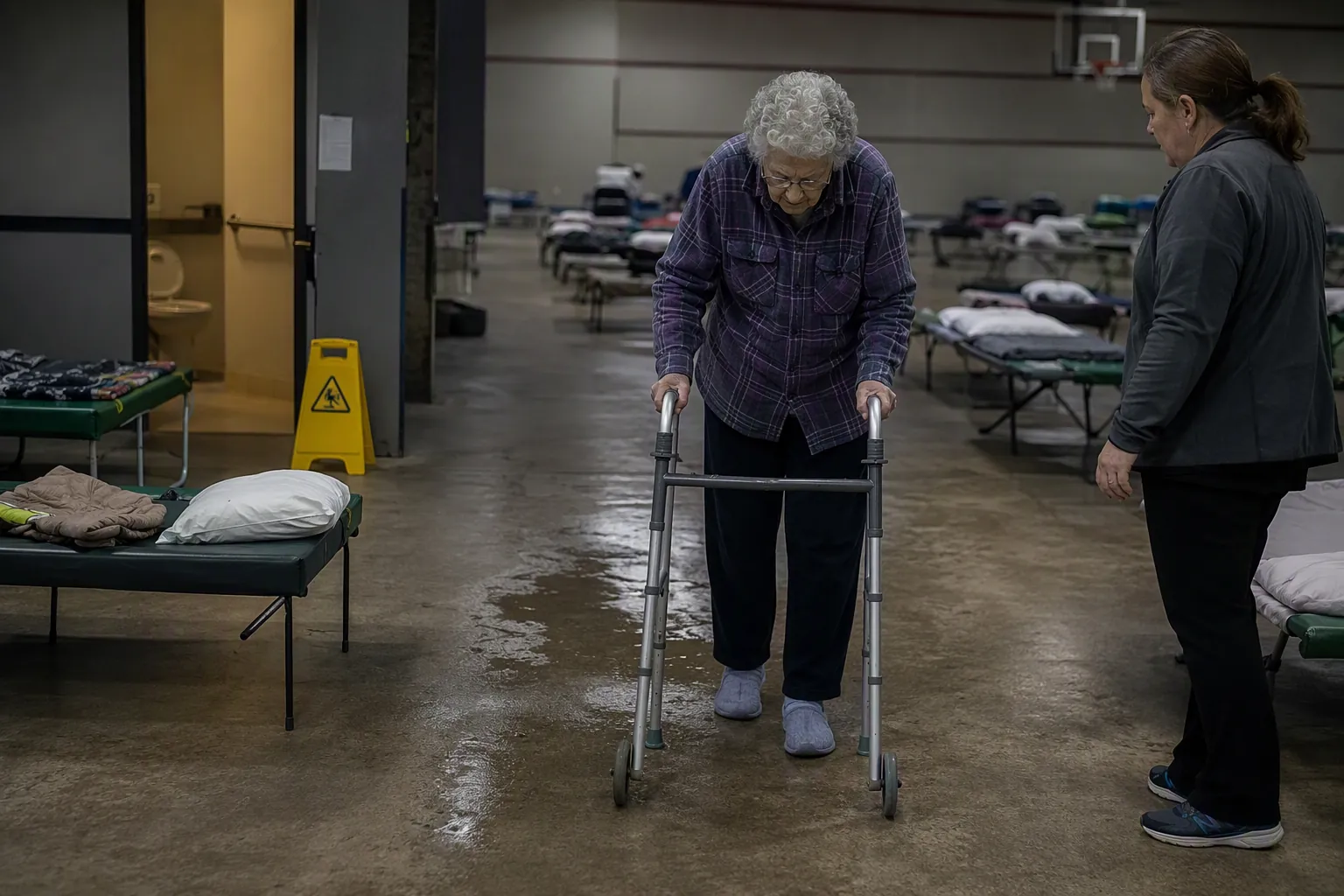
Before unpacking everything, choose the sleeping spot with walking in mind. Closer to the bathroom is not always better if the route is crowded, wet, or poorly lit. Look for a place with enough room to park the walker on the side the person uses to stand, a clear path to the bathroom, and a wall or fixed landmark that helps orientation. If the only available cot is low or unstable, ask shelter staff whether there is an accessible option rather than trying to solve it at midnight.
Walk the bathroom route once in daylight or full lighting. Notice door thresholds, wet areas, loose mats, trash cans, cords, and places where a walker will not fit. If the restroom has grab bars, check that they are firmly attached before the older adult relies on them. Put a flashlight, glasses, hearing aids, shoes, and mobility aid in the same positions every time. For more general fall-prevention principles that apply outside hurricane season, the site's Fall Prevention FAQ for Seniors and Caregivers can help caregivers think through balance, lighting, footwear, and home hazards.
- Keep the walker or cane within arm’s reach of the cot, never folded across the room.
- Place shoes where feet naturally land when sitting up.
- Use a small light for nighttime bathroom trips, but avoid glare aimed into the older adult’s eyes.
- Ask shelter staff to help move cords, boxes, or supplies that block the path instead of stepping around them.
- Do not let the older adult walk alone to an unfamiliar restroom the first night if balance is already a concern.
Temporary housing with relatives or in a hotel has its own traps. A guest bedroom may have a tall bed, a loose rug, a bathroom down a dark hall, or a shower without grab bars. Do not wait for the first bathroom trip to discover that. Move furniture, clear luggage, test nightlights, and decide whether the older adult needs help overnight. Small lighting tools can matter in unfamiliar rooms; the site's guide to weather-themed gifts that prevent nighttime falls is useful here because the problem is not decoration—it is finding the floor, the bathroom, and the walker in the dark.
If the Older Adult Has Dementia
Dementia changes the fall problem because the hazard is not only weak lighting or a wet floor. It is also agitation, wandering, misreading a crowded room, or trying to leave a shelter to find a familiar place. The Alzheimer’s Association recommends packing familiar comfort items, an ID bracelet, a recent photo, and noise-reducing headphones for individuals with dementia during disasters.[7]
Those items are not sentimental extras. A familiar blanket, sweater, or small object can help anchor someone in a room where nothing looks right. A recent photo helps others assist if the person wanders. Noise-reducing headphones can reduce overload in a loud shelter. The caregiver still has to handle the physical route: keep the sleeping area away from exits when possible, identify shelter staff early, and avoid leaving the person alone during bathroom trips or crowded meal lines.
Watch Heat, Fatigue, and Medication Timing
Falls during evacuation are not only caused by tripping. Heat, dehydration, missed meals, poor sleep, delayed medications, and long waits can make an older adult weak or dizzy. This becomes more likely when power outages follow the storm and air-conditioning is unavailable. For that part of hurricane season, the site's guidance on how to cool seniors without AC and prevent falls during heat waves is directly relevant.
Medication continuity belongs in the fall-prevention plan because skipped doses, doubled doses, or taking medication without food can change alertness and balance. Keep the medication organizer, full medication list, prescriber contacts, pharmacy information, and refill plan together. If the older adult uses blood pressure medication, sedatives, diabetes medication, or anything that has previously caused dizziness, mark that clearly for the caregiver or shelter medical staff.
If a severe-weather plan already exists for thunderstorms, do not assume it covers hurricane evacuation. Thunderstorm safety may focus on staying inside, avoiding windows, and maintaining power-dependent needs. Hurricane evacuation adds the harder problem of moving an older adult through public spaces, vehicles, and temporary housing. The site's severe thunderstorm safety resource for seniors can still help with storm readiness, but evacuation needs its own mobility check.
Return Home Like You Are Entering an Unknown Building
The trip home is when people get careless because the danger feels finished. It is also when the house may have changed: water at the threshold, swollen flooring, shifted furniture, fallen branches, mud, broken glass, downed power lines outside, a refrigerator leak, a rug that will not lie flat, or a bathroom grab bar loosened by water damage.
Do not let the older adult be the first person through the door. One able-bodied adult should inspect the route from vehicle to entrance, then the route from entrance to chair, bathroom, bedroom, and kitchen. Use daylight if possible. If power is out, use a flashlight before stepping, not after. Check for standing water before using electrical switches. If there is any smell of gas, visible structural damage, or downed power lines, stay out and follow local emergency instructions.
- Clear branches, loose mats, wet leaves, and debris from the path before the older adult exits the car.
- Test steps, ramps, railings, and grab bars before anyone relies on them.
- Remove wet rugs and towels that can slide under a cane or walker.
- Restore night lighting before the first overnight bathroom trip.
- Keep the medication bag, glasses, hearing aids, phone, water, and mobility aid near the first safe chair.
- Delay unpacking if it would fill the hallway with bags and boxes.
Post-outage heat can continue the fall risk after return, especially if the home is closed up, humid, and without air-conditioning. Heat-related weakness can turn a familiar hallway into a hazard, so cooling, hydration, and rest need to happen before laundry, cleanup, or sorting supplies. The related guide on senior heat wave preparedness is useful when hurricane damage leaves a home hot even after the storm has passed.
Only after the route is dry, lit, and clear should the older adult resume normal movement through the home. The evacuation is not over when the car reaches the driveway. It is over when the person can get from chair to bathroom to bed without stepping around storm debris, luggage, darkness, heat, or a missing mobility aid.
References
- Why it can be more difficult to evacuate older adults in a disaster, PBS NewsHour
- Evacuation and Transportation Barriers Among Vulnerable Populations, PMC, 2025
- Hurricane and Emergency Preparedness for Seniors, Miami Jewish Health
- Disaster Risks to Older Adults, AARP, 2022
- Older adults elderly senior weather hurricanes, Fox Weather
- Older Adults, American Red Cross
- In a Disaster, Alzheimer’s Association
Related reading
Noticed something outdated or inaccurate on this page? Flag a correction. We review every report against CDC, NIA, and AARP HomeFit guidance before updating a page.
Part of the Fall Prevention section.