
STEADI: Intervene
How to Fall-Proof a Volcano Evacuation for Older Adults
Ash-covered surfaces, rushed departures, and hands full of supplies make volcano evacuations a high-risk time for falls in older adults. Here is how to prepare and move — footwear, mobility aids, packing, driving, and post-return cleanup — so a fall does not become the complication of an already-dangerous evacuation.
Volcano evacuations do not raise fall risk in one dramatic way. They raise it through small, predictable failures: ash makes steps and pavement slippery, rushed movement shortens balance checks, visibility drops, and the bag meant to help can occupy the same hand an older adult needs for a cane, walker, railing, or car door. Ready.gov and the American Red Cross both warn that ash-covered surfaces can be slippery, which is enough reason to treat evacuation safety tips for older adults during a volcano eruption as fall-prevention work, not just emergency packing advice.[1][2]
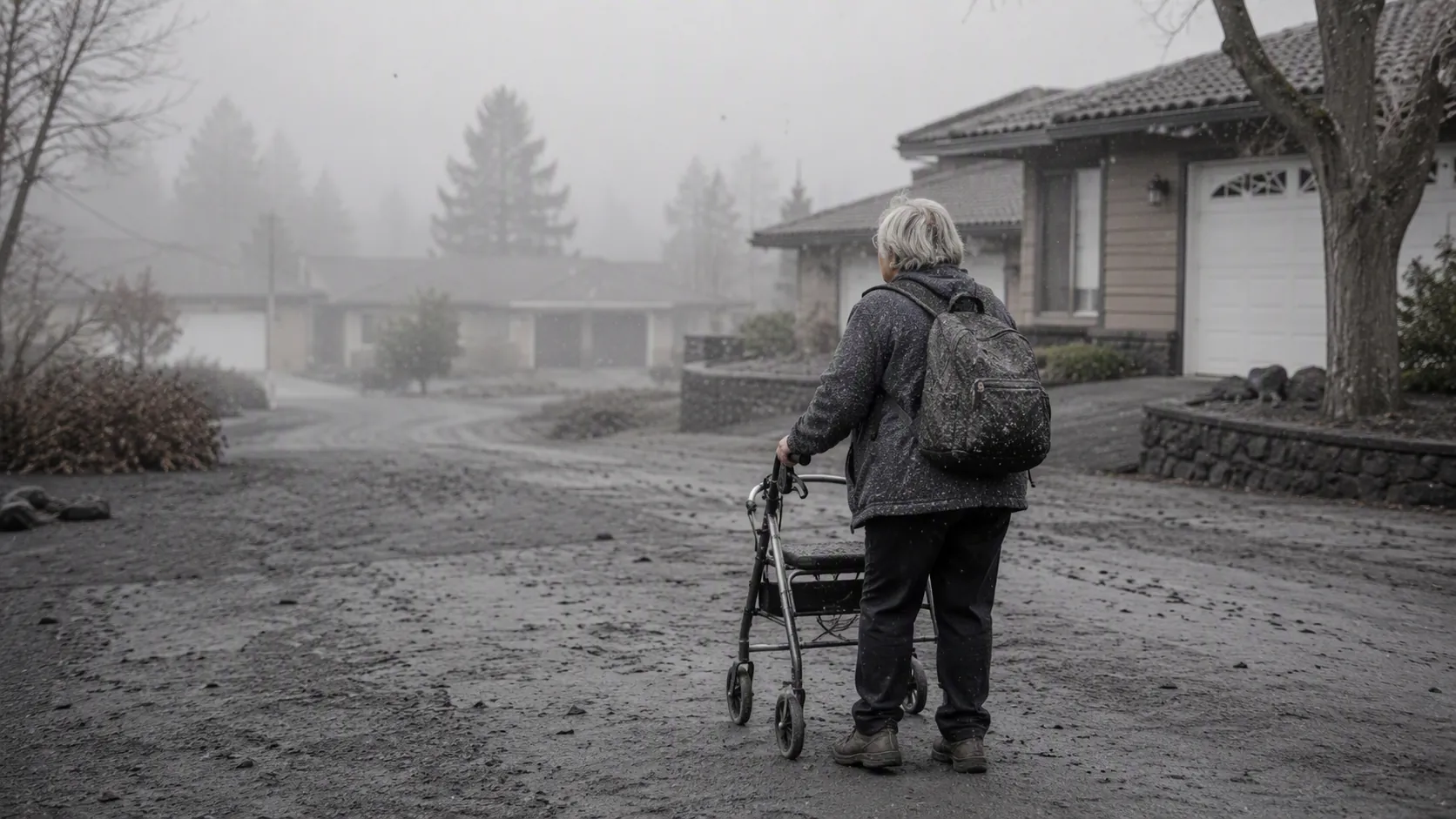
Reviewed for fall-prevention education. This article is general safety information, not medical advice or a substitute for local emergency instructions, evacuation orders, or guidance from a clinician who knows the older adult’s mobility, breathing, vision, medications, and assistive-device needs.
The evacuation has to be built around the body that will actually move through it
A tidy volcano plan can still fail at the threshold. The older adult may have the right supplies, the right destination, and the right alert app, then step outside in loose slippers because the boots are in a closet. Or the cane is beside the bed while the person is already at the back door. Or the supply tote is heavy enough that the person has to choose between carrying water and keeping a hand on the railing.
The Red Cross older-adult preparedness guidance is useful here because it names the things generic go-bag lists often treat as secondary: extra assistive items such as a cane and eyeglasses, and people who can help with evacuation.[3] For fall prevention, those are not comfort items. They are the equipment that lets the person stay upright while every surface and decision is getting worse.
| Evacuation point | Common fall failure | Fall-proofing move |
|---|---|---|
| Before an alert | Shoes, glasses, cane, walker, charger, or hearing aids are scattered in different rooms | Create one exit station with sturdy footwear, the main mobility aid, backup essentials, and a hands-free bag |
| Leaving the home | The person steps onto ash, gravel, porch boards, or stairs while carrying supplies | Put supplies on the body or in the helper’s hands before the door opens; keep the older adult’s hands available for support |
| Walking to a safe area | The plan assumes average walking speed and clear footing | Check local walk-time maps or evacuation routes in advance and pace the route around the slowest safe walker |
| Driving | The car transfer becomes rushed, and ash reduces traction or visibility | Seat the older adult before loading extra gear; drive only when conditions and local instructions allow |
| Arrival | Fatigue, unfamiliar thresholds, and unloaded bags create a second fall risk | Retrieve the mobility aid before standing; let a helper manage bags, doors, curbs, and steps |
| Return and cleanup | Ash remains on steps, ramps, decks, and roofs | Clear a walking path first; do not send the older adult onto an ash-covered roof |
Before an alert: set up the exit, not just the emergency kit
The best time to prevent the evacuation fall is before the older adult has to decide anything quickly. That means the plan should start at the door, not in a storage bin.
- Put sturdy, closed footwear where the older adult will actually exit. The shoes should be easy enough to put on under stress but stable enough for ash-dusted pavement, stairs, and vehicle transfers.
- Keep the primary cane, walker, or rollator on the evacuation side of the home when a volcano advisory or elevated risk period is in effect. A perfect walker in the bedroom is not much help if the person is leaving through the garage.
- Store backup items that preserve balance and orientation: spare eyeglasses, a folding cane if appropriate, hearing-device batteries or chargers, a phone charger, and any small item the person needs to move safely.
- Pack the first carry load so both hands can stay useful. A small backpack, waist pack, or helper-carried bag is usually safer than a hand-held tote for someone who uses a cane, walker, railing, or another person’s steadying arm.
- Name the helper before the alert. The job is not vague reassurance; it is carrying supplies, opening doors, checking footing, retrieving the mobility aid, and staying with the person who moves slowest.
For households that already use a fall-prevention plan, this is the same logic moved outside. If you are starting from scratch, build from a plan-ahead fall-prevention path first, then adapt it to the volcano route. For everyday decisions about canes, walkers, balance, transfers, and functional movement, use the site’s Mobility & Daily Independence guidance before an emergency forces rushed choices.
Do not let the go bag become the hazard. The useful split is simple: the older adult carries only what can be carried without changing gait, posture, or hand use; heavier water, food, blankets, documents, and pet supplies go with a helper or into a vehicle if that is part of the local plan. If nobody is available to carry the heavier load, the plan needs revision, not optimism.
A short pre-alert drill should include the awkward parts
A useful drill is not a race to the door. It should answer the physical questions: Can the older adult put on the shoes without sitting too low to stand back up? Does the backpack pull the shoulders backward? Can the walker fit through the doorway with the bag on? Does the face covering fog the person’s glasses? Can the helper lock the door, carry supplies, and still stay close enough on steps?
Those details look small until ash is falling or sirens are sounding. Then they are the difference between walking out and being helped up from the porch.
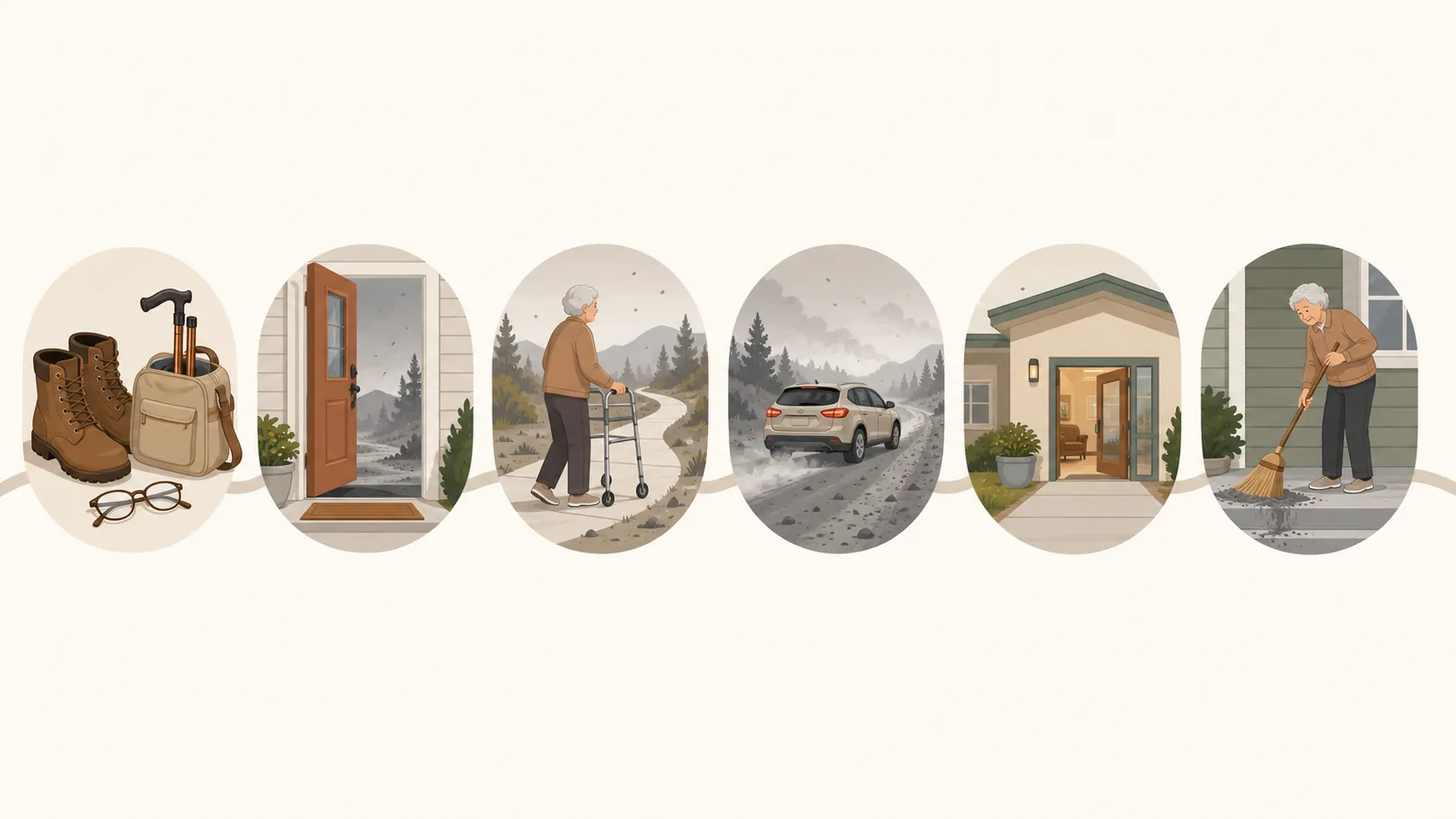
Leaving the home: slow the first thirty steps
The first fall is often invited by the first rush. Before the door opens, the older adult should already have footwear on, glasses in place, the mobility aid in hand, and the carry load settled. A helper should handle anything that swings, bumps, blocks vision, or steals a hand from the walker or railing.
- Turn on lights or use a hands-free light if visibility is poor. A flashlight that occupies the cane hand solves one problem by creating another.
- Pause at the threshold and look down before stepping. Ash can hide the edge of a step, the lip of a mat, a hose, gravel, or a curb.
- Use the railing before using speed. If the older adult needs both the railing and a cane, the helper should carry the bag and stay close enough to assist without pulling.
- Move one transition at a time: doorway, porch, steps, walkway, driveway, vehicle. Most falls during an evacuation will not wait for the dramatic part of the route.
- Keep the mobility aid with the person until the person is seated in the vehicle or safely inside the next building. Do not load the walker first and ask the person to cross the driveway without it.
If ash is in the air, speed is not the only concern. USGS guidance says to avoid undue exertion when ash is present because heavier breathing draws small particles more deeply into the lungs.[4] That does not mean ignoring an evacuation order. It means the helper should prevent panic pacing: no unnecessary trips back into the house, no overloaded carrying, no half-running because the plan failed to put shoes and supplies in the right place.
If walking is part of the route, check the local walk-time reality
Some volcano hazards are planned at neighborhood scale, not just household scale. Around Mount Rainier, for example, Puyallup provides lahar evacuation walk-time maps so residents can see estimated walking times to evacuation areas.[5] That kind of map matters for older adults because “walk to high ground” is not one instruction. It is a route with slopes, crossings, surface changes, crowding, weather, and a body that may not walk at the speed assumed by a healthy adult.
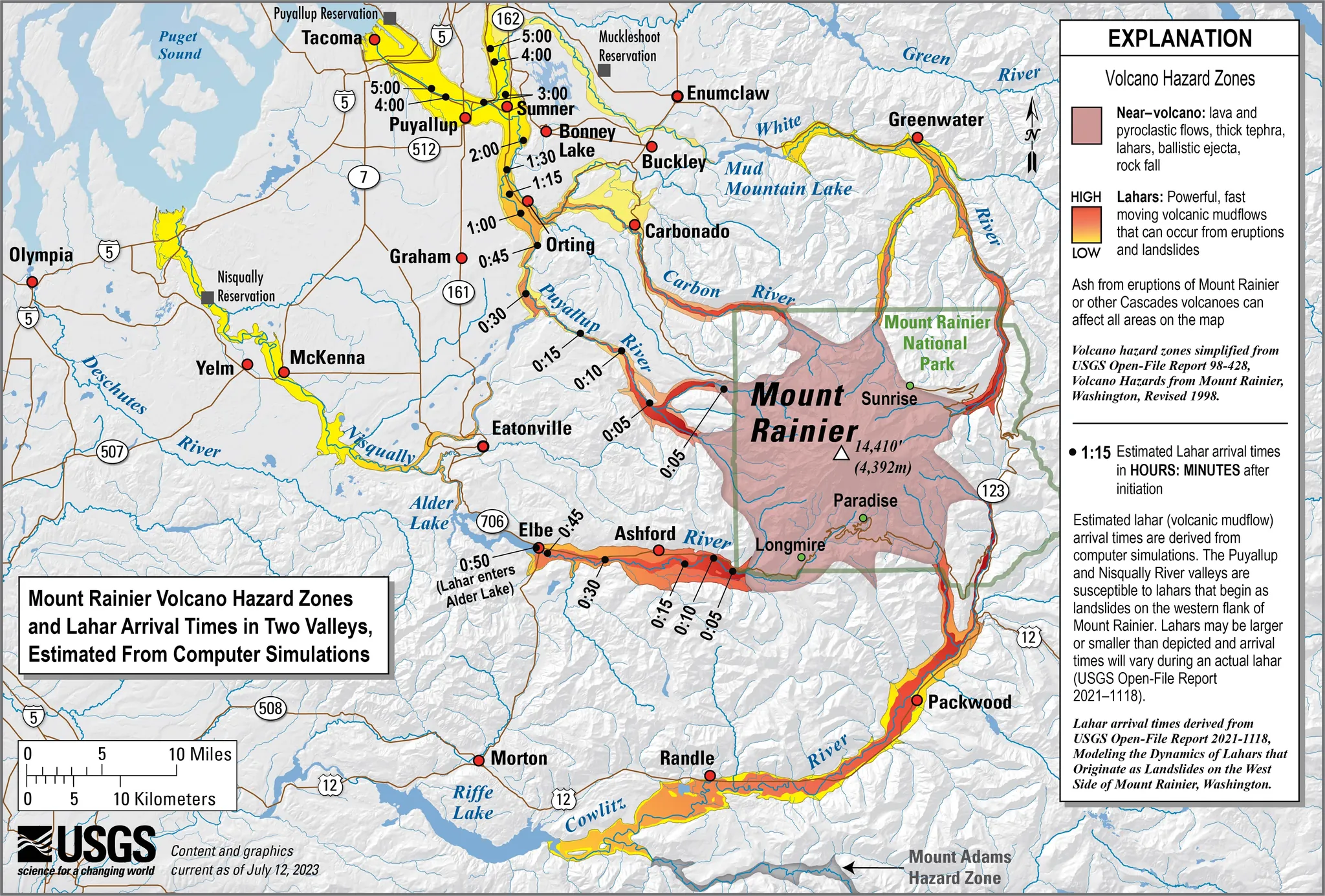
The practical check is blunt: take the older adult’s actual walking route, with the actual mobility aid, at a careful pace, and compare it with the local evacuation map or county instructions. If the route only works when the person walks faster than usual, carries nothing, and never pauses, it is not a finished plan.
This is also where county-specific planning matters. A family in Pierce County or Puyallup may be looking at lahar sirens and walk-time maps. A household in Hawaii, Alaska, or another Cascade community may be dealing with different alerts, road closures, shelter locations, ashfall expectations, or evacuation zones. There is no universal safe route hiding in a national checklist.
Walking with a cane, walker, or helper
Ash changes the job of every mobility aid. A cane tip that feels secure on dry indoor flooring may be less predictable on dusty outdoor surfaces. Walker wheels may roll differently over grit or transitions. The answer is not to abandon the aid; it is to keep the pace slow enough that the person can place, test, and move rather than swing the device forward and chase it.
- Use shorter steps than usual on ash-covered pavement, ramps, and stairs.
- Stop before adjusting a mask, glasses, hood, backpack strap, or phone.
- Do not let a helper pull the older adult forward by the arm. If hands-on help is part of the plan, practice the safest method beforehand with a clinician or mobility professional when possible.
- If the walker catches, skids, or feels unstable, stop and reset. Lifting and twisting at the same time is the move to avoid.
- Keep the communication device accessible, but do not make the older adult walk while looking at a phone.
A named helper is not only for people who cannot walk alone. During a volcano evacuation, the helper can carry the load, watch for curbs and hidden edges, manage doors, communicate with others, and notice when the older adult is breathing hard enough to need a brief pause if conditions allow. That is a fall-prevention role.
Driving in ashfall: do not make the car transfer the dangerous part
Driving may be part of the official evacuation plan, but it is not automatically safer for an older adult if the transfer into the car is rushed. The mobility aid should stay with the person until the person is seated. The helper or driver can load bags after the older adult is stable, then place the cane or walker where it can be retrieved before the person stands up at the destination.
Ash also changes the road. King County’s volcano preparedness guidance says that if you must drive during ashfall, you should drive 35 mph or slower because ash reduces visibility and traction.[6] Ready.gov also cautions against driving in heavy ashfall unless driving is necessary.[1] For an older passenger with balance or frailty concerns, that slower driving is not only about the road surface. Abrupt braking, sharp turns, and poor visibility can turn the ride and the arrival into another transfer hazard.
- Seat the older adult before loading loose supplies.
- Keep the cane, walker, glasses, phone, and essential communication items reachable, not buried under evacuation bags.
- Avoid asking the older adult to stand on ash-covered pavement while the driver reorganizes the vehicle.
- At the destination, retrieve the mobility aid first, open the door fully, check the ground surface, and then help the person stand.
If local officials tell residents not to drive, that instruction controls. If they direct vehicle evacuation, the older adult’s fall plan still has to cover the two places where falls often happen: getting into the car and getting out of it.
Arrival is still part of the evacuation
A shelter, relative’s home, hotel, or public building can feel like the finish line, but fatigue changes balance. The older adult may be stepping onto an unfamiliar curb, crossing a crowded entrance, using a bathroom with different grab points, or sitting in a low chair that is hard to rise from.
The first arrival task is not unpacking. It is getting the person safely inside with the same supports used to leave: proper footwear, glasses, the mobility aid, a clear hand for rails, and a helper managing doors and bags. If the older adult uses a walker, do not park it across the room after entry. If the person uses a cane, do not lean it where it can slide behind furniture or disappear under coats.
This is also the moment to separate fall-prevention essentials from the larger disaster supplies. Medications, respiratory protection, documents, food, water, and communication plans are important, and official emergency guidance should direct those choices. But the items that keep the person upright need their own priority: shoes, glasses, cane or walker, phone, charger, hearing support, and a named person who knows the movement plan.
Returning home and cleaning ash: clear the walking path first
Post-eruption cleanup can be a quiet fall trap. The emergency feels over, so people step onto porches, decks, ramps, and driveways as if the surface has returned to normal. It may not have. Ash on steps or pavement should be treated as a traction problem until a safe walking path is cleared.
The roof deserves a hard line. Ready.gov warns not to climb onto a roof to remove ash because ash makes surfaces slippery and can add dangerous weight to an overloaded roof.[1] That is not a chore for an older adult with balance concerns, and it is not a chore for an untrained helper trying to be brave. The safer task is to keep the older adult off ash-covered elevated surfaces and arrange appropriate help if roof ash has to be addressed.
- Clear the porch, steps, ramp, and main walking route before the older adult carries anything inside.
- Keep sturdy shoes on during cleanup and re-entry, even if the person is only stepping from the car to the door.
- Use handrails and mobility aids until surfaces are visibly clear and dry enough for safe footing.
- Do not let fatigue turn cleanup into a second evacuation. Bring in essential items first; leave heavy unloading for helpers.
The plan is local, and the fall risks are physical
A safer volcano evacuation for an older adult is not built from a longer checklist. It is built by matching five things before the siren: the person’s actual mobility, the assistive items that keep that person upright, the helper who will carry and steady rather than rush, the route the county actually expects residents to use, and the ash conditions that can make ordinary surfaces slippery.
The stubborn test is simple: can this older adult do this while tired, anxious, breathing carefully, seeing poorly, and moving over ash with both hands available for balance? If the answer is no, the evacuation plan is not finished yet.
References
- Volcanoes — Ready.gov
- Volcano Safety — American Red Cross
- Older Adults — American Red Cross
- Protecting yourself during ashfall — U.S. Geological Survey
- Volcanic Rainier — City of Puyallup
- Volcano — King County
Related reading
Noticed something outdated or inaccurate on this page? Flag a correction. We review every report against CDC, NIA, and AARP HomeFit guidance before updating a page.
Part of the Fall Prevention section.