
STEADI: Intervene
How to Protect an Older Parent from Dust Storm Air Pollution
A caregiver-directed action plan for protecting an older parent during an active dust storm — confirming the warning and AQI, sealing the home, cleaning indoor air, and keeping the house safe to navigate if the power goes out. It also covers the after-storm monitoring window and how to decide between calling a provider and calling 911.
If a Dust Storm Warning just hit your phone, treat the next few minutes as a home-air and movement problem. The warning means visibility may drop to about 1/4 to 1/2 mile with strong winds; the National Weather Service and NWS Phoenix describe dust-storm conditions with gusts in the 40 to 60 mph range, which is not weather you should ask an older parent to walk through, drive through, or stand in while taping a window from the outside.[1][2]
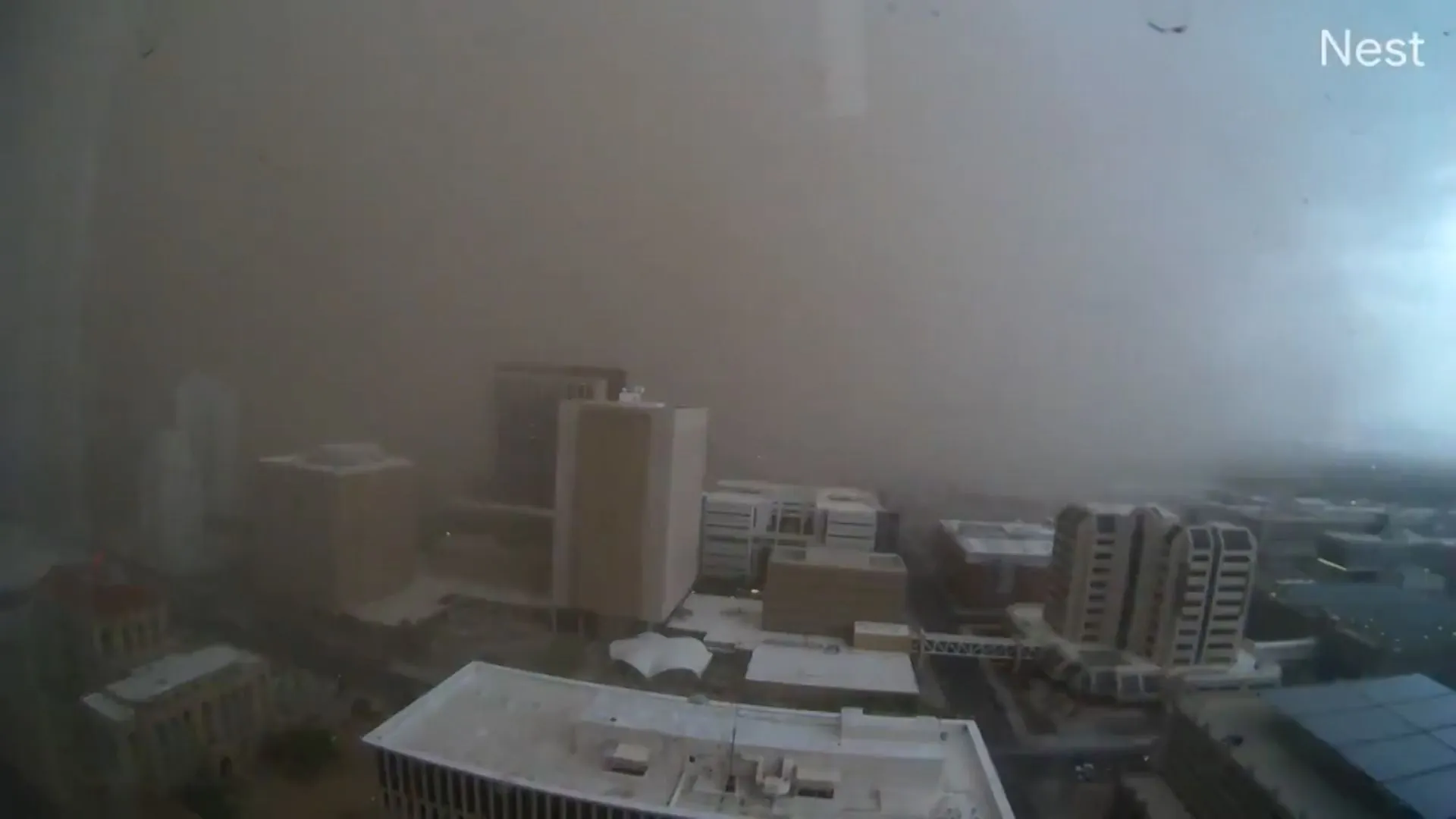
Start with the call you can actually make: “Are you inside? Sit down while we do this. I’m going to check the alert and air quality, and then we’ll close up one room.” Older adults are one of the groups AirNow identifies as at higher risk from particle pollution, and the CDC explains why dust is more than a nuisance: larger PM10 particles can irritate the eyes, nose, and throat, while smaller PM2.5 particles can travel deep into the lungs and even enter the bloodstream.[3][4]
This article is general safety education, not medical advice. If your parent has COPD, asthma, heart disease, oxygen equipment, or a clinician-provided action plan, use that plan and call their care team for individual instructions. If symptoms feel urgent or life-threatening, call 911 rather than trying to manage the situation by phone.
The first call: confirm the threat, then stop extra movement
Do not make the first task “go check outside.” Confirm the warning from your own phone, local weather office, Wireless Emergency Alert, weather radio, or the NWS page, then check the AQI for your parent’s location. If you need a color-by-color refresher while you are on the phone, use the AQI alert guide for older adults with breathing problems as a secondary screen, not as a reason to delay the immediate steps.
| What you verify | What you ask your parent to do | What you avoid |
|---|---|---|
| Live Dust Storm Warning or very poor AQI | Get fully indoors and sit down | Walking outside to look, move trash bins, check the car, or tape exterior gaps |
| Which room is easiest to close up | Stay on one level if possible and choose the room with the fewest outside openings | Sending them upstairs, into a garage, or across the house repeatedly |
| Whether the power is on | Turn on lights now, place a flashlight within reach, and keep the phone charging | Waiting until the house is dark to search for batteries or cords |
| Whether breathing medications or oxygen supplies are nearby | Put inhalers, medications, water, glasses, phone, and charger beside the chair or bed | Having them bend into cabinets or walk room to room after they are winded |
When you are directing this by phone, every instruction should reduce steps. “Close the bedroom window and sit back down” is safer than “go around the house and check every window.” If you are there in person, you can do the walking. If you are not, choose the room that gives the most protection with the least effort: usually a bedroom or interior room with a door, a place to sit, a nearby bathroom, and an outlet for an air cleaner.
Close the home envelope without turning the house into a hazard
The American Lung Association’s dust-storm guidance is plain: stay indoors, close windows and doors, and use air conditioning on recirculate during a dust storm.[5] That advice is useful, but it needs translating for a parent who may be alone and moving slowly.
- Ask them to close the windows and exterior doors in the room they are using first. If they can safely close one or two nearby windows without rushing or climbing, fine. Do not ask them to tour the whole house while dust is blowing.
- If there is a visible gap at the bottom of the chosen room’s door or a drafty sill, a rolled towel can help. Damp towels at sills are included in AARP indoor-air guidance, but the key word for an older adult is “reachable.” No step stools, no kneeling if they cannot get up easily, and no exterior taping during the storm.[6]
- If the central HVAC is running, switch it to recirculate if that setting is available. If the system uses a filter, a higher-efficiency filter such as MERV 13 or better can reduce particle movement when the system can handle it; AARP cites CDC-aligned guidance on portable HEPA cleaners and higher-efficiency HVAC filtration for indoor air.[6]
- If there is a window air conditioner, close the outdoor air damper if the unit has one. The point is to cool indoor air rather than pull dusty outdoor air inside.
- Turn off evaporative coolers, also called swamp coolers, and whole-house fans during the dusty period. They depend on outdoor air movement, which is exactly what you are trying to limit.[5][6]
There is one uncomfortable exception: heat. A tightly closed house can become unsafe if the cooling plan fails or the indoor temperature climbs. Do not let “seal the house” override heat illness risk. If the room is getting hot, the air conditioner is not working, or your parent sounds confused, faint, or too weak to manage, treat that as a competing emergency and get local help. The heat and smoke safety checklist for seniors is useful for that trade-off, but during a live dust storm the practical question is immediate: can they stay cool enough in the cleaner room without opening the house to dust?
Start cleaning indoor air before symptoms appear
Do not wait for coughing to begin before turning on filtration. Put the portable HEPA cleaner in the room where your parent will sit or sleep, close the door if that can be done safely, and run the unit continuously while the air outside is dusty. If the unit has speed settings and the noise does not bother them, a higher setting during the worst dust period may clean the room air faster.
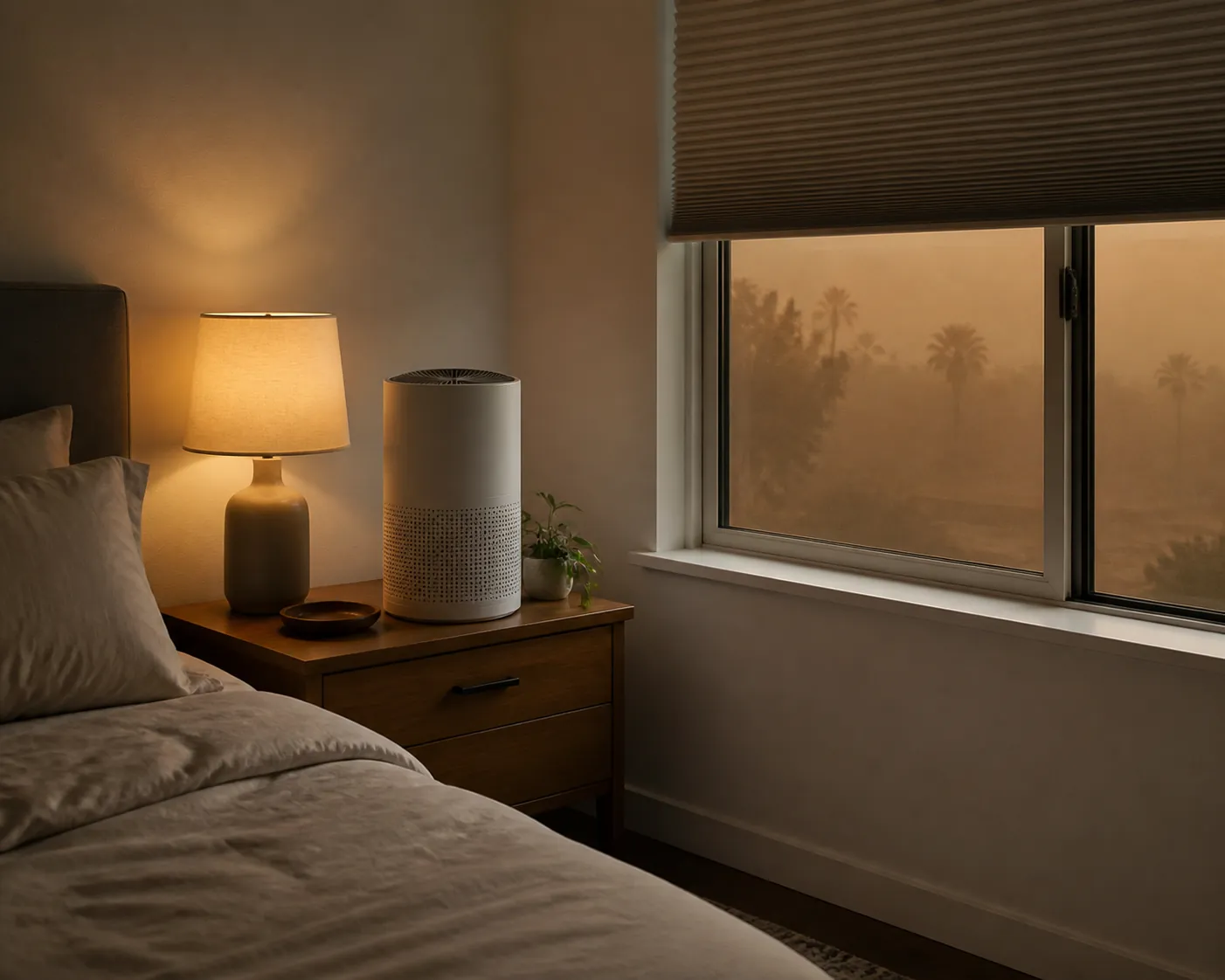
If you have already built a clean-air room for smoke season, use it now. The same room-level logic applies: fewer leaks, fewer doors opening, a correctly sized portable cleaner, and the parent’s necessities within reach. For the deeper setup details, use the clean-air room guide for seniors or the whole-home smoke sealing guide after the immediate call is stable.
A box-fan filter can be a fallback when there is no portable HEPA cleaner. AARP and the Washington State Department of Ecology both point to a do-it-yourself option using a box fan and a high-efficiency furnace filter, often described with a MERV 13 filter.[6][7] This is not the same as promising that a homemade unit equals every commercial HEPA cleaner in every room. It also depends on electricity, a safe fan, correct assembly, and someone who can set it up without strain. If your parent is alone and the parts are in the garage, this is not the time to send them searching.
Keep the room simple: air cleaner on, windows closed, door mostly closed, parent seated, phone charging. Avoid vacuuming, sweeping, frying food, burning candles, or anything else that adds particles indoors while you are already fighting outdoor dust.
Make the room safe if the power goes out
Dust storms can darken a home fast, and a power outage turns a breathing problem into a navigation problem. The fall-prevention work is not separate from the air-quality work; it is what keeps your parent from crossing a dark room while short of breath.
- Turn on a lamp before the room gets dark, if power is still on.
- Place a flashlight, phone, charger or power bank, glasses, water, tissues, rescue inhaler if prescribed, and regular medications within arm’s reach.
- Clear only the immediate path between the chair or bed and the bathroom. Do not ask them to tidy the whole house.
- If they feel dizzy, winded, or shaky, have them sit first and move later. A slower bathroom trip is better than a rushed fall.
- If they use oxygen or powered medical equipment, check the backup plan. If you do not know it, use the severe-weather preparedness checklist for older adults once the immediate room is stable.
If the power fails, the portable cleaner and central HVAC may stop. That does not mean all protection is gone. Keep the room closed, reduce door opening, keep the parent seated, and reassess heat. If the house becomes too hot, the oxygen equipment fails, or your parent cannot safely remain there, call local emergency services or the utility/medical-equipment backup number rather than trying to improvise through a dangerous outage.
If they must go outside, keep it rare and brief
The safer plan is not to go out. If there is a true necessity — a medical transfer, evacuation instruction, or another urgent safety issue — use the shortest possible route and get help rather than having an older adult manage it alone. AARP’s dust-related mask guidance favors a well-fitting N95, P100, or KN95 respirator over a surgical mask for filtering fine particles.[8] A loose mask, a damp bandana, or a scarf is not a reliable substitute for someone with breathing disease.
For a non-urgent errand, the answer is no. Groceries, mail, trash bins, patio furniture, and car checks can wait. If the outdoor decision is not obvious, use a go/no-go bad-weather checklist for seniors after the storm has settled, not while visibility is collapsing.
Keep watching after the sky looks better
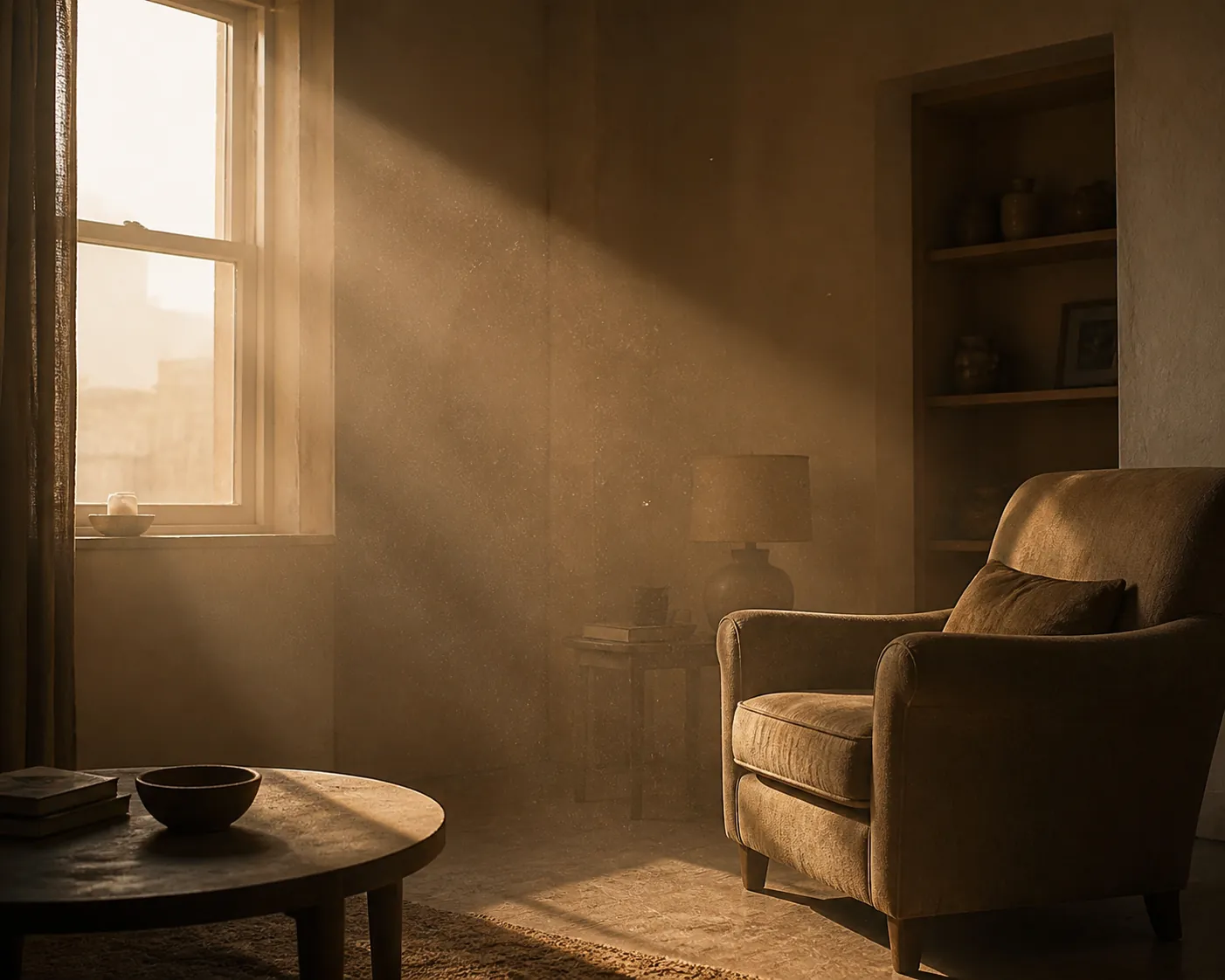
The visible wall of dust is not the end of the exposure. The American Lung Association says dust particles can remain in the air from a few hours up to 10 days after a storm, depending on particle size, wind, and weather conditions.[5] That one fact should change the caregiver plan: do not open the house wide just because the sky is no longer brown.
For the next several hours, and longer if the AQI remains poor, keep using the cleaner room, continue HVAC recirculation when safe, and check the AQI again before airing out the house. If you use a three-part check — outdoor AQI, indoor conditions, and your parent’s symptoms — the air-quality check guide for elderly parents can help structure those follow-up calls.
The health evidence is serious, but it is not perfectly uniform. A systematic review of 140 studies found dust events associated in many studies with emergency calls, hospitalizations, and mortality, while also noting that some studies found no significant association.[9] For a caregiver, the honest conclusion is not that every dust storm will cause a crisis. It is that an older adult with lung or heart vulnerability deserves a lower threshold for protection and follow-up.
What to ask on the next call
Use specific questions instead of “Are you okay?” An older parent may answer yes because they do not want you to worry, or because breathlessness has been creeping up slowly.
- Are you coughing more than usual?
- Any wheezing, chest tightness, or shortness of breath?
- Are your eyes, nose, or throat burning or irritated?
- Do you feel dizzy, weak, or unsteady when you stand?
- Have you used your rescue inhaler or breathing treatment more than your usual plan allows?
- Is the room staying cool enough with the doors and windows closed?
If symptoms are new, worsening, or outside their usual pattern, call their clinician, nurse line, or respiratory-care team for individualized guidance. If they have severe or rapidly worsening breathing trouble, chest pain or pressure, fainting, confusion, blue or gray lips, or cannot speak normally because of breathlessness, call 911. Do not try to diagnose dust irritation versus asthma, COPD, heart symptoms, anxiety, heat stress, or infection over the phone.
The Southwest valley fever question
In Arizona and other parts of the Southwest, caregivers often wonder whether a haboob means valley fever is more likely. Keep the answer balanced. Mayo Clinic says older adults are more likely to develop valley fever and advises people over 60 to seek medical care if they have symptoms.[10] At the same time, ASU epidemiologist Dave Engelthaler has said haboobs do not raise valley fever cases.[11] So the practical step is not to assume every cough is valley fever, and not to dismiss a persistent or concerning illness either. Track symptoms, protect the lungs, and involve a clinician when the pattern does not settle or your parent is in a higher-risk group.
References
- Dust Storms, National Weather Service.
- Monsoon Safety, National Weather Service Phoenix.
- Older Adults, AirNow.
- Air Pollutants, Centers for Disease Control and Prevention.
- Dust Storms, American Lung Association.
- Improve Home Air Quality, AARP.
- Dust storms: How to protect yourself, Washington State Department of Ecology, July 2024.
- Saharan Dust Cloud: Health Risks and How to Protect Yourself, AARP.
- Health effects of desert dust and sand storms: a systematic review and meta-analysis.
- Valley fever - Symptoms and causes, Mayo Clinic.
- What you need to know about dust storms and Valley fever, ASU News, August 28, 2025.
Related reading
Noticed something outdated or inaccurate on this page? Flag a correction. We review every report against CDC, NIA, and AARP HomeFit guidance before updating a page.
Part of the Fall Prevention section.