
STEADI: intervene
How to Protect Older Adults From Ebola at Home
Ebola risk for most older adults in the U.S. is near zero, so the right response depends on whether a real household exposure exists: a returning traveler, home care of an ill family member, or an affected-area visitor. For those situations, caregivers get the 21-day monitoring protocol, the 100.4°F fever threshold, isolate-and-call steps, no-touch rules for body fluids, and a plan-ahead readiness checklist.
Start with the exposure filter
For most older adults in the U.S., the safest Ebola plan is not a special Ebola routine. It is ordinary hygiene, ordinary medical care, and no escalation unless a real exposure scenario exists. As of the July 2026 CDC material cited here, there were no U.S. Ebola cases, and CDC has described the general-public risk in the U.S. as low. The risk changes when Ebola is actually present in a household situation: CDC names family members who care for an ill person without proper infection control as one of the groups at highest risk.[1]
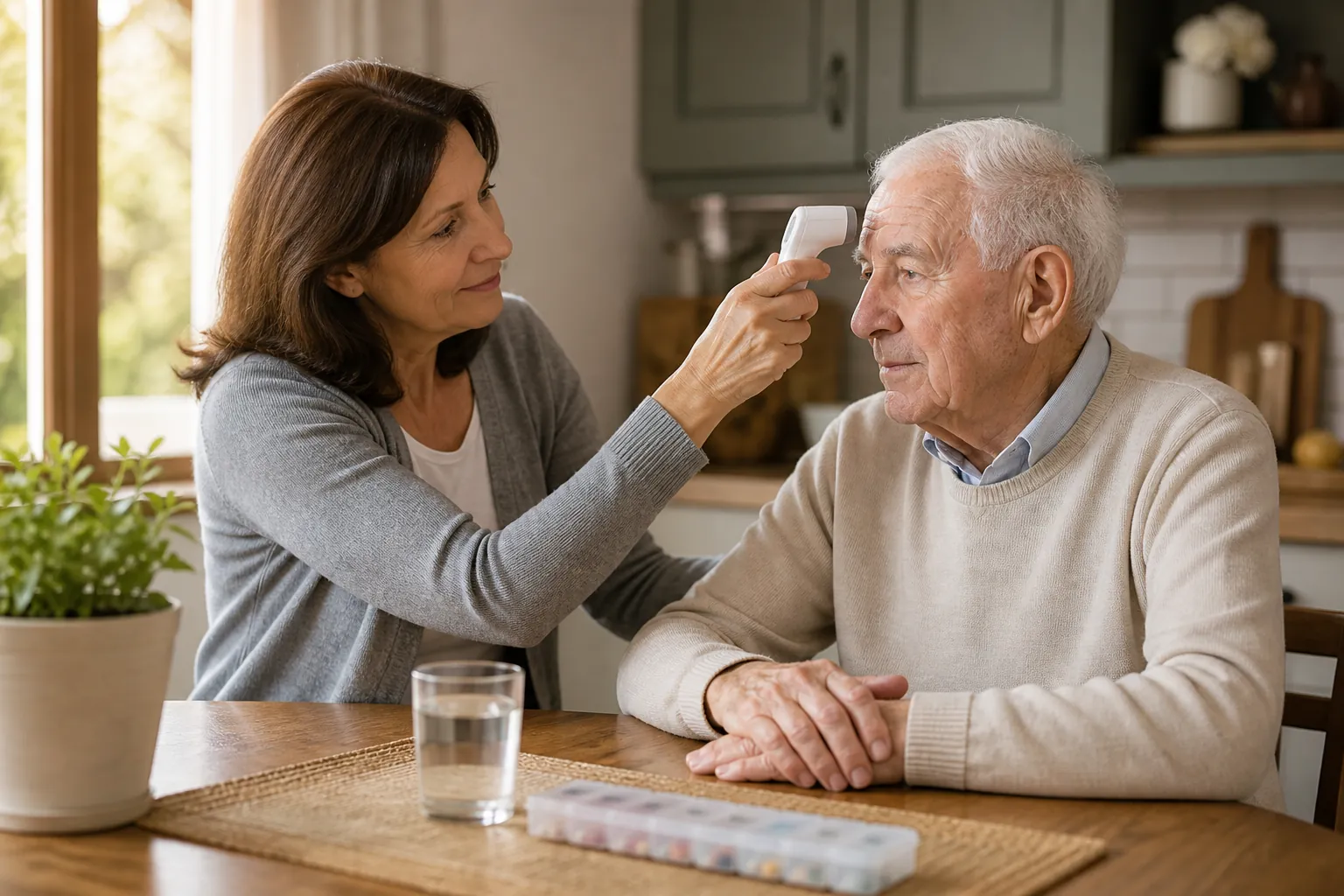
Use this filter before you move a chair, buy supplies, cancel appointments, or start warning relatives:
- Has someone in the household returned from an Ebola-affected area within the monitoring window?
- Is a visitor arriving from an affected area and likely to stay in the home?
- Has a health department directed the family to help care for or separate an ill person with possible Ebola exposure?
If the answer to all three is no, your older parent or spouse does not need Ebola precautions at home. Do not isolate them from grandchildren, bleach the house, or treat every fever as Ebola. Keep doing the boring things that actually protect frail adults day to day: handwashing, safe food handling, routine infection control, medication organization, and fall prevention.
The reason this guide belongs on the table in 2026 is the Bundibugyo virus outbreak context, including a CDC health alert after the public health emergency declaration and U.S. travel measures, plus CDC travel guidance for people returning from Ebola-affected areas.[1][2] CDC’s August 2026 travel notice advised avoiding all travel to Ituri and North Kivu provinces in the Democratic Republic of the Congo and using enhanced precautions for Uganda and unaffected DRC provinces.[3] That is a travel-and-exposure issue, not a reason for every U.S. senior household to perform Ebola precautions year-round.
Last verified: August 5, 2026. This article is household-safety guidance, not a diagnosis or a substitute for instructions from your clinician, emergency medical services, or your state or local health department.
What Ebola protection means inside a home
Ebola protection at home is built around timing and fluids. CDC describes Ebola as spreading through direct contact with blood or other body fluids of a person who is sick with or has died from Ebola, or through contaminated objects; a person is contagious after symptoms begin, not during the symptom-free incubation period.[4] The incubation period is 2 to 21 days.[4]
That gives caregivers a clear job. You are not trying to disinfect life. You are trying to notice the right window, keep the older adult away from body fluids, and call the right people before anyone walks into a clinic waiting room.
| Household situation | What changes tonight |
|---|---|
| No returning traveler, no affected-area visitor, no health-authority-directed home care | No Ebola routine. Use ordinary hygiene and ordinary medical judgment. |
| Returning traveler or affected-area visitor with no symptoms | Start the 21-day monitoring clock from the last possible exposure; check temperature daily; avoid travel if directed by public health. |
| Exposed person develops fever or symptoms | Separate the person immediately, keep the older adult away, call the health department or emergency instructions, and call ahead before entering any healthcare facility. |
| Body fluids, soiled laundry, bathroom contamination, or death are involved | Do not let family members improvise cleanup or handling. Wait for public health direction and trained responders. |
If exposure is real, start the 21-day clock
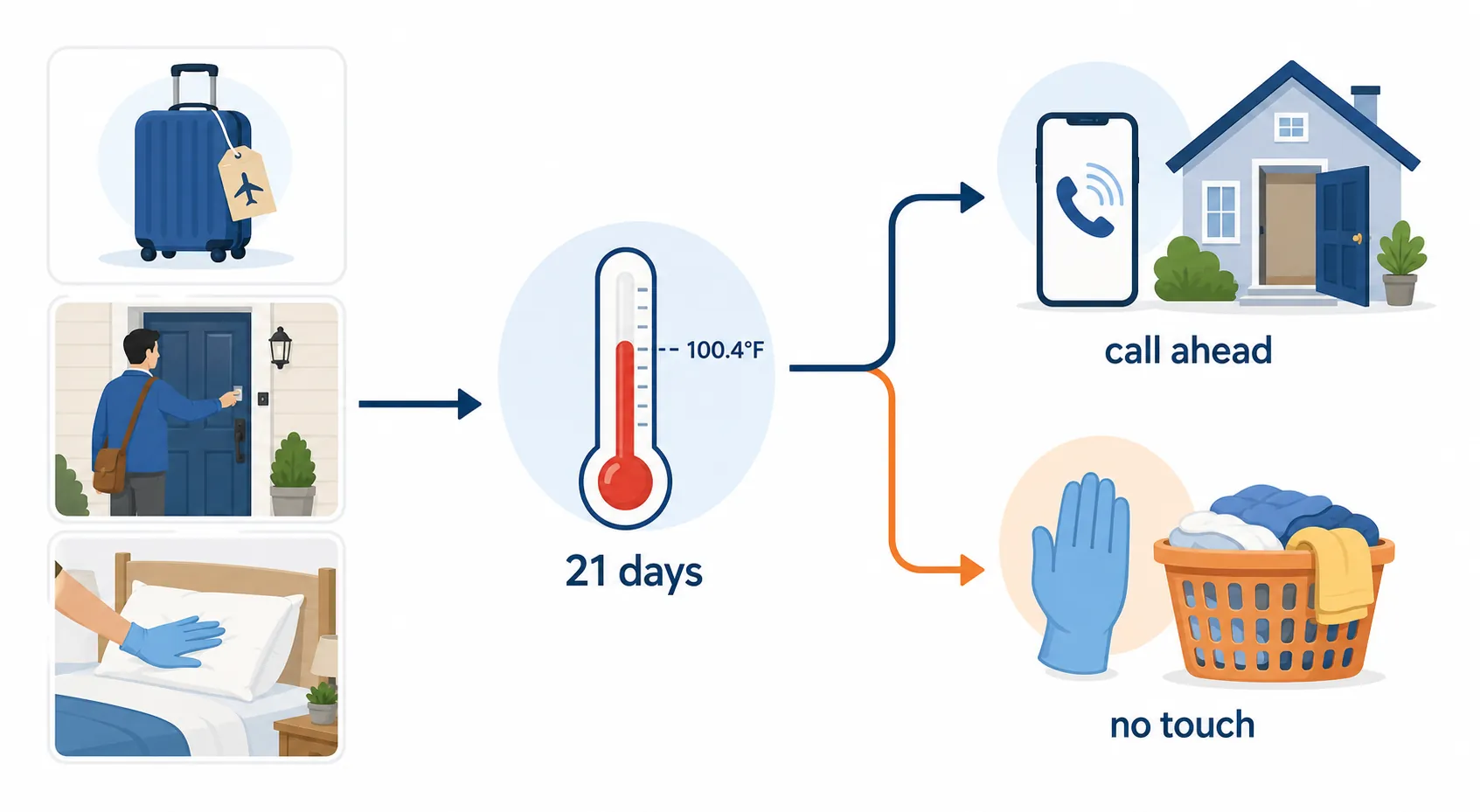
The monitoring period starts from the last possible exposure, not from the day the family heard about the outbreak. CDC’s returning-traveler guidance uses 21 days of health monitoring and names a fever threshold of 100.4°F, or 38°C.[2] Put that number where the person taking temperatures will see it: on the refrigerator, on the medication chart, or inside the notebook where you track blood pressure and appointments.
- Write down the last possible exposure date and the date the 21-day period ends.
- Check temperature every day, using the same thermometer if possible.
- Ask about new symptoms once a day without turning the home into an interrogation room.
- Keep the health department number, the primary clinician’s number, and the nearest emergency department number in one visible place.
- Follow public-health instructions about travel, activity limits, and monitoring check-ins.
For an older adult who was exposed but feels well, the goal is calm observation. Do not stop heart medications, diabetes care, dialysis transport, home oxygen deliveries, or other essential care unless a clinician or health department tells you to change the plan. Ebola monitoring should not create a second emergency by interrupting the care that keeps the person stable.
If the exposed person is someone else in the home, such as an adult child returning from travel, keep that person’s monitoring separate from the older adult’s daily needs. The older adult should not be the one bringing meals into a bedroom, collecting laundry, cleaning a bathroom, or checking on a sick traveler.
If symptoms begin, isolate first and call before care
The dangerous moment for a family is often the helpful reflex: someone spikes a fever, and a relative says, “I’ll drive you to urgent care.” With possible Ebola exposure, do not make an unannounced trip to a clinic, pharmacy clinic, urgent care, or emergency department. CDC tells returning travelers to isolate and call immediately if symptoms develop, and to avoid travel while being monitored.[2]
Illinois public-health guidance adds the practical point families need in the doorway: call ahead before entering a healthcare facility and disclose the travel history.[7] That call lets the facility route the person away from a crowded waiting room and use the right infection-control steps before arrival.
The first hour should be simple:
- Move the symptomatic person into a separate room and close the door.
- Keep the older adult, children, visitors, and pets away from that room.
- Call the local health department, the monitoring contact you were given, or emergency medical services if the person is severely ill.
- Say plainly: possible Ebola exposure, symptoms, temperature if known, travel or contact history, and whether an older adult or medically fragile person lives in the home.
- Do not bring the person into a healthcare facility until you have been told how to arrive.
If the older adult is the symptomatic exposed person, the same rule applies, but the household may need more help quickly. Someone with limited mobility, dementia, oxygen needs, or a high fall risk may not be able to remain safely alone in a bedroom. Tell the health department exactly what support the person needs: walker, wheelchair, toileting help, oxygen equipment, hearing impairment, confusion, or a need for time-sensitive medication.
Home care for possible Ebola should be treated as a temporary, directed measure while public health arranges safe evaluation and isolation. It is not a family nursing project. WHO describes isolating cases in treatment centers and using infection-prevention measures as core outbreak-control steps.[6]
The no-touch rule: fluids, laundry, bathrooms, and bodies
If there is one rule to make nonnegotiable with relatives, it is this: body fluids are not a family-handling task. Blood, vomit, stool, urine, saliva, sweat, semen, breast milk, soiled linens, used towels, and bathroom surfaces can become the point where a worried household turns one exposure into more.
Do not ask the older adult to “just hold the bag,” “just put the sheets in the washer,” or “just wipe the floor.” Do not let a spouse with arthritis, poor balance, or poor vision try to clean a bathroom after an exposed person becomes ill. The right action is to keep distance, close off the area if you can do so without contact, and wait for public-health instructions.
New York State health guidance emphasizes hand hygiene with soap and water or alcohol-based sanitizer as part of prevention.[8] Hand hygiene matters, but it is not a permission slip to handle Ebola-contaminated laundry. Gloves in a supply basket do not make family cleanup safe. If public health gives specific instructions for a particular home situation, follow those instructions exactly; otherwise, the household rule is distance and phone calls, not cleanup.
A death in the home changes the situation immediately. WHO lists direct contact with the body of a person who died of Ebola as a transmission route.[6] In a Sierra Leone household-transmission cohort published in 2016, Bower and colleagues found corpse contact had the highest measured attack rate among the exposure types they analyzed: 83% of those exposed.[9] That is one study in one outbreak setting, not a universal household percentage, but it is strong enough for a clear family rule: do not touch, wash, dress, move, or prepare the body. Call emergency services or the health department and wait for trained safe-handling teams.
Older age changes the consequence, not the exposure gate
Older adults deserve special care if Ebola exposure is real because severe infections are harder on aging bodies. WHO’s Ebola fact sheet gives an average case fatality rate around 50%, with rates ranging from 25% to 90% across past outbreaks.[6] MedlinePlus notes that the immune system responds more slowly with age, which can raise infection risk and reduce vaccine response in general.[10]
The age signal also appears in household research, though it should be used carefully. In the 2016 Sierra Leone household cohort, Bower and colleagues found attack rates exceeding 60% for adults over 30 and an exposure-adjusted relative risk of 1.5 for people over 50 compared with ages 20 to 29, with a 95% confidence interval of 1.1 to 2.0.[9] That does not prove the same risk level for every outbreak, every strain, or every home. It does support stricter protection for an older adult once an actual exposure enters the household.
This is the calibration that keeps the plan honest: older adults may do worse once infected, but age alone does not create Ebola risk in a U.S. home with no exposure scenario.
Do not build the household plan around a vaccine
Vaccine wording is easy to get wrong in 2026. WHO’s vaccine Q&A states that there is no licensed vaccine for Bundibugyo virus disease, and that ERVEBO is licensed for protection against Zaire ebolavirus, not Bundibugyo virus.[5] CDC’s ERVEBO product information describes its use for Zaire ebolavirus disease and notes eligibility beginning at 12 months of age, with trial data including 542 adults age 65 and older, but that does not make it a solution for the current Bundibugyo outbreak.[11]
For a family caregiver, the practical conclusion is narrow: do not assume a parent is protected because someone mentions “an Ebola vaccine.” If a real exposure exists, the protective plan is still monitoring, isolation if symptoms begin, call-ahead care, and no-touch rules for fluids and contaminated items.
Plan ahead before a trip or visitor, not all year
Preparedness makes sense before a trip, before a visitor arrives from an affected area, or after a health department has told the household to monitor someone. It does not make sense as permanent Ebola theater in a home with no exposure.

Before travel or hosting, set up the parts that are hard to improvise when someone is tired and frightened:
- Choose the room that could be used for temporary separation. A room with a door and nearby bathroom access is better than a high-traffic living area.
- Decide who will take the older adult away from the exposure area if illness appears. That person should not also be the one checking on the symptomatic traveler.
- Make a one-page contact list: local health department, primary care office, pharmacy, home-health agency, dialysis or infusion center if relevant, emergency medical services, and a nearby relative who can help with errands without entering the home.
- Refill essential medications early enough that a monitoring period does not collide with an empty pill organizer.
- Arrange delivery options for groceries, incontinence supplies, oxygen supplies, wound-care supplies, and pet food.
- Put a thermometer, notepad, trash bags, tissues, hand sanitizer, and the contact list where the monitoring caregiver can find them.
- Tell relatives ahead of time that visits may be paused if symptoms appear. The family member who enforces that rule should not have to negotiate it at the door.
This kind of planning should feel familiar if you already keep a home ready for power outages, medication disruptions, or safe hospital discharge. The same discipline used in a severe-weather preparedness checklist for older adults applies here: decide the room, the caller, the backup caregiver, the supplies, and the medication plan before the stressful moment arrives.
It also fits the caregiver’s observation role during medical risk. Families who use a bedside checklist to protect a parent from hospital errors already know that clear notes, call-ahead information, and a designated communicator can prevent confusion. The difference with Ebola is that the family’s job stops sooner: once symptoms begin, public health and properly prepared healthcare teams need to take over.
If someone is returning from an affected area
Before the traveler comes home, ask for the itinerary, the date of last possible exposure, and any instructions received during travel screening or public-health follow-up. If the traveler is well, do not treat them as sick. Set up monitoring, reduce unnecessary close contact with the older adult during the 21-day window if public health advises it, and make sure the older adult is not responsible for the traveler’s laundry, dishes, trash, or bathroom cleaning.
If you are hosting a visitor from an affected area
Do the awkward conversation before the visit, not after someone develops a fever. Ask whether the visitor has had any known exposure, whether they are under monitoring, and whether public health has given activity instructions. If the older adult is frail, immunocompromised, or dependent on hands-on care, consider postponing nonessential visits until the monitoring window is over.
If public health directs home separation
Write down the instructions while they are being given. Ask exactly who may enter the room, what to do about bathroom use, what to do if symptoms worsen, how to handle routine medications, and who to call after hours. If the older adult needs hands-on help and the exposed person also needs help, those caregiving roles should not be assigned to the same person unless public health specifically directs it.
This is also where ordinary infection prevention still matters. In older adults, infection can become part of the fall-risk chain: dehydration, fever, weakness, diarrhea, missed meals, and medication disruption can all lead to a fall. That is why practical prevention in salmonella safety for seniors and food-recall safety for older adults belongs in the same household mindset. Ebola is far rarer for U.S. families, but if exposure is real, the fall-prevention question becomes very concrete: who keeps the older adult away from the sickroom, hydrated, medicated, and safely moving while the exposed person is handled through public-health channels?
When to stop escalating
If no exposure scenario applies, stop escalating. Use ordinary hygiene. Keep routine care steady. Do not add Ebola precautions to an older adult’s life just because the word is frightening.
If exposure applies and the person is well, use the timed protocol: 21 days from last exposure, daily temperature checks, 100.4°F as the fever threshold, and public-health instructions about movement and monitoring.[2]
If symptoms begin, separate the person, keep the older adult away, do not handle body fluids or laundry, do not transport casually, and call before care. That is the line between preparedness and improvisation.
References
- Health Alert Network (HAN) - 00530, CDC, May 19, 2026, link
- Information for Travelers Returning from Ebola-Affected Areas, CDC, July 23, 2026, link
- Ebola in the Democratic Republic of the Congo and Uganda, CDC Travelers’ Health, August 4, 2026, link
- About Ebola Disease, CDC, June 2, 2026, link
- Ebola vaccines, WHO, June 25, 2026, link
- Ebola virus disease, WHO, April 24, 2025, link
- Ebola Virus Disease, Illinois Department of Public Health, link
- Ebola Virus Disease, New York State Department of Health, link
- Exposure-Specific and Age-Specific Attack Rates for Ebola Virus Disease in Ebola-Affected Households, Sierra Leone, Emerging Infectious Diseases, 2016, link
- Aging changes in immunity, MedlinePlus, July 15, 2024, link
- ERVEBO Vaccine, CDC, January 30, 2025, link
Related reading
Noticed something outdated or inaccurate on this page? Flag a correction. We review every report against CDC, NIA, and AARP HomeFit guidance before updating a page.
Part of the Fall Prevention section.