
STEADI: intervene
A Fall-Safe Tornado Warning Plan for Seniors
Learn the exact steps seniors should take during a tornado warning to reach shelter without falling, with techniques tailored for walkers, canes, wheelchairs, and limited mobility.
When a tornado warning comes through, the instruction for seniors is not simply “run to the basement.” The safer instruction is: stop for a breath, choose the safest shelter you can actually reach, then move there with the same care you would use on a bad balance day. The basement may still be the best place. But if the trip to it means hurrying down stairs in socks, dragging a walker over a rug, or trying to hear shouted instructions over a weather alert, the fall can happen before the tornado ever reaches the house.
That adjustment matters because older adults are not just slightly more vulnerable in tornadoes. An analysis of NOAA/SPC-aligned tornado fatality records reports that adults 75 and older have a tornado death rate roughly three times that of adults 25 to 64.[1] Disaster risk is also higher for disabled people; United Spinal Association cites the Partnership for Inclusive Disaster Strategies in reporting that people with disabilities are two to four times more likely to be injured or die in a disaster than people without disabilities.[2] Those numbers do not prove that rushing causes falls during tornado warnings. I would not claim that without a study measuring it. They do show why the usual advice needs a mobility plan attached to it.
The core tornado guidance still stands: get to a small interior room, basement, storm shelter, or lowest safe level; stay away from windows; protect your head and neck; and remain sheltered until the danger has passed.[3][4][5] The missing piece is how an older body gets there when balance, vision, hearing, pain, reaction time, or a mobility aid changes every step.
The First Seconds: Do Not Bolt
The first useful action after the warning is not movement. It is a controlled pause. Put both feet flat if you are standing. If you are seated, sit fully back for one breath before rising. Turn on a lamp or flashlight if it is within arm’s reach. Put on shoes only if they are right beside you and do not require bending, searching, or crossing the room. If the shoes are in another room, leave them. Shelter comes first.
That pause should take seconds, not minutes. Its purpose is to prevent the preventable: stepping onto a throw rug with a walker caught on the edge, standing too quickly and getting lightheaded, grabbing the wrong cane, or trying to descend stairs while still half-startled by the alert.
- Say the shelter location out loud: “Hall bathroom,” “interior closet,” “basement landing,” or “safe room.”
- Take the mobility aid you actually use, not the one that is fastest to grab.
- Look for the first hazard in the path: rug edge, pet, oxygen tubing, laundry basket, threshold, cord, or stair.
- Move at a deliberate pace. A fall that leaves you on the floor is not faster than careful walking.
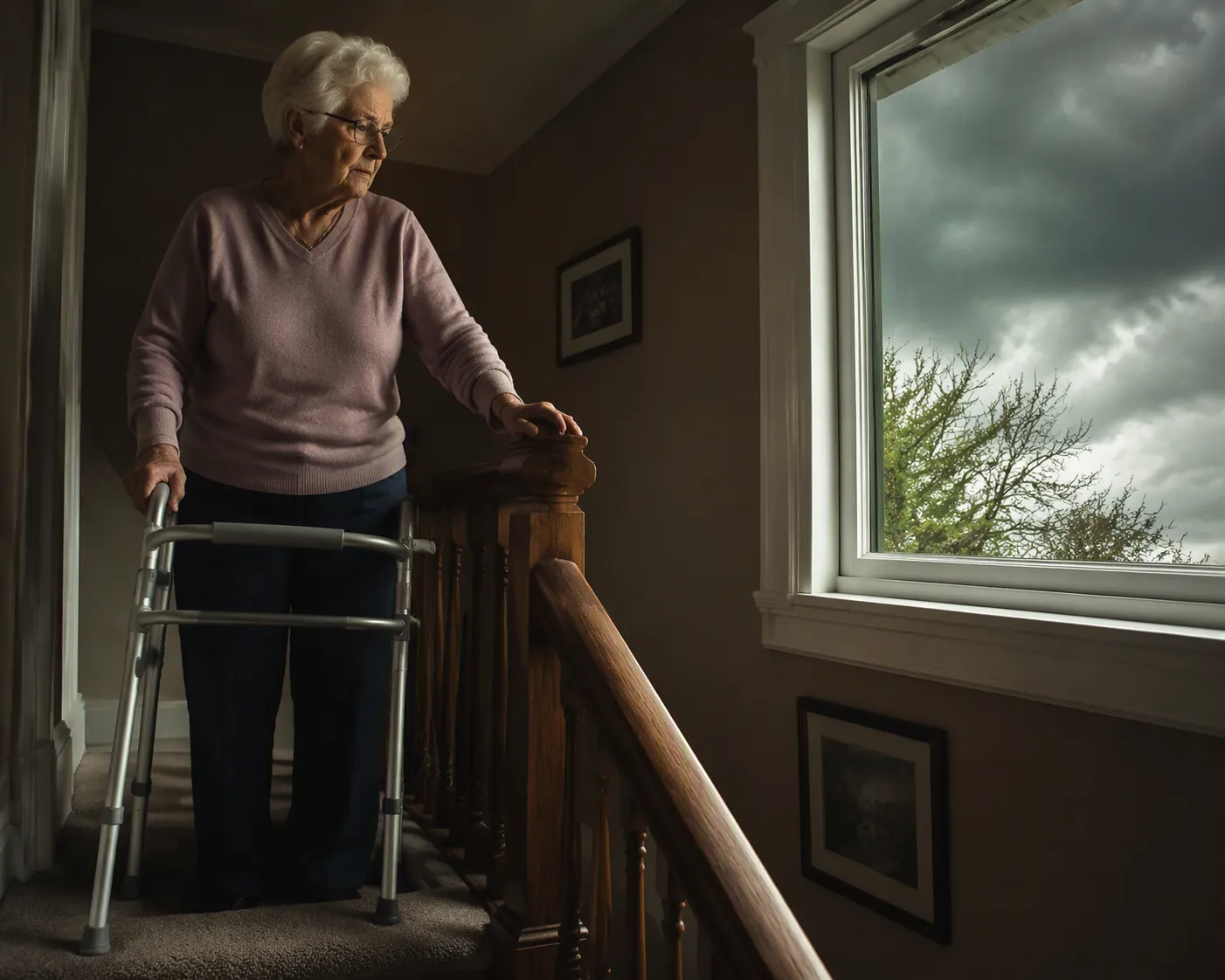
Choose the Safest Reachable Shelter, Not the Perfect One
A basement or storm shelter is best when you can reach it safely and quickly. If you cannot manage stairs without another person, if the stairway is dark, if you are dizzy, or if your walker cannot be used on the steps, the safer reachable choice may be a ground-floor interior room away from windows. That might be a bathroom, closet, hallway, or small interior room.
Wheelchair users need this decision made before the siren, not in the middle of it. United Spinal Association specifically emphasizes identifying an accessible safe room and notes that a ground-floor interior room may be more realistic than a basement when stairs block access.[2] CDC guidance also tells wheelchair users to move to an interior room away from windows and cover their head.[3] That is sensible advice; the practical addition is to choose a room the chair can enter without tight turns, piles of storage, or a raised threshold that has to be crossed at speed.
| If the ideal shelter is... | Use it when... | Choose this instead when... |
|---|---|---|
| Basement or storm shelter | You can reach it without rushing, unsafe stairs, or abandoning a required mobility aid | A ground-floor interior room away from windows |
| Interior bathroom or closet | The doorway is clear and there is room to sit, turn, or position a wheelchair | An interior hallway with fewer obstacles |
| Bedroom | You are bedbound or cannot safely transfer before the tornado arrives | Protect yourself in bed with pillows, blankets, and the mattress or sturdy padding if available |
| Mobile home | Only if there is no time or no safer shelter reachable | A pre-identified sturdy building or community shelter reached before the warning, when severe weather is expected |
Mobile homes deserve a plain warning. The same fatality analysis reports that mobile homes accounted for 43% of tornado deaths while representing less than 8% of U.S. housing stock.[1] During an active warning, the choice may already be limited. Before storm season, though, seniors in mobile homes need a realistic plan for where they will go when watches or severe weather forecasts give enough lead time.
Move With the Aid You Use, Not the Body You Wish You Had
The warning moment is not the time to prove independence by leaving the walker behind or taking stairs with a cane when you normally avoid them. Use the device that keeps you upright on an ordinary day. The tornado plan should fit that device.
If You Use a Walker
Before the first step, put both hands on the walker grips and bring the walker squarely in front of you. Do not reach for a wall, furniture, or door frame while the walker is off to the side. That sideways reach is where many people lose balance.
Advance the walker a short distance, set all legs or wheels firmly, then step into it. Keep your feet inside the frame, not behind it. If the walker has wheels, do not let it roll ahead while your body lags behind. If it has tennis balls or glides, be especially careful at rug edges and thresholds because the frame can catch just long enough to pitch your weight forward.
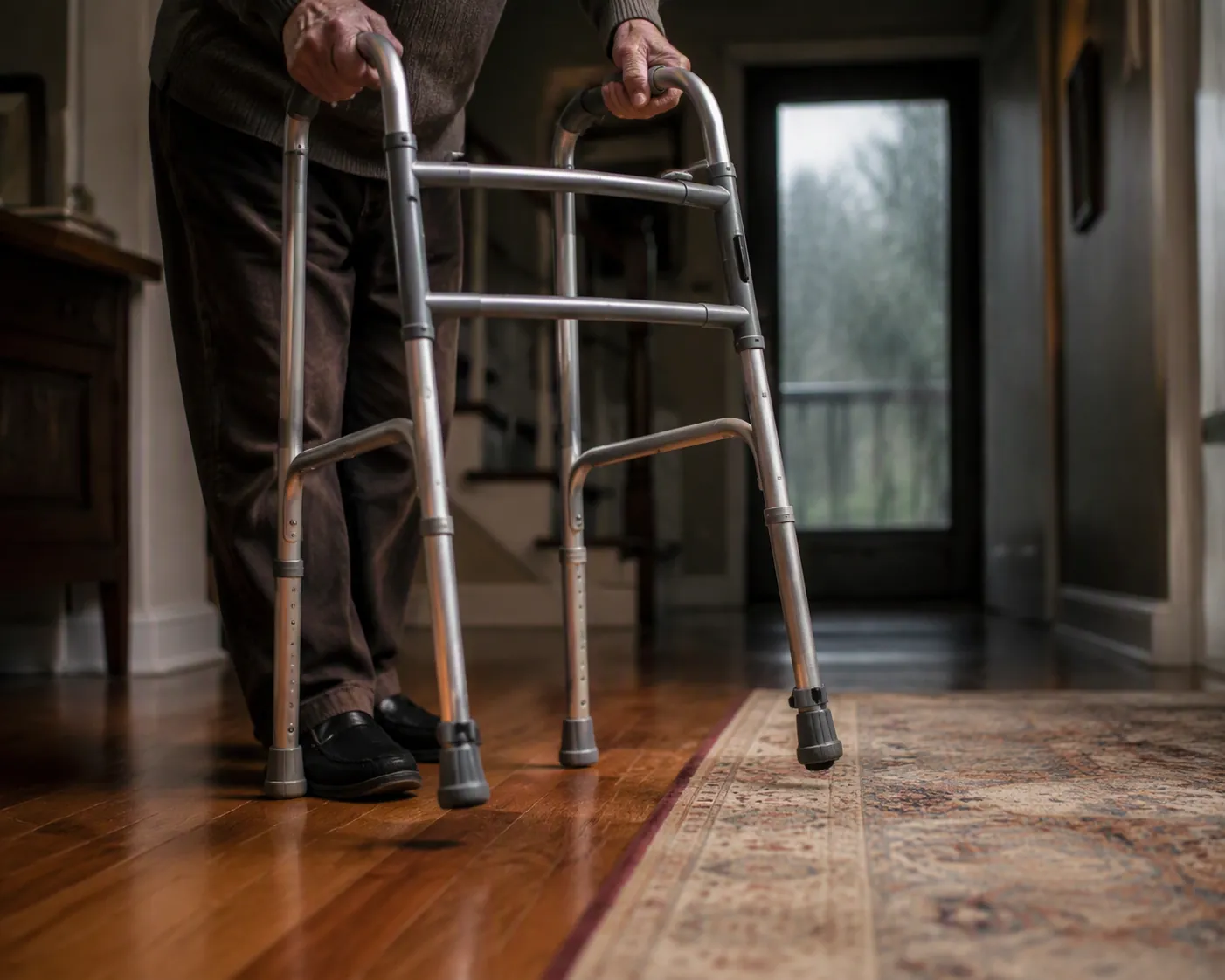
Turn in a small arc rather than twisting your trunk while the walker stays planted. Pick the walker up or roll it a few inches, turn your feet to match it, then repeat. A rushed pivot can wrap the walker around a rug corner, oxygen line, pet bed, or furniture leg. If a rug is in the path and there is time before storm season, remove it from the shelter route entirely. During the warning, lift the walker just enough to clear the edge if you can do so safely; otherwise, detour around it.
Do not carry a heavy emergency bag on the walker unless it is already attached and balanced. A loose tote hanging from one side changes how the walker moves. If supplies matter for your medical safety, they should already be in the shelter area or in a lightweight container you can move without upsetting your balance.
If You Use a Cane
Use the cane on the side you normally use it. In the warning, people often switch hands to carry a phone, flashlight, or pet. That can make the next step feel unfamiliar at the worst time. If you need the phone, put it in a pocket or hold it only after you are settled in shelter.
Take shorter steps than usual. Place the cane, then the weaker or more painful leg, then the stronger leg. Keep your eyes on the next safe landing spot rather than the weather outside. If there are stairs between you and the basement and you do not normally take those stairs alone, do not make the tornado warning the exception. A ground-floor interior room is the safer plan.
If you must use one or two steps, use the handrail. The cane is not a substitute for a rail on stairs. Keep the cane tip fully on the step, not half on the edge. If the step is poorly lit, pause and feel the step with the cane before moving your foot.
If You Use a Wheelchair
Move to the preselected interior room if the route is clear. Lock the brakes once you are positioned. If you can transfer safely to a lower, sturdier position without help and without rushing, do so. If not, stay in the chair, lock it, cover your head and neck with a cushion, folded blanket, pillow, or your arms, and keep away from windows.[3]
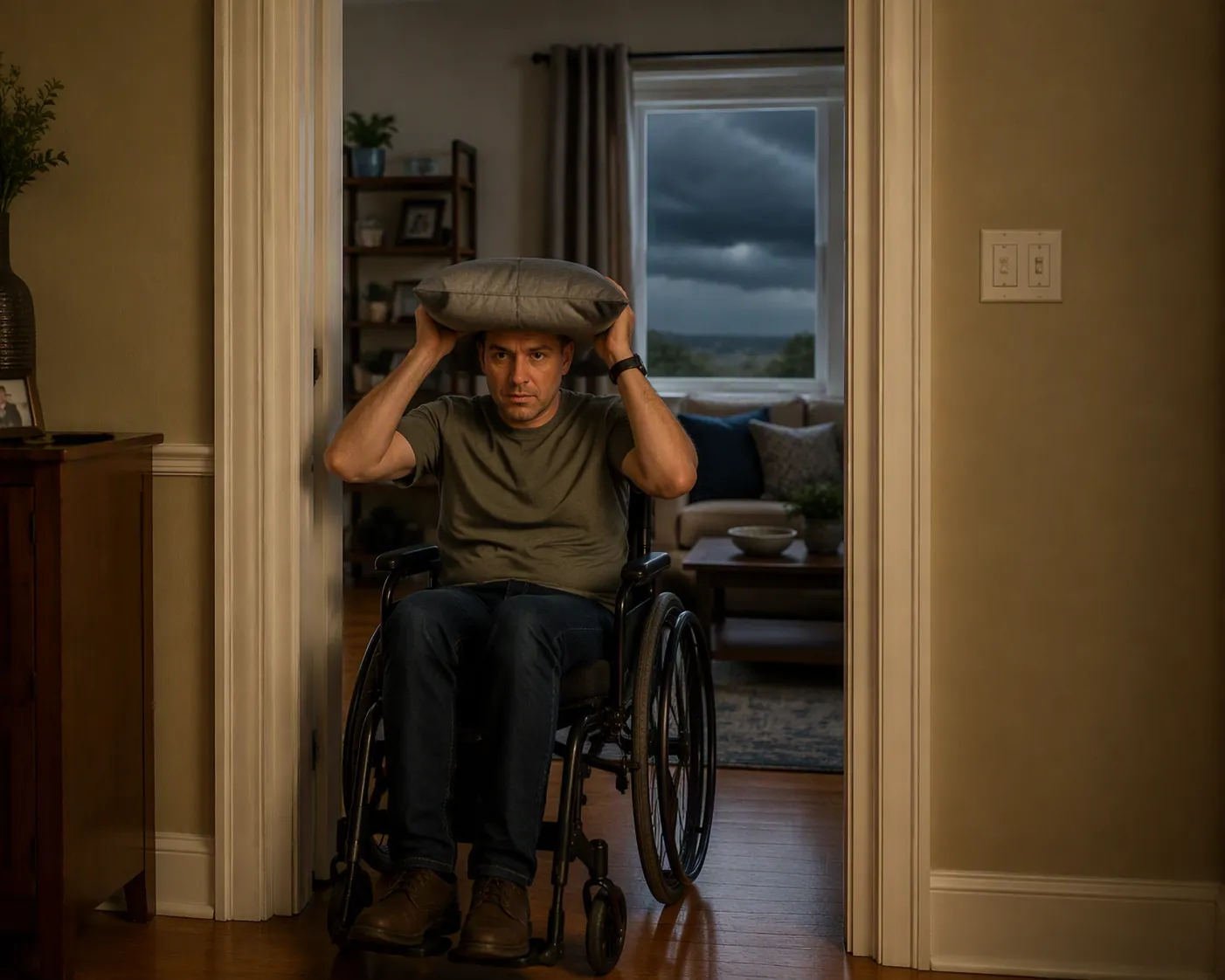
Watch the turning radius. A chair that fits through a doorway may still catch on a laundry basket, trash can, floor mat, or half-open door. The safe room should not become the place where household overflow is stored. In a warning, do not try to force the chair through clutter. Stop, back up if needed, and choose the nearest interior area that keeps you away from glass.
If the home has a stair lift, treat it cautiously during severe weather. It may be useful before a warning or in a drill, but a power failure, panic, or transfer problem can turn it into a trap. If there is any doubt, plan around a ground-floor shelter.
If You Have Low Vision
Do not start by looking for several items. Start by orienting yourself: feet flat, hand on the usual mobility aid, face toward the known route. If you have a flashlight within reach, use it. If not, move by touch along a familiar wall only if that does not pull you away from your cane, walker, or balance support.
The shelter route should be boring on purpose. No baskets waiting to be taken downstairs. No decorative table in the hall. No dark throw rug that blends into the floor. During calm weather, rehearse the path in daylight and again in dim light. The warning is not the moment to discover that the hallway chair has been moved.
If You Have Hearing Loss
Use more than one alert method before the storm season: phone alerts, weather radio with visual or vibration features if available, television captions, and a support person who knows how to reach you. Once the warning is received, reduce confusion before moving. Turn off a loud appliance if it is beside you. Look at the alert source long enough to confirm that it is a warning, then go to the planned shelter.
If an adult child or neighbor calls, the call should be brief: “Go to the hall bathroom now. Take your walker. Call me from there.” Long explanations make the older person stand in place, divide attention, and delay the movement that matters.
If You Are Bedbound or Cannot Transfer Safely
If you cannot move from bed, CDC advises covering yourself with blankets and pillows.[3] Pull protection over the head and neck first. If another person is present, they can help place pillows along the side facing windows and use a blanket or cushion over the upper body. Do not attempt a last-second transfer if transfers already require help, a lift, or careful setup. A failed transfer can leave you on the floor without protection.
Caregivers should decide in advance what “stay in bed and cover” looks like: which pillows are used, where extra blankets sit, whether the bed can be moved away from windows, and who calls whom. In the warning itself, there should be no debate at the bedside.
Once You Reach Shelter
Sit if you can do so safely. A seated position lowers the distance of a fall if you get dizzy or the house shakes. Keep the walker, cane, phone, and flashlight within reach, but do not leave the protected spot to retrieve something minor. Cover your head and neck with a pillow, cushion, folded coat, small mattress, or your arms. Stay away from windows and exterior walls as much as the room allows.[3][4][5]
If you are with someone who is frightened, speak in short, practical instructions. “Sit here.” “Cover your head.” “Keep your feet still.” Fear makes people stand up, turn around, and go looking for reassurance. Reassurance is useful only if it keeps the person protected.
Do not come out because the noise changed. Wait for the official all-clear or for reliable confirmation that the warning has expired. Tornadoes can be followed by more storms, and the first quiet minute is not a safety signal.
Prepare Only What Changes the Warning Moment
Preparedness can become a closet full of good intentions. For fall safety, the useful preparation is the kind that removes a decision, a reach, or a trip during the warning.
- Clear one route to the shelter and keep it clear every day, not just during storm season.
- Keep sturdy shoes, a flashlight, glasses, hearing aids, and essential medications where they can be reached without bending or searching.
- Store supplies in or near the shelter area, not on a high shelf or in the back of a closet.
- Practice the route with the walker, cane, wheelchair, oxygen tubing, pet gate, and lighting exactly as they are used at home.
- Give adult children or neighbors one short script and one shelter location, so they do not improvise during the warning.
Oklahoma State University Extension recommends that older adults keep emergency kits in easily accessible locations and notes that wheeled containers can help seniors with arthritis move supplies more safely.[6] That is the right idea, as long as the container does not block the shelter path. A wheeled kit parked in the hallway can become the very obstacle that trips someone.
Ready.gov’s older-adult preparedness guidance centers on assessing needs, making a plan, and engaging a support network.[7] For a senior with fall risk, that support network should know the mobility details: whether stairs are safe, which doorways fit the wheelchair, where the walker is parked at night, whether the person hears phone alerts, and whether they need help after the storm to avoid debris.
After the All-Clear, the Fall Risk Changes
The all-clear does not make the floor safe. CDC after-tornado guidance warns about injury risks from debris and recommends wearing sturdy shoes or boots, long sleeves, and gloves when handling debris.[8] For older adults, the first post-storm hazards are often close to the chair: broken glass, wet flooring, loose insulation, tipped furniture, cords, branches, and darkness.
Stand slowly. Check that the cane or walker is still where you can reach it. Turn on a flashlight before stepping if power is out. If you smell gas, see sparks, hear shifting debris, or cannot see the floor clearly, stay put if that is safe and call for help. Do not walk outside in slippers to “just look.” Curiosity after a tornado has a way of finding nails, glass, and uneven ground.
Seniors should not ignore tornado warnings, and they should not treat them casually. They should also not be asked to move as if fear can make stiff knees, poor balance, low vision, or a wheelchair vanish. The safer plan is rehearsed, direct, and honest: stop, assess, choose the safest reachable shelter, move with the right technique, protect the head and neck, wait for the all-clear, and leave shelter as carefully as you entered it.
References
- Tornado Fatality Statistics, TornadoSimulator.net
- Tornado Preparedness for the Disability Community, United Spinal Association
- Safety Guidelines: During a Tornado, CDC
- Tornadoes, Ready.gov
- What to Do During a Tornado, National Weather Service
- Older Adults and Planning Ahead for Severe Weather, Oklahoma State University Extension
- Older Adults, Ready.gov
- Safety Guidelines: After a Tornado, CDC
Related reading
Noticed something outdated or inaccurate on this page? Flag a correction. We review every report against CDC, NIA, and AARP HomeFit guidance before updating a page.
Part of the Fall Prevention section.