
STEADI: intervene
How to Fall-Proof Your Tornado Safety Plan for Elderly
This guide helps adult-child caregivers identify and remove fall hazards along an older adult's tornado evacuation route, from bedroom to shelter. Using room-by-room checklists from CDC and expert sources, readers can prepare ahead of a storm to prevent falls during an emergency rush.
The weakest part of a tornado safety plan for an elderly parent is often the walk to the shelter, not the shelter location itself. At 2 a.m., the plan has to work before glasses are on, before shoes are tied, while the room is dark and the warning is already active. A walker that is three steps too far away, a loose rug at the bed, or an unlit basement stair can turn “go to the lowest level” into the part of the plan most likely to fail.
That concern is not just family overthinking. In the CDC’s report on the 2011 southeastern tornado outbreak, two indirect tornado deaths were attributed to falls during cleanup after the storms. That is a specific outbreak finding, not a current national fall-death count, but it is enough to show that tornado-related fall hazards can be fatal when the emergency movement does not end at the warning siren.[1]
The practical test is simple: can the older adult get from bed, recliner, bathroom, or kitchen to the chosen shelter with the mobility, vision, balance, footwear, lighting, and assistance they actually have during a warning? If not, the tornado plan still needs fall-proofing.
Start With the Route, Not the Weather
The weather basics still matter: warnings need to be received, a shelter area needs to be chosen, medications and essentials should be ready, and family members should know how they will communicate. But once those pieces are named, the caregiver’s work shifts to the route. The question becomes less “Does Mom know where to go?” and more “Can Mom get there without falling?”
Walk the path from every place where the older adult spends real time. Do it from the bed. Do it from the favorite chair. Do it from the bathroom. Then do it again in low light, at the pace the person would actually use, with the cane, walker, rollator, rail, or caregiver assist that would be available during a warning.
| Part of the route | What to inspect before tornado season |
|---|---|
| Bedside or main chair | Walker or cane within reach, shoes or non-slip footwear nearby, flashlight reachable without standing first |
| Bedroom and living area floor | No loose rugs, cords, pet beds, laundry baskets, or furniture corners narrowing the first steps |
| Hallway | Clear width for the mobility aid, nightlights or battery lighting, no glossy or uneven surfaces |
| Stairs or basement transition | Stable handrails, bright lighting, dry steps, enough time and support to descend without rushing |
| Shelter entry | Door or opening wide enough to enter with the mobility aid, steady footing, no threshold that catches the walker |
| Return route after the storm | Debris, wet flooring, power outage conditions, and cleanup tasks treated as fall hazards |
The First Five Steps Out of Bed
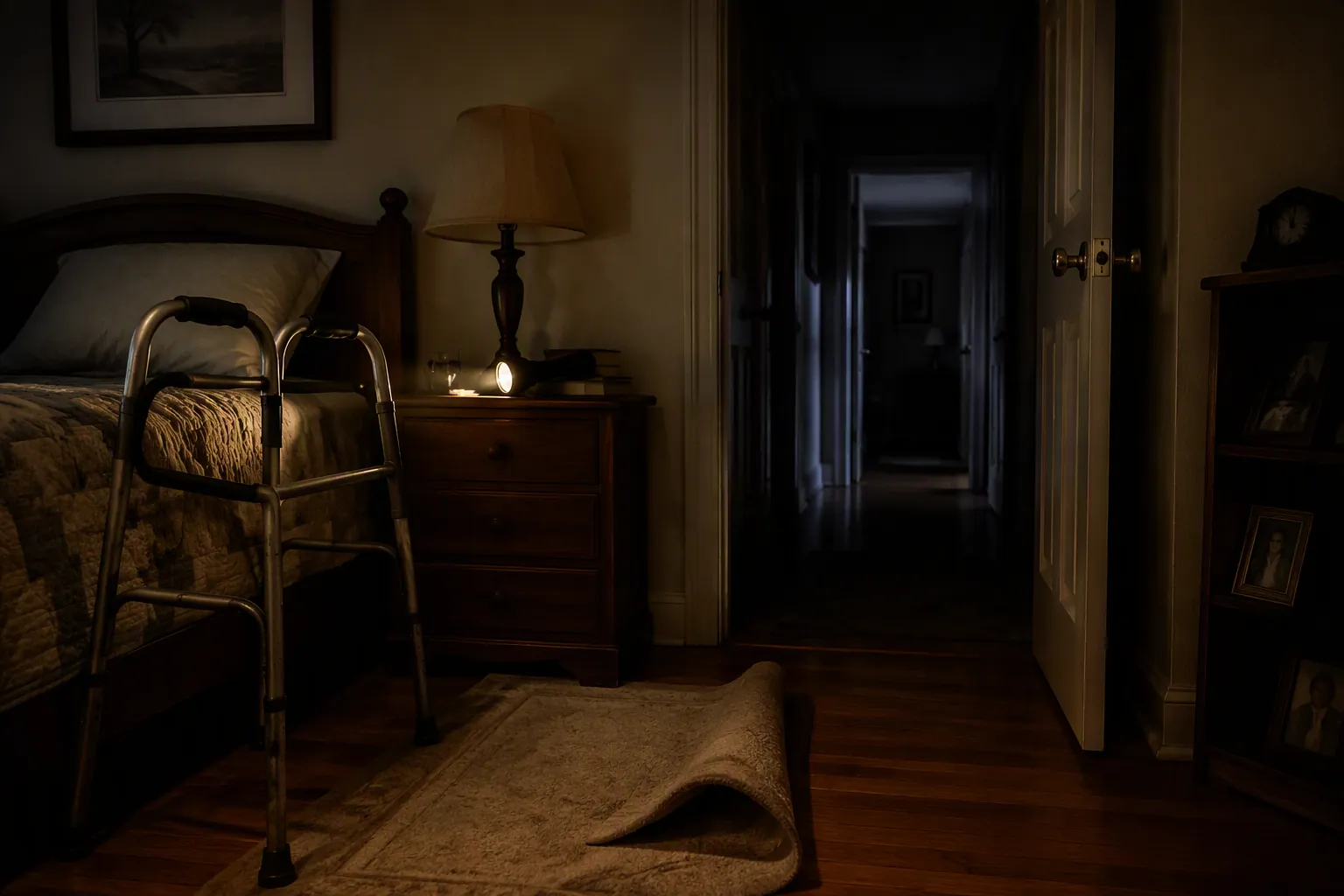
A bedroom that looks safe at noon can become a different room during a warning at night. The first inspection point is not the basement door. It is the reach from pillow to glasses, phone, flashlight, footwear, and mobility aid.
Keystone Health’s emergency preparedness guidance for seniors specifically recommends keeping flashlights in easy-to-reach places and taping down or removing area rugs that could cause trips in low light.[2] Those two items belong at the top of the tornado route check because they affect the first movement: sitting up, standing, orienting, and taking the first step.
- Place a flashlight where it can be reached from the bed without standing.
- Keep glasses, hearing aids, phone, and emergency alert device in the same place every night.
- Park the walker, cane, or rollator on the side of the bed the person actually uses.
- Remove the bedside throw rug if it curls, slides, bunches, or catches the mobility aid.
- Keep non-slip shoes or slippers where they can be put on quickly without crossing the room.
The walker position matters more than families sometimes admit. If it is folded in a corner, blocked by a laundry basket, or parked on the wrong side of the bed, the older adult may take unsupported steps before the plan has even started. During a warning, those unsupported steps are exactly what the plan should be designed to prevent.
Clear the Hallway Like Someone Is Moving Fast in the Dark
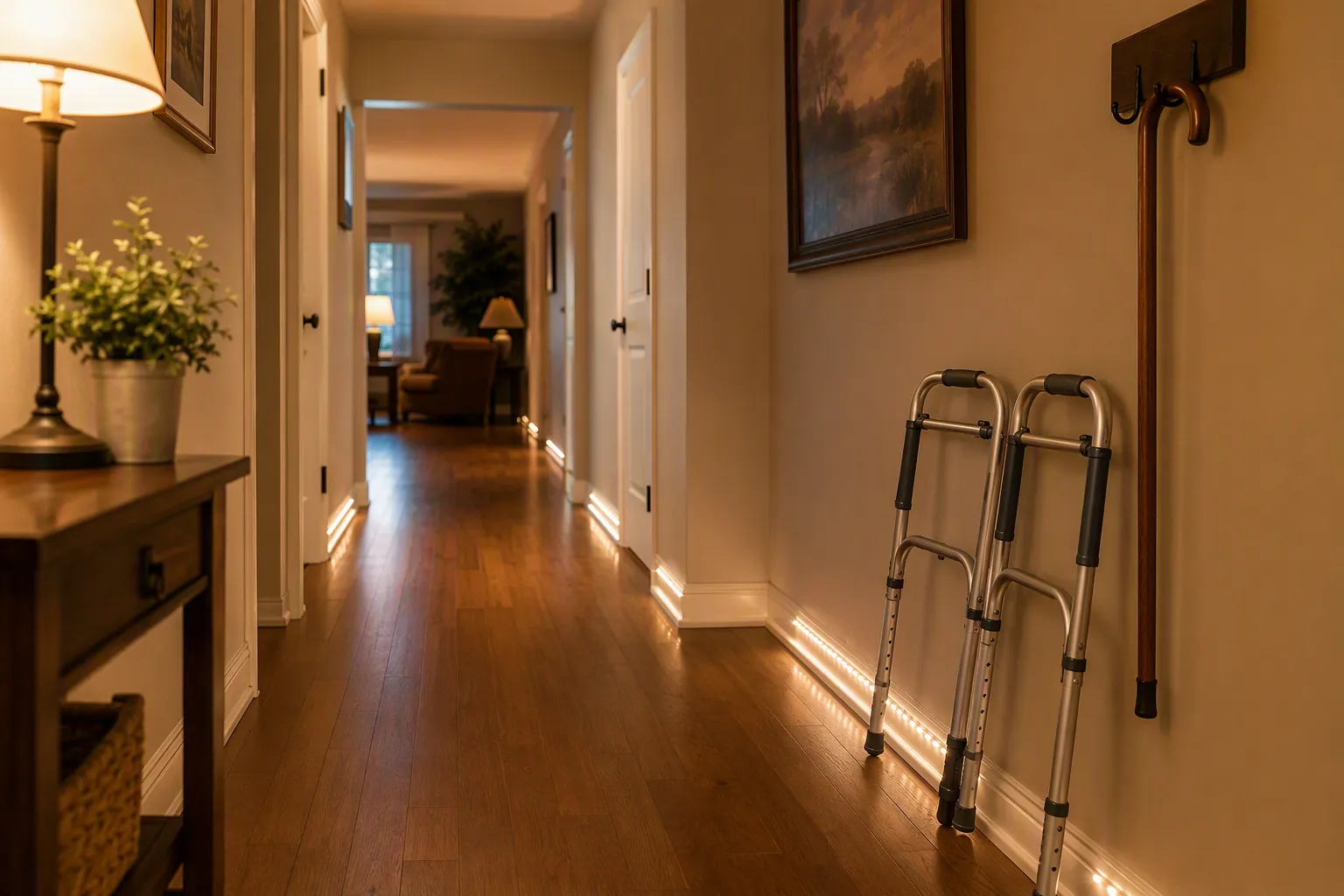
The hallway is where many tidy-looking homes stop being safe. A narrow runner, a decorative table, a plant stand, a charging cord, or a pet bowl may not bother anyone during ordinary walking. Add a walker, poor night vision, urgency, and a siren, and the same objects become obstacles.
Do not inspect the hallway by looking down it from the doorway. Walk it with the mobility aid. If a walker clips a rug edge, move the rug. If the hallway requires turning sideways around furniture, move the furniture. If a cane tip lands on a transition strip or curled mat, fix that spot before storm season.
Lighting should not depend on the older adult finding a switch while half-awake. Use nightlights, motion lights, or battery-backed lights along the route, especially where the floor changes direction or surface. A flashlight at the bed helps, but it should not be the only light source if the person also needs both hands for a walker or rail.
Check the route from the rooms actually used
A tornado warning may not come when the older adult is in bed. If evenings are spent in a recliner, inspect the path from that chair. If the bathroom is on the opposite side of the hall, inspect that path too. If the person cooks alone, include the kitchen route, because a warning can interrupt an ordinary task.
- Remove small mats from the bathroom-to-shelter path unless they are firmly secured and do not catch a cane or walker.
- Keep hall doors fully open or fully closed so they do not narrow the path unexpectedly.
- Move pet gates, baskets, footstools, and magazine racks out of the emergency route.
- Make sure the path is wide enough for the actual device, not just for a person walking unaided.
Basement Stairs Need Their Own Plan
Many tornado instructions tell people to go to a basement or lowest level. For an older adult, that advice is incomplete until someone asks how the person gets down the stairs. Oklahoma State University Extension notes that older adults may face challenges maneuvering down steps to a basement, cellar, or other ground shelter, and recommends identifying mobility issues before severe weather strikes.[3]
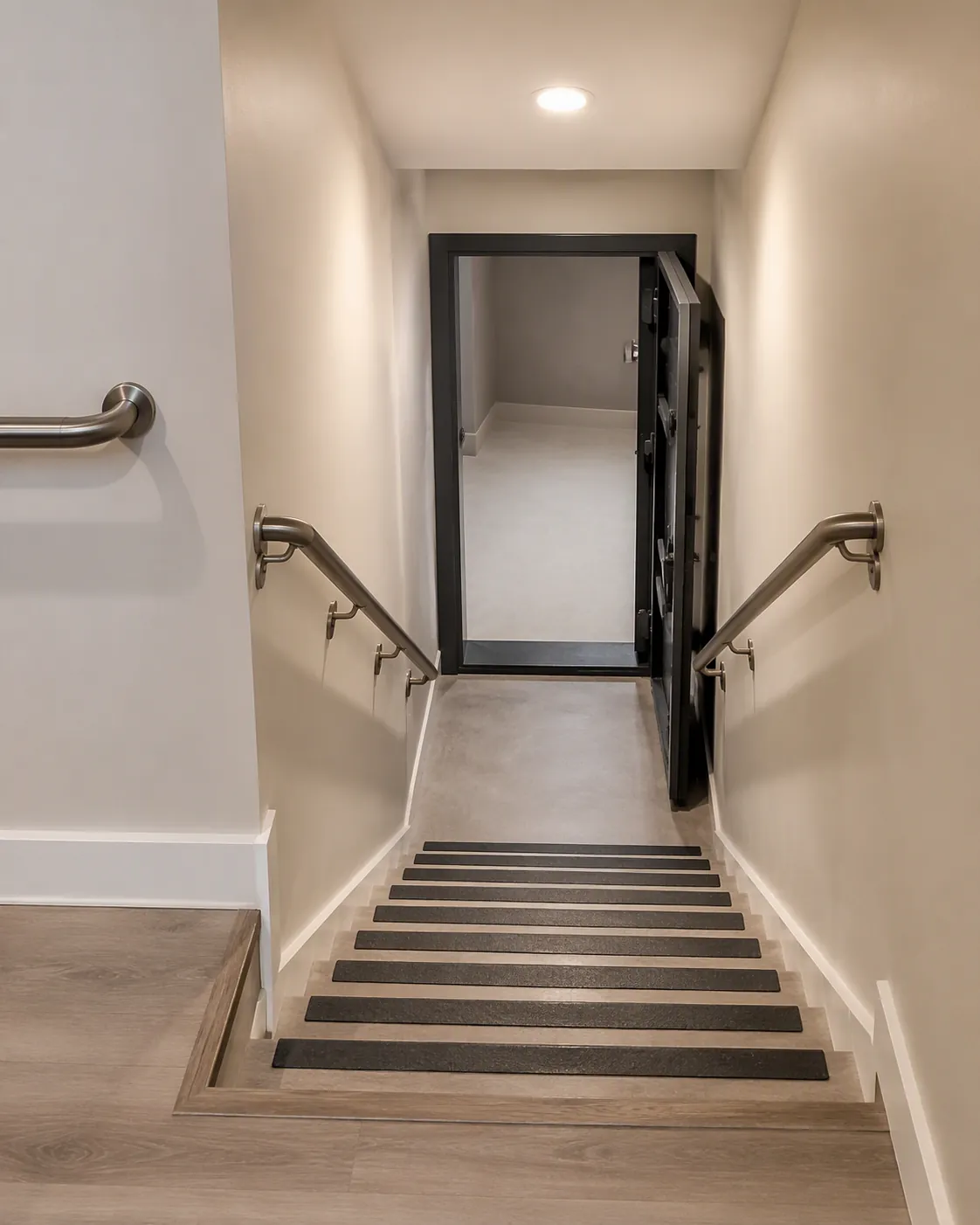
That means the stairs deserve a slower inspection than the rest of the route. The top landing is often the tense point: the person has to stop, turn, place a hand, manage the mobility aid, and begin descending. If the walker has to be left at the top, decide ahead of time who moves it, where it goes, and what support replaces it on the stairs.
- Confirm that stair lighting can be turned on before the first step down, and add battery lighting if outages are likely.
- Check that handrails are sturdy, easy to grip, and present where the person needs them, including the top and bottom transitions.
- Remove stored items from the stairs and landings, even if they are usually stepped around.
- Use non-slip tread surfaces if the steps are smooth, worn, or hard to see.
- Practice the descent at a calm time and time it honestly, without asking the older adult to hurry.
If the stair route cannot be made safe, the plan needs a different shelter decision, not more confidence. An interior room on the lowest accessible level may be safer than a basement that the person cannot reach without a high risk of falling. That decision should be made before storm season, not during the warning.
The Shelter Entry Is Part of the Fall Risk
Once the older adult reaches the shelter area, the route is not over. The entry itself can create the final fall hazard: a raised threshold, a narrow turn, a heavy door, a step down, or a place where the walker has to be lifted or angled.
Refuge Shelters, writing from a storm-shelter industry perspective, recommends a wide, accessible entryway and steps that allow for a steady pace to reduce the risk of tripping or feeling rushed.[4] That is not the same as an official accessibility standard, and it should not be treated as product-selection advice. But the underlying route logic is useful: the entry should let the older adult move steadily instead of forcing a fast, awkward transfer at the most stressful moment.
Stand at the shelter entrance and watch the whole motion. Does the person have to turn sharply? Is there a place to put a hand? Does the cane tip or walker wheel catch? Can a caregiver stand close enough to help without blocking the doorway? Can the door be opened before the older adult reaches it, or does the person have to manage the door and the mobility aid at the same time?
Do not turn the shelter into storage
Basement shelter corners and interior rooms often become storage zones. Boxes, holiday bins, folding chairs, paint cans, and tools may not look dangerous until someone has to enter quickly with a walker. Keep the entry clear, keep a seated place available if the older adult needs to rest, and avoid stacking supplies where they narrow the turn into the protected space.
Rehearse Once When Nothing Is Happening
A rehearsal does not need to feel dramatic. It should feel like checking a recipe before guests arrive. Pick a calm afternoon, then ask the older adult to move from the bed or main chair to the shelter using the same aid they would use at night. The caregiver’s job is to watch the route, not coach the person into moving faster.
Look for pauses. Pauses show where the plan is asking for too much. A pause at the bed may mean the walker is poorly placed. A pause in the hall may mean the lighting is weak or the path is too narrow. A pause at the stairs may mean the rail begins too late. A pause at the shelter door may mean the entry needs to be cleared, widened, or managed by someone else.
| What happens during rehearsal | What to change |
|---|---|
| The older adult stands before reaching the walker | Move the mobility aid within direct reach of the bed or chair |
| The walker catches on a rug or threshold | Remove the rug, secure the edge, or adjust the transition |
| The person reaches for a wall instead of a rail | Add support where the hand naturally goes, if appropriate and safely installed |
| The person rushes at the stairs | Build in more warning time, assign caregiver help, or reconsider the shelter route |
| The shelter entry requires twisting or lifting the walker | Clear the entry and adjust the setup so the person can enter steadily |
If the older adult lives alone, the rehearsal should include how they receive the warning and when they move. Some families wait too long because they picture a healthy adult’s transfer time. A person who needs several minutes to stand, gather balance, reach the stairs, and descend safely may need to act earlier than the rest of the household would.
Use a Pre-Warning Check When Storms Are Possible
The best time to fall-proof the route is before tornado season. The second-best time is earlier in the day when severe weather is possible but no warning has been issued. That is when the small objects that drift back into the path can be moved again.
- Put the walker, cane, shoes, glasses, phone, and flashlight in their assigned places.
- Turn on nightlights or confirm that battery lights work along the route.
- Move laundry baskets, cords, pet items, shoes, and delivery packages out of the path.
- Open the shelter area and clear the entry before anyone has to use it.
- If stairs are involved, make sure the stair light works and both landings are clear.
- Agree on who helps, who calls, and when the older adult starts moving if a warning is issued.
This is also the moment to handle the ordinary preparedness items without letting them replace the route check. Keep emergency supplies, medications, water, and communication tools ready, but do not let a well-stocked shelter hide the fact that the person cannot safely reach it.
After the Warning, Slow the Return Trip
The fall risk does not end when the warning expires. The house may be dark. The floor may be wet. Power may be out. Stairs may be cluttered by items that shifted or were moved quickly. Outside, cleanup can add debris, uneven ground, and fatigue. The CDC’s 2011 outbreak report is a reminder to treat the cleanup period as part of tornado safety, not as an afterthought.[1]
Before the older adult leaves the shelter, someone should check the route back if help is available. If the person is alone, the return should be slower than the trip in. Use the flashlight. Keep the mobility aid close. Do not carry heavy items while navigating stairs. If there is debris, water, broken glass, or no lighting, waiting for help may be safer than trying to reset the house immediately.
A tornado safety plan for an older adult is not finished when the family names the basement, hallway, or interior room. It is finished when the route has been cleared, lit, rehearsed, and adjusted for the person who has to make the trip. If they cannot move from bed to shelter safely in darkness and urgency, the plan still needs fall-proofing.
References
- Tornado-Related Fatalities — Five States, Southeastern United States, April 25–28, 2011, CDC MMWR
- Emergency Preparedness for Seniors, Keystone Health
- Older Adults and Planning Ahead for Severe Weather, Oklahoma State University Extension
- Storm Shelters for Seniors: Key Features for Safety and Accessibility, Refuge Shelters
Related reading
Noticed something outdated or inaccurate on this page? Flag a correction. We review every report against CDC, NIA, and AARP HomeFit guidance before updating a page.
Part of the Fall Prevention section.